“…That side was made for you and me”

This morning my friend Steve asked if I remembered the last line of Woody Guthrie’s folk song “This Land Is Your Land”? Here’s the last stanza. Scroll down to hear it.

There was a great high wall there

That tried to stop me;

A great big sign there

Said private property;

But on the other side

It didn’t say nothin’.

That side was made for you and me!

Behind the high wall of the U.S. Supreme Court’s “Citizens United” decision, join Pete Seeger and Bruce Springsteen singing Woody Guthrie’s song on the way to “the other side.” And remember to celebrate hope Organize. Organize. And keep on singing.

“Love your neighbor” NOT unconstitutional

Rabbi Arthur Waskow of the Shalom Center in Philadelphia sent this email regarding the Supreme Court decision on the Affordable Care Act.

The Supremes have decided:

“Love your neighbor as your self”

is NOT unconstitutional. 

Mazeltov to them and to all of us that, when push came to shove, the Justices of the U.S. Supreme Court mostly reaffirmed the notion that fellow-human beings and fellow-citizens owe loving-kindness to each other.

That we owe each other food when we are hungry, a place to live when some bank takes our home away,  money to tide us over when some boss or some bank  takes away our job.  And health care when we are sick.

That notion is rooted, thanks be to God, in our ancient religious traditions.  But over and over, it’s up for grabs.

And I do mean “grabs” –-  grabs of the merely wealthy to be super-wealthy, grabs of the super-wealthy to invest hundreds of millions in campaign ads and lobbying,  to grab still more power…

Even this decision treated some neighbors as not quite worthy of the same respect and loving care as others. This one gave the states a way out of their Medicaid obligations  — to the very very poor. No surprise. If somebody’s gonna be left out, who else?

It’s also true that this Supreme Court has done some terrible damage — that ironically misnamed decision “Citizens United,” worst of all.  And yet I’m tickled that this time Chief Justice Roberts did what his appointer, President “W,”  would not have wanted. The history of Justices whose lives turn out to have a tiny taste of freedom tucked away —  it’s delicious.

So there is still more work to do.  In the New Declaration of Independence from Corporate Domination we sent yesterday in honor of July 4, we mention Medicare for All.  That’s still the fully decent answer.

But for now, take a deep breath, grab your sweethearts and dance a dance of joy.

In the Passover Seder, there is a really strange song. It says, “If we had reached the Red Sea but it had not split, Dayenu! – good enough! If we had reached Sinai but there had been no Revelation, Dayenu! – good enough!”

At one level, this makes no sense. At another, it makes EVERY sense. If we want to transform the world, then we must celebrate each step on the journey, even if it’s only half a step. We know there must be another step; the song has many verses. But if we refuse to celebrate, we will burn out before we can take another step.

Today, right now, rejoice. Tonight, tomorrow, on the FOURTH itself, begin to plan the steps we still must take.

Enjoy the fireworks. They are celebrating one small step of Independence from the Corporate King George.

And — fly the Flag of Freedom. It’s right here.

Blessings of justice and joy —  Arthur

Who is the poorest person you will meet today?

Written in honor of Dale Robb*.

Who is the poorest person you will meet today?

The senior or teenager who will hand you food

at the drive-through window?  Or tonight when you stay

in a motel, could you leave cash to make the maid

feel good for days?  A tip, gratuity, can let

a worker keep their dignity and pay a bill

as well.  (A teller in a bank, however, can’t

accept a tip–give them fruit, a sweet, they can sell

or eat.)  All folks who earn minimum wage are poor:

be generous, be kind, and share if you have more.

– Steve Shoemaker, Urbana, IL June 18, 2012

*I asked Steve about Dale. Here’s what he wrote:

“Dale Robb is a retired Presbyterian Pastor. For 25 years he served the First Presbyterian Church of Jacksonville, Illinois. Was a Campus Pastor at Miami of Ohio, & Presbyterian missionary in Asia.  McCormick Theological Seminay Alum of the year in the 1980s, University of Illinois grad (1943),attended McKinley Presbyterian Church, student officer in McKinley Foundation.  Retired to Urbana, he & wife, Arlene, attend First Presbyterian Church of Champaign…..  Member of the Reformed Round Table.

“The first question in the verse comes from Dale.”

Take Away our Numbness – A Memorial to Sydney Mahkuk

These words were spoken on the sidewalk where 12-year-old Sydney Mahkuk died. Community leaders and Sydney’s family asked me to bring some kind of meaning and hope to the sidewalk where Sydney had been dumped from a car by the side of the funeral home.

November 4, 2005

Gordon C. Stewart

Executive Director, Legal Rights Center, Inc.

Once upon a time a proud people lived on this land. They called themselves Ojibwe, Anishinabe, Dakota, Lakota, and Winnebago. Occasionally a Menominee would visit.  They lived close to the land.  They hunted. They fished. They gave thanks to the Great Spirit for every day.  They saw themselves as part of nature. They rose with the sun. When the sun went down, they gathered in a circle by the light of the campfire.  By the light of the campfire, they listened to the elders, whose stories broke the silence to told the children who they were.  The children went to bed in safety.
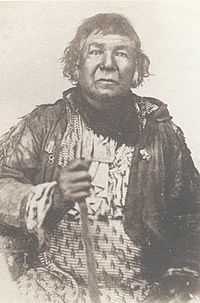
Shabbona, Potawatami Chief, c. 1775 – 1859

They were people of great dignity.  Their ways were good ways.  They respected the land. They respected each other.  They honored their elders.  They cared for the children.  They trained their youth to become adults.  They died with dignity.  They were buried with honor. Earth was their mother. Gitchi Manitu, Wakan Tonka, the Great Spirit, was the common Grandfather of them all.

Then something terrible happened.  A plague came across their land.  It took their land.  It stole their culture.  It laughed at their spiritual practices.  It called them names.  It tore down their tepees, their longhouses and their sweat lodges.  And in their places the plague built big buildings – tall buildings, arrogant buildings, skyscrapers, they called them, that invaded the sky, turning the land into something it is not.  The Ojibwe and Dakota who lived here no longer rose with the sun.  They no longer gathered around the campfire.  They no longer heard the stories of who they were.  They knew only what the white plague had taught them – that unless they joined the plague, they were nobody, and that if they challenged it, they would lose.  They would die.

And so they lived in grief.  A sorrow too hard to bear.  A loss too great to carry.  And the plague offered them relief to numb the pain – firewater that would make them happy in spite of their despair.  Drugs to drive away the memories of who they were.  Escapes to make them numb.  To numb the pain.  Opiates to freeze their tongues.

The elders no longer acted like elders.  The parents were numb with grief.  There were no aunts.  No uncles. No cousins.  No grandparents.  Nobody dared to be a neighbor.  The children were left with no campfire at night – no community to tell them the stories of who they were and who they were not – and so the children and the youth drifted out into the night in search of themselves.  Locked in lonely prisons of confusion, the youth no longer knew Mother Earth as their Mother; they no longer knew how to give thanks to the Great Spirit for the day.  They no longer went to bed with the sun.  They wandered the night in search of the community they had lost and never known.  And the gangs and the drugs and the alcohol offered them the promises of a better life that was the kiss of death.  Ecstasy was no longer a way of life – it was a pill that would make them higher than the skyscrapers that ruined the once humble landscape.  And sometimes the alcohol and the drugs and the gangs that had promised to numb their pain took their lives and they were found in the morning as the sun came up.  They were found by strangers.

Sydney Mahkuk, RIP

Then one day a girl named Sidney, a 12 year-old Menominee-Portawatami, was found beside a funeral home on Columbus Avenue. How she got there nobody knew.  How she died, nobody knew.  But everybody knew why.

The community had unravelled.  It had become dry bones in the valley.

But on that day that the people gathered on the sidewalk on Columbus Avenue to mourn her death, there was a sound from heaven – a rattling, the sound of dry bones coming together, a resurrection of the once proud community. And as a result Sidney Mahkuk’s tragic death the community came together as it had not come together since the plague had begun.

On the day they gathered on Columbus Avenue – a street named after the European explorer who had not discovered their land – on that day, the community woke from its sleep.  It came together – Ojibwe, Dakota, Menominee, Potawatami, Lakota, African-American, Somali, Hispanic, Hmong …and, yes, even the descendants of Columbus.  And on that day, because of a little girl’s unexplained death, they stood together arm in arm and said “Enough” to the plague.  “Enough” to numbness.  They said, “No more. No more. No more death on Columbus’s Avenue.”  And it was more than words.  They looked up at the sun again and really saw it…as if for the first time. They looked down at Mother Earth and saw it, as if for the first time.  And they gave thanks.  Then they looked at each other and they said, “We are a proud people.  We will take back this land.  We will be the people who honor our elders.  We will be the people who support the parents and care for the children.  We will be the people who guide the youth.  We will be a people of hope, not despair.  We will be a people of love, not hate.  We are all Menominee-Potawatami. We are all grandchildren of one Grandfather.  We are the people who care for each other.  We are the people who refuse to go numb.  We are the people who will teach the children of Columbus – starting right here, right now… on Columbus Avenue – how to live in a good way with Mother Earth, in a good way with Iraq, in a good way with the rivers and the sky, the ozone and the sun.  We are the people whose spirituality will help to cure the cancer of the spiritual and economic plague that has left our people in despair.

From that day on, November 4, 2005 at twelve noon, 12 year-old Sidney Mahkuk – our daughter, our granddaughter, our little sister, our friend, our neighbor – would be forever remembered as the one whose deadly silence on this sidewalk spoke so loudly that we could not stay numb.  And we took the city back and brought it back to life.

Merciful God – Wakon Tonka, Gitchi Manitu, God and Father of our Lord Jesus Christ, Jehovah, Allah, Grandfather, Great Spirit who breathes life into all things and receives all life at the end – Your’s is the air we breath, the land on which we walk.  Assure us that your love is stronger than every power to divide or hurt us.  Receive your child Sidney into your eternal care.  Wrap your arms around Glenda, around Sidney’s brothers and sisters, around all the defenseless children of the night, around all of us who mourn their plight and mourn Sidney’s death.  Re-kindle the light of faith and hope. Take from our souls the plague of hate, self-hatred and despair.  Take away the numbness and the apathy.  Make us a people of healing.  A humble and quiet people, but a proud people of love and spiritual strength. A people who are not afraid to feel the pain, who really feel the loss, who feel our feelings and do not fear them.  A people who dare to believe that every tear that falls from our eyes flows into the common stream of human suffering that leads into the ocean of community restored.  A people secure in the knowledge of your love.  Amen.

The Death of Sidney Mahkuk

November 10, 2005

I stood there on the spot where she was found a few hours before.

An 11 year old girl dumped from a car onto the sidewalk…next a funeral home.

There were tokens of love and remembrance – a teddy bear, a Snickers bar, some fresh flowers, a poem, evidence that fear and intimidation could not stop the love of those who dared to reclaim that piece of land.

Sidney Mahkuk did not die of an overdose. She was overdosed. She was murdered. I wondered how it could happen. I wondered, as Sidney’s older sister would ask later at an impromptu memorial service on that same spot,

“Was she lonely?  Was she scared?  Did she know we cared?  Did she know we loved her?”

I never met Sidney. But I felt very close standing alone hours after her death on the spot where someone(s) had dump her body to send a message perhaps to someone else that you’ll end up here – at the funeral home – if you mess with us.

Then it dawned on me why this felt strangely familiar. This violence was not unusual.  It was ghastly, but it was not unusual.  Ask the prisoners who died at Abu Graib. Ask the parents of the Sidneys in Baghdad and Felujiah and Kabul. Ask the mothers and fathers of the young Americans who have lost their lives for what they were told was the noble cause of disarming Saddam’s weapons of mass destruction and promoting freedom – American mothers and fathers, Iraqi mothers and fathers whose teddy bears and Snicker bars and poems are ignored…because nobody dares to stand there and say that violence and intimidation are not acceptable.

Sidney’s death is unique. Sidney was unique. One of a kind – a Menominee and Potawatome. Sidney was a stranger on her on own native soil. She was American Indian, one of America’s First People, as the Canadians say. But as a stranger on her own soil she is like many of us who, weeping and bewildered, seek to find our way in this strange and foreign land we call America.

The tears falling on the sidewalk beside the funeral home – and only the falling tears – can wash the blues away and lead again joy.

Sometimes I feel all blue

sad  sorry  blue

all down in minor key

a rhapsody in blue.

Sometimes

when blue begins to play

its melody in me, sometimes

the minor turns to major key –

Blue bursts into purple and,

leaping into joy,

a burst of sun-burst yellow

splashes  the blues away

And I feel all clean

all wet  all whole  up

like a purple-yellow rhapsody,

an Ode to Purple-Yellow Joy.

NOTE: I was Executive Director of the Legal Rights Center when I wrote this piece. The tears still flow. Like too many other cases in Minneapolis’s poorer neighborhoods, Sydney’s case is still “open”.

– Gordon C. Stewart

Church to become home for homeless families

Shepherd of the Hill Presbyterian Church in Chaska has decided to use its space as temporary overnight accommodation for homeless families. The press release and the Chaska Herald’s online story just made its way to AOL.com.

Click HERE for the story. The project is targeting to begin in February, 2013. To help with the project, leave a comment here.

The Silence and the Child’s Voice

This young woman (“a child,” she calls herself) spoke as clearly and boldly to power as I have heard. “And a child shall lead them.”

Follow the Money

money - follow the money

money – follow the money

Eight years as Executive Director of the Legal Rights Center, Inc. in Minneapolis confirmed this perspective by Fareed Zakaria.

Money spent on Prisons is rising 6 times the rate spent on higher education  By Fareed Zakaria,  March 25, 2012.

“Televangelist Pat Robertson recently made a gaffe. A gaffe, as journalist Michael Kinsley defined it, occurs when a political figure accidentally tells the truth.

“Robertson’s truth is that America’s drug war has failed and that the country should legalize legalize marijuana. This view goes against the  deepest political, moral and religious positions Robertson has held for decades, so imagine the blinding evidence that he has had to confront-and  that has been mounting for years-on this topic.

“Robertson drew attention to one of the great scandals of American life.
“Mass incarceration on a scale almost unexampled in human history is a
fundamental fact of our country today,” writes the New Yorker’s Adam Gopnik.
“Over all, there are now more people under ‘correctional supervision’ in
America-more than 6 million-than were in the Gulag Archipelago under Stalin
at its height.”

“Is this hyperbole? Here are the facts. The U.S. has 760 prisoners per
100,000 citizens. That’s not just many more than in most other developed
countries but seven to 10 times as many. Japan has 63 per 100,000, Germany
has 90, France has 96, South Korea has 97, and Britian – with a rate among
the-highest – has 153. Even developing countries that are well known for
their crime problems have a third of U.S. numbers. Mexico has 208 prisoners
per 100,000 citizens, and Brazil has 242. As Robertson pointed out on his TV
show, The 700 Club, “We here in America make up 5% of the world’s population
but we make up 25% of the [world’s] jailed prisoners.”

“There is a temptation to look at this staggering difference in numbers and
chalk it up to one more aspect of American exceptionalism. America is
different, so the view goes, and it has always had a Wild West culture and a
tough legal system. But the facts don’t support the conventional wisdom.
This wide gap between the U.S. and the rest of the world is relatively
recent. In 1980 the U.S.’s prison population was about 150 per 100,000
adults. It has more than quadrupled since then. So something has happened in
the past 30 years to push millions of Americans into prison.

“That something, of course, is the war on drugs. Drug convictions went from
15 inmates per 100,000 adults in 1980 to 148 in 1996, an almost tenfold
increase. More than half of America’s federal inmates today are in prison on
drug convictions. In 2009 alone, 1.66 million Americans were arrested on
drug charges, more than were arrested on assault or larceny charges. And 4
of 5 of those arrests were simply for possession.

“Over the past four decades, the U.S. has spent more than $1 trillion
fighting the war on drugs. The results? In 2011 a global commission on drug
policy issued a report signed by George Shultz, Secretary of State under
Ronald Reagan; the – archconservative Peruvian writer-politician Mario Vargas
Llosa; former Fed Chairman Paul Volcker; and former Presidents of Brazil and
Mexico Fernando Henrique Cardoso and Ernesto Zedillo. It begins, “The global
war on drugs has failed … Vast expenditures on criminalization and
repressive measures directed at producers, traffickers and consumers of
illegal drugs have clearly failed to effectively curtail supply or
consumption.” Its main recommendation is to “encourage experimentation by
governments with models of legal regulation of drugs to undermine the power
of organized crime and safeguard the health and security of their citizens.”

“Bipartisan forces have created the trend that we see. Conservatives and
liberals love to sound tough on crime, and both sides agreed in the 1990s to
a wide range of new federal infractions, many of them carrying mandatory
sentences for time in state or federal prison. And as always in American
politics, there is the money trail. Many state prisons are now run by
private companies that have powerful lobbyists in state capitals. These
firms can create jobs in places where steady work is rare; in many states,
they have also helped create a conveyor belt of cash for prisons from
treasuries to outlying counties.

“Partly as a result, the money that states spend on prisons has risen at six
times the rate of spending on higher education in the past 20 years. In
2011, California spent $9.6 billion on prisons vs. $5.7 billion on the UC
system and state colleges. Since 1980, California has built one college
campus and 21 prisons. A college student costs the state $8,667 per year; a
prisoner costs it $45,006 a year.

“The results are gruesome at every level. We are creating a vast prisoner
under-class in this country at huge expense, increasingly unable to function
in normal society, all in the name of a war we have already lost. If Pat
Robertson can admit he was wrong, surely it is not too much to ask the same
of America’s political leaders.”

– appeared on-line, IllinoisDemNews@yahoogroups.com

The Tower

Tower, Ray Erickson photo used by permission

Tower, Ray Erickson photo used by permission

Of course a tower is built by starting from

the bottom. Strong arms and shovels make

a joint to earth with wet, gray gravel, and form

with time, a foundation almost like rock.

Orange steel is welded, riveted and made

to stand naked pointing skyward.  Then blocks

and bricks are hoisted slowly up the side

providing covering flesh the tower lacks.

Small children make towers in trees, and these,

though only made of rotting boards, still stand

as proudly strong (in the children’s eyes)

as those from which much older ones descend.

But both kinds of towers seem built to say

with their builders–we look down on the sky.

Steve kneeling behind Sheldon Jackson’s pulpit

– 6’8″ Steve Shoemaker

Anglican Theological Review, April, 1973

Steve wants you to know that we’re both important. He has his tower. I have mine. Steve is host of “Keepin’ the Faith,” a Sunday evening program on on WILL – archive programs, “including two with Gordon Stewar” (Steve ordered me to put this in here – he’s taller, so I do everything he says), can be heard anytime, anywhere @ www.will.illinois.edu/keepinthefaith

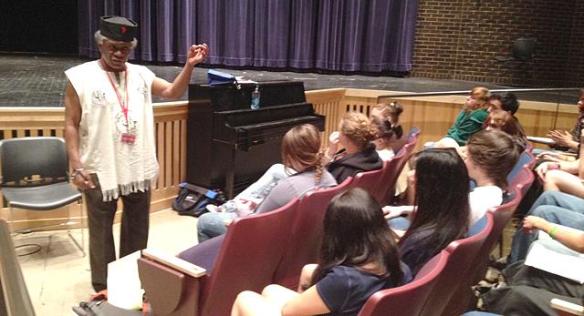
Dr. Mahmoud El-Kati talks of racism and mesmerizes students at South

Click on: Dr. Mahmoud El-Kati talks of racism and mesmerizes students at South. This man is a legend in his own time Minnesota. He deserves all the air time the world will give him. He has spoken at Shepherd of the Hill Church‘s First Tuesday Dialogues on the historical roots of the colony at Jamestown, and is a highly esteemed colleague and friend.