
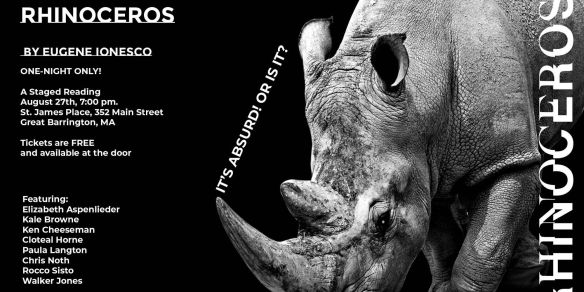
The video of a rhinoceros killing a lion and throwing it into the air like trash called to mind Eugene Ionesco’s Rhinoceros. As I remembered it, Rhinoceros, like other works of The Theater of the Absurd, tore back the curtain of presumption that keeps us from seeing who we really are. If Rhinoceros was about anything else, it was about order and chaos, dominance and subservience, power and the wannabe herd that surrenders its power to the Rhinoceros.
A day in Brooklyn Park
My sense of the absurd grows every day. I see myself as E.E. Cummings’ “Little i” –– Who am I, “little i” among the herd of “little i’s” clamoring for dominance? I know so much less than I once knew. The sense of absurdity has shredded my confidence in the unseen hand of divine providence.
Kay and I live in Brooklyn Park, Minnesota, where a police bulletin advised all residents to stay in our homes until a future advisory. Keep the doors locked while the police searched for a shooter at loose in our neighborhood. The man is armed and dangerous. Do not answer the door under any circumstances. The suspect may be dressed like a police officer. Do not answer the door for anyone until you receive a further advisory.
The next day we learned that a suspect had been arrested. He had shot and killed former Speaker of the Minnesota House of Representatives, Melissa Hortman and her husband, Mark, and had critically wounded MN state Senator John Hoffman and his wife, Yvette.

The Army of God and the ‘unhumans’
The shooter had abandoned his van to flee on foot. The van contained a hit list of 40+ public servants. Everyone on the list was prominent member of the Democratic-Farm-Labor Party (DFL). To some, it came as a shock that the suspect identified himself as a Christian. On most Sundays, he attended worship at an evangelical megachurch. Others were not surprised. They recalled Stephanie McCummen’s article, “The Army of God Comes Out of the Shadows” (The Atlantic, January 9, 2025). The far-right New Apostolic Reformation has quietly sweeps through charismatic-evangelical Churches with its message of Christian nationalism.
“Our study of history,” says a book endorsed by JD Vance, “has brought us to this conclusion: Democracy has never worked to protect innocents from the unhumans. It is time to stop playing by rules they [i.e.‘unhumans’] won’t [keep].”
Earlier in American public life, residents of Brooklyn Park did not imagine that hate, heartlessness, and cruelty would define their community. Nor would they have thought of a Christian drawing up a hit list, disguising himself as a police officer driving a squad car facsimile loaded with guns, rifles, and military-style weapons used for assassinations and executions of public servants. There was, as there always is among humans anger, frustration, scapegoating, and loathing of others, but the community, for the most part, observed its own cultural commandments of do’s and don’ts.
Living with the Absurd
The ethical norms required for a healthy society have been eroded so slowly that we wonder how we got to the America of 2025 so quickly. Like buildings of brick and mortar, nations, religions, and communities need maintenance. Without it, they crumble.
While a student at a small Christian college, the Theater of the Absurd suddenly came to make more sense than the “Life-of-Brian” view of divine providence in which God’s in his heaven and nothing can go wrong. Things were not right with world. Unless God is a sadist, the world made no sense. I was 19 years-old when Eugene Ionesco, Albert Camus, and Jean-Paul Sartre pulled me, dragging and screaming, into the Theater of the Absurd. I had experienced the angst to which Camus’ The Plague, Sartre’s No Exit, and Ionesco’s Rhinoceros gave expression, but I did not know enough history to understand the Sitz im Leben from which they wrote.
Don’t you see?

White Rhinoceros, courtesy of Working with Wildlife, South Africa
All these years later, I get it. Life in 2025 bears ghostly resemblance to these authors’ experience almost a century ago. In an interview published in 1983, Ionesco described the circumstances that led him to the image of a rhinoceros:
I first thought of the rhinoceros image during the war, as I watched Romanian statesmen and politicians and later French intellectuals accommodate themselves to Hitler’s way of thinking. They might say something like, “Well, of course the Nazis are terrible, terrible people, but you know, you must credit them with their good points.” And you wanted to say to them: “But don’t you see, if you start granting them a good point here, a good point there, eventually you will concede everything to them.” Which is exactly what happened. But they looked upon you as an alarmist, then a nuisance, finally an enemy to be run down. They looked like they wanted to lower their heads and charge.
Eugene Ionesco, Le Nouvel Observateur, February 1983
Conceding Everything
The statesmen, politicians, and intellectuals who today accommodate themselves to the thinking and morality of a rhinoceros are not Romanian, German, or French. They are Americans. The way of thinking is the same. The psychology is the same. Though the targets are different, the phenomena are the same. If Jews, gypsies, and homosexuals became the scapegoats that propped up the illusion of Aryan racial superiority in Germany, today in America, the enemy is leftists, socialists, communists, people of color, immigrants, and migrants poisoning the blood of our country. The scapegoat mechanism is the same. The excuses and accommodations are the same. The results are the same.
The strategy and tactics that now threaten democracy in the U.S.A. have a history. Too little has been made of the similarity of the Nazi’s failed coup d’etat –– the Beer Hall Putsch (November 8-9,1923) in Munich –– and the attempted coup d’etat in Washington, D.C. on January 6, 2021. Or of the fact that Adolf Hitler was tried and found guilty of treason and the charges in the second impeachment trial of Donald Trump in the wake of January 6. Or that the book Hitler wrote in prison, Mein Kampf, and the Speeches of Hitler, were, according to members of the Trump family and the co-author of The Art of the Deal, Tony Schwartz, were the only books in his bedroom. Most poignant is the Nazi decision to shift from the strategy of violent revolution to a slower evolutionary road to victory. It would happen more slowly and less spectacularly, but it would succeed. They would destroy democracy from within. And they did.
“Hitler’s lesson from the failed putsch,” wrote historian Christopher Browning in the February 2022 issue of The Atlantic, “was that he needed to pursue revolution through ‘the politics of legality’ rather than storm Munich City Hall. The Nazis would use the electoral process of democracy to destroy democracy.”
The late Bill Moyers (RIP) described Donald Trump as a man who has an open sore where a soul should be. Eugene Ionesco saw a Rhinoceros, and a herd of wannabe rhinoceroses, tromping behind the Rhinoceros whenever a snort tells them to lower their heads and charge.
Gordon C. Stewart, Presbyterian Church (USA) pastor, social critic, and public theologian, author of Be Still! Departure from Collective Madness (2017 Wipf and Stock), 49 brief commentaries on faith and public life, Brooklyn Park, MN, July 9, 2025.


















 Views from the Edge