Get a Rush out of this tongue-in-cheek acrostic by my friend Steve.
“Barak Obama” (acrostic)
Barak Obama was not born here in
America. He is not qualified,
Really, to be the President. Fear in
All the conservative radioland:
Knowing he will take away each one’s gun.
—–
ObamaCare says all must be insured,
But who wants health care for everyone?
Arrest Saddam Hussein? Don’t say a word…
Marriage should only be between a man
And woman. Gay folks equal? That’s absurd!
President Barak Obama at National Prayer Breakfast
Steve Shoemaker, host “Keepin’ the Faith” @www.will.illinois.edu/keepinthefaith. Steve knew the President when he was an Illiinois State Senator. He told me then, “This is one very unique human being. He’s special.”
“Man and nature belong together in their created glory – in their tragedy and in their salvation.” – Paul Tillich quote on monument in Tillich Park, New Harmony, Indiana.
Paul JohannesTillich’s gravestone in the Paul TillichPark, New Harmony, Indiana
Inscription on Paul Tillich’s gravestone reads:
“He shall be like a tree planted by the rivers of water that bringeth forth his fruit in due season. His leaf also shall not wither; and whatsoever he doeth shall prosper.”
A visit to Tillich Park in New Harmony, Indiana, inspired these lyrics. Unfortunately, the blog editing continues to erase the stanza divisions. Each stanza is four lines.
“God above God” is the language of Paul Tillich for whom God is not a being among others – an object of finitude – but the Ground of Being Itself, the Ground that remains when all of our concepts and idea collapse.
The source of this affirmation of meaning within meaninglessness, of certitude within doubt, is not the God of traditional theism but the “God above God,” the power of being, which works through those who have no name for it, not even the name God.
— PAUL TILLICH, SYSTEMATIC THEOLOGY, VOL. 2, P.12
“Man and nature belong together in their created glory – in their tragedy and in their salvation.” – Paul Tillich monument, Tillich Park, New Harmony, Indiana.
Steve wants you to know that we’re both important. He has his tower. I have mine. Steve is host of “Keepin’ the Faith,” a Sunday evening program on on WILL – archive programs, “including two with Gordon Stewar” (Steve ordered me to put this in here – he’s taller, so I do everything he says), can be heard anytime, anywhere @ www.will.illinois.edu/keepinthefaith
Whose flesh is the flesh of hills and hummingbirds and angleworms,
Whose skin is the leathered skin of the barge-toter and the old Indian Chief and the smooth skin of a newborn babe,
Whose color is the color of the zebra and the brown bear and the green grass snake,
Whose hair is the aurora borealis, the rainbow and nebulae,
Whose eyes sometimes shine like the evening stars, and then like fireflies, and then again like an open wound,
Whose touch is the touch of life and the touch of death,
Whose name is everyone’s, each and all alike, for just a fleeting moment on the shore of time, the hem of your eternity:
Grant us to see ‘tis only the splendor of light hideth thee.’ Let Your healing balm salve the tender wounds of grief and turn the tears of mourning into tears of unshakable joy.
God of the sparrow, God of the whale, God of the pruning hook: You ask only that we do justice, love mercy and walk humbly with You. Lead us to take the claims of justice, mercy and humility into the palaces and chambers of power where public policy is made and administered. Give us confidence that, though truth still sways upon the gallows, yet it is truth alone that is strong.
Let our lives flow in endless song above earth’s lamentations. Let no storm shake our inmost calm. No tempest dim our vision. No noisy gongs or clanging cymbals of ignorant armies clashing by night drown out the gentle sounds of the flute and the dulcimer, the quiet chords of love.
For this work and this alone, raise us up on eagles’ wings to follow Wamble Pok-he, our lead eagle now departed, and to see him standing there, like old Joe Hill, as big as life and smiling with his eyes. “What they could not kill,” says Joe, says Doug, “went on to organize, went on to organize.” “I did not die,” says he. “I did not die. Where workers strike and organize,” says he, “You’ll see Doug Hall,” says he, “We’ll see Doug Hall,” says he. How can we can we keep from singing? Amen.
– GCS, pastoral prayer at Doug Hall’s Memorial Celebration, Wabasha, MN.
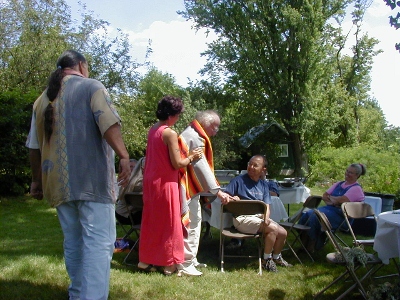
Stephanie Autumn and Clyde Bellecourt honoring Doug with Indian blanket
Doug was the definition of “the street lawyer.” The farewell to Doug was attended by the people he had defended over many years, the founders of the American Indian Movement, African-American activists, U.S. District Court Judges, MN Supreme Court Justices, Indian drummers, and “America’s troubadour, Larry Long.” Doug was an important figure in the standoff between the federal troops and the AIM members who occupied Wounded Knee. He served as Director of the Legal Rights Center, and, in the last decade of his life was a leading figure in the state-wide movement for restorative justice. He was the Honorary Chair of the Minnesota Restorative Justice Movement.
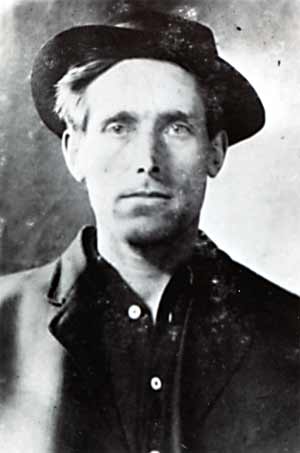
Joe Hill, Swedish-American labor organizer, songwriter, (1879-1915)
I dreamed I saw Joe Hill last night
Alive as you or me.
Says I, “But Joe, you’re ten years dead.”
“I never died,” says he,
“I never died,” says he.
“In Salt Lake, Joe,” says I to him,
Him standing by my bed.
“They framed you on a murder charge.”
Says Joe, “But I ain’t dead,
Says Joe, “But I ain’t dead.”
“The copper bosses killed you, Joe,
They shot you, Joe,” says I.
“Takes more than guns to kill a man.”
Says Joe, “I didn’t die,” Says Joe,
“I didn’t die.”
And standing there as big as life,
And smiling with his eyes, Joe says,
“What they forgot to kill Went on to organize,
Went on to organize.”
“Joe Hill ain’t dead,” he says to me,
“Joe Hill ain’t never died.
Where working men are out on strike,
Joe Hill is at their side,
Joe Hill is at their side.”
“From San Diego up to Maine
In every mine and mill,
Where workers strike and organize,”
Says he, “You’ll find Joe Hill.”
Says he, “You’ll find Joe Hill.”
I dreamed I saw Joe Hill last night
Socrates is reported to have said that “the unexamined life is not worth living.”
Judas' conscience - G.E Nikolaj (1891)
Any honest self-examination knows that to be human is to experience betrayal. We betray and we are betrayed.
Would it help to think of God as being closer to our betrayals than we ever dare to be?
Would it help, perhaps, to see your betrayal of others and your self-betrayals, as scenes in a drama with many different scenes and acts, a drama bigger than betrayal? A drama of One who knows our nature. Our fears. Our dashed hopes. Our un-trustworthiness. The side of us so ugly that we dare not look it in the eye – the side that, for thes moment, cannot imagine the larger dramatic piece and the hopeful theme we have forsaken: the persistence of love, of forgiveness, of life out of death, the resurrection of love itself…here and now…not just then and there.
There are two traditions about Judas, disciple of Jesus whose betrayal has been handed down across the ages, the scapegoat Betrayer we don’t want to be.
According to the first story In Matthew, “when Judas, [Jesus’] betrayer, saw that [Jesus] was condemned, he repented and brought back the thirty pieces of silver…and throwing down the pieces of silver…he departed; and he went and hanged himself.” The first story puts Judas at the end of his own noose. But there’s an altogether different tradition according to which Judas exploded from within while walking across a field. In this story, the Betrayer is a walking dead man, walking with such self-hatred – a self-loathing so profound – that he could not live with himself, and as he was walking, “all his bowels gushed out” (Acts of the Apostles 1:18).
A few of us have attempted suicide. Most of us have not All of us, if we’re honest, know something of what it’s like to walk through life with unsettled stomachs and intestines. The prescriptions we take for upset stomachs or roiling bowels cannot touch the issue of betrayal when we have betrayed or have been betrayed.
But – stay with me a moment longer -here’s the thing I’ve come to see. The word for “gift” in New Testament Greek is didomi. The word most often translated “betrayal” is paradidomi – to give over – para (over or across) and didomi (gift). Tradition is handing over the gift from one generation to the next.
Interesting…strange, even…that these words are so closely related. In Christian tradition, Jesus is the great Gift. Judas, the Betrayer, unwittingly passes on the gift, gives the gift over, hands the gift over… to the authorities…and to us…with a kiss.
With Judas’ kiss the story of Jesus the betrayed becomes OUR story: the story of the Betrayer and the Betrayed, the tradition handed over to us across the millenia.
Betrayal Steve Shoemaker, Urbana, IL, 2012
J. seemed a friend–he chose to join the group.
We trusted him. We let him keep the purse
we held in common. We would meet for supper
often–yes, our hands would touch, we’d curse
the same opponents, be amazed and shake
our heads at miracles. We later learned
he stole, and made a secret deal to take
the silver from the Priests–from grace he turned
to greed.
Soon after, he was overcome
with shame: he threw the money at their feet.
J. left us then, he had himself to blame
and took his life: Disciple of Defeat.
The greatest miracle of all he’d miss
because he betrayed Jesus with a kiss.
Betrayal is not the most importance scene in life. Stick around for the next scenes and acts that transform the laments of examined lives into anthems to the One who is closer to our betrayals than we ever dare to be. The examine life is worth living.
Steve’s walk down memory lane arrived as I prepare to moderate a public meeting tomorrow night (Tuesday, May 1) that could repeat the history of religious arrogance. Pro and con positions will be offered on the proposed “marriage amendment” to the MN State Constitution that would define marriage as between one man and one woman. Lord, help the moderator…and the speakers…and all who attend to speak boldly and clearly, but also with some meekness. This is not a laughing matter.
Steve Shoemaker standing at historic pulpit of Sheldon Jackson Church, Colorado
“Views from the Edge” note: Steve is not a Deacon and he’s not a lawyer. He’s a retired Presbyterian minister, poet, and activist living on the prairie near the University of Illinois. Steve was Pastor and Director of the McKinley Presbyterian Church and Foundation at the University of Illinois. He concluded his ministry as Executive Director of the University YMCA at the University of Illinois, a vigorous campus student center as big in heart and mind as Steve. His voice is heard every Sunday evening as host of “Keepin’ the Faith” an interview show on the University of Illinois’s radio station, WILL AM – Illinois Public Radio.
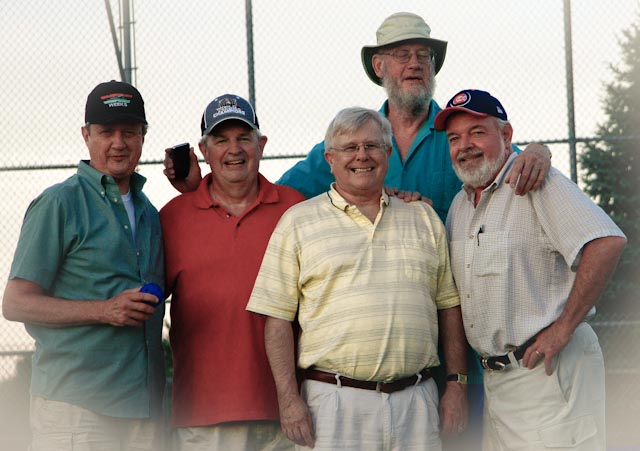
Picture of classmates - Harry Strong on the far right
Yesterday classmate Harry Strong,sent this by email in response to Steve and my reflection “Words from childhood” posted on Views from the Edge. I asked Harry for permission to publish part of his email here. Harry’s reflection ends with questions for your reflection.
– by Harry Lee Strong, San Juan Mountains, Colorado, sent April 28, 2012
While teaching adult classes at the Church of the Wildwood in Green Mountain Falls, I led a course called: “Could I Sing That Song and Mean It?” We sang and listened to a number of sacred and secular pieces on various topics. This was one of them.
“Child Again” (Beth Nielsen Chapman)
She’s wheeled into the hallway
Till the sun moves down the floor
Little squares of daylight
Like a hundred times before
She’s taken to the garden
For the later afternoon
Just before her dinner
They return her to her room
And inside her mind
She is running
She is running in the summer wind
Inside her mind
She is running in the summer wind
Like a child again
The family comes on Sunday
And they hover for a while
They fill her room with chatter
And they form a line of smiles
Children of her children
Bringing babies of their own
Sometimes she remembers
Then her mama calls her home … CHORUS
Playmate, come out and play with me
(It’s raining, it’s pouring, the old man is snoring)
And bring your dollies three
(Bumped his head on the edge of the bed)
Climb up my apple tree
(Never got up in the morning)
Slide down my rain barrel
(Rain, rain, go away)
Into my cellar door
(Come again another day)
And we’ll be jolly friends
(Little Johnny wants to play)
Forevermore
(Some more) … CHORUS
Do you have family members or friends who are suffering from Alzheimer’s or dementia?
What counsel, wisdom, or inspiration do you have to offer to caregivers and loved ones who are trying to be helpful companions to those whose mind is not what it used to be?
Personal reflection – a Visit with Red – written April 28, 2012
I walk through the door to his room…quietly. He is lying on his left side, his back to the door, his body turned toward the windows, in a fetal position.
His wife of 50 years had put him there. Couldn’t care for him anymore at home. That was a year ago.
Now he didn’t know her name or recognize her face.
The usual visits are the theater of the absurd. Becket’s’ Waiting for Godot. Blank stairs. Monologues. Boredom. Wondering why I go…except…he’s there. I could be too.
I tiptoe around the foot of the bed. I hear his voice. His eyes are closed. His lips are moving. “Now I lay me down to sleep, I pray the Lord my soul to keep. If I should die before I wake, I pray the Lord my soul to take” – the prayer he committed to memory as a child.
Slow - Children
He finishes and seems at peace. I pause…quietly speak his name…and place my hand gently on his shoulder. He opens his eyes.
“Good morning, Red. It’s Gordon.”
Blank stare.
“Your pastor…from Knox Church.”
His eyes grow wide. He smiles. He reaches out his hand…and looks me in the eye – a memory unlocked from deep within his soul…beyond the reach of Alzheimer’s.
“The Church Choir” – Steve Shoemaker, Urbana, IL, April 28, 2012
Words sung can be remembered long
after words said. A person with
Alzheimer’s still may sing a song
recalled from church or school. The myth
that music is a gift for few
blessed with a perfect pitch is just
malicious: any in a pew
who talk can sing! Of course, they must
speak S-L-O-W-L-Y and (the hardest thing
of all) must listen to others
around them–and follow the fingers
or baton of conductors
who beg and plead, talk loud or soft
to lure folks into the choir loft
All these years later…I wish I’d sung with Red that day. “Jesus loves me; this I know…” S-L0-W-L-Y… from the choir loft… in the nursing home.