Elijah Learns about Gravity

Video

Enjoying a snack with his Mom yesterday, Elijah learned about gravity.

Mom, what happened?

You turned the bag upside down.

So?

You can’t turn it upside down unless you want the snacks to fall to the floor.

Why?

It’s called gravity. Gravity pulls everything down.

Uh-uh!

Uh-huh!

Uh-uh!

Uh-huh!

Uh-uh! Doesn’t pull me down! I’ll just reach for my snacks!!! Nothing takes me down!

  • Grandpa Gordon, Chaska, MN, May 2, 2018.


The Eleventh Commandment

“Thou shalt not even think about using a chain saw.”

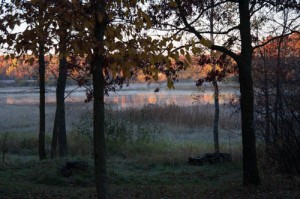
IMG_9456At the cabin next to the wetland we love quiet candle-lit evenings by the wood-burning stove. The candles are easy. We buy them. The wood for the fires is harder. We gather the logs and the kindling from the surrounding woods, drag them next to the deck, and break or cut them into pieces to fit the dimensions of the small wood stove. In a week or two, a friend and I will get out the chain saw to cut up large oaks that have fallen in the woods. But that will come later.

This morning Kay and I gathered what we could carry from the woods and were breaking the breakable pieces into kindling. It felt good to be making progress on our first spring work day. Barclay, the five year-old ever cheerful, light-chasing Cavalier King Charles Spaniel, was entertaining himself on the ground above the septic system. He doesn’t know there’s a sceptic system under there, and, if perchance he did know, wouldn’t care as long as there were light and shadows, squirrels, chipmunks, birds flitting around him and soaring over the wetland. Back by the deck, Kay and are enjoying the creative act of turning twigs into kindling and tree limbs into logs for the wood stove. It occurred to only one of us to stand at the edge of the pile instead of in the center of the cluster branches twisting every which way. The other who is typically less aware of his surroundings suddenly lost his balance and hit the deck, so to speak.   

Unruffled by my failure at even the smallest of tasks, I lay still for a moment as Kay rushed to my side, asked if I had hurt myself, and extended a loving hand to pull me to my feet. Barclay never noticed. Then came the eleventh commandment:

ten commandmentsThou shalt not even think of using a chain saw, for in the day that you use it, you shall surely die! 

“No chain saw for you,” said Kay. “Don’t even think about it!”

  • Gordon C. Stewart writing from the wilderness, April 29, 2018.

The Beauty of the Swamp

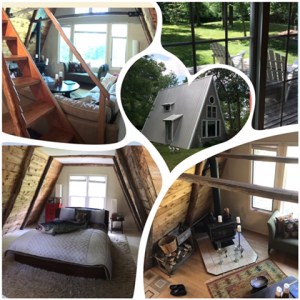
Quite serendipitously, you might say, The Pea Pod — the-small A-frame cabin by the wetland — became ours last August. It came into view in an internet search for an affordable lake or river-front property within easy driving distance from the metro area.

cabin IMG_6563Before stepping foot on the property we thought it was on a small lake, not a swamp on outskirts of the Silvan Shores Association. We immediately fell in love with the quiet serenity of the place and the simplicity of the wood cabin.

We soon learned that some of the Silvan Shores folks gather regularly at the association’s clubhouse at 10 A.M for coffee and conversation. Although we’ve chosen the Pea Pod by the wetland as a full retreat from all things civilized, we want to be good neighbors, and it’s a chance to meet others and pick their knowledge who who to call for various homeowner matters. At our first coffee hour Kay and I introduce ourselves by name and by the property’s location next to ‘the wetland’ just north of Turtle Lake.

Oh! You mean ‘the swamp’!” says Judy. We all have a good laugh.

Call it what you will — swamp, wetland, or marsh (remember Sydney Lanier’s “The Marshes of Glynn”?) — , the little cat-tailed not-quite pond with the trumpeter swans, great blue herons, mallards, loons, and beavers next to the equally unenviable cabin is its own sacred place for two peas in a pod.

This morning, eight months months after the ‘wetland’ turned into a ‘swamp’, I wake with the morning sun and see the beauty of the wetland other folks don’t get to see. Oh, they too might have a fat robin making her nest in the oak tree outside their patio doors, but they don’t experience dawn next to the beaver lodge and the loons paddling by in plain sight while the mallards, wood ducks, and the buffleheads greet the day with play near the wetland’s far side.

We prefer the wetland to the five lakes of the association. There are no boats here on the swamp. No motors to disturb the silence. No water-skiers. No anglers. No noisy humans. Within days the Trumpeter Swans will break the silence. The only oars on the water belong to the waterfowl and the flat tail of the beavers. It’s an uncivilized place that reminds us of the incivility of civilization and the beauty of nature’s frailty and glory.

  • Gordon C. Stewart at the Swamp, April 29, 2018.

I heard and then began to feel, in my chest, a deep rhythmic whooshing

This piece opened my day. Maybe it will open yours — and your sense of joy — also. Its sensibility is akin to watching the Manatees in “Stillness at Blue Spring” (Be Still! Departure from Collective Madness, p. 3-4). Thanks to Kay and her friend Mary for bringing it to my attention. It’s pure joy!

Live & Learn's avatarLive & Learn

A few years ago in a forest in northeast India, I heard and then began to feel, in my chest, a deep rhythmic whooshing. It sounded meteorological, but it was the wingbeats of a pair of great hornbills flying in to land in a fruiting tree. They had massive yellow bills and hefty white thighs; they looked like a cross between a toucan and a giant panda. As they clambered around in the tree, placidly eating fruit, I found myself crying out with the rarest of all emotions: pure joy. It had nothing to do with what I wanted or what I possessed. It was the sheer gorgeous fact of the great hornbill, which couldn’t have cared less about me.

The radical otherness of birds is integral to their beauty and their value. They are always among us but never of us. They’re the other world-dominating animals that evolution has…

View original post 133 more words

Geoengineering and the Climate Crisis

Rex Tillerson clearly stated his views of climate change during remarks in 2012 at an event sponsored by the Council on Foreign Relations.

“And as human beings as a — as a — as a species, that’s why we’re all still here. We have spent our entire existence adapting, OK? So we will adapt to this. Changes to weather patterns that move crop production areas around — we’ll adapt to that. It’s an engineering problem, and it has engineering solutions. And so I don’t — the fear factor that people want to throw out there to say we just have to stop this, I do not accept.” 

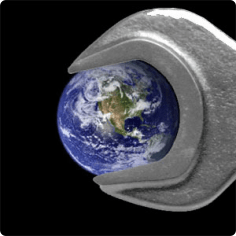
earthwrenchGeoengineering now seems to have become the de facto climate policy of the Trump White House and the GOP as they, on the one hand, deny the apparent fact of climate change, and on the other hand, prepare to fight it by employing poorly tested technology with unknown long term effects! 

In Conservative circles, seductive but superficial reasoning exists for Geoengineering being so popular.  One is that on a large scale, it can make several corporations and individuals very rich.  Another is that the effects of carbon based fuels can be downplayed by government and industry now.  After all, any atmospheric heating caused by burning fossil fuels and a buildup of carbon dioxide can be minimized by employing geoengineering technologies.  In short, the current state of Conservative thinking, Jobs, Jobs, Jobs translates into Burn, Burn, Burn.

Globally, the atmospheric carbon dioxide level reached 403 ppm this year (it held between 180 ppm and 290 ppm for the previous 800,000 years).  Even so, fossil fuels still reign supreme as the power source of world economies.  With no end in sight for the abatement of atmospheric carbon dioxide levels or the employment of alternative/renewable power sources, carbon dioxide levels will continue to rise.  Planet cooling by geoengineering will just mask the warming effects of elevated carbon dioxide levels.  At some point, as yet undetermined, Earth will depend upon geoengineering to remain within livable limits.  It is apparent that once we are hooked on geoengineering in a world with high atmospheric carbon dioxide levels, any cessation of geoengineering efforts will be accompanied by rapid and severe global climate changes to unacceptable levels.

Obviously, clear thinking is in short supply.  At best, geoengineering is the environmental equivalent of the opioid crisis and at its worst it is applied asininity, if not a downright “Faustian Bargain” of epic proportions.

If you want deeper insight into geoengineering and the climate emergency, please read the following:

https://cleantechnica.com/2017/11/09/new-computer-modeling-helps-scientist-analyze-effects-geoengineering

http://www.mcclatchydc.com/news/nation-world/national/article183547911.html

http://www.npr.org/sections/thetwo-way/2017/11/02/561608576/massive-government-report-says-climate-is-warming-and-humans-are-the-cause

https://www.usatoday.com/story/news/politics/2017/11/08/pruitt-says-alarming-climate-report-not-deter-replacement-clean-power-plan/839857001

https://www.theguardian.com/environment/2017/nov/06/how-indias-battle-with-climate-change-could-determine-all-of-our-fates

https://www.theguardian.com/environment/2017/nov/08/seven-megatrends-that-could-beat-global-warming-climate-change

https://qz.com/index/1116160/for-800000-years-carbon-dioxide-levels-moved-between-180-ppm-and-290-ppm-last-year-they-got-to-403-ppm/

Only the Splendor of Light

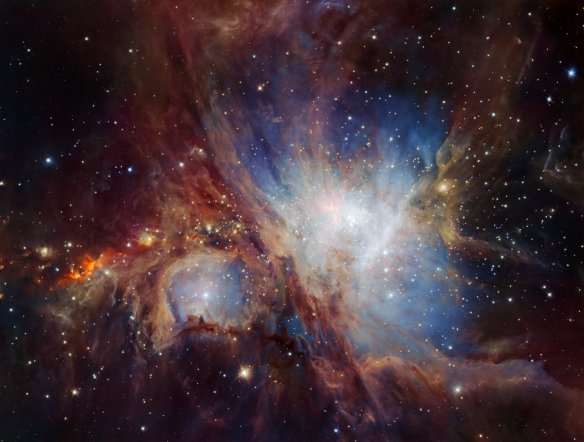
What we now see through the Hubble telescope is poetry written on a grand scale much larger than our mortal minds can fathom.

A deep infrared view of the Orion Nebula from HAWK-ILong before the Hubble and long before the onset of climate departure that rocks our illusion of the human species’ exception to nature, Walter Chalmers Smith‘s poetry gave voice to the sense the Hubble elicits, the sense of mortal awe looking at what we cannot fathom.

How do you express the inexpressible mystery of the Creator whose name was unutterable in Hebrew Scriptures, save the self-described “I AM”? How do you put into words what cannot be known? How do you sing about the One who is ineffable — beyond all words? —  Professor C. Michael Hawn, Perkins School of Theology, “History: ‘Immortal, Invisible, God Only Wise’.”

Poetry is the language of faith. Perhaps it is also the language of God, the Ineffable.

To all, life Thou givest, to both great and small,
in all life Thou livest, the true life of all;
we blossom and flourish as leaves on the tree,
and wither and perish, but naught changeth Thee.

Great Father of glory, pure Father of light,
Thine angels adore Thee, all veiling their sight;
all praise we would render, O help us to see
’tis only the splendor of light hideth Thee!

— Walter Chambers Smith (1824-1908), “Immortal, Invisible God Only Wise” (1867), stanzas three and four.

  • Gordon C. Stewart, Chaska, MN, October 30, 2017.

The Fly that Would not Flee

In the pre-dawn pastel glow

Outside the lakeside window,

The fly inside is very still.
pre-sunrise glow

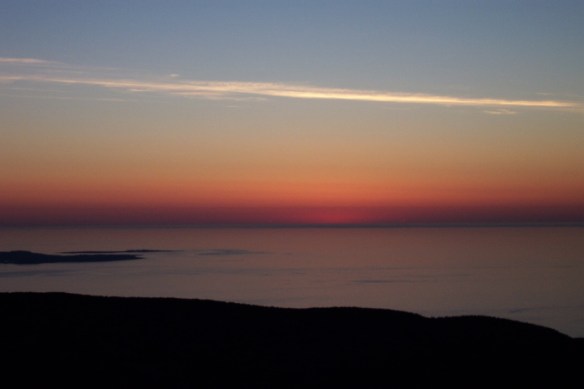
Lake Superior pre-dawn pastel glow.


For the half hour before the sun

Pokes its yellow head over

The brim of Superior’s horizon,

The fly does not move.


Perhaps the fly is dead, I think,

And gently touch it from below.

It does not fly away.

200px-Simulium_trifasciatum_adult_(British_Entomology_by_John_Curtis-_765)

It takes a few steps forward,

An inch or two higher on the window —

This oratory the intruder has disturbed

In the hour of morning prayer.


Only after the sun has risen

Does it leave the window

But not before completing


Its sun-dance: turning from east

To south, to west, to north, and

Back to East again to greet the day.


The observing intruder from whose

Finger the fly did not flee reads

from The Book of Common Prayer:


“Deliver me, O Lord, from evil-doers;

Protect me from the violent,

Who desire evil in their hearts

And stir up strife all day long.”

[Psalm 140:1-2]


A fly lands on the prayer book.

I swat the fly away.

  • Gordon C. Stewart, the intruder, Encampment Forest, Lake Superior, MN, October 6, 2017



Things too hard for me

Momentary access to the world-wide-web leads away from many words toward reflection on an ancient text.

O Lord, I am not proud;

I have no haughty looks.

I do not occupy myself with great matters

or with things that are too hard for me.

But I still my soul and make it quiet,

like a child on its mother’s breast;

my soul is quieted within me.

O Israel, wait for the Lord,

from this time forth and for evermore. 

[Psalm 33, Book of Common Prayer psalm for the morning]

sunrise-over-lake-superior

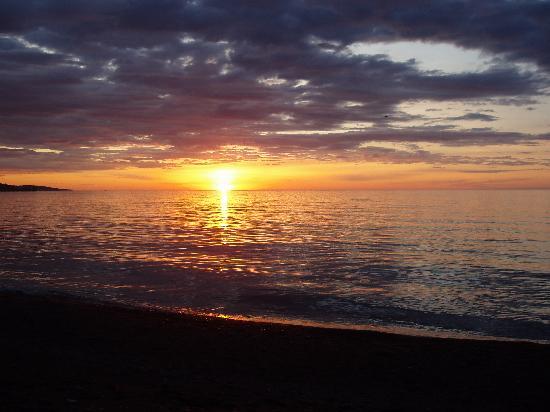
I wake before dawn to see the sun rise over the far horizon beyond Lake Superior, shining its rays across the waves, a beauty beyond compare. I do not occupy myself with “great things” that matter less and things too hard for me. I am not proud.

— Gordon C. Stewart, Encampment Forest, Two Harbors, MN, October 5, 2017.

In stillness I wait

fd102fe612128b9da9857f58e5286d30I see things in the wilderness I do not notice at home.

Last night the sky was lit by lightning on every side —north and south, east and west— but the lightning was flashing from far away. There was no sound. There was no thunderstorm within miles of the A-frame under the stars.

The cabin by the wetland is like that — a place apart for a news-weary soul. A humble shelter of rough-cut pine without electronic devices among the crows, owls, white-tailed deer, skunks, and swans. Yes, the skunks are here, digging for grubs at night, but the skunks here don’t stink up the place like humans do back home, and, like the crows, owls, deer, and swans, they know nothing of the world I’m trying to leave behind.

1928_bcpThis morning’s Psalm from the Daily Office of The Book of Common Prayer brings its own kind of light from afar.

We give you thank, O God, we give you thanks,
calling upon your Name and declaring your wonderful deeds.

“I will appoint a time,” says God,
“I will judge with equity.

“Though the earth and all its inhabitants are quaking,
I will make its pillars fast.

“I will say to the boasters, ‘Boast no more,’
and to the wicked, ‘Do not toss your horns;

“‘Do not toss your horns so high,
nor speak with a proud neck.’”

[Psalm 75:1-5, Book of Common Prayer]

The lightning flashes from ages ago, calling me to hope for such a time.

In the morning stillness of the wilderness, I wait.

  • Gordon C. Stewart, uploading at the truck stop 12 miles away, September 23, 2017.


Respite off the map

Sanity demands solitude.

thoreau quoteHenry David Thoreau withdrew to Walden Pond to come to his senses. His time was much simpler than mine. He never got out of bed to check his emails or search the internet. But even in that less over-stimulated time he felt the need to leave everything that distracts the human spirit from the deeper truth about itself.

Solitude loves silence.

The wilderness cabin in northern Minnesota feels a bit like Henry’s place on Walden Pond. The wetland separates it from the small pond that has no name on a map. There are no sounds here other than the loons’ calls, Barclay’s bark, and the occasional mooing from a mile or two away when the wind is right.

Solitude puts me in touch with nature.

Not all the sounds are calming. In the night darkness, the howls of a nearby coyote and the scratching sounds of skunks digging for grubs remind me that nature is not as altogether sweet as romantics sometimes make it out to be. The cabin provides a respite from the human howls and odors that startle me in the world beyond these woods.

I ponder with the psalmist the societal ills that drove Henry to Walden Pond and have driven me here.

Their idols are silver and gold,
the work of human hands.

They have mouths, but they cannot speak;
eyes have they, but they cannot see;

They have ears, but they cannot hear;
noses, but they cannot smell;

They have hands, but they cannot feel;
feet, but they cannot walk;
they make no sound with their throat.

Those who make them are like them,
and so are all who put their trust in them.
[Psalm 115:4-8, The Book of Common Prayer]

fd102fe612128b9da9857f58e5286d30I become aware of the light dancing on the aspen leaves in a gentle breeze, the yellow oak leaf signaling the turn of summer toward fall, the sudden gust of wind from across the nameless pond, the osprey circling overhead on currents I cannot see, the ice-cold water hand-pumped from the well, the warmth of the fire in the wood stove, the feel of dirt from the flower beds—the living silence of a dead stop.

  • Gordon C. Stewart, Walden Pond, MN, September 2, 2017.