Another Verse by Steve Shoemaker

Bees

Ora Conley had not liked
her middle name,
so she said, “I’m Ora Bee!”
It had a ring…
She was teased by kids, of course,
“Don’t sting! Don’t sting!”

She had ten kids of her own
and gave the same
name to her child number three,
“She’s Wilma Bee.”
Willie hated “Wilma,” but
she kept the “Bee”
and she passed it on to daughter
Nadja Bee.

Nadja kept her middle name
just for family:
one odd name would do for school,
thank you very
much… “My Dad was reading
Dostoyevsky!”
Her daughter naturally was
her Marla Bee.

Grace Olivia Bee carries
on the fame…

Grace

– Steve Shoemaker, Urbana, IL, January 20, 2014,

Photo is of Grace Olivia Bee at age 11, grand daughter of Nadja Bee, great-great-grand daughter to Ora Bee, and grand daughter of Nadja’s husband. That would be Steve, who loves bees.


She mowed the lawn in high heels!

Joan Copeland in Cubs

Joan Copeland in Cuba

We LOVE interesting people!

Joan Copeland was one of a kind. She was a complete stranger to Views from the Edge before Steve Shoemaker read the unique obituary the led us to post The Foster Child who Succeeded at Fostering.  Family members caught eye of the posting and sent comments worth sharing.  The bolded print is added for those who don’t read entire blog posts! -:)

First family comment: I’m her granddaughter…. She was amazing… Growing up she kept me smiling and giggling…she was a free soul… Cubans and Martinis…when I would stay the night she used to pour me ginger ale in a fancy glass cup so we could have woman time lol she never let her past define her…And her family was her life…Sophie her cat lol…meanest thang ever…but she loved her….I’m glad you all enjoyed reading the smallest excerpt of her life…if only you knew the stories of Cuba…her first tattoo at age 75….her passion for dancing…how dolled up she loved to get…my granny was a true diva…an amazing woman….inside and out…- Seylon

Views from the Edge replies: Seylon, WHAT AN UNEXPECTED TREAT to hear from you. I never know who reads the blog, so to hear from you means a lot. Please say more about the Cuban references. Was she Cuban? Had she spent time in Cuba? Smoked Cuban cigars, drank Cuban rum?

At the helm on suitor's boat on the way to Cuba..

At the helm on suitor’s boat on the way to Cuba..

Seylon responds: I googled her name just to see if old real estate photos would pop up and stumbled across your blog. I called my mom she thought it was pretty cool. My grandma was Romanian….but she loved Cuba…she traveled there twice on a friend’s sailboat….I believe ’92 was either her first trip or second…I told her if they ever dropped the embargo and allow all the US citizens not being able to travel there I would take her there on vacation again. 🙂 I wish I could post pictures for you. I have plenty of them from when she was there. [NOTE: the photos on this page were sent later.]

She used to talk about the dolphins that would swim along the sailboat. Her first tattoo the family took her to get was of Dolphins and the word Cuba 🙂 She was 75. She would talk about how she brought a roll of shiny new pennies to give out to the kids there because she knew the country was poor and she thought it would be a cool gift to them. I guess a little boy she had met was not thrilled with the pennies…she used to say he expected more money then her little pennies.

Joan Coleman cigar

Joan Copeland smoking Cuban something or other

But she also loved cigars and used to smoke them. I am in the military and tried getting her cigars made from every place I’ve been…my last trip I got her a while box of Cubans…I told her we could crack the box open once I had my baby. She laughed, she said she didn’t even know if she could smoke one anymore. She mostly collected the boxes…. she collected a lot of stuff… antiques, paintings, everything 🙂 It’s crazy that her obituary got all the way to Minnesota. It’s pretty neat how someone who means so much to you can be a small part of a stranger’s life.

Another granddaugher responds: Hi, I am her oldest granddaughter, Summer. My gran would have loved this!! My gran never left her house without looking like a movie star from her big up-do to her fur coats. She went to the top of a mountain on a dirt bike and mowed the yard in heals. Always had a cocktail and ready for some fun. We always had a project to do together from making jewelry, beading necklaces, sorting jewelry or gemstones. We even made picture frames with jewelry. My mom and I took her to get her tattoo. All three of us got one that day. Three generations getting a tattoo coolest thing ever.
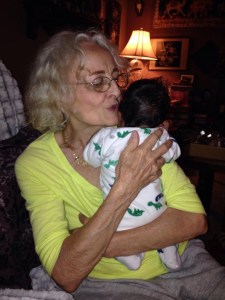
Great grandma singing "Itsy bits spider" to Seylon's newborn child.

Great grandma singing “Itsy bits spider” to Seylon’s newborn child.

She loved her family more than anything else. She wrote notes on everything she ever gave me. She made a tote box for all her grandkids and when I opened mine it has every Christmas card, valentine , letter, picture I drew and my baby clothes. She kept everything I ever gave her my whole life was in this box. She treasured me as much as I did her. Thank you for taking the time to write about my amazing grandma.

Joan’s oldest daughter comments: Hi Gordon. This is Joan’s oldest daughter, Rebecca. My niece, Seylon, called her mother from Germany this afternoon just as my sis and I were sorting thru “the goods.” (There’s a packed house.) I cried as she read your column to us. I’ll have you know that I went all out when writing the obituary because my mother did not want a funeral. She said, “I don’t want a bunch of people strolling by my dead body pretending that they liked me. I know who my friends are.” To be led to your column was an amazing stroke of synchronicity, and I’m sure my mother would think you did right by her. My mother was not Cuban. Her father was a Romanian immigrant who came here as a child. Her mother was from Illinois, and we don’t know much more because the family split up when Joan was young.

Joan Copeland on suitor's yacht sailing illegally to Cuba.

Joan Copeland on suitor’s yacht sailing illegally to Cuba.

Her sailing trips to Cuba were with one of the prospects she finally told to go away. She was in her mid-60’s at the time, and wouldn’t hesitate to smoke a good cigar w/ you.

Here’s just one more little tidbit I thought you might like. My mother enjoyed her martinis and for years she collected antique pewter. At my sister’s suggestion, we had her ashes put into a pewter cocktail shaker from her collection. When Seylon gets to come home on leave in July, we will scatter Joan’s ashes over her mother’s grave as per her wishes. – Rebecca.

I wish we were all that interesting!

Verse – 50th Anniversary Memory

She brought her long brown hair
home in her hand.

From twenty-five to forty
it had grown
till she could tuck it under
her fine, round,
full bottom as she sat.
When she would stand
in front of me, my fingers
found her hair
and stroked and petted. Now
it all was gone…

The pixy cut was cute–
it would compare
to Michelle Williams now,
or Audrey Hepburn then–
the stylist was a friend
of ours, but so
was Bill, the County Sheriff.
I called, he sent
a deputy with handcuffs
to get Sue
at the downtown salon,
make her repent
of her barbaric crime
against true beauty.

I had no doubt it was
my civic duty…

– Steve Shoemaker, Urbana, IL, Jan. 16, 2015.

Steve and Nadja were married August 21, 1965.

Nadja Shoemaker

Nadja Shoemaker

God wounded in Paris

Today’s news from Paris is chilling. Still reeling from the Charlie Hebdo attack, hostages are taken in a Kosher (Jewish) market in Paris. Fear of extremist Islamic terrorism spreads across France.

During a gathering of twelve of us at The Reformed Roundtable in Indianapolis two days ago, South African anti-Apartheid leader  the Rev. Dr. Allan Boesak quoted none other than John Calvin, according to whom whenever a human being wounds another, God is wounded.

The killers and hostage-takers in Paris claim the name of Allah. Their abuse of the name is an affront to faithful Muslims who reject violence and terror as much as adherents of Judaism, Christianity, Hinduism, and Buddhism. Religion itself, whatever its form and doctrine, is to be measured by its compassion.

Events in Paris remind me of Dr. Boesak’s statement and the Very Rev. James A. Whyte‘s sermon at the January 9, 1989 memorial service after Pan Am flight 103 carrying 259 passengers exploded over Lockerbie December 22, 1988. Eleven more were killed on the ground in the small town of Lockerbie.  The Church of Scotland reluctantly called it’s Moderator, James Whyte, out of mourning his wife’s death for his to preach at the memorial service for the victims of the terror at Lockerbie.

In that sermon he proposed a vexing answer to the vexing question: Where was God when the plane went down? “God,” he said, “was on the plane.” 

“Justice, yes; retaliation no,” he declared. “For if we move in the way of retaliation we move right outside of the fellowship of Christ’s suffering, outside of the Divine consolation. There is nothing that way but bitterness and the destruction of our own humanity.”

Four hundred years after Calvin’s statement and decades before James Whyte’s sermon at Lockerbie, Dietrich Bonhoeffer wrote the following from his prison cell before he was hanged by the Nazi’s whose “God” was without compassion. Bonhoeffer wrote as a disciple of Jesus, the Crucified, but his picture of God as suffering and the call to stand with God in God’s suffering int he world of human cruelty represents the compassionate faith shared by compassionate people of every stripe.

Christians range themselves with God in his suffering; that is what distinguishes them…. As Jesus asked in Gethsemane, “Could ye not watch with me one hour?” That is the exact opposite of what the religious man expects from God. Man is challenged to participate in the sufferings of God at the hands of a godless world. He must therefore plunge himself into the life of a godless world, without attempting to gloss over its ungodliness with a veneer of religion or try to transfigure it. He must live a ‘worldly” life and so participate in the suffering of God. He may live a worldly life as one emancipated from all false religions and obligations. To be a Christian does not mean to be religious in a particular way, to cultivate some particular form of asceticism (as a sinner, a penitent or a saint), but to he a man. It is not some religious act which makes a Christian what he is, but participation in the suffering of God in the life of the world.  [Bolded type added]

Dietrich Bonhoeffer, Letters and Papers from Prison

Today God is wounded again…in Paris, and we participate in the suffering of God at the hands of a cruel world.


Verse – Words with Enemies

Words with Enemies

You smile, and I’ll smile
and all the while we’ll
talk behind each other’s back
(but just to those we know
will have OUR back).

Then you will use a word
with just that tone, a word
that tears the skin from my back
(flaying piece by piece
and leaving bloody flesh.)

The words that I will then say
in return will burn and scar
and pierce you front to back
(I know it should be peace I seek,
but I won’t turn the other cheek.)

– Steve Shoemaker, Urbana, IL, January 4, 2015


A Man and His Dog

Barclay and Gordon

Barclay and Gordon

Few bonds are as close as a man and his dog. I sorely miss Barclay, the soccer dog, who’s living with his “sister” Kristin while Kay and I are “somewhere else” for a long time.

Kristin reports he’s doing well, eating all his food, taking his medicine, and happily playing goalie with his ball.

I wonder if Robert Frost had a dog. After writing “Mending Wall,” – Something there is that doesn’t love a wall….”, he might have thought, “Something there is that loves…a dog.”


God as Policeman or Lover

Sebastian Moore, OSB

Sebastian Moore, OSB

In the eyes of Views from the Edge, the  late Dom Sebastian Moore, O.S.B. (12.17.1917 – 02.21-2014) of Downside Abbey, England, is one of our time’s more interesting thinkers.

Steeped in the psychology of Carl Jung, the spiritual discipline of the Benedictine Order, the theology of Bernard Lonergan, S.J., and the mimetic theory of Rene Girard, his eyes were penetrating, his vision both deep and far-reaching. During a long life os spiritual searching, he wrote in his book The Inner Loneliness:

[O]nce you see the self as naturally self-centered, you deny that the self wants God above all things, and you degrade God from being the fulfiller, the lover, into being the policeman. Paul’s conversion, through the stunning vision of Jesus he had on the road to Damascus, was from God the policeman to God the lover.

[The Inner Loneliness, Crossroads Press, 1982, p.49]

We met briefly in 1971 at a meeting of campus ministers in Milwaukee. He was chaplain at Marquette University at the same time I served as campus minister at the University of Wisconsin-Whitewater. Gathered at the Episcopal Campus Ministry Center at UW-Milwaukee, I wondered who this strange monk was who seemed to observe everyone very closely without saying more than a word or two. I’m not sure I even knew his name. I just knew he was unusual.

Twenty-six years later, during a period of personal and professional turmoil, a therapist mentioned the name Sebastian Moore. I purchased The Crucified Jesus Is No Stranger and saw his picture on the jacket. His perspective left me in awe and anchors me still. I’ve been knocked off my horse on the way to way to Damascus. Every real conversion is the turning from God the policeman to God the Lover.

Poem #76 – The Prairie

The prairie at night is dotted with light
Of farms where people live and love,
Fight and hate, and celebrate.

Now and again the lights congregate
Like happy peasant women
Singing their songs, dancing their dances.
And I am not so alone.

– Dale Hartwig (1940-2012), looking out the window from his room at the Care Center in Grand Rapids, Michigan where Parkinson’s Disease had left him alone.

Joseph the Widower – Christmas Eve

Steve’s poems and verses often capture something very large in a few short lines. His “In the Stable” manages to keep the earthly and the heavenly together: an iconic smile at the end offered to a grief-stricken Joseph in the shame-filled, smelly stable. We publish “In the Stable” again for those of you who, like Steve’s Joseph, are dealing at the same time with grief and hope on Christmas Eve:

The shame that old man Joseph felt
in taking Mary to the barn
was mainly that, of course, it smelt:
it reeked with sheep shit, donkey dung,
and cattle plops. The widower
knew wives who whelped were never clean
themselves until the midwives pour
the well water over their loins
and legs, wash front and back. His first
young wife had died in giving birth
to their third child. He shook his fist
at heaven as she lay in filth
and breathed no more. Sweet Mary mild
step-mother, virgin, pushed and smiled…

– Verse by Steve Shoemaker; introduction by Gordon.

CLICK “Festival of Nine Lessons and Carols” to hear today’s live BBC broadcast (10:00 a.m. EST) from King’s College, Cambridge England.  Merry Christmas to all our readers.

Verse – In the Stable

The shame that old man Joseph felt
in taking Mary to the barn
was mainly that, of course, it smelt:
it reeked with sheep shit, donkey dung,
and cattle plops. The widower
knew wives who whelped were never clean
themselves until the midwives pour
the well water over their loins
and legs, wash front and back. His first
young wife had died in giving birth
to their third child. He shook his fist
at heaven as she lay in filth
and breathed no more. Sweet Mary mild,
step-mother, virgin, pushed and smiled…

– Steve Shoemaker, Urbana, IL, Dec. 24, 2014