
Pops Warfel and the School Playground

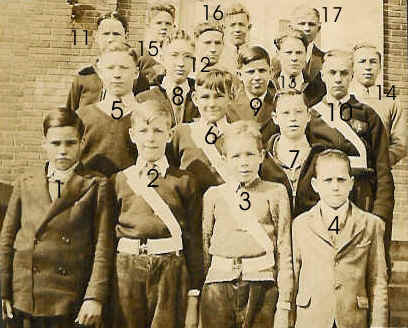
“Pops” Warfel, the Principal at Marple Elementary School in Broomall, PA, was like a prison warden. Every prison warden has his guards, his ‘goons’, as the prisoners call them. Every school back in the 1950s had its Safeties, the Principal’s goons who wandered the Yard during recess to keep the students in line. Real guys. Like Sammy Peacock.
schools_trainer_safeties_1935-36

School Safeties

In the 3rd Grade Sammy, attired in his Safety outfit, “arrested” his classmate Gordon during recess for cursing. “I DIDN’T curse,” said I.

“You did, too,” said Sam. “You said a bad word. I’m taking you to the Principal’s Office!”

Pops Wafel asked his Goon what happened out in the Yard. “Gordon, you know better than that. You father’s a minister! He wouldn’t approve of you using language like that. We’ll keep this between us just this once. But if it happens again, I’ll have to tell your father.”

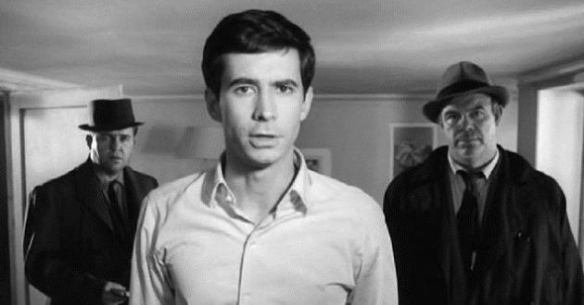
Long before I read Kafka’s The Trial, I experienced existential guilt – the feeling of guilt for something I never did – the guilt of being alive. I was Josef K in The Trial.

Meanwhile, Pops Warfel was violating one of the prison rules daily: no eating in class. Pops often reached into his desk drawer, and, pretending to cough, would pop in a jelly bean. No one dared say a word.

  • Gordon C. Stewart, Marple Elementary Inmate #00056789, Jan. 22, 2016
1-The-Trial


Ah, Finally a Florida Vacation!

Three couples rented a house this week in Florida. We selected the place after an extensive search using criteria of natural setting, water-front, quiet, three bedrooms, fully-equipped kitchen, views, kayaks/canoes provided, cost with a no-smoking policy. The house is on an estuary with manatees, ospreys, pelicans, egrets, Great Blue Herons, oyster-catchers, and advertised a million dollar view. It was too cool for the manatees, but that’s understandable. All 10 of the renters who rated their experience gave it ***** out of five. Hmmm.

QUESTIONS YOU MIGHT WANT TO ASK BEFORE BOOKING A VACATION RENTAL.

Do the owners live on the lower level?

  1. Do the owners smoke?
  2. If they smoke, how many packs/day do they smoke?
  3. Does the smoke seep up through the floors into the closets of the rental unit?
  4. Do they smoke anything else?
  5. How do we get up to the rental unit?
  6. Are the steps inside or outside?
  7. If outside, are they protected from high winds and torrential rains?
  8. Do the beds squeak?
  9. Is there an odor and standing water around the house that’s related to nature, but not the estuary?
  10. Are you on the city sewer system, or do you have a septic tank?
  11. If septic tank, has it been pumped out in the last year or two?
  12. Is there a limit on the number of showers we can take per day?
  13. What’s the meaning of a “quick” shower?
  14. Is there a limit on the number of times we can flush the toilet before it runs down the driveway?
  15. What kind of deck and balcony furniture is provided?
  16. If it’s made of plastic, how long has it been weathering?
  17. Has any of the plastic chairs on the balcony crumbled underneath a renter recently?
  18. chair on balcony
  19. Do you have drinking glasses? How many?
  20. Do you have coffee cups? How many?
  21. Do you have enough forks, knives, and spoons for six people to all eat at the same time or must we eat in shifts?
  22. Do you have a dishwasher?
  23. Will we need to buy Imodium because of the drinking water?
  24. When it rains, does the rain pour through the top of the west-facing window frames?
  25. Does the wind echo through the house like a freight train?
  26. Once you lower yourself the kayak from the deck, is there a way to get out without injuring yourself?
  27. Did you build the house yourself with the proper building permits?
  28. Was the house built with salvaged materials?

On the plus side, when we asked the owner for more plates, bowls, and coffee cups – there were four or five of each – he said he’d go downstairs and tell his wife. Nothing happened. Later in the day, before dinner, we asked again. “Oh,” he said “I’ll be back in 20 minutes.” He returned from Marshalls with newly purchased plates and glasses. We were grateful. He went back for the coffee cups, and everyone was happy! 

Now…about that  broken plastic chair that still sits the bedroom balcony!

  • Gordon C. Stewart, FL, January 22, 2016


Verse – The Word-Supple Couple

OR “THE BIRTH OF HERMENEUTICS”

There once was a dissatisfied couple
whose way with words was quite supple.
An Ermine was he; a Eunice was she.
“I hate being “Ermine,” said he;
“I hate being Eunice,” said she.
With Plato in hand, they looked
and they looked for a new name
to couple the word-supple couple,
so it was that Ermine and Eunice gave
birth to the world’s first Hermeneutics.

  • Gordon (with apologies!), Tampa, FL, Jan. 21, 2016

NOTE: Read “Hermeneutics” posted moments ago.


Hermeneutics

Never heard of it? It’s not one of the big words we hear every day. But ‘hermeneutics’ is a basic activity we’re engaged in every day. It’s like breathing – one of those basic things we don’t notice until someone disagrees with us.

The word’s origins date back to Greek philosophy, long before Peewee Herman, Herman Goehring, or George Herman (“Babe”) Ruth did it. But I digress. Their names were spelled with an ‘a’; there was no ancestor named Hermen.

But Peewee, Herman, and George each engaged in hermeneutics, the theory and practice of interpretation. They interpreted life, respectively, as comedy, tragedy, and sport. They looked at the human experience through their own interpretative lenses.

Every time we read a text, watch a film, listen to a speech, or view a painting, we interpret it. We are doing hermeneutics. We put into practice the largely unconscious principles that shape how we experience the world.

The study of hermeneutics, a Latinized version of the Greek hermeneutice, reaching back to Plato and Aristotle, has been part of the great thinkers of Western civilization down to our own times. Click The Stanford Encyclopedia of Philosophy for the history of the term.

  • Gordon C. Stewart, Tampa, FL, January 21, 2016.

Thanks to Wonderfulwordsblog for inviting readers to create a post on a lesser known word.


Looking and Seeing – Thoreau


What you see, not what you look at, is what you get. Or is it?

Is something there you don’t see? Is what you see there because you put it there?

The relation between subject and object is an ancient philosophical question that’s not about to go away.

When I saw the Thoreau poster, I saw the darkness behind the words. Then it drew me to the light – the sunrise or sunset. But, which is it: a sunset preceding darkness, or sunrise bringing the light? Or are we seeing cars, pavement, poles, and signs? What would Thoreau see?


I want to be an Egret

image1In the estuary 100 yards from our deck, 18+ Egrets, Great Blue Herons, and Wood Storks have gathered in mid-day prayer at low tide.

They’re facing the same direction like worshipers in a mosque, or a church, or a choir facing a Maestro before the downbeat that opens the symphony. They stand perfectly still. Their heads are raised, looking up, focused on the sun as it moves the day from sunrise to mid-day to sundown to the night that will be broken again, as always, with daybreak.

The estuary is part of a tidal river that leaves the wide bay beyond our porch shallow and nearly empty at low tide. A feast of mud, oysters, clams, and small fish enough to satisfy them all. In the morning they turn their prayer mats to the East and give thanks for the new day. From noon to three, they look up, slowly turning their mats from East to South to West, unaware of the smell of smoke billowing up into the VRBO renters’ temporary shelter from the owners below, the cheap plastic chair that broke under me on the balcony, or the sceptic tank that overflowed onto the driveway after five inches of rain the other day.

Today I want to be an Egret or a Great Blue Heron. We came here to sit in the sun like the birds, to be more natural at thanksgiving, freer from the plastic, the smoke, the greed, the cold. I’ve decided to be a Great Blue Heron, an Egret, or maybe one of the forgiving, cooing mourning doves perched on the telephone wire between our place and the estuary bay.

Life is good! Life is for the birds!

  • Gordon C. Stewart, Snowbird, Tampa, FL, January 20, 2016.


The Way We Eat

A prompt on Modern Families got me to thinking. 

“If one of your late ancestors were to come back from the dead and join you for dinner, what things about your family would this person find the most shocking?” 

How would you answer? Here’s my shot at the question. 

Well…for starters, most folks don’t join each other for dinner anymore.

My grandparents and parents honored a long-standing family tradition.  They ate dinner around the dining room table. ALL of them. At the same time. In the same place.

But we didn’t just eat together. We lingered together. We served each other. We passed the food in large bowls – mashed potatoes, green beans, peas, stuffing, salad – family style. No one ate until all had been served.

In their generations, the roles were clearly defined. Mom wore and apron and cooked the meal. She sat at one end of the table. Dad, sitting  at the opposite end (the head of the table) with the carving knife served the entree on plates to the other members of the family. If it was a turkey, for instance, he carved the bird in front of us at the table.

“Skip, you like dark meat.” He’d carve from the thigh or the leg. “Don, you like both white and dark.” “Bob, you like the leg and a wing.” And so it went, until we all had been served according to our liking, and we all had served each other.

Mom and Dad lived long enough to see the change in their children’s family eating habits and graciously, if sadly, accepted the fact that there was no longer a set time for dinner, there were soccer games, Little League games, concerts, and the demands of this, that, and the other that tore apart the cherished hour when the kids and parents all checked in on the day and discussed the big issues of the news.

My grandparents would be shocked by the fraying of common life, the loss of careful attentiveness to each member of the family’s preferences, likes and dislikes, the substitution of the automat for the dining room table.

If they came back from the dead, they would wonder how and why sharing and serving around the table and nightly dinner conversations have vanished, replaced by family members staring at their iPhones, texting people who aren’t in the room. They might re-frame Shakespeare’s question in Hamlet, “To be, or not to be?” They might say:

“To eat alone, quickly, or to eat at the dinner table with others, slowly?” – that is the question.

I think I’ll turn on the TV, go to the fridge to see what’s there, send a text or two, and enjoy the ballgame.

  • Gordon C. Stewart, Chaska, MN, January 18, 2016


Link

Last Monday I learned of a student’s tragic death in Saint Paul. This morning I read this remarkable reflection. The writer and blog are new to me. I’ve chose to “follow” this site.

The Donald at 11 year old

Imagine a class room of 11 year olds. Donald Trump takes on the teacher!

Click Li’l Donald to enjoy Bill Flanagan’s story in the The New Yorker. 

About Us: One Little Corner

I’ve always had a sense of living at the edge of the world. It’s not a bad thing. It’s not a good thing. It’s just the way it’s always been for me. But, as I watch and listen from my little corner of the world, something’s changed. I have a growing sense of blah, blah, blah, both others’ and my own.

Ours is an anxious time that cries out for a foothold. Speech is the primary way we establish a foothold in changing times.

“Threatened by nonbeing, by chaos, and meaninglessness, man looks for a foothold in the Imperishable,” wrote Dutch philosopher Willem Zuurdeeg years ago in Man Before Chaos: Philosophy Is Born in a Cry.

Influenced by Zuurdeeg’s work, I look and listen for the footholds – unspoken convictions that rarely get discussed – in the battlefield of ideas “where ignorant armies clash by night” (Matthew Arnold, “Dover Beach“). Just below the words, or between them, lie the ideological, prejudicial, cultural, national, class, political, religious, and economic ideals and convictions (footholds) by which we secure our existence in the face of the threat of nonexistence.

My friend and colleague Steve Shoemaker adds his poetry and verse – unique voice that draws readers to Views from the Edge. Over the years, our number of posts have been about the same with Steve’s being the more popular by far.  The frequency of Steve’s contributions has decreased in the past few months following diagnosis and treatment for pancreatic cancer. His recent posts on death and dying continue the joyful sense of humor and play that draw people to his poetry and verse.

Whether Views from the Edge (VFTE) contributes to thoughtful social criticism and a deeper appreciation of life, or adds more to the blah, blah, blah, is for readers to decide. Like other writers, we just can’t help ourselves!

NOTE: This post About Us is part of an assignment for a three-week course with WordPress.com. I’m also re-doing the tagline and the platform. Thanks for your patience.