
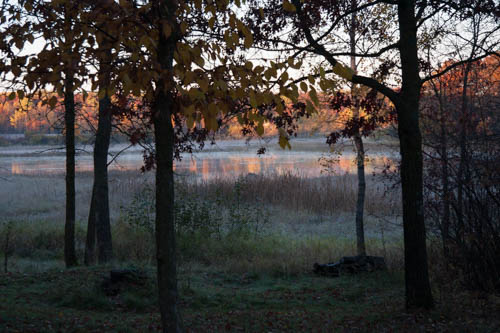
The marsh in northern Minnesota
Ralph Waldo Emerson’s essays offer the perfect complement to the sights and sounds of the marsh at dawn. Like his contemporary Henry David Thoreau, Emerson expressed a profound reverence for Nature. His eyes and ears were tuned differently. Emerson’s essay “Nature” helps interpret my experience by the marsh here in northern Minnesota. It provides spiritual context to the breaking of the day.
He who knows the most, he who knows what sweets and virtues are in the ground, the waters, the plants, the heavens, and how to come at these enchantments, is the rich and royal man. Only as far as the masters of the world have called in nature to their aid, can they reach the height of magnificence. This is the meaning of their hanging-gardens, villas, garden-houses, islands, parks, and preserves, to back their faulty personality with these strong accessories.
Like Thoreau writing at Walden Pond, Emerson invites the common man and woman to rouse from our confusion of wealth with royalty. Emerson wrote, “When the rich tax the poor with servility and obsequiousness, they should consider the effect of men reputed to be the possessors of nature, on imaginative minds. Ah! If the rich were rich as the poor fancy riches!”
The public mind does a very strange thing. While despising the one percent who disdain the poor and steal the worker’s wages, something in us aspires to be among them. We envy their Mara-Largo’s and penthouses. We want to be the ones who hire and fire. Emerson stripped away the illusion that the rich are truly rich.
Yet, despite his praise of Nature, Emerson continued to believe that we humans stand atop Nature’s pyramid as the exceptional species. In this time of climate departure, I part ways with him and turn more toward Thoreau.
Thoreau gets closer to how I feel at the Walden Pond-like site next to the wetland. I’m glad to get away awhile to be among the trumpeter swans, wood ducks, loons, hooded mergansers, great blue herons, and redwing blackbirds.
I love Nature partly because she is not man, but a retreat from him. None of his institutions control or pervade her. There a different kind of right prevails. In her midst I can be glad with an entire gladness. If this world were all man, I could not stretch myself, I should lose all hope. He is constraint, she is freedom to me. He makes me wish for another world. She makes me content with this.
Narcissus has no place here. No “faulty personality” but my own. The trumpets are the swans’. I think I just saw a daffodil bloom where Narcissus once knelt! “[Nature] makes me content.”

- Gordon C. Stewart, Chaska, MN, May 30, 2018
 The dead are unable to see the American flags posted at their graves or hear the sobering “Taps” that honors their sacrifice. Nor can they see the other flag that has taken its place on the flag pole where Old Glory once waved on Memorial Day. They didn’t die for this.
 On Mothers Day 2018, “60 Minutes” featured an interview with the film-maker of “A Man of His Word,” the new documentary on Pope Francis in which Pope Francis speaks boldly about Mother Earth, the mother of all life.

 The whole time in the park his mouth never cracked a smile, it never even opened. It stayed solemn, determined, right in the center of his gaze. The only animation of this whole experience was when he decided the leather molded baby-swing he had been lowered into, which he accepted initially, was really not that much fun after all—way too far away from mommy. Right after that, though he was ok to be seated in the big molded chair hung onto an overhead glider-thing (new high tech park!), because he could see mommy right in front of him.
 At the cabin next to the wetland we love quiet candle-lit evenings by the wood-burning stove. The candles are easy. We buy them. The wood for the fires is harder. We gather the logs and the kindling from the surrounding woods, drag them next to the deck, and break or cut them into pieces to fit the dimensions of the small wood stove. In a week or two, a friend and I will get out the chain saw to cut up large oaks that have fallen in the woods. But that will come later.
 Thou shalt not even think of using a chain saw, for in the day that you use it, you shall surely die!
 Views from the Edge