Think dogs don’t reason as we do? Think their reasoning is less precise? That they act only on instinct? Have no purpose of forethought? Think they can’t talk?
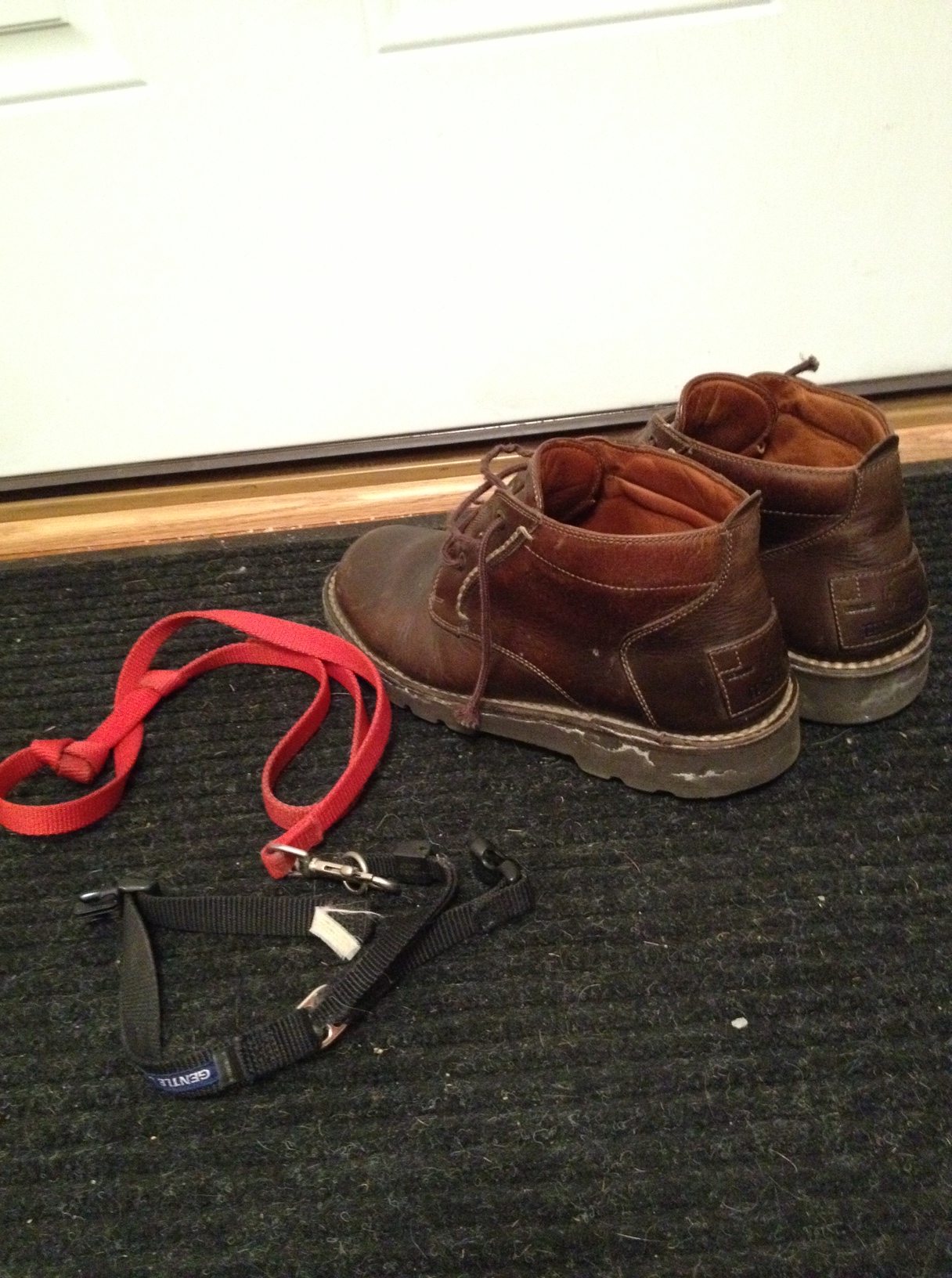
Consider the shoe by the front door.
The shoes belong to the “dog-owner” who has been upstairs blogging obsessively, ignoring his dog’s persistent pestering. Sebastian pawed, scratched his back feet on the carpet, and barked. At first the blogger ignored him and then chastened for interrupting the important message he was preparing to send into cyberspace.
Dog surrenders. Disappears for 10 minutes. Returns and quietly, without a word, jumps up to his customary place on the sofa in the blogger’s office.
Blogger completes his thoughtfully reasoned cyberspace communication and decides it’s time to take the little guy out. Blogger goes downstairs, takes off his slippers, puts on the left shoe next to the leash by the front door, and winces.
Sebastian has left a perfectly directed, perfectly contained puddle in the shoe. No evidence to the side of the shoe or the back or front of the shoe. All of the message is IN the shoe, nature striking back at cyberspace with the clearest of messages carefully delivered with forethought and drone-like precision:
The planned Martin Luther King Day program fell to shambles with a phone call at 4:00 p.m. yesterday afternoon. The Minneapolis African drummer and the Liberian Choir that was to sing “The Hallelujah Chorus” a capella would not be coming to the 7:00 p.m. MLK Celebration here in Chaska.
When the bad news came, I was apoplectic. “This can’t be. We’ve advertised this. People are coming to hear the drumming and the singing of this unusual choir. We can’t change this after we’ve done the PR. We’ve sent out electronic and Chaska Herald invitations to the community. We can’t disappoint these people like this.” I wanted to crawl under a rock. I wasn’t of a mind to remember or believe that sometimes…”God moves in a mysterious way his wonders to perform” (hymn by William Cowper, 1774).
After the momentary paralysis, Momoh Freeman, guest soloist and song-leader Jerry Steele, and Chaska resident Ray Pleasant quickly scrambled to put our heads together to scratch together an emergency game plan. The people who would come would be the choir – we would sing, and sing, and sing. There would be nothing to confuse as entertainment; instead there would be full participation…all the way from beginning to end. “What a concept!” I thought to myself. “That’s how it’s supposed to be. As the President had said in earlier in his Second Inaugural Address, ”It’s about we, the people.”
Jerry, a superb African-American soloist and song-leader, was magnificent. The collective voice of the people singing “Every time I feel the Spirit” filled the Chapel with joy. Strangers turned and welcomed each other easily with signs of warmth and kinship. Sections of the Sermon on the Mount that had inspired Dr. King were read. “You have heard that it was said, ‘You shall love your neighbor and hate your enemies’. But I say to you, Love your enemies, bless those who curse you, do good to those who hate you, and pray for those who despitefully use you and persecute you, that you may be children of your Father who is in heaven, for he makes his sun to rise on the evil and on the good, and sends the rain on the just and the unjust.”
A hush filled the room except for Jerry’s baritone voice, singing the song to which Martin Luther King, Jr. so often turned in tough times. “Precious Lord, take my hand, Lead me on, help me stand; I am tired, I am weak, I am worn; Through the storm, through the night, Lead me on to the light; Take my hand, precious Lord, lead me home.”
Chaska resident Ray Pleasant, a retired engineer and former MN State Representative and Bloomington City Councilman, shared the CD of African drumming he had quickly supplied for the ad hoc program.
The room was hushed by the rhythms of the drums, followed by Ray’s explanation of the central importance of drumming to African culture and the reminder that the drumming was once forbidden the African slaves.
Ray set the historical context of what later became known as “Letter from the Birmingham Jail”: Dr. King’s decision to march in Birmingham, refusing to put the need for fund-raising for the fledgling Civil Rights Movement and the Southern Christian Leadership Conference ahead of his conscience. Many of the white northern church pastors and the northern newspapers that had previously supported him rebuked him for his arrest, arguing that now was not the time, arguing that he should be law-abiding and patient. It was in that context of lonely exile in the Birmingham Jail that a young Martin Luther King, Jr. penned with courage “The Letter from the Birmingham Jail” that addressed his critics in ways that changed the world.
A brief portion of that letter fell on the ears of all of us – eyes closed so as to savor the words without distraction – and the once forbidden drums from the quickly fetched CD again filled the Chapel with African drumming and hope.
Three-time Mayor of the City of Chaska Bob Roepke and Carver County Commissioner Randy Maluchnik were invited to share brief excerpts from the speeches of Dr. King. Randy a personal moment of his visit to the MLK museum in Memphis, which is housed in the motel on whose balcony Dr. King was killed by an assassin’s rifle. Randy’s sharing, which had not been planned and could not have been anticipated, is but one example of the what happened in that room, movement of the Spirit of the Living God and the gift of something better than the lost plan that caused a distraught planner’s apoplexy just three hours before.
The voices of the 90 people who had left their couches on a freezing cold night echoed through the Chapel: “God down, Moses, way down to Egypt land. Tell ol’ Pharaoh, ‘Let my people go!'”; “Siyahamba” (“We are marking to the Light of God”), a movement song that had kept the light of hope burning on the way to the end of apartheid and the democratic election of Nelson Mandela as President of the Republic of South Africa; “Lift Every Voice and Sing,” the Black national anthem of poet James Weldon Johnson; and “We Shall Overcome”.
The evening ended with prayer for the safety and well-being of the newly inaugurated President, whose election would have been so joyfully celebrated by the man on whose shoulders he stands.
“God moves in a mysterious way his wonders to perform.” Thank you, precious Lord, and thank you Ray, Momoh, Jerry, Bob, Randy, and each and every one who came on a frigid Minnesota night to warm your spirits by the CD drumming of an indoor campfire.
It’s the eve of Martin King Day. This morning’s Star Tribune tells the story “Murderous ‘monster’ acquires an arsenal” in Carver County, Minnesota. Three cheers to you, Jim Olson, Carver County Sheriff. Thanks to the Star Tribune and other newspapers for keeping us informed.
The Oberender case exposes loopholes in national gun laws and Minnesota’s background checks. Here’s the link to the piece:
Today in worship we will look again at the call of Samuel and the call of Jesus’ first disciples who asked Jesus an odd question. “Where are you staying?” “Come and see,” he said. I wonder: Are there guns where Jesus lives?
Thanks to Robert Perschmann for bringing attention to this link, sent out as a New Year’s gift by The People’s World, the newspaper of the Communist Party USA.
Robert sent the link as a part of a comment on Views from the Edge’s post from “Every Valley” from Handel’s “Messiah”. I responded with the following reflection, slightly edited here.:
“Robert, the valleys and mountains, and the rough places a plain, or level place, are so clearly (biblical) metaphors for the coming of economic just. “He has put down the mighty from their thrones, and exalted those of low degree. He has filled the hungry with good things, and the rich he has sent empty away.” The hearer is transported into a vision and hope that can only be voiced and heard in poetry. It is the day of the lion and the lamb, the end of violence and sorrow, the end of the disparities of the sated and the sorrowful.
Josef Hromadka
“Josef Hromadka, Czech theologian and “father of Christian-Marxist Dialogue” during the Cold War, always said the church’s unfaithfulness to its calling was responsible for the atheism of communism. In Czarist Russia there were, on the one hand, the Czar and the Church, and, on the other, the peasants, the poor, the suffering who were oppressed by the throne and consigned to perpetual poverty by the church that taught them to be patient in their hope for another world. Hromadka called for the church to confess the sin of abandoning it charter and its hope. He saw in communism the re-awakening of the original grand hope for the coming of the Kingdom of God.
“Hromadka was a much-beloved professor of theology at Princeton Theological Seminary during the 30s and 40s. My father studied with him and remembered him fondly as a great teacher. When Hromadka left his secure teaching position in Princeton in 1947, many of his Western friends and colleagues were deeply disappointed and highly critical. They viewed him as naïve, a communist, or communist-sympathizer. Hromadka returned to create in Czechoslovakia and the wider Eastern bloc a dialogue that would contribute to the hope for a more humane and human society in both the church and the society..
“Thanks for the link. So interesting and rather mind-blowing that the newspaper of the Communist Party USA would choose Beethoven’s 9th as a New Year gift. I’ll listen with new ears.”
Princeton Theological Seminary Professor Charles West’s “Hromadka: Theologian of the Resurrection” offers an in-depth look at Hromadka’s life and witness as seen by a faculty colleague in the West. Here are some excerpts from the article:
Hromadka rejected both liberalism, with its shallow view (of the human crisis, and conservatism, with its allegiance to old structures which had lost their moral power. “We are living on the ruins of the old world, both morally and politically,” he concluded. “No one single element and norm of our civilization can possibly be taken for granted.”
With this faith which he continually translated into political judgments, Hromadka made the choice to return to Czechoslovakia in 1947, to accept the Communist coup d’etat in 1948, and to work as a Christian within the framework of a Marxist-dominated socialist society.
“I am in no sense a Communist,” he wrote, “but I take part in this revolution from the point of view of my Christian faith which sees the work of the forgiving grace of God in the midst of changes that are coming about.”
Thanks for coming by Views from the Edge. Leave a comment to promote discussion.




 Views from the Edge