
A Tribute to Hope

In memory of Abigail Salyers
B.A, Math, 1963; PhD, Nuclear Physics, 1969.
(An Acrostic)

All A’s were on her report card,
But because she was pregnant she
Is told in 1959
Graduation will not be
Allowed. But her English teacher
Is on her side and fights to see
Learning will continue for her.

She stays in school. Mrs. Baker
Also helps her go to college
Late though it is in pregnancy.
Yes, she works, keeps her baby,
Even gets Phi Beta Kappa,
Receives “Honors” on her degree.
Serves others as a Professor.

– Steve Shoemaker, Urbana, IL, November 10, 2013

Abigail Salyers Obituary

Abigail A. Salyers died at 11:56 PM in Urbana, Illinois, Wednesday, November 6, 2013 at the age of 70. She was known worldwide as a research scientist, author and professor at the University of Illinois, Urbana-Champaign. Abigail attracted students from all over Illinois and the world. They appreciated her mastery of science, her intellect, her skills as a lecturer, mentor, and her unique sense of humor.

Abigail was born on December 24, 1942 in Louisville, KY to Robert K. and Loretta S. Salyers. Survivors include her life partner Jeffrey F. Gardner of Champaign, IL; a daughter Georgia E. Will of Seal Beach, CA; a brother Robert K. Salyers, of Louisville, KY; and sister Martha J. Salyers, of Ashville, NC.

Abigail began at Illinois in 1978 after an undergraduate degree in Mathematics (Phi Beta Kappa) in 1963 and a PhD in Nuclear Physics in1969 from George Washington University, Washington, D.C. After four years of teaching, research and tenure at St. Mary’s College in Maryland she switched fields by taking courses in Biochemistry and Microbiology and secured a second post-doctorate position in Biochemistry and Microbiology from Virginia Polytechnical Institute. She studied, taught and did research at VPI from 1973 to 1978.

She became the first female tenured professor in Microbiology at Illinois in 1983 and a full professor in 1988. While at Illinois, Abigail was named a University Scholar, Faculty Member of the Year in the College of Medicine, a member of the Center for Advanced Study and an Affiliate in the Institute for Genomic Biology. She received the Pasteur Award for Research and Teaching, the All-Campus Award for Excellence in Teaching in the University of Illinois Medical School and the Golden Apple Award for Medical School Teaching three times. She was named the G. William Arends Professor in Molecular and Cellular Biology from 2004 until she retired in 2012.

Among the books she authored are Bacterial Pathogenesis: A Molecular Approach, (by A. A. Salyers and Dixie Witt) first published in 1994 and now in its Third Edition. Bacterial Resistance to Antimicrobials, (by A.A. Salyers and co-authors) first published in 2002 and is now in its Second Edition. Revenge of the Microbes, (by A.A. Salyers and D. Witt) was published by 2005. It was a popular treatment of the latest scientific information in the fields of microbial pathegenesis and antibiotic resistance. It was intended for a broad audience.

Abigail was assisted in her research and publications by Research Associates Nadja B. Shoemaker, Gui Wang and over 30 Graduate Students working on their Ph.D.s and Masters Degrees in Microbiology at Illinois. Her 5 books, over 200 peer-reviewed research articles, reviews and chapters in books edited by others, were read by fellow microbiologists and biochemists everywhere. Her papers were cited widely (received over 600 citations) by other scientists.

Abigail was President of the 40,000 member American Society for Microbiology in 2001-2002. Her research was supported by the Department of Energy and the National Institutes of Health. In recognition of her standing in the scientific community she served several terms as a member of National Institutes of Health panels that reviewed research grants. She was awarded an an honorary Doctorate from ETH University in Zurich, Switzerland in 2001. One of Abigail’s main interests was the diversity of microorganisms on the planet. She was Co-Director of the Microbial Diversity Summer Course at the Marine Biological Laboratory in Woods Hole, MA for the Summers of 1995-1999. Abigail and her co-director, Ed Ledbetter, modernized the course. The course was extremely popular and attracted graduate students and even university faculty members with a wide range of backgrounds from all over the world. Students performed field work to enrich for and isolate a diverse array of microorganisms. They also used state of the art laboratory technology to study the biochemistry and genetics of the microorganisms isolated from the field.

Abigail was a committed teacher and taught classes in both Liberal Arts and Sciences and in the Medical School at the University of Illinois. She was awarded the 2009 National Graduate Teacher Award in Microbiology. She was also committed educating the public. For example she met with local postal workers to educate them about risks of anthrax during the alarm in 2001.

When asked about her own most influential teacher in an interview at an ASM meeting, Abigail surprised her radio questioner by saying it was a Wakefield High School (Arlington, Va.) English teacher. Mrs. Baker kept Abigail from being kicked out of school for being pregnant and helped her get into college. At that time, pregnant teenage girls were not often accepted by college administrators.

Memorials may be directed to the Development Office at the Marine Biological Laboratory, 7 MBL Street, Woods Hole, MA 02543 to establish an endowed lectureship or student scholarship for the Microbial Diversity Course in her name.

Sermon on Courage, Work, and Assurance

The school bus driver

The white cane moving back and forth in front of him belongs to seven-year-old Sam. The little guy moves cautiously, as the blind must do, hand-in-hand with a young woman I presume to be his mother, on his way into the Artist’s Reception.

Many of the people here on this Friday night are school bus drivers for District 112 School District. I’m wondering if perhaps Sam’s mother is a school bus driver.

Turns out that the featured artist, John Lince-Hopkins, is Sam’s school bus driver. John has invited Sam to see “Morning has broken: a Celebration of Light”, the collection of oil painting that now hangs on the walls of the Gathering Space at Shepherd of the Hill Presbyterian Church in Chaska where I serve as pastor.

It’s an evening of revelation about a very special group of people who know their passengers by name, quietly welcome each child every morning, say good-bye to them in the afternoon, and watch to be sure that children like Sam with his white cane make it safely across the street no matter what dark clouds may cross their paths that day on their slow, daily journey toward adulthood.

Most of my teachers’ names are long forgotten. But I remember my school bus driver. Why we called Mr. Thompson “Tommy” is a sign of the time in which I grew up when, sadly, school bus drivers did not command the respect that lawyers and doctors do. “Good morning, Gordon.” “Good morning, Mr. Thompson.” All these years later Mr. Thompson stands out in my memory. Bus drivers are special people. Perhaps because they call no attention to themselves, they stand out in our memories as signs of light.

John welcomes Sam in that special way some bus drivers have. “Would you like to see a painting?”

John, whose art has sold for thousands of dollars in Texas, Alaska, New Mexico, Wisconsin, and Minnesota, is inviting Sam to do what most landscape artists most dread. He’s inviting Sam to touch his paintings, to “see” the only way Sam can: by touch.

Lifted high so he can touch the oils of the cloud formations and the light of “Morning Has Broken: a Celebration of Light” Sam reaches out his hand. Very carefully he runs his fingers over the dry paint that allows him to see the light and contours of the clouds and landscapes of his bus driver’s paintings, more raptly attentive to the art than those of us who presume to see what we are viewing.

On this night John’s art is a bus ride into the light of morning breaking into the darkness of night. A seven-year-old boy named Sam, whose eyes have never seen light, gets to touch it for himself.

Morning has broken like the first morning, blackbird has spoken like the first bird. Praise for the singing! Praise for the morning! Praise for them, springing, fresh from the Word!”

Boy gets a life Lesson on Halloween

Small boy dressed as Robin. I give him candy and he says “I don’t like that. I want the M&Ms in the bowl.” I say, “I already gave you candy”. He says, with more belligerence, “I want the M&Ms”. I say, “Take what you got kid. You can’t always get what you want. How’s that for a life lesson?” Diane bans me from handing out anymore candy.

– Mark Wendorf, Sanford, ME, friend and colleague with a great sense of humor. Diane is Mark’s spouse.

The Waiting Room

The voices of the visitors
would drop when they entered
the almost empty anteroom
and stood before the blond wood door
of her positive pressure room.

The air could exit but could not
bring more bad bugs into her lungs
immuno-compromised by stays
in this or other hospitals.

Her breathing stopped on the 4th night
as cancer squeezed another last
breath from exhausted failing lungs.
The empty room keeps breathing out.

[Abigail A. Salyers, 12/24/42–11/6/13, received a Ph. D. in nuclear physics from George Washington University, later did Post-Doctoral studies in Microbiology in Virginia & was the first female tenured Professor in the microbiology department at the Univ. of Illinois. She was elected President of the 40,000 member American Society for Microbiology for 2001-2. She was the author of several books & hundreds of professional articles in her field.]

– Steve Shoemaker, Urbana, IL, November 7, 2013

Verse – The Cancer Joke

She knew cancer
better than almost
anyone else
in the hospital.
Although not an MD,
she had taught
in the Med School
while doing research
and writing books
and using her Ph. D.
to produce others.

Cancer Society money
had come to her lab
of busy bees for years.
She sat on panels
of judges that chose
who would study which
type of the deadly C.

Now the crooked cells
that had begun in her throat
had caused spots, as they say,
on her lungs and heart
and in her bones.

As a pastor married to the lab
headed by this agnostic,
I knew how to visit
folks given the death sentence:
listen, touch an arm, a shoulder,
remember good times together.

She wanted to tell me a joke.
I leaned close to hear the raspy voice
above the hissing oxygen.
“A microbiologist’s joke
is only one millionth as funny
as a regular joke.”

She raised a needle-filled hand
to touch my worried brow
bowed over her dry grinning lips.

-Steve Shoemaker, Urbana, IL, November 5, 2013

Editor’s Note: Steve was “married to the lab” at the University of Illinois through one of its research scientists, his wife, Nadja.

National Health Care

health_care_reformMuch of the fuss over The Patience Protection and Affordable Care Act (“Obamacare”) could have been avoided by a genuine national health care system. The insurance industry is still running the show and doing very well by it. The debacle is NOT about national health care. It’s over a hybrid.

Real national health care is an expression of democracy (“government of, by, and for the people” – ALL the people), not its enemy. Built on the foundation of the old private insurance company system, The Patient Protection and Affordable Care Act was destined from its inception to be a mess.

Do I hear a “Yes!”? A “No!”? A yawn?

After the Joyful Concert

Post Concert Animal Triste

Sixty of us sang
under one baton
spirituals and folk
songs to SRO
crowd of friends and fans
standing clapping some
shouting AMEN when
soloist filled church
with his ringing sound

Now the silence rings
through the empty space
in between my ears
early the next day
snatches of the songs
come and go glow then
fade finally bring
ashes to my tongue

never again sing

[Post coitum omni animal triste est–after sex all animals are sad] Steve Shoemaker
Urbana, IL, November 4, 2013

Verse – Late October Rain

Later it would not be grey,
dismal, lukewarm, fall in waves.
Now it soaks the fallen leaves,
mutes their colors, strips the tree.

Clouds and fog…is fog a cloud
held close to the ground by grief
at the loss of summer? Half
harvest completed, work stalled.

City street lights dim above
stay on in the daynight gloom.
Windshield wipers swipe the storm.
There is nothing here to love.

– A cheerful verse 🙂 by Steve Shoemaker, Urbana, IL, October 31, 2013.

Communio Sanctorum

As a boy I thought of All Saints Day and the Communio Sanctorum, the Communion of Saints, the way I felt about Halloween. It was spooky.

Today it’s no longer spooky. I’m thinking about all the people who have touched my life along the way. Few of them are saints in the sense our culture has come to understand the word, but they were all saints in my book. The extraordinary thing about saints is that they know they are not extraordinary. They refuse to believe they are exceptional.

The people I’m remembering drew little attention to themselves, for the most part. Some of them, like Uncle Dick Lewis, who was an uncle not by blood but by affection only, were people of few words. Uncle Dick stood under the maple tree every Sunday morning waiting for our weekly routine: nothing more than a handshake, the strength of which tested and honored my growing toward manhood. The handshake is the only speech I remember. During the week Uncle Dick’s hands painted houses. On Sunday morning he clasped his hands together after painting a boy into a man under the maple tree.

The place where I grew up was a working class community with a working class church. Its members were house painters, plumbers, carpenters, and bus drivers with a few middle management people sprinkled in, and one generous rich man named George. George and Phoebe always sat in the front row.

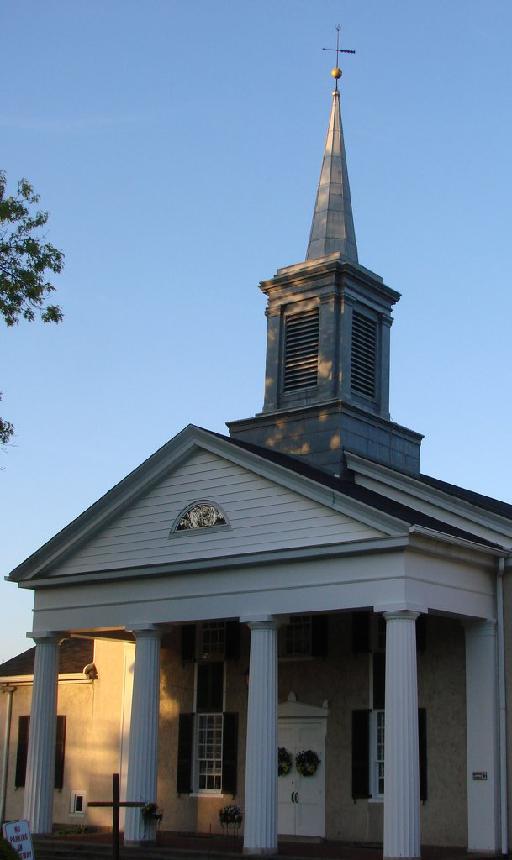
Marple Presbyterian Church, Broomall, PA

Marple Presbyterian Church, Broomall, PA

George decided one day to donate a stained glass window. Although much of the money for the new building had come from George, a stained glass window was inappropriate for Colonial architecture. The church board, with some fear and trepidation, refused the proposed gift. George left the church in a huff. He moved his and Phoebe’s membership to the wealthy church in Bryn Mawr, leaving the carpenters, plumbers, and bus drivers with a clear message: “Good luck. You won’t have George to kick around any more! You’re on your own.”

Karl Marx observed that the rich will do anything for the poor but get off their backs, and that the ruling ideas of any society are the ideas of its ruling class. After George left, they didn’t love Karl, the man everyone at Marple loved to hate, any less than before, but they re-discovered the Beatitudes of Jesus: “Blessed are you poor. Blessed are the meek. Blessed are you who mourn.” Blessed are the peacemakers.”

George was always kind to me in a distant kind of way. He got a chuckle watching the mischievous tow-head preacher’s kid break the rules he didn’t dare break. My only pictures from childhood were taken by Phoebe’s camera. I still see George in his three-piece suit with a big cigar, looking like a statue of William Randolph Hearst, the newspaper magnate – not quite that rich, but likely every bit as lonely before and after the church refused his stained glass window.

Approaching All Saints’ Day this year, I see them all compacted, you might say, into a single communion, the communion of the dead who have left behind every illusion that they were exceptional to the common lot of humankind. I see them gathered again at Marple Church, but gathered differently: George in Uncle Dick’s painter’s coveralls and Uncle Dick dressed in George’s three piece suit smoking George’s Cuban cigar, and Phoebe still taking her snapshots of a community now repaired by the common threads of love and death, dragged kicking and screaming into the Communion of Saints that knows no exceptions.