Limerick on Heinlein’s Razor

My first thought was that he was horrid.
The language he used was quite florid.
Perhaps he was mean
or not very keen–
is it wrong just to say he was stupid?

Steve Shoemaker’s limerickized version of Heinlein’s razor (sometimes called Hanlon’s razor): “Never attribute to malice that which can be adequately explained by stupidity.”

God the Stranger

I “know” less and less of what I thought I knew. The world has driven me into the unknowing silence out of which James A. Whyte spoke at the funeral in Lockerbie, Scotland in 1989.

During his term as Moderator of the Church of Scotland, The Right Rev. Dr. Professor James A. Whyte , still grieving the death of his wife, was called upon to lead the memorial service after Pan Am Flight 103 was blown out of the sky over Lockerbie. Among the most quoted parts of the sermon is this excerpt:

“That such carnage of the young and of the innocent should have been willed by men in cold and calculated evil, is horror upon horror. What is our response to that?

The desire, the determination, that those who did this should be detected and, if possible, brought to justice, is natural and is right. The uncovering of the truth will not be easy, and evidence that would stand up in a court of law may be hard to obtain.

Justice is one thing. But already one hears in the media the word ‘retaliation’. As far as I know, no responsible politician has used that word, and I hope none ever will, except to disown it. For that way lies the endless cycle of violence upon violence, horror upon horror. And we may be tempted, indeed urged by some, to flex our muscles in response, to show that we are men. To show that we are what? To show that we are prepared to let more young and more innocent die, to let more rescue workers labour in more wreckage to find the grisly proof, not of our virility, but of our inhumanity. That is what retaliation means.”

For James Whyte God is often silent. We are called to enter the space of God’s silence, the silence of the cross, the confusion and horror of the suffering of God at the hands of a world filled with man-made gods: security, freedom, nationalism, religion, muscle, revenge and self-righteousness, cultural supremacy. In the Jesus of the cross, Whyte’s eyes saw not only a naked man but God’s nakedness – a naked God stripped of all power, his arms roped to a cross-beam paradoxically spread wide to embrace the whole world of human suffering and folly.

James Whyte took time out of his busy life in 1991 to act as a conversation partner and mentor for an American pastor whose congregation had granted its pastor a sabbatical leave in St. Andrews. They met twice weekly for two months in his flat over tea and scones, the young American absorbed in the vexations of Christian claims to Christ’s uniqueness and universality, on the one hand, and religious pluralism, on the other, the good Right Rev. Dr. Professor listening attentively, maintaining a poignant silence that respected his mentee’s process. When the pastor left Scotland, he asked his mentor for a copy of prayers James Whyte had offered during worship at the Hope Park Church in St. Andrews. Each of the prayers was as thing of beauty. Each began with a quotation from the Book of Psalms.

James Whyte’s spirituality echoes that of an old Hasidic Rabbi (Barukh of Medzebozh [1757-1811]) reflecting on Psalm 119.

“I live as an alien in the land;
do not hide your commandments from me”
– Psalm 119:19

Rabbi Barukh of Medzebozh said of this psalm:

“The one who life drives into exile and who comes to an alien land has nothing in common with the people there and has no one to talk to. But if a second stranger appears, even though that person may come from quite a different place, the two can confide in each other. And had they not both been strangers, they would never have known such a close relationship. That is what the psalmist means: ‘You, even as I, are a sojourner on earth and have no abiding place for your glory. So do not withdraw from me, but reveal your commandments, that I may become your friend.”
– Martin Buber, <a href="http://www.amazon.com/Tales-Hasidim-Early-Masters-Later/dp/0805209956(

” title=”Link to information on Tales of the Hassidim”>Tales of Hassidim – the Early Masters.

Thanks you, James Whyte, good and faithful servant and friend of God the Stranger. RIP.

The Countertenor’s Magnificat

Christopher Holman, Countertenor

strong>” A Blessing for Both”

He sings with flutes about the homeless poor
invited to the table of the rich
by God, by God! They eat their fill and more,
and not like dogs that lift their jaws and catch
the scraps, but guests with vintage wine
to match each course made by the Chef.
He sings
about the rich evicted from their fine
designer homes by God, by God! With rings
that flash and fancy shirts, they leave
their table before food is served! Instead
of feasting, they are empty and will have
no need for trainers, purging, before bed…

(Tonight, Sunday, December 15, 2013 A. D.,
at Holy Cross Catholic Church
In Champaign, Illinois, this ironic aria
will be sung as part of J. S. Bach’s
” Magnificat”– Mary’s song. Directed
by Chester Alwes.)

– Steve Shoemaker, Urbana, IL, December 14, 2013

Christopher Holman, Countertenor

Christopher Holman, Countertenor

Editor’s Note: Christopher Holman is an American organist, countertenor, and choral conductor, currently residing and studying in Urbana-Champaign at the University of Illinois, whose primary interests lie in the realm of historically-informed performance.

In Honor of Newtown, Nickel Mines, and Nelson Mandela

The Palsied Man and Us

The family and friends of Susan Telander (b6.25.1947 – d.11.30.2013) gathered for her funeral at Shepherd of the Hill Church in Chaska. In her last days under hospice care in the memory care unit I had taken Barclay, the six-month old Cavalier King Charles Spaniel, on one of the visits. Susan loved dogs. Barclay licked her face. Susan’s face glowed with the joy of it, forgetting for a moment that she could not remember. Here is the homily shared with the congregation at her funeral.

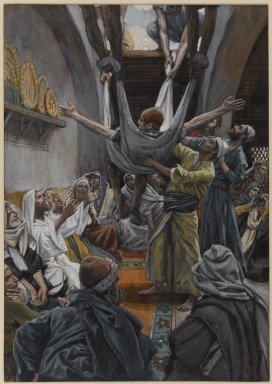
Thinking about Susan, both in the midst of her life in her strength and at the end of her life in her weakness, I couldn’t help but think of the story of the man who whose friends lowered him through the roof for healing (Luke 5:17-26).

"The palsied man let down through the roof" - James Tisot

“The palsied man let down through the roof” – James Tisot

The man was paralyzed, as each of us is, each in his or her own way. Not quite ourselves, not quite able to walk through life as fully as we might or as we ought. Burdened by some memory, some history, some bodily infirmity, some circumstance beyond our control, or of our own making. In that sense each of us is the person in the story who was lowered through the roof to Jesus.

Susan played two parts in this ongoing story of the Christian life.

In her strength she reached out to others when they needed her. She helped them. Like the “friends” of the paralytic in the Jesus story, she helped to lift others up to onto the stretcher. Then she navigated the stairs that ran up the side of the house, a treacherous feat on narrow steps with no siding, no banister, the steps that were necessary to climb in order to get up to the roof. Managing, with great care, to carry her charges up those stairs, she used her own hands to dig a hole in the roof to lower someone else into the presence of the Healer.

Susan kept the faith. She was a carrier of those less fortunate than herself, changing their diapers, rocking them in a rocking chair, coming to the rescue when a friend had died and her children needed someone to care for them in her home. ….

If Susan was a rescuer who took people and animals into her home during her years of strength, she also had come to know what it is to be on the stretcher, at the mercy of others. Her children, her friends, the people of this church who brought her to worship, who visited her at Auburn, who sang to her and the other residents of the Memory Care Center, the marvelous staff at Auburn who did for Susan what she had once done for her own children and for the other children who had fallen to her care, and the Deacons and others who took turns sitting with Susan in her last days so that she would not be alone.

They all carried Susan up the stairs and dug a hole through the roof with their bare hands until they lowered her down every so gently into the arms of her Lord.

During the days when she was being lowered through that roof, she relaxed when we would pray. “The Lord is my shepherd, I shall not want….” “Our Father who art in heaven, hallowed be Thy Name, Thy kingdom come on earth as it is in heaven. Give us this day our daily bread. Forgive us our debts as we forgive our debtors, and lead us not into temptation, but deliver us from evil, for Thine is the kingdom, and the power, and glory forever.”

Her eyes would close. Her face relaxed. He body at ease. Her trust intact. Her faith still strong. She kept the faith.

Her eyes are closed now. She is at rest in the peace of her Lord. For those of us whose days and years remain awhile, let the traditional graveside prayer be ours:

“O Lord, support us all the day long, until the shadows lengthen, and the fever of life is over, and the busy world is hushed and our work is done. Then, in Your mercy, grant us a safe lodging, a holy rest, and peace at the last.”

-Rev. Gordon C. Stewart

Verses – Peter Michalove

Two Acrostics

Peter, like many Arts Ph. D.s,
Entered the work-force, but could not find
The right music composition place.
Earning money for his brand new bride
Required taking a job at the school.

Music would be heard for 30 years
Instead of written. But then a real
Creative time in retirement days.
He wrote music, heard it played, but when
Aggressive cancer hit him he had
Little strength left to compose. The pain
Overcame the music in his head.
Valiantly he taught others to hear,
Even laughing, having music near.

— — — —

Perhaps it was hallucination,
Even a vision, but a guy named
Tom showed up the last hours the patient
Endured the cancer. Ghostly Tom claimed
Right after death we all will get a preview

Making clear what the afterlife will be.
If people wish, they enter in–but few do
Choose that life, “Been there, done that!” they say.
How can more years, even if pain-free
Atone for dying young and leaving
Loved ones, music, teaching, history
Of stamps… The time would be spent grieving.
Very plain spoken always, he said:
Everlasting sleep I choose instead.

– Steve Shoemaker, Urbana, IL, December 12, 2013

Dr. Peter Michalove, who died last week, was a career Business Manager for several academic departments at the University of Illinois, where he had received his Doctorate of Musical Arts in composition.

In retirement, music he wrote was played and appreciated (see “Peter Michalove” on YouTube).

Chemotherapy fatigue eventually made writing music impossible, but Peter taught music classes to other retirees at the University, to enthusiastic applause. He has written about music and cancer: http://petermichalovecomposer.com

John the Baptist, Jesus, and Mandela

Preached the Sunday after the death of Nelson Mandela, this sermon sought to tie together the first anniversary of the tragedy of Sandy Hook in Newtown, CT (December 15) and the date of Reconciliation Day in post-Apartheid South Africa (December 16), the date in 1977 when Nelson Mandela marked a quote from Shakespeare’s Julius Caesar in what became known as The Robbins Bible, a complete works of Shakespeare that had been smuggled into the Robbins Prison by an Indian inmate.

Two plus four

…… 2 + 4 =

Laughter and giggling,
Crying, hair-pulling,
Yelling, “That’s not fair!”
Snuggles and duets.

Two runny noses
Wobbly first steps
Sibling jealousy
Sibling loyalty

Car seats and strollers,
Diapers and powder,
Cribs and big-girl-beds,
Two shoes but lost socks,

Exhausted parents,
Yelling in restaurants,
Rich baby-sitters,
No baby this year.

-Steve Shoemaker, Urbana, IL, December 11, 2013

There Is a Longing in Our Hearts

A sermon delivered at Shepherd of the Hill Presbyterian Church in Chaska, Minnesota.

Verse – Stimulus and Response

eight adults were at the party
all were sharing air and stories
three were couples two were singles
married folks heard few surprises
tales were old though some were funny

one would listen as their partner
heard a second use a keyword
and would know the family legend
for the thousandth time told retold
the same pauses the same laughter

the same pride that in our family
there was such an odd character

– Steve Shoemaker, Urbana, IL, December 7, 2013