Victoria’s Secret Angels

All the reports say people
who see real Angels fear them.
They blaze in glory from bringing
their message from the Holy One.
There are no descriptions
of high heels or underwear.

Steve Shoemaker, Urbana, IL, Dec. 9, 2014

EDITOR’S REFLECTION

Readers unfamiliar with Jewish and Christian Scripture may not have heard of Isaiah’s vision in the Temple (Isaiah 6:1-8) that begins his work to reform his nation:

In the year that King Uzziah died I saw the Lord [“the Holy One] sitting upon a throne, high and lifted up; and the train of his robe filled the temple. Above him stood the seraphim [“angels”]. Each had six wings: with two he covered his face, and with two he covered his feet, and with two he flew.  And one called to another and said:

“Holy, holy, holy is the Lord of hosts;
vthe whole earth is full of his glory!

And the foundations of the thresholds shook at the voice of him who called, and the house was filled with smoke. And I said:

“Woe is me! For I am lost; for I am a man of unclean lips, and I dwell in the midst of a people of unclean lips; for my eyes have seen the King, the Lord of hosts!”

Then one of the seraphim flew to me, having in his hand a burning coal that he had taken with tongs from the altar. And he touched my mouth and said: “Behold, this has touched your lips; your guilt is taken away, and your sin atoned for.”

And I heard the voice of the Lord saying, “Whom shall I send, and who will go for us?” Then I said, “Here I am! Send me.”

Good News and Hard News – Nature and Capitalism

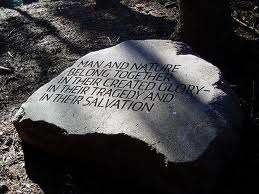
Paul Tillich quote in Tillich Park, New Harmony, IN: "Man and nature belong together in their created glory - in their tragedy and in their salvation."

Paul Tillich quote in Tillich Park, New Harmony, IN: “Man and nature belong together in their created glory – in their tragedy and in their salvation.”

A spiritual reflection for the Second Sunday of Advent, December 7, 2014.

The beginning of the GOOD news is HARD news, according to John the Baptist, calling people out into the wilderness. “We must change,” he said.  “Repent” by which the Judeo-Christian tradition means a 180 degree turn. “About face!” Only by turning will we be delivered from the consequences of the actions that have led us here.

For John the Baptist and the writer of the Gospel of Mark’s opening paragraph (Mark 1:1-8) the system at issue was Roman imperialism, an economic system centered in Rome, expanding out, and enforced by, military invasions, subjugation, religious tolerance (so long as the religious practice did not interfere with Roman prerogatives) and occupation.

One could repeat the sentence in 2014 with little change: “the system at issue [is [American] imperialism, an economic system centered in [Washington] expanding out, and enforced by, military invasions, subjugation, religious tolerance (so long as the local religious practice [does] not interfere with [American] prerogatives) and occupation.”

It is our spiritual, moral, economic, cultural and political captivity to a global system that cannot satisfy our real needs or the world’s that produces a longing in our hearts, a readiness to make the lonely trip to the wilderness.

We’re a weary people in 2014. Wearied and still disheartened 11 years after the “Shock and Awe” that took down Saddam Hussein on the pretense that he had weapons of mass destruction (WMDs) that threatened us, the Administration’s manufactured association of Saddam Hussein as the cause of 9/11. We’re wearied of lies and misrepresentations. Weary from budget fights that barely reference 10 years of un-budgeted military expenses, the loss of thousands of American soldiers’ lives and as many as 100,000 Iraqi civilians, a military venture undertaken on the assumption that the Iraqi people would welcome our presence as the beginning of democracy and a “free market” economy that would lift them all up.

That belief in the goodness of American intentions hit the rocks as quickly as Saddam’s statue hit the pavement in Baghdad. All the while we were wearied by the earlier invasion of Afghanistan, whose original justification was a quick elimination Osama bin Ladin and Al-Qaida untempered by realistic knowledge of the long history of the military interventions that mired the invaders in quagmires such as the Soviet Union found itself before leaving in defeat. To the Afghans it didn’t matter whether the troops were Soviet or American. They were the same. They were the occupation forces of an imperial power destined to fail.

In the midst of the weariness about what was happening abroad, the financial system at home took the American economy to the brink of disaster in 2008. Occupy Wall Street rose to the top of the news cycles. Although the movement fizzled over time, as such movements inevitably do, it caught the attention of television viewers, internet surfers, and newspaper and magazine readers. Occupy Wall Street and the spot light it placed on “crony capitalism” became a hot topic around water coolers at work and the table in the coffee shops.

For the first time in recent memory, capitalism was no longer sacred, no longer off limits. Time’s front cover asked the question whether Capitalism was dead. But, as with Occupy, public attention is short-lived. Amnesia sets in when people are weary. How soon we forget…until some new John the Baptist issues the cry for a 180 degree turn for the sake of something better.

Maybe Naomi Klein is edition of John the Baptist. This Changes Everything: Capitalism vs. the Climate, reviewed by the New York Times – places the over-riding systemic issue squarely before the general public again. Senator Bernie Sanders, America’s only socialist Senator who names climate action as among his four top priorities, is gaining attention as a possible presidential candidate. Elizabeth Warren, the Senate’s bulldog on holding Wall Street accountable is creating a wave of populist momentum. Put them with Bill McKibbon and 350.org and you begin to hear the echo of John’s all to the hard truth that is the beginning of the good news.

The hard truth that precedes good news is the discovery of the myth that has coupled democracy with capitalism in the American psyche, while demonizing socialism as democracy’s opposite. Ideological blinders are to nations and peoples what blinders are to horses on a race track: they limit vision to the straight-ahead narrow limits of the track. Ideological blinders prevent the owners’ horses from thoughts of anything but the track on which they’ve been placed to race each other.

But when the climate is changing our track in ways that compel our attention, and when we ask how we will make it through the changes together, the bigger question of the economic system – the race track itself – comes into view by virtue of necessity. It calls us off the track into the wilderness of Nature.

The words ‘economy’ and ‘economics’ derive from the Greek words for ‘house’ and ‘the management of the household’.  Economics not about markets, free or otherwise, or about the technicians and pundits who monitor investments and predict quarterly outcomes. It is not an academic discipline, the exclusive province of experts on Wall Street or in university Economics departments who understand how the free market works.

Economics is a spiritual perspective like the one on Paul Tillich’s marker in Tillich Park in New Harmony, Indiana. “Man and nature,” he said, “belong together in their created glory – in their tragedy and in their salvation.” There is no humanity with nature; the human calling of our time is to reshape our lives for the wellbeing of the one house in which all life lives.

During this Advent season of longing expectation, John the Baptist with his axe aimed at the root of the tree reminds us that economics is the spiritual issue of the first order. The good news is what the Hebrew Bible calls “the Day of the Lord” and John the Baptist and Jesus of Nazareth called “The Kingdom [i.e. Society] of God”. The hard news is we’ve been running on the wrong track, or, you might say, barking up the wrong tree.

The planet – this home we call “nature”, without which no person, society or form of life exists – is an economy that requires different management. The economy for which our hearts long is the one house imagined by the psalmist and announced by John in the wilderness beyond the Pax Romana: the good news awaiting our longing hearts to embrace it, a planetary home where “righteousness and peace will kiss each other” (Psalm 85:10) and wars will be no more.

The beginning of the GOOD news is HARD news. “Repent, for the kingdom of heaven is at hand.”

– Gordon C. Stewart, Chaska, MN, December 7, 2014

The Human Menagerie

The reference is to Carl Sandberg’s poem.

O, I got a zoo, I got a menagerie, inside my ribs, under my bony head, under my red-valve heart—and I got something else: it is a man-child heart, a woman-child heart: it is a father and mother and lover: it came from God-Knows-Where; it is going to God-Knows-Where—For I am the keeper of the zoo: I say yes and no: I sing and kill and work: I am a pal of the world: I came from the wilderness.

After 14 years of living at home,  my cousin Alan was institutionalized. His Cerebral Palsy had finally come to the point of seizures at all hours of the day and night.

For 14 years Alan’s bed was just outside the open door between his room and his parents, my Aunt Gertrude and Uncle Bob in South Paris, Maine. His mother slept with an ear open for any change in Alan’s breathing pattern. She had come to learn the breathing changes that preceded a seizure. She would hear the change and rush to Alan’s side.

Alan required round-the-clock care. The years when my Aunt and Uncle felt secure in leaving him alone for shopping or running an errand had now become a wistful memory. My cousin Gwen remembers that their mother could no longer go outside to hang the laundry without calling a neighbor to stay with Alan for 10 minutes. Alan’s care became the all-consuming center of family life to the neglect of Alan’s younger siblings, Dennis (11) and Gwen (7) and the deteriorating health of Uncle Bob and Aunt Gertrude.

In the 14 year of Alan’s life, when things had gone beyond the point where they could care for him adequately, they made the hardest decision of their lives. They admitted him to the Pownal State School and Training Center in New Gloucester, Maine where he spent the last five years of his life with other severely disabled residents. Members of the family made the hour-and-a-half trip to New Gloucester twice a week to be with Alan at Pineland. During those next five years Alan’s friends at Pineland became friends to the entire Smith family.

My cousin Dennis describes the scene at Pownal in words of his own:

These were children with Downs Syndrome, dwarfs of all kinds, microcephalics, hydrocephalics, people we used to call morons, idiots, and imbeciles, and non-ambulatory people like Alan. All of natures mistakes in one big room.

When my mother and I would do concerts for them, they would bring Alan in on a gurney. They would sway to and fro to the music trying to sing or moan to the melody. At first their responses raised the hackles on the back of my neck. It was like a scene out of a Hollywood movie.

Some of the residents assisted in Alan’s care. In his room they would talk to him like dear friends and Alan would respond to them with his familiar ‘ah’s and laughter. I grew to understand he was in his element there with constant attention by those he knew and trusted…. I’m convinced he died a happy, contented young man who was free at last to be himself. Just another human being surrounded with friends who loved him.

The human species itself is what Carl Sandburg said each one of its members is: a menagerie.  We are all in the menagerie, the most ‘abled’ and the least ‘abled’ of us. Every attempt to engineer a species without “mistakes” – a purified race, a super race, a genetically modified species – is a mistake doomed to fail. The wilderness always prevails.

Those who have met the zoo within themselves come to understand that we all come from the wilderness just outside the castle walls and moats of human pride and self-deception:

“…it [i.e., the zoo inside my ribs] came from God-Knows-Where; it is going to God-Knows-Where….I am a pal of the world: I came from the wilderness.”

Capitalism, Socialism, and the Earth

The online Oxford Dictionary defines democracy as “a system of government by the whole population or all the eligible members of a state, typically through elected representatives….”

But it immediately biases the discussion with the following sentence to illustrate the word democracy: “capitalism and democracy are ascendant in the third world.” That is, capitalism and democracy go together. Wherever capitalism goes, democracy goes. The ascend together as was imagined to be the case in the Arab Spring.

To the contrary, the online Oxford Dictionary defines capitalism as “an economic and political system in which a country’s trade and industry are controlled by private owners for profit, rather than by the state.”

The Oxford Dictionary identifies what we are coming to realize in America. We do not live in a democracy. We live under “the economic and political system in which a country’s trade and industry are controlled by private owners for profit rather than by the state.” Neither are they controlled by the people of the state, the body politic.

The presumed ideological kinship between capitalism and democracy has existed in America culture as long as most of us can remember. It wasn’t always so in the 1920s and ‘30s, but, as we are beginning to understand again by virtue of circumstance, democracy does not depend upon a capitalist economy. In fact, democracy and capitalism are contradictions in terms. They are philosophically incompatible.

The more natural kin of democracy is socialism, as defined by the online Oxford Dictionary: “A political and economic theory of social organization that advocates that the means of production, distribution, and exchange should be owned or regulated by the community as a whole.”

Democracy is the rule of the people, “a system of government by the whole population….” or, “the community as a whole.”

Finally in America an intelligent discussion is afoot about democratic rule and economics. Naomi Klein’s This Changes Everything: Capitalism vs. the Climate takes the discussion to a new level that views global capitalism as “the most profound threat humanity has ever faced: the war our economic model is waging against life on earth.”

Voices

NOTE: This e-mail was shared among friends from my wife Kay’s high school days. When asked how best to introduce her, Kathy replied, “just another person seeking to understand how to respond.”

“It’s so hard to make sense sometimes of all the voices, the messages, that break into a usual day.

“Downtown, I heard the sound of a ragtag bunch of demonstrators on the next block, chanting in one voice, ‘Hands up, don’t shoot’, in solidarity with protesters all around the country. I saw an armored police vehicle, moving quietly, on the next block, seemingly trying to get ahead of where the protesters would be coming next. There was no sound at all coming from the twelve or fifteen police who were mounted around the outside of the vehicle, like so many tin soldiers, with protective gear and plexiglas shields. If they were speaking, it wasn’t for us to hear. On the next block, at least two dozen police on bicycles were making their way up a crowded sidewalk; probably more in total than the group of protesters.

“Somewhat shaken, and wondering, as I often do, whether I belong out there with the marchers, and where is my place in the confusing discussion. What does my own voice need to say? I made my way back home. After all, there was no place to leave my car in our crowded downtown if I wanted to join the marchers. I was not “dressed” for a protest. I said to myself, “a walk in the park is what I need, even though it is getting dark. It’s not raining, and it’s mild and not windy”.

“As I walked up the slope around the corner from our house, I heard chanting again, this time happy voices. I couldn’t quite make out the words at first, but soon I realized it was three girls singing “Come on down to our holiday sale, our holiday sale, our holiday sale”. Of course, that group was much easier for me to join, and there were most certainly no police in sight. The girls had hot cocoa, gingerbread cookies, and origami birds for sale. Conversation was easy. One girl told me she was raising money for ‘cancer’, the next for the ‘pet shelter,’ and the last for ‘homeless’.

“I had to offer a prayer of gratitude for everyone who is working to make this longing world a more just and welcome place.”

Kathy Elliott
Portland, Oregon
December 7, 2014

Verse – Limerick: We Racists

We racists know we can’t treat laws like a joke,
We’d all go to jail if WE kill all those folk
That we hate and we fear,
But we secretly cheer
That if I’m a COP I can beat, shoot, or choke.

– Steve Shoemaker, Urbana, IL, December 8, 2014

He had his own means of communication

My cousin Dennis sent this following the post about his older brother Alan who was paralyzed with Cerebral Palsy. See the earlier two posts on Views from the Edge for background information.

“For all the limitations Alan suffered, he was so loved by all of us and in his own way could express his love with ‘ah’s and laughter and joy that came through his facial expressions, vocal inflections and expressive eyes. He had his own means of communication which Gwen and I grew to understand. He could express all the human emotions. Alan could speak in his own special way. He called our Dad ‘fata’.

“I learned so much about life and what real love is from growing up with him. We never felt him a burden in any way. We all helped feed him, bathe him and change his diapers.  It was a family project that we all did willingly.

“When he was put in an institution we missed his laughter and grieved for him deeply as a family. I don’t think any member of my family was loved and admired more than Alan.

“My father, mother and sister would be so proud of this blog.  Their hearts would soar knowing Alan is part of the real world again and a living example of God’s love for us all.  Alan did not live in vain.  He was a courageous person who had to battle through his palsy to be just another human being like you and me.

“No father cared more for a son than my  Dad.  He was entirely devoted to him.  And Alan looked up to him with adoration in his eyes.  Alan could utter several words much like a one year old. He used his throat and lips to utter a very gutteral sound that few could understand but the immediate family.  His ‘ah’s were his method of communicating his emotions and it varied depending on the circumstance.  He understood everything you said to him and he would respond in his own way to let you know that he understood what you were saying.  His eyes and facial expressions spoke a thousand words.”

Joy and Gratitude – my cousin Alan

Over lunch today my 89 year-old friend asked what had drawn my attention to my paralyzed first cousin Alan who never spoke a word due to Cerebral Palsy (see Views from the Edge’s  post “Father and Son – Bob and Alan”).

Alan was completely helpless. His body was rigid. He had no control over his bodily functions or anything else. He was utterly dependent on his family. He could not feed himself. He couldn’t speak. Even so, his eyes communicated joy.

The joy of kinship and love came from inside himself in spite of all.  I want the joy and gratitude that emanated from Alan’s eyes and smile whenever we came into each other’s presence. Control is a debilitating disability – an isolating illusion – among the “abled”.

The Dancing Dog Eatery and Juicery

An Acrostic Tribute

The vegetarians love it!
How do omnivores love it too,
Even though all is vegan food?

Delicious, each bite of the pies!
Animal friends happy outside!
Nice, the waiters are always nice!
Chips and fish, the menu says,
Inside is plant-based tasty food,
Never cooked from any other!
Good! And never had a mother!

Delicious, I use the word twice!
Orange, apple, grape, amazing juice!
Good wine and beer, let’s give a cheer!

– Steve Shoemaker, Urbana, IL, Dec. 4, 2014. The Dancing Dog is in Urbana, IL. Here’s a link to the restaurant.

The Dancing Dog Eatery and Juicery

The Dancing Dog Eatery and Juicery

Father and Son – Bob and Alan

Bob Smith and his first-born child, my cousin Alan, never had what you and I would call a normal conversation. But I suspect they “talked”more deeply in their own father-son ways.

Alan’s tongue and body were held captive from birth by Cerebral Palsy. He never spoke a word that I could understand.

Each morning Alan’s mother, my Aunt Gertrude, and his father, my Uncle Bob, lifted Alan from his bed, cared for his morning needs with tender respectfulness, carried him downstairs to the kitchen for breakfast. Sitting on his father’s lap, the spoon and fork came to his mouth from the hand of his father. Uncle Bob would then carry Alan to the parlor, the back room on the first floor of the house on Porter Street, where Alan would lie until lunch. Uncle Bob came home from the Oxford County Court House for lunch every day  to be with Alan, Gertrude, and Alan’s young brother and sister, my cousins Dennis and Gwen. He would go to the den, lug Alan to the kitchen, feed him lunch…. Repeat, repeat, repeat at dinner. Carry Alan upstairs, prepare him for bed, and, as I imagine it, say a prayer that Alan could hear and understand but could not speak. He did that for 14 years.

My time with Uncle Bob and Alan dates back to my earliest years. Every summer I stayed at my uncle and aunt’s house for a week while the rest of my family stayed with my grandparents. My relationship with my cousin Dennis, only six months older than I, was special enough to separate me out for special time at the house on Porter Street.

Looking back on it now awakens me to the sense of heaviness that came over me watching Alan, seeing the joy in his eyes and the contorted smile that broke out on his face, and listening to the moans of greeting and sheer delight that came from his palsied vocal chords whenever he and I would see each other after the long year’s absences between my family’s vacations.

There was a bond deeper than words. The bond of eyes and smiles. The bond of kinship and shared joy, as well as sorrow. I always wondered what was going on in Alan’s head. Aunt Gertrude, an elementary school teacher, claimed he was very intelligent, but there was no way to measure it. Had he been born 40 years later Alan might have been a Stephen Hawking “talking” by other means, but he wasn’t. He was born in 1939. And if there was a silent bond of awkwardly expressed love between two cousins whose visits were annual, how much deeper and familiar was that bond between the father and his son?

I’ve often wondered what it was like being Alan. I’ve scolded myself in times of self-pity, and sought the deep courage and joy that emanated from Alan.

I’ve also marveled at Uncle Bob, a wrrior in the trenches, fighting despair over Alan’s plight, what might have been and would never be for him, rising to the daily-ness of it all, some days resenting it, some days wishing he could take his family of vacations like other families, some days finding comfort and courage playing a great sacred music piece on the organ of First Congregational Church of South Paris where he served as Organist and Choir Master for 40 years. Perhaps the familiar hymn tune “Serenity” set to John Greenleaf Whittier’s poem “Immortal Love, Forever Full”, encouraging the love he bore for his speechless son:

Im-mort-al Love, for-ev-er full,
For-ev-er flow-ing free,
For-ev-er shared, for-ev-er whole,
A nev-er ebb-ing sea!

The heal-ing of [Christ’s] seamless dress
Is by our beds in pain;
We touch Him in life’s throng and press,
And we are whole a-gain.

At the end of really good days when joy was high with thanksgiving for the father-son bond with Alan, I imagine him walking down Main Street to the darkened church, taking his seat on the organ bench with the lights out except for the organ light, his feet pumping the pedals, his fingers flying over the keyboards and reaching for the stops to play the Widor Toccata he played every Easter, a lush oasis “in life’s throng and press.”