Elijah is the apple of more than two eyes. Long before he’s old enough to do anything for which he might merit his Views from the Edge fame, he exhibits a spirit of joy and generosity that runs against the grain of grumpiness and greed. Not only does he strut (see yesterday’s post); Elijah SHARES.
He doesn’t have much, but he shares what little he has. He shares his ‘Cheerios’ with the less fortunate, and it seems to come naturally. Like a mother Robin stuffing worms in a baby Robin’s mouth, Elijah shares his Cheerios with his six month younger cousin, Calvin (10 months). Take a look.
“Love has its own color, Share it with someone before it fades away.” — Nishan Panwar
“All who joy would win must share it. Happiness was born a Twin.” — Don Juan Canto II, Lord Byron ((1788 – 1824)
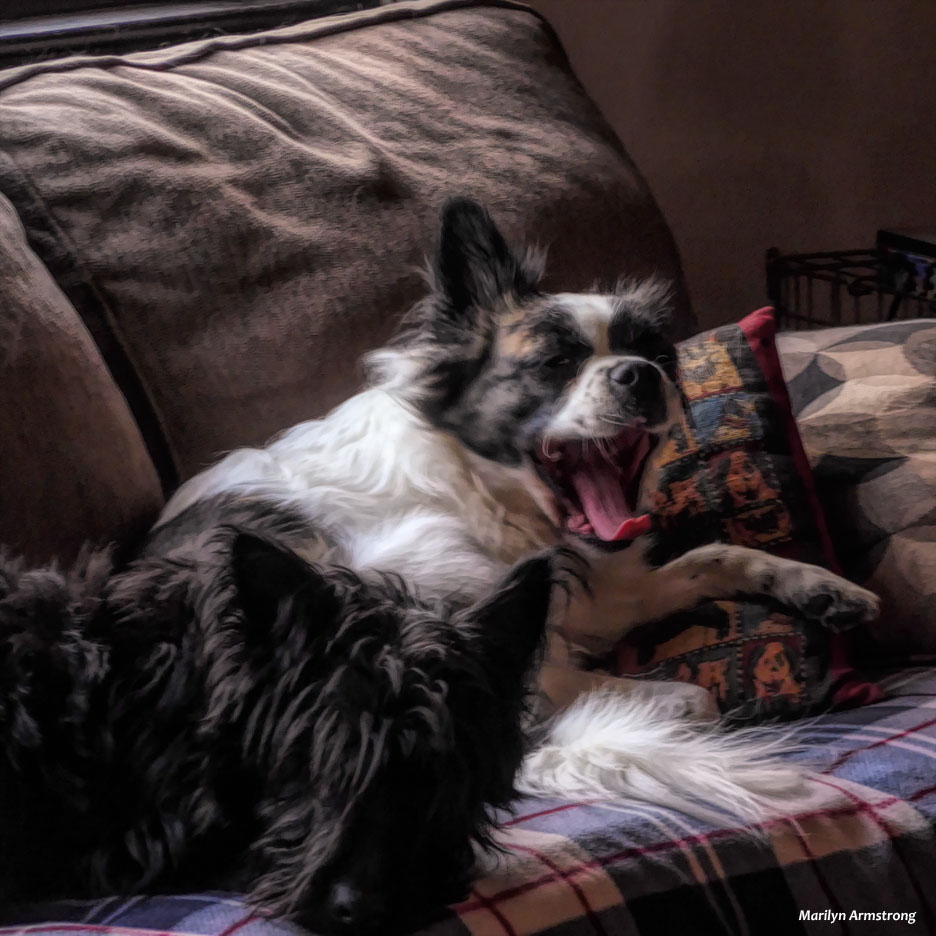
Marilyn Armstrong’s story of retired journalist Garry Armstrong and his dog Duke offers a great way to greet a Saturday. I’ve often wondered lately whether canines are superior to humans. The joy on Garry’s face leads to a different conclusion: humans and canines are meant for mutual play with no thought of superiority or species exceptionalism. Enjoy!
Duke is not our first dog. We’ve had a big selection of hounds, terriers, and mutts of various backgrounds, sizes, ages. Somehow or other they have all fit in here because anyone or anything can fit in here, assuming they want to. For years, there has been great howling and yapping and barking in this house and that’s the way we seem to like it.
Duke
The thing we’ve never had, however, are truly obedient dogs. We don’t demand obedience, so we don’t get it. I wasn’t a very good disciplinarian as a mom, either.
Discipline makes me feel guilty. Who am I to demand obedience? Who do I think I am anyway?
Garry is worse. Garry was born with a gene that says “whatever you tell me to do, I won’t do it.” It’s a special piece of DNA that screams “Oh yeah? Who’s gonna make me?” Even in…
It’s been awhile since Elijah and Grandpa had an online conversation. Although this month-old video isn’t exactly a conversation, Elijah was inviting one. He was at the airport with Kristin, his wonderful mother, waiting to get on the big plane for the flight to Texas. Elijah loves his mom; his mom adores him. And…they’re excited.
While waiting to board the plane, Kristin sends exciting news to Grandma that Elijah is using a spoon! Elijah’s excited, too, but wants to be sure Grandpa’s part of the conversation. He adds a ‘word’ of his own. “Bumpaa?”
“This light-house, a single firefly illuminating the dark.”
Like the “single firefly” (a family on a front porch) in today’s I Can’t Sleep post, Andrew, Alice, and grandson Calvin are being more natural at the cabin this weekend. I’Il think of them in light of David Kanigan’s commentary (scroll down to read) and The Fireflies that lit up the pitch dark sky above the wilderness cabin almost a month ago.
It was a week ago. An otherwise unforgettable day, but for a moment, a single firefly with its other worldly bioluminescence, which keeps circling back.
“Do you want a ride home?”
It’s a short walk home from the train station, ~2000 steps. One hour in the quiet car on Metro North didn’t quench it, the thirst for more solitude, more Alone, more decompression. I walk.
The torso leans forward, the feet step one-two-one-two. Lean forward? A tip from a Youtube fitness coach who explained that it propels you forward. So I lean forward. If he told you to hop on your right foot and rub your stomach round and round with your left hand, you’d do it.
It’s humid. God, it’s Humid. Torso leans forward, thick air pushes back, slowing forward motion. Thunderheads build in the distance.
The neck tie is in my brief case. The slim fit button down…
Elijah has a palate like the host of Bizarre Foods with Andrew Zimmern. It doesn’t discriminate, and he LOVES food. His tastes are far-reaching and wide-ranging. Mexican? Chinese? German? American? French? Escargot or a grub or tasty earthworm from the lawn? It makes no difference.
Andrew Zimmern
Like Andrew, who, BTW, lives in the same town, Elijah would try it. He loves it all.
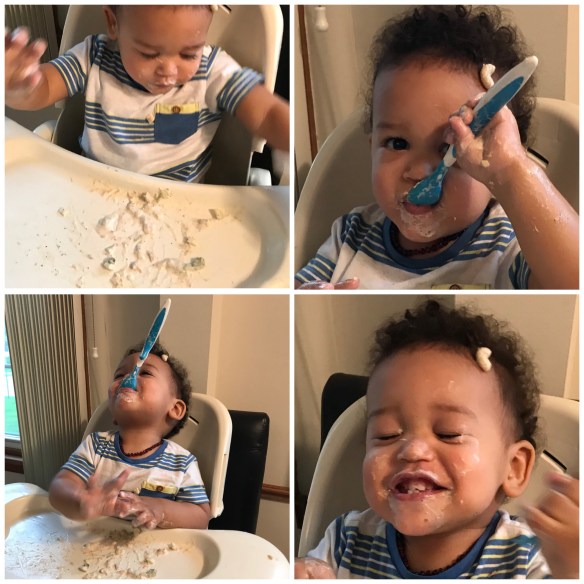
The big news is that Elijah is eating with a spoon, as well as his fingers, and he’s proud of it!
Who cares if he drops a few peas, or some applesauce, or gets a little food in his hair, or shares his spoon with the family dog!
Grandpa Gordon (‘Bumpaa’), Chaska, MN, July 31, 2018.
There’s love and there’s joy. The two go together. But not always. Sometimes love brings sadness. Likewise, sometimes joy — or, rather, what seems like joy (self-indulgent self-satisfaction — knows nothing of love. We live for the moments when love and joy are joined at the hip.
Elijah and Grandma joined at the hip
This photo of Elijah and Grandma on the swing serves as a reminder that love and joy really do belong together. Could two people enjoy each other more than Elijah and his Grandma?
It’s been a while since Elijah and Grandpa had a conversation on Views from the Edge. Elijah celebrated first birthday in late May, and has had a lot to say to Grandpa (“Bumpaa”). His words continue to cheer me. But it’s his baby Cheerios that bring the greater joy. His actions speak louder than words.
Elijah loves Cheerios! He carries them around the house in a plastic cup, plunges his hand into the cup, and pulls out two or three Cheerios. He loves them almost as much as light sockets, computer wires, and the remote to the television. But, when he eats his Cheerios, no one tells him to stop.
Kay and I been out of town last week, enjoying a lovely week at the cabin in the low 70s with breezes from across the wetland, but we missed the little guy! Yesterday Grandma resumed her Friday routine of caring for Elijah. He ran to Grandma and threw his arms in the air asking her to picked him up before he went back for his cup of Cheerios.
Elijah and his Cheerios with Bumpaa
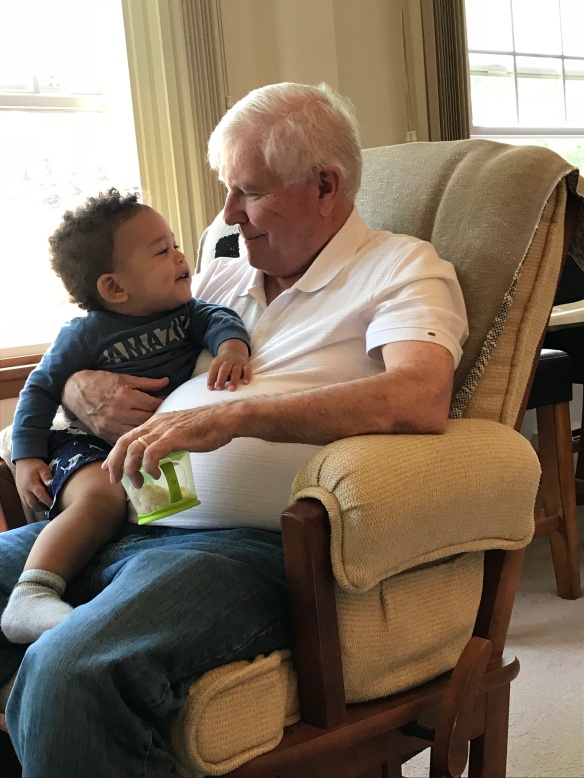
When Grandma sent word that Elijah was calling for me — “Bumpaa? Bumpaa ?” — I joined the two of them at Kristin’s apartment. During our time together, Elijah was dipping his hand into the Cheerios. But he wasn’t just feeding himself. He was sharing his Cheerios. One by one, he reached out his hand to place his precious Cheerios into Grandpa’s mouth. He was doing what human beings are meant to do. He was sharing his Cheerios with Bumpaa, and it came naturally, years before he learns the commandment to love his Bumpaa as himself.
A father sometimes knows his son better than his son knows himself. Occasionally — but rarely — he knows him better than the boy’s mother. Parental conversations leading to decisions about a troubled child’s welfare are private. But the outcomes of such decisions sometimes become a matter of public record.
Mary Anne
Imagine, for instance, a conversation between Fred and Mary Anne about their difficult son whose behavior at school was bringing shame to the family name. Mary Anne, a Scottish-born immigrant raised in a small fishing village on the Outer Hebrides’ Isle of Lewis, was aghast at her son’s rude behavior.
A product of her Scottish Presbyterian heritage, Mary Anne had a high sense of right and wrong, and a low sense of human nature — and of the British crown. “Fred,” she said, “I’m a Scot. We don’t like the Queen! Donald thinks he’s a king! I don’t like that! I didn’t raise my son to be a Brit, let alone a monarch!”
“Mary Anne,” said Fred, “it is troubling and he’s troubled. He needs discipline. He needs boundaries. If we don’t act soon, he’ll be sent off to reform school by the end of the year.”
“Fred, if your strict discipline here at home hasn’t reformed him,” said Mary Anne, ”a reform school won’t do any better. I think we need to think outside the box. I can’t take it anymore. I’m tired of his insults, and the faces he makes. He makes fun of my work with kids who have cerebral palsy and adults with disabilities. They’re not ‘crips’ and ‘morons’! And I’m not ‘illegal’. He thinks he’s the Queen! If you don’t agree with him, you’re just a Scot from the Outer Hebrides, a chamber maid working in his palace.”
“Well, dear, we haveto remember that you were working as a maid when we met at the dance. Donald knows right where to get you. He knows your Achilles heel. He’s taken that ability with him to school and that’s what’s getting him in trouble: finding people’s sore points, their weaknesses, calling them names. The only times he responds to my discipline is when I call him a name.”
“Like what, Fred? I can’t hear your conversations from the kitchen.”
“I hesitate to tell you. I don’t want to hurt your feelings more than he’s already hurt them. I’ve tried different names. Some work. Some don’t. We’re Americans now. America won World War II. We beat the Axis powers. I thought calling him ‘Adolf’ or ‘Benedetto’ might get to him, but he didn’t take it as an insult. He took it as a compliment. He’s a chip off the old block. He likes being strong like Hitler and Mussolini. But . . . I’m sorry, dear, but it’s true — he hates it when I call him ‘Scottie’! He thinks Scots are sissies — crossdressers, guys running around in tartan skirts and knee socks. Sorry to say, dear, Donald’s not proud to be a MacLeod.”
“That breaks my heart, Fred! I know he doesn’t respect his heritage. He doesn’t respect me. He treats me like dirt. He treats me the same way he treats girls and bullies boys who are vulnerable at school.
“There’s only one answer I can see, Mary Anne. A military academy. I put in a call to the Superintendent New York Military Academy this morning. He’s agreed to take him on probation on condition that we not interfere with their discipline. We can visit once a month on the weekend and take him to church.”
“He doesn’t like church, Fred. He hated confirmation class. He says church is for losers.”
Norman Vincent Peale
“I know. We won’t take him back to First Pres. Jamaica is changing. All our neighbors are leaving First Pres. I’ll drive him into Manhattan to hear Norman Vincent Peale. We’re dealing with some hard facts, Mary Anne. So is Donald. He needs some positive thinking. Like Dr. Peale says, ‘Any fact facing us is not as important as our attitude toward it, for that determines our success or failure. The way you think about a fact may defeat you before you do anything about it. You are overcome by the fact because you think you
“Norman Vincent Peale is President Eisenhower’s favorite preacher, Mary. Who knows? If someone like Donald learns to face facts by thinking positively about himself, he could become president.”
“God forbid, Fred! How could we have raised a son like that?”
Years later, the son returned to Scotland. Over dinner he paid tribute to his mother at the Turnberry Hotel of his Turnberry Golf Club.
He will look with favor on the prayers of the homeless;
he will not despise their plea. (Ps. 102:17)
It was the psalmist who said it (Psalm 102:17). Not the New York Times or the Washington Post. Long before the children were separated from their parents at the Mexican border.
I lie awake and groan:
I am like a sparrow, lonely on a house-top. (Ps. 102:7)
The loneliness is known. Expressed. Likened to a small bird alone on some else’s house-top. The plight is seen from the place above every house-top. The groans of the captive are heard on high.
The LORD looked down from his holy place on high;
from the heavens he beheld the earth;
that he might hear the groan of the captive,
and set free those condemned to die… (Ps. 102:19-20)
The voice from the holy place on high echoes among the people who had forgotten who they are. The partisan and the complacent hear the children crying in the Pit of cruelty. They remember their better selves. Because of a national outcry across party lines the separation policy that began six weeks ago comes to a sudden end with an overdue stroke of a pen.
He redeems your life from the Pit;
and crowns you with mercy and loving-kindness. (Ps. 103:4)
The LORD is full of compassion and mercy,
slow to anger and of great mercy. (Ps. 103:8)
Families will no longer be separated at the Mexican border. But 2,300-plus children who have been separated from their parents remain at-large, their identities and whereabouts unknown. Their plight makes America less again.

 Elijah is the apple of more than two eyes. Long before he’s old enough to do anything for which he might merit his Views from the Edge fame, he exhibits a spirit of joy and generosity that runs against the grain of grumpiness and greed. Not only does he strut (see yesterday’s post); Elijah SHARES.
 Marilyn Armstrong’s story of retired journalist Garry Armstrong and his dog Duke offers a great way to greet a Saturday. I’ve often wondered lately whether canines are superior to humans. The joy on Garry’s face leads to a different conclusion: humans and canines are meant for mutual play with no thought of superiority or species exceptionalism. Enjoy!

 Like the “single firefly” (a family on a front porch) in today’s I Can’t Sleep post, Andrew, Alice, and grandson Calvin are being more natural at the cabin this weekend. I’Il think of them in light of David Kanigan’s commentary (scroll down to read) and







 Views from the Edge