
You gotta be kidding!
This is the picture of my lovely grand-daughter Ruby hearing the shocking news from the grand jury in the Ferguson case.
“That’s not right. That prosecutor was naughty!“

You gotta be kidding!
This is the picture of my lovely grand-daughter Ruby hearing the shocking news from the grand jury in the Ferguson case.
“That’s not right. That prosecutor was naughty!“
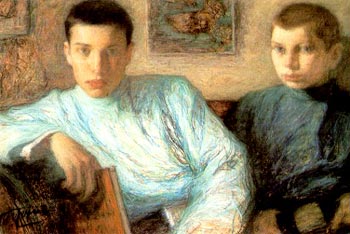
Leonid Pasternak painting of his sons Boris and Alex
Thinking about father – son relationships led me to the Pasternaks, starting with the son, Boris. Boris is seated to the left in this painting, done by his father. One wonders whether Boris and Alex were as angry as the father has painted them, or whether the father only imagined them to be resentful about sitting for the portrait. Father-son relationships are often hard to figure out. They’re about perceptions.
The name Boris Leonidovich Pasternak (1890-1960), the Nobel Laureate who declined the award in 1958, is etched in the annals of Russian literature.
So is the name of his father, Leonid (1865-1945), the revered Russian painter and illustrator, friend of Rainer Maria Rilke and Leo Tolstoy, among others. Leonid’s drawings illustrated Tolstoy’s War and Peace and Resurrection.
Can you see the father in the sons, and the sons in the father who painted them?

Photo of Leonid Pasternak, Russian painter.
Why, then, would the sons’ father leave them behind?
In 1921 when Leonid Pasternak left Russia for eye surgery in Berlin, he took his wife and two daughters, Lydia and Josephine, leaving Boris and Alex behind in Russia. He never returned. He, his wife, and the girls remained in Berlin until 1938 when he fled from the Nazis to England. The sons remained in Russia.
According to the Pasternak Trust, “Leonid Pasternak was the friend and illustrator of Tolstoy.
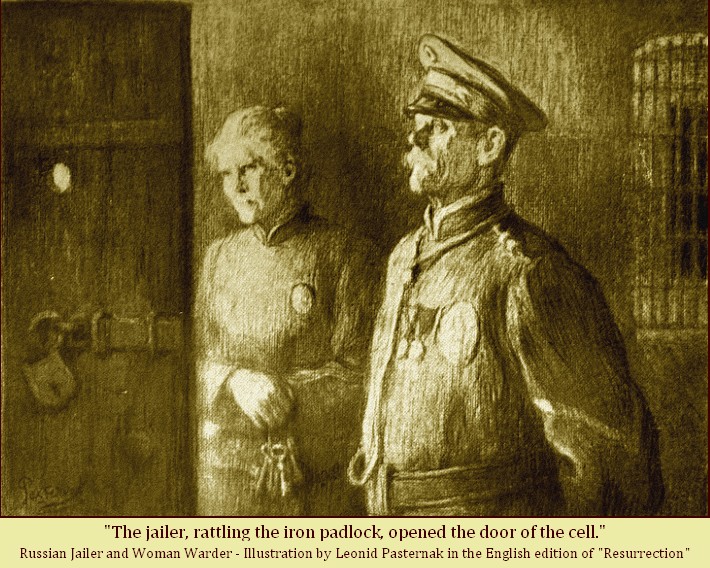
Leonid Pasternak illustration in Tolstoy’s Resurrection.
His portraits include studies from life of writers (Tolstoy, Gorky, Rilke, Remizov, Hauptmann); musicians in performance (Scriabin, Chaliapin, Busoni, Rachmaninov); other distinguished contemporaries including Einstein, Hoffman, Gordon Craig and Lenin.
“Sketches of family scenes – his wife at the piano, and their four children reading and playing – are among his most intimate and charming works. His landscapes stretch from the Black Sea to the Bavarian Alps and Palestine.” – Excerpt from The Pasternak Trust.
Although Leonid never returned to Russia, it was his brush that painted Boris into life as a painter whose brush was words, and one can imagine it was his mother’s music that lulled him to sleep even as an adult His mother was a concert pianist.
“‘What is history?” wrote Boris in Doctor Zhivago.
“Its beginning is that of the centuries of systematic work devoted to the solution of the enigma of death, so that death itself may eventually be overcome. That is why people write symphonies, and why they discover mathematical infinity and electromagnetic waves.”
– Boris Pasternak, Doctor Zhivago (English translation by Nikolay Nicholayevich, 1957), Chapter 1, Section 5.
“In our imaginations, we listen for the distant murmurs of prayer,” wrote Dennis Aubrey in his post “In Seclusio at Thines” posted on Via Lucis Photography.
Listening for the distant murmurs immediately brought to mind a hymn composed by Anne Quigley in 1992. The tune is LONGING. The textual refrain is:
“There is a longing in our hearts, O Lord, for you to reveal yourself to us. There is a longing in our hearts for love we only find in you, O God.”
It was the recollection of the text that drew me to LONGING. I searched YouTube for possible videos for this post but found that the lightness of the tune, like so much contemporary Christian music, left me longing for “the distant murmur of prayers” that echo down the ages in the Gregorian Chants once sung in the now empty or mostly empty monasteries and churches that inspired Dennis to conclude “In Seclusio in Thines”:
“[PJ and I] … hear the echoes of sandaled footsteps in lonely churches long deprived of their monastic communities. And in our imaginations, we listen for the distant murmurs of prayer.”
I long for gravitas awakened by the beauty of silence.
Funny how things slip away. Not really funny. Just strange and sad.
Dennis Aubrey’s posts on Via Lucis Photography have been meaningful to me over the past few year. But because i’m technically challenged and just a bit lazy, Via Lucis has slipped out of site. Until tonight. Wondered why Via Lucis was not popping up on my email notifications. I went to see what Dennis Aubrey and P.J McKay were saying, and there it was. Another thoughtful post , on Weeping for Zion, about which Views from the Edge recently published,
If you haven’t yet noticed Via Lucis Photography, it’s worth your time. Few other authors offer such deep insights into the human condition.
Thank you, Dennis Aubrey and P.J. McKay.
This post by Dennis Aubrey on Via Lucis Photography is splendid.
By the rivers of Babylon, there we sat down, yea, we wept, when we remembered Zion. Psalm 137:1 (King James Bible)
Aleksandr Solzhenitsyn was quoted as saying, “Over a half century ago, while I was still a child, I recall hearing a number of old people offer the following explanation for the great disasters that had befallen Russia: ‘Men have forgotten God; that’s why all this has happened.’ Since then I have spent well-nigh 50 years working on the history of our revolution; in the process I have read hundreds of books, collected hundreds of personal testimonies, and have already contributed eight volumes of my own toward the effort of clearing away the rubble left by that upheaval. But if I were asked today to formulate as concisely as possible the main cause of the ruinous revolution that swallowed up some 60 million of our people, I could not put…
View original post 765 more words
The choir’s BASS was to be the Foundation,
And his low “C” was quite the sensation,
But so flat was he,
His “C” was a “B,”
So elation became consternation.
The ALTO could sing like a bird.
And her beauty the males all allured,
But her tempo was slow,
And her voice was so low,
She never could really be heard.
The TENOR was a prima donna;
His tux had bright diamonds upon a
Stud here and there,
But when we’d despair,
His voice would shake all of La Scala!
Our conductor said “I am the BOSS!
Without me you all would be lost.
So watch me explore
This musical score:
The fast notes will make your eyes cross!”
– Steve Shoemaker, Urbana, IL, Nov. 14, 2014
On the piano bench talent just landed
Bragging “A band I replaced, single-handed!”
He plays for our choir,
But he is a liar:
I watched, and he plays DOUBLE-handed!
– Steve Shoemaker, Urbana, IL, Nov. 15, 2014
This picture taken by AP photographer Ria Novosti at the APEC Conference in Beijing is worth a thousand words. Look at the faces of the black President and the white President patronizing Mr. Obama with his hand on President Obama’s back. Put into words: “I own you, Boy!” and “Get your hand off me!”

Putin: “He’s my BOY”; Obama: “Get your hand off me.”
There was a young singer from Oslo,
A soprano with such a vibrato,
Across a fjord
You could hear her record:
She always sang FORTE, not piano.
– Steve Shoemaker, Urbana, IL, Nov. 13, 2014
NOTE: In his retirement, Steve sings in three choirs: his church choir of about 12 , a community choir of 60, and a University choir of 30 that sings music from the Baroque. These are mainly a pleasure–except for an occasional soprano soloist.

The Throes of Creation – Leonid Pasternak
I’m newly retired.
Today was rough. All day.
Didn’t want to get up, semi-awake, my mind become a subatomic particle collider of memories, facts, people – confused, whirling, disoriented.
Got up, had coffee, but couldn’t write. Didn’t want to. Didn’t want to do anything.
Searched the emails, rummaged through the morning paper for something of interest. Nothing.
This house is dark in the morning. Not just at 5:00 a.m. It’s dark all morning. No sun. And the skies are cloudy. Gray. Like my spirit. Purposeless. Alone. Disinterested. Blah.
It’s the first taste of retirement. The congregation is gone, or, rather, I am gone from them. I miss them. I am without role. Without work. Without routine. No longer a shepherd. Nor am a sheep within a flock. Adrift. Aimless. Dead to what was. Unclear about what is or will be. I am alone.
Except for Barclay who doesn’t get it. He want’s to play. It’s just another day. Go out. Come in. Get the ball. Drop the ball at Dad’s feet. Play ball with Dad, eat food, play some more, go out, wonder why Dad isn’t paying attention and why we’re not getting exercise when there’s such nice snow outside.
Barclay drove me nuts today. Not his fault. He’s a dog. He knows nothing about retirement, nothing yet about aging, about hearing loss, about depression.
Barclay knows nothing about the Mayflower, the Pilgrims, the Puritans, the Congregationalists or the Presbyterians. He’s lucky. He carries no existential guilt, no multigenerational trauma, only the Now. Only the present. Sit. Roll Over. Get the ball. Heel. Treat. “Good Dog.”
I realize that today is Veterans Day and I think of my father, the Chaplain who shipped out for the South Pacific when I was a year-and-a-half old. I hear the train whistle near our house here in Chaska and remember being on the train with my mother after his ship left Los Angeles, the horror of being alone hearing and watching my mother’s inconsolable sobbing in the birth of the night train on the cross-country trip home to Boston. I hear the whistle and feel forlorn.
I remember years later being in the Lebanon Valley Hospital at the age of 14, two hours from home, and 15-minutes from losing a kidney from a football accident. It didn’t strike me as strange then that my parents weren’t there. Strange that their absence didn’t strike me as strange. I just thought they were busy. Now I wonder why they were not there. My mother didn’t drive. Why did my father not come until he arrived a week later with the ambulance driver to take me home? I was alone, forlorn, and thought it was normal. What could have been more important at the church or in the family than being there for their son who was in serious condition in a distant hospital?
The role – his robe – defined my father until the end of his life. It defined him. For most of my adult life it defined me. Until the sullying of the robe and the eight years without it at the Legal Rights Center. At LRC I learned to live without the robe among the criminal defendants and the lawyers and community advocates who pled their cases before the court. I lived the life of a “retired” pastor, a shepherd without a flock.
It’s that time again. I am not unprepared for this thing called retirement. But I realize tonight: I’ve been there. I need no robe to be the person I am and always was. A Stewart, a Titus, and an Andrews with a long ancestral history of dealing with life and death, flight and fight, denial and courage, faltering faith and faithfulness, cruelty and kindness, beheading blocks and pardons.
It’s time for the pardon. Time to let go of the past. Time to let go of the robe. Time to be open to the freshness of a life as it was at the beginning: naked and glorious, crying out for meaning and the wonder of anything at all.
Tomorrow I write!

 Views from the Edge