Farmer walking through fields in Kumta

Scroll down for Joshi Daniel’s photograph that inspired this reflection.

Tourists and residents see things differently. Actually, it’s more than that. They see different things, like the farmer walking through the field in Kumta, and this tourist website that introduces would-be visitors to Kumta.

Today we’re tourists in Beynac-et-Cazenac, one of the loveliest places we’ve ever experienced. Well, i,e. experienced as tourists. But even a tourist (we’ve rented a house      for the week (pictures to follow) recognizes the slower pace of this medieval town on the banks of the Dordogne River.

The Experiment in International Living (EIL) offered a deeper way of seeing the world forty years ago. That summer I lived with a host family in Bratislava, Czechoslovakia. Immersed in the daily life of my Slovakian family and students at the university, I was not a tourist. I cared nothing about the sites a tourist might visit. I walked everywhere, paying attention to where I was, looking more deeply, more thoughtfully – being more present, one might say – less disembodied, less virtual, less distracted, not as entertained, but so much happier in my body.

Like the Experiment in International Living, Kosuke Koyama encouraged me to slow down, to walk instead of run by, drive past, or fly over – to see the dailyness and the natural field of the man Joshi’s photograph. God, said Kosuke, is a three-mile-an-hour God who meets us at the pace of human being walking.

Momentarily, we’ll walk very slowly down the steep hill into the village on Sunday morning in this beautiful place. If we go to fast, we’ll fall on our faces.

  • Gordon C. Stewart, Beynac-et-Cazenac, June 12, 2016.

joshi daniel's avatarJoshi Daniel Photography

A farmer walking through fields in Hegde, Karnataka while holding a basket Farmer walking through the fields | Hegde, Kumta, Karnataka, India

If you would like to buy a print of any of the images, get in touch with me here.

View original post

Cathédrale Saint-Nazaire de Béziers (Dennis Aubrey)

Once again Dennis Aubrey’s writing and photography on Via Lucis Photography of Religious Architecture offers a rare jewell worthy of wider circulation.

Dennis Aubrey's avatar

Beziers has fallen!
They’re dead.
Clerks, women, children:
No quarter.

They killed Christians too.
I rode out,
I couldn’t see nor hear a living creature.
I saw Simon de Montefort.
His beard glistened in the sun.

They killed seven thousand people!
Seven thousand souls who sought sanctuary
In St. Madeline’s.
The steps of the altar were wet with blood.
The church echoed with their cries.

Guiraut Riquier, troubadour (Translated by Martin Best)

In 1130, the master builder Gervais built a Romanesque cathedral in the thriving episcopal town of Béziers. Built eighty years before Notre Dame de Paris, it had a comparable nave height as that Gothic masterpiece and was 50 meters long. Evidence given at the time indicates that it was a truly remarkable structure but it lasted only 79 years. The Cathedral of Saint Nazaire was burnt to the ground on July 22, 1209.

We went to Béziers in…

View original post 1,316 more words

The Dostoyevskys – a Love Story

If you relish literature and insight into the inner worlds of those who write the greatest of it, this selection on the life of Fyodor and Anna Dostoyevsky is a meal like no other:

“Anna Dostoyevsky on the Secret to a Happy Marriage: Wisdom from One of History’s Truest and Most Beautiful Loves” – Brain Pickings.

  • Gordon C. Stewart, Chaska, MN, Feb. 21, 2016.

Cherubic smile

Joshi Daniel’s photograph reminds viewers of the power of inner joy. Thank you, Joshi, for using your extraordinary gift in a way that makes the world a better place.

joshi daniel's avatarJoshi Daniel Photography

Black and white portrait of an old woman with an angelic smile from Trivandrum, Kerala Old woman with a cherubic smile | Trivandrum, Kerala, India

This charming old lady kept on speaking to me while I took this photo of hers.

View original post

Making the nation great again?

Vincent_Willem_van_Gogh_037

Prisoners exercising in the Yard – Vincent Van Gogh

Might Vincent Van Gogh’s painting of the Prisoners Exercising have been inspired by conflicting biblical texts, like the ones read in many churches two Sundays ago?

The reading from the Book of Nehemiah tells the story of rebuilding the walls of Jerusalem.

In the absence of leadership, the people’s confidence – their sense of national destiny – has been shaken. The citizens have intermarried. They’ve welcomed and married foreigners. Now Jerusalem’s exiled leaders have returned to restore the nation’s religious identity, to rebuild a nation that has lost its way. Ezra, the priest, and Nehemiah, the governor, are rallying the people to make the nation great again.

Sound familiar?

Jesus, Ezra, and Nehemiah shared a common faith. They were children of Abraham, Isaac, and Jacob. Their lives were rooted in Torah. Each interpreted Scripture in his own time, according to his own lights. Ezra and Nehemiah re-built the wall. Jesus doesn’t like walls.

Jesus returns to his home town synagogue in Nazareth. He opens the scroll to the Book of Isaiah, and selects the reading announcing good news to the poor, release to the prisoners, recovery of sight to the blind, freedom for the oppressed.

There is nothing about building walls. Nothing about isolation. Nothing about privilege. Nothing about rebuilding the nation. Nothing about the nation at all. Nothing about building the walls of a self-imposed penitentiary.

When he came to Nazareth, where he had been brought up, he went to the synagogue on the sabbath day, as was his custom. He stood up to read, and the scroll of the prophet Isaiah was given to him. He unrolled the scroll and found the place where it was written:

“The Spirit of the Lord is upon me,
because he has anointed me
to bring good news to the poor.
He has sent me to proclaim release to the captives
and recovery of sight to the blind,
to let the oppressed go free,

to proclaim the year of the Lord’s favor.”

And he rolled up the scroll, gave it back to the attendant, and sat down. – Luke 4: 16-18

No more prison. No more wall. No more other! Every Other is a BrOther. Otherwise, we’re all exercising in the prison yard.

  • Gordon C. Stewart, Chaska, MN, Jan. 31, 2016

Looking and Seeing – Thoreau


What you see, not what you look at, is what you get. Or is it?

Is something there you don’t see? Is what you see there because you put it there?

The relation between subject and object is an ancient philosophical question that’s not about to go away.

When I saw the Thoreau poster, I saw the darkness behind the words. Then it drew me to the light – the sunrise or sunset. But, which is it: a sunset preceding darkness, or sunrise bringing the light? Or are we seeing cars, pavement, poles, and signs? What would Thoreau see?


The Green Man

Every generation tends to think of itself as superior to its predecessors. Ours is no different. Sometimes we’re right. Often, we’re wrong. We ignore or don’t know history.

Take, for example, the consciousness of green and climate change – the discovery, or is it the re-discovery, of nature as the context of human life. We tend to think it’s a new consciousness that sets aside the longer consciousness by which the human race justified ravaging the earth.

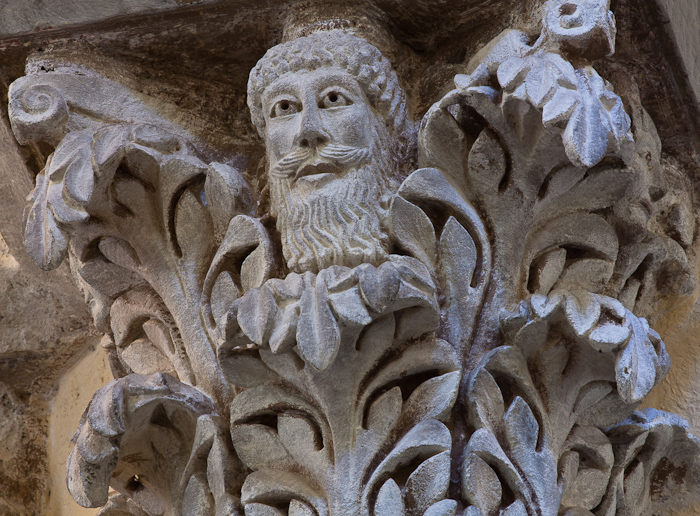
The Green Man in Clermont-Ferrant, Photo by Dennis Aubrey, Via Lucis Photography

The Green Man in Clermont-Ferrant, Photo by Dennis Aubrey, Via Lucis Photography

But, then, along comes the forgotten Green Man of Romanesque churches build in the Medieval Period, one version of which is featured in Dennis Aubrey’s post “A Green Man in Clermont-Ferrand” on Via Lucis Photography of Religious Architecture.

I turn to Via Lucis whenever I feel the need to get out of my skin, to shed the ignorant arrogance of the 21st Century presumption of progress and superiority.

The whole human story is captured in the various Medieval renderings of The Green Man, the human race fatally mis-perceived as “man over nature” and properly conceived as “man within nature”. 

Gordon C. Stewart, Chaska, MN, January 13, 2016

Verse – Yule-ogy

after christmas the tree puked
needles the cat even ignored ornaments
the smudgy guilty fingerprints
enhanced the window glass
about two feet up with proof
of candy eaten frosting licked
from fingers and dog nose prints
mixed in for the seurat effect
while good people slept the sleep
of the over-indulged oblivious to the
recent refugees while focusing
on their personal holy family

  • Steve Shoemaker, Urbana, IL, Jan. 6, 2016
Detail from Seurat's La Parade de Cirque (1889), showing the contrasting dots of paint used in Pointillism, Metropolitan Museum of Art

Detail from Seurat’s La Parade de Cirque (1889), showing the contrasting dots of paint used in Pointillism, Metropolitan Museum of Art

NOTE: I, Gordon, not as well educated as Steve, had to look up ‘seurat’. Click HERE for information on George Seurat, the 19th Century painter known for introducing chromoluminarism and pointillism. and to get the drift of Steve’s upbeat poem. Though not feeling well these days, as noted elsewhere on Views from the Edge and on his CaringBridge page, Steve continues to amaze with his sardonic sense of humor in the face of the eventual eulogy.

Today three close mutual seminary friends from Texas, Arizona, and Illinois meet at Chicago’s Midway Airport and drive to Urbana for a short visit with Steve, Nadja, and their confused dog, Blazer. Blessings and peace to Don Dempsey, Bob Young, Harry Strong, Steve, Nadja, and Blazer.

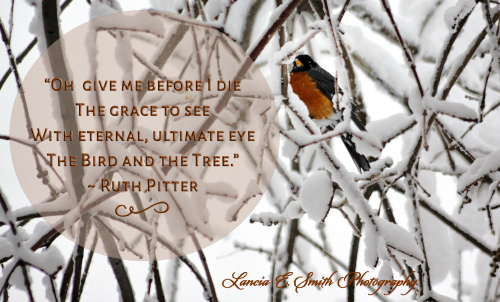
Verse – The Bird in the Tree by Ruth Pitter

Scroll all the way down to the link View the Original Post to read and hear Ruth Pitter’s poem The Bird in the Tree.

malcolmguite's avatarMalcolm Guite

https://lanciaesmith.com/image-for-the-day-advent/ https://lanciaesmith.com/image-for-the-day-advent/

For January 2nd in my  Anthology from Canterbury PressWaiting on the Word, I have chosen to read The Bird in the Tree by Ruth Pitter. On New Year’s Eve we considered Hardy’s almost reluctant glimpse of transfiguration ‘when Frost was spectre-grey, and ‘shrunken hard and dry’, and Hardy’s heart, bleak as the world through which he moves, nevertheless hears for a moment the ‘ecstatic sound’ of his darkling thrush. And even though he wanted to end his poem with the word ‘unaware’, something of the transcended has ‘trembled through’ his poem. Today’s poem, also about hearing a bird in a tree, also addresses the question of how the transcendent might for ‘a moment of time’ ‘tremble through’ into the immanent.

You can hear me read this poem by clicking on the title or the play button. the image above was created by Lancia Smith, and carries a quotation…

View original post 167 more words

Eve of the Climate Summit

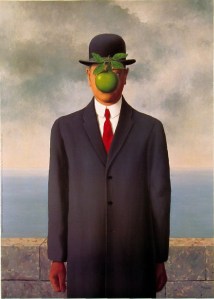
Son of Man, René Magritte (1898-1967)

Son of Man, René Magritte (1898-1967)

Son of Man, René Magritte’s self-portrait with the green apple in front of his face, seems equally appropriate for the First Sunday of Advent and the opening of the United Nations Climate Summit in Paris.

What Magritte meant by hiding his face (except for one eye) with the apple is left to the imagination.

To this viewer the apple’s presence in front of a man of civilized sophistication – bolo hat, buttoned-up dark suit, fitted white shirt, and perfectly knotted red tie – moves imagination in two directions.

The first is often discussed by art critics: the Genesis story of the Fall and the forbidden fruit – the serpent’s whisper that the creatures in the garden could “be like God” by stepping over the one limit imposed on their behavior by a paradisiacal ecosystem.

On this eve of the World Climate Summit, a second interpretation comes to mind – the primacy of nature – the green apple. For all our sophistication, we are nothing without the green planet whose green-ness climate change places at risk.

Magritte’s Son of Man opened me to hear today’s assigned Hebrew Scripture from the Revised Common Lectionary with different ears.

The days are surely coming, says the LORD, when I will fulfill the promise I made to the house of Israel and the house of Judah.

In those days and at that time I will cause a righteous Branch to spring up for David; and he shall execute justice and righteousness in the earth. [Jeremiah 33:12-14]

A righteous branch yet may spring up in Paris. If it does, it will be green. One can pray that the Climate Summit representatives arrive in Paris without their bolo hats, starched white shirts, buttoned-up suits, and power ties, ready to concede finally that, despite all appearances to the contrary, all is nothing without green.

  • Gordon C. Stewart, Chaska, MN, Nov. 29, 2015