Who has the edge? Bernie or Hillary?

Nicholas Kristof’s New York Times Op-Ed piece “2 Questions for Bernie Sanders” asks:

Can you translate your bold vision into reality?

Can you get elected? Or would your nomination make a President Cruz more likely?

Both good questions. Serious questions raised by a journalist who first talked with Bernie after Bernie had been elected Mayor of Burlington, VT. It was a phone conversation with someone in the Mayor’s Office. Mr. Kristof, an intern with the New York Times, ended the conversation by asking the aide for his name. “Oh, I’m Bernie Sanders.” That was 1981.

Kristof’s editorial cites a Gallop Poll from a year ago that seems to give the edge to someone else: to Hillary in the Democratic primary, and to a Republican opponent in the general election. Why? According to the Gallop Poll one year ago, Americans show the most negative bias toward socialists (50%) and atheists (40%) when asked how various factors would affect their vote for a presidential candidate.

As a retired minister of the Presbyterian Church (U.S.A.), I have supported Bernie Sanders from the day he announced his candidacy for President. I support him because he boldly proclaims a social vision that is consistent with my faith. Democratic Socialism is not, as often supposed, an oxymoron. Democracy is a political form of government in which the people rule. Not corporations. Not big money. Not oligarchs. The people.  Socialism is a form of economics that places emphasis on a fair standard of living, quality of life for all, and that narrows the gap in the distribution of wealth. A Democratic Socialist is someone who promotes 1) the return of the integrity of the electoral system to the general population (big money out of politics), and 2) the general wellbeing of everyone in the society rather than leaving it to be settled by the vicissitudes of the free market.

My religious tradition puts the public square front and center as a matter of faith and ethics. The first question of any candidate is what s/he would do if elected. It is not whether they profess my religious faith. “Would the world be a better place?” is the most important question. As I listened to Bernie speaking at Liberty University, I was struck again by how deeply he represents the best of the Jewish-Christian tradition and how respectful he was of the evangelical audience he was addressing. Both his demeanor and his thoughtful engagement of common ground with his audience’s Christian faith and practice defined the meaning of civility and respectful discussion. The atheistic Jewish Democratic Socialist was the opposite of the fears that paint any socialist as an anti-religious demagogue. His message could have been delivered from the pulpits of many churches and synagogues in America.

Then there’s Hillary Clinton, who by the measures of the Gallop Poll, is much more electable than Bernie. Hillary’s not a self-proclaimed socialist, not Jewish, and not an atheist. She’s a Christian heavily influenced by the United Methodist youth group she credits with turning her from right-wing politics into a social gospel progressive. On that question of electability, Hillary holds the edge.

But there’s another edge to Hillary that people are reticent to address. Although she has the edge on Bernie by the Gallop Poll measures, she has “an edge” to her that is off-putting, an air of self-righteousness that reduces her likability.

Remember the 2007 presidential primary debate in which Obama quipped “You’re plenty likable, Hillary”? Candidate Obama was criticized at the time, and rightly so, for being condescending. Nevertheless, his sarcastic quip exposed a truth about Hillary’s likability.  She’s not. Too often her facial expression is smug and condescending. Research in the communications field reminds speakers that 90% of what people take away comes from the speaker’s body language.  That’s a problem. It’s a thing she does with her eyes and mouth that seems to disdain those who disagree or ask a hard question. Hillary’s “edge” gives Bernie the edge on likability.

Bernie also gets the edge for his consistency over 35 years in public office. People are seeing in him a quality nearly absent from ordinary politics. What you see is what you get. When you believe that what you’re seeing is what they’re going to get, you’re much more likely to trust that person. Whether or not you like such a candidate, you view him or her as trustworthy. Hillary not so much. Edge to Bernie.

Turning from the question of electability to the question of Bernie’s and Hillary’s respective abilities to get things done, the edge tends toward Hillary.

Both she and Bernie are experienced politicians, but their experiences are different. Bernie’s only executive experience was years ago as Mayor of Burlington, VT. Congresspeople and Senators are legislators, not executives. The transition to the Oval Office from the Senate Office Building is a steep climb into another set of skills, power, and authority. Hillary is familiar with the Oval Office and executive responsibility. She occupied the White House for eight years, watching the patterns, discussing the most vexing problems with her husband and the press, and she served as Secretary of State managing the Department of State. On the level of executive experience, the edge goes to Hillary.

Although a fighter like Bernie, Hillary is connected by history and experience with congressional Representatives, Senators, Governors, party operatives, and leaders in the private sector on Wall Street and beyond. People owe her – even the most unlikely supporters like Senator Al Franken (D-MN), as close to Bernie’s democratic socialism as they come – because she came to their sides in hard-fought campaigns. Bernie, the Democratic Socialist, on the other hand, has always maintained his partisan independence while allying himself with the Democratic Caucus. Bernie would bring few IOUs to the White House. Edge to Hillary.

If politics is the art of the possible and the do-able, Hillary seems to have the edge. In the current oligarchic world of un-democratic American politics and capitalist economics, a more likable and trustworthy Democratic Socialist will have a tough time hold his edge. And that’s a crying shame.

  • Gordon C. Stewart, Chaska, MN, Feb. 11, 2016.


Somebody has my ashes!

It’s Ash Wednesday. I put on my ministerial robe 15 minutes before the traditional Service that marks the beginning of Lent with the imposition of ashes and go the drawer of the credenza.

Ash Wednesday“They’re missing! Where are the ashes?!” 

Every year I store the ashes in the credenza in my office. I’ve forgotten that we’d moved the credenza from my office last fall. I rush downstairs to look for it. No credenza anywhere. Then…I remember. We sold it at the Annual Fall Festival!

“Somebody has our ashes!”

What to do with no ashes? Burn some newspapers? Smoke a cigar and use the ashes? No time.

I grab a pitcher and pour water into the baptism font.

We begin the Service with the story of the missing ashes. Smiles break out everywhere. Maybe even with signs of relief. “Instead of the imposition of ashes this year, we will go to the font for the waters of baptism, the waters of the renewal of life.”

We have some fun justifying the change in the Service, focusing on the that part of the Gospel text for the day – the words of Jesus himself. “And when you fast, do not look dismal, like the hypocrites, for they disfigure their faces that their fasting may be seen my others….But when you fast, anoint your head and wash your face, that your fasting may not be seen by others but by your Father who is in secret…”(Mt. 6:16-18).

People come to the font, one-by-one, for “the Imposition of … [Water]”. I dip my hand into the font. “Pat, (making the sign of the cross on her forehead), “Dust to dust; ashes to ashes. Remember that you are dust and to dust you shall return. You are a child of God. Live in this peace.”

After the Service is over, one of the worshipers asks whether anyone has done the same for me. She reaches her hand into the font. “Gordon, dust to dust, ashes to ashes. Remember…You are a child of God…..”

I’ll never forget it. Neither will they. And somewhere in this world a stranger has a credenza with a sack full of ashes. Whoever you are, feel free to keep them. They’re all yours.

  • Gordon C. Stewart, Chaska, MN, Feb. 10, 2016 – a memoir from 2012 at Shepherd of the Hill Presbyterian Church in Chaska, MN


Conservative, Progressive, or….

the True Believer?

Republican and Democratic candidates for President all have the same problem. They’re focusing on one of two words.

Who’s REALLY conservative? Who’s REALLY progressive?

The buzz words, which mean little or nothing without clear definition, have become the litmus tests. No can define what they mean exactly. But on both sides of the aisle, what is at stake is a new kind of true belief, a new form of orthodoxy (i.e., right thinking) – the true believer. Or, as it is described in my tradition, ‘the righteousness.

The claim to righteousness is a soul-numbing claim. In the face of it, Micah shifts the conversation from righteousness to goodness:

“He has told you, O mortal, what is good; and what does the Lord require of you
but to do justice, and to love kindness,and to walk humbly with your God?” – Micah 6:8.

What would happen if we considered policy/program proposals and political candidates by the standards of goodness: justice, kindness, and humility?

Micah test is both conservative and progressive. It conserves a core ancient teaching of the western tradition, and it puts social justice, kindness, and humility at the center of public life.

What’s not to like about that?

  • Gordon C. Stewart, Chaska, MN, Feb. 8, 2016.


Making the nation great again?

Vincent_Willem_van_Gogh_037

Prisoners exercising in the Yard – Vincent Van Gogh

Might Vincent Van Gogh’s painting of the Prisoners Exercising have been inspired by conflicting biblical texts, like the ones read in many churches two Sundays ago?

The reading from the Book of Nehemiah tells the story of rebuilding the walls of Jerusalem.

In the absence of leadership, the people’s confidence – their sense of national destiny – has been shaken. The citizens have intermarried. They’ve welcomed and married foreigners. Now Jerusalem’s exiled leaders have returned to restore the nation’s religious identity, to rebuild a nation that has lost its way. Ezra, the priest, and Nehemiah, the governor, are rallying the people to make the nation great again.

Sound familiar?

Jesus, Ezra, and Nehemiah shared a common faith. They were children of Abraham, Isaac, and Jacob. Their lives were rooted in Torah. Each interpreted Scripture in his own time, according to his own lights. Ezra and Nehemiah re-built the wall. Jesus doesn’t like walls.

Jesus returns to his home town synagogue in Nazareth. He opens the scroll to the Book of Isaiah, and selects the reading announcing good news to the poor, release to the prisoners, recovery of sight to the blind, freedom for the oppressed.

There is nothing about building walls. Nothing about isolation. Nothing about privilege. Nothing about rebuilding the nation. Nothing about the nation at all. Nothing about building the walls of a self-imposed penitentiary.

When he came to Nazareth, where he had been brought up, he went to the synagogue on the sabbath day, as was his custom. He stood up to read, and the scroll of the prophet Isaiah was given to him. He unrolled the scroll and found the place where it was written:

“The Spirit of the Lord is upon me,
because he has anointed me
to bring good news to the poor.
He has sent me to proclaim release to the captives
and recovery of sight to the blind,
to let the oppressed go free,

to proclaim the year of the Lord’s favor.”

And he rolled up the scroll, gave it back to the attendant, and sat down. – Luke 4: 16-18

No more prison. No more wall. No more other! Every Other is a BrOther. Otherwise, we’re all exercising in the prison yard.

  • Gordon C. Stewart, Chaska, MN, Jan. 31, 2016

The Story of Ed

Click The End of Exile to read the story of Ed, the beloved Jewish atheist communist in the assisted living facility. The story is memorable, especially for those losing their memories.

The Varieties of Religious Appearance

Pulpits and lecterns are “One size fits all!”
Visiting preachers will cover the wall.
A very short woman,
She carries her step in
I’m very tall, so I carry a hole…

  • Steve Shoemaker, Urbana, IL, January 25, 2016

NOTE: These photographs of Steve kneeling (l) and standing (r) were taken several years ago at the historic pulpit of Sheldon Jackson in Colorado.Sheldon_Jackson Sheldon was a smaller guy with a big heart. Steve’s has the same heart and is likely much more humorous than Sheldon, but who’s to say?
Two Guys from Corinth

The students at Liberty University heard about the two guys from Corinth yesterday. Guest speaker Donald Trump quoted 2 Corinthians, confirming his Christian credentials to the scripture-based evangelical Christian audience at Liberty University.

There were snickers. People who know the New Testament don’t call Paul’s Second Letter to the Corinthians “TWO Corinthians”; they use the short hand “Second Corinthians.”

Most other places Trump’s mention of Two Corinthians would make a great opening line for a story.

A guy walks into a bar and says, “‘Hey, listen up. Two Corinthians were walking in mid-Manhattan, and the one guy says to the other, ‘You know what? This Trump guy comes up to me at 86th and Fifth Avenue and starts talking like he knows our town.’

“‘Yeah?’says the second guy from Corinth. ‘He did the same with me. But does he speak Greek?’

“‘What’s the matter with you! As long as he tells stories about Two Corinthians, I don’t care. The guy’s makin’ us famous. The people at Liberty love us. Besides, Greece is in big trouble. Maybe Trump can fix Greece, too!'”


The Green Man

Every generation tends to think of itself as superior to its predecessors. Ours is no different. Sometimes we’re right. Often, we’re wrong. We ignore or don’t know history.

Take, for example, the consciousness of green and climate change – the discovery, or is it the re-discovery, of nature as the context of human life. We tend to think it’s a new consciousness that sets aside the longer consciousness by which the human race justified ravaging the earth.

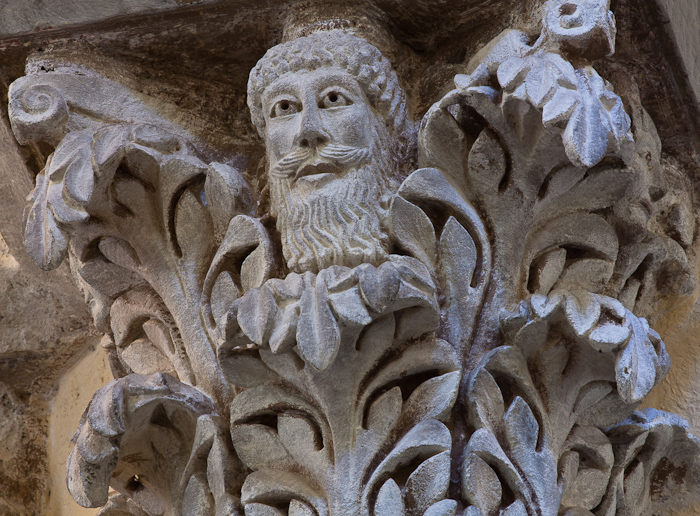
The Green Man in Clermont-Ferrant, Photo by Dennis Aubrey, Via Lucis Photography

The Green Man in Clermont-Ferrant, Photo by Dennis Aubrey, Via Lucis Photography

But, then, along comes the forgotten Green Man of Romanesque churches build in the Medieval Period, one version of which is featured in Dennis Aubrey’s post “A Green Man in Clermont-Ferrand” on Via Lucis Photography of Religious Architecture.

I turn to Via Lucis whenever I feel the need to get out of my skin, to shed the ignorant arrogance of the 21st Century presumption of progress and superiority.

The whole human story is captured in the various Medieval renderings of The Green Man, the human race fatally mis-perceived as “man over nature” and properly conceived as “man within nature”. 

Gordon C. Stewart, Chaska, MN, January 13, 2016

Adolf Hitler’s Appeal to the German People

Radio broadcast, January 31, 1933

Over fourteen years have passed since that unhappy day when the German people, blinded by promises made by those at home and abroad, forgot the highest values of our past, of the Reich, of its honor and its freedom, and thereby lost everything. Since those days of treason, the Almighty has withdrawn his blessing from our nation. Discord and hatred have moved in. Filled with the deepest distress, millions of the best German men and women from all walks of life see the unity of the nation disintegrating in a welter of egoistical political opinions, economic interests, and ideological conflicts.

As so often in our history, Germany, since the day the revolution broke out, presents a picture of heartbreaking disunity. We did not receive the equality and fraternity which was promised us; instead we lost our freedom. The breakdown of the unity of mind and will of our nation at home was followed by the collapse of its political position abroad.

We have a burning conviction that the German people in 1914 went into the great battle without any thought of personal guilt and weighed down only by the burden of having to defend the Reich from attack, to defend the freedom and material existence of the German people. In the appalling fate that has dogged us since November 1918 we see only the consequence of our inward collapse. But the rest of the world is no less shaken by great crises. The historical balance of power, which at one time contributed not a little to the understanding of the necessity for solidarity among the nations, with all the economic advantages resulting therefrom, has been destroyed.

The delusion that some are the conquerors and others the conquered destroys the trust between nations and thereby also destroys the world economy. But the misery of our people is terrible! The starving industrial proletariat have become unemployed in their millions, while the whole middle and artisan class have been made paupers. If the German farmer also is involved in this collapse we shall be faced with a catastrophe of vast proportions. For in that case, there will collapse not only a Reich, but also a 2000-year-old inheritance of the highest works of human culture and civilization.

All around us are symptoms portending this breakdown. With an unparalleled effort of will and of brute force the Communist method of madness is trying as a last resort to poison and undermine an inwardly shaken and uprooted nation. They seek to drive it towards an epoch which would correspond even less to the promises of the Communist speakers of today than did the epoch now drawing to a close to the promises of the same emissaries in November 1918.

Starting with the family, and including all notions of honor and loyalty, nation and fatherland, culture and economy, even the eternal foundations of our morals and our faith—nothing is spared by this negative, totally destructive ideology. Fourteen years of Marxism have undermined Germany. One year of Bolshevism would destroy Germany. The richest and most beautiful areas of world civilization would be transformed into chaos and a heap of ruins. Even the misery of the past decade and a half could not be compared with the affliction of a Europe in whose heart the red flag of destruction had been planted. The thousands of injured, the countless dead which this battle has already cost Germany may stand as a presage of the disaster.

In these hours of overwhelming concern for the existence and the future of the German nation, the venerable World War leader [Hindenburg] appealed to us men of the nationalist parties and associations to fight under him again as once we did at the front, but now loyally united for the salvation of the Reich at home. The revered President of the Reich having with such generosity joined hands with us in a common pledge, we nationalist leaders would vow before God, our conscience and our people that we shall doggedly and with determination fulfill the mission entrusted to us as the National Government.

It is an appalling inheritance which we are taking over.

The task before us is the most difficult which has faced German statesmen in living memory. But we all have unbounded confidence, for we believe in our nation and in its eternal values. Farmers, workers, and the middle class must unite to contribute the bricks wherewith to build the new Reich.

The National Government will therefore regard it as its first and supreme task to restore to the German people unity of mind and will. It will preserve and defend the foundations on which the strength of our nation rests. It will take under its firm protection Christianity as the basis of our morality, and the family as the nucleus of our nation and our state. Standing above estates and classes, it will bring back to our people the consciousness of its racial and political unity and the obligations arising therefrom. It wishes to base the education of German youth on respect for our great past and pride in our old traditions. It will therefore declare merciless war on spiritual, political and cultural nihilism. Germany must not and will not sink into Communist anarchy.

In place of our turbulent instincts, it will make national discipline govern our life. In the process it will take into account all the institutions which are the true safeguards of the strength and power of our nation.

The National Government will carry out the great task of reorganizing our national economy with two big Four-Year Plans:

Saving the German farmer so that the nation’s food supply and thus the life of the nation shall be secured.

Saving the German worker by a massive and comprehensive attack on unemployment.

In fourteen years the November parties have ruined the German farmer.

In fourteen years they created an army of millions of unemployed.

The National Government will carry out the following plan with iron resolution and dogged perseverance.

Within four years the German farmer must be saved from pauperism.

Within four years unemployment must be completely overcome.

Parallel with this, there emerge the prerequisites for the recovery of the economy.

The National Government will combine this gigantic project of restoring our economy with the task of putting the administration and the finances of the Reich, the states, and the communes on a sound basis.

Only by doing this can the idea of preserving the Reich as a federation acquire flesh and blood.

The idea of labor service and of settlement policy are among the main pillars of this program.

Our concern to provide daily bread will be equally a concern for the fulfillment of the responsibilities of society to those who are old and sick.

The best safeguard against any experiment which might endanger the currency lies in economical administration, the promotion of work, and the preservation of agriculture, as well as in the use of individual initiative.

In foreign policy, the National Government will see its highest mission in the preservation of our people’s right to an independent life and in the regaining thereby of their freedom. The determination of this Government to put an end to the chaotic conditions in Germany is a step towards the integration into the community of nations of a state having equal status and therefore equal rights with the rest. In so doing, the Government is aware of its great obligation to support, as the Government of a free and equal nation, that maintenance and consolidation of peace which the world needs today more than ever before.

May all others understand our position and so help to ensure that this sincere desire for the welfare of Europe and of the whole world shall find fulfillment.

Despite our love for our Army as the bearer of our arms and the symbol of our great past, we should be happy if the world, by restricting its armaments, made unnecessary any increase in our own weapons.

But if Germany is to experience this political and economic revival and conscientiously to fulfill its duties towards other nations, a decisive act is required: We must overcome the demoralization of Germany by the Communists.

We, men of this Government, feel responsible to German history for the reconstitution of a proper national body so that we may finally overcome the insanity of class and class warfare. We do not recognize classes, but only the German people, its millions of farmers, citizens and workers who together will either overcome this time of distress or succumb to it.

With resolution and fidelity to our oath, seeing the powerlessness of the present Reichstag to shoulder the task we advocate, we wish to commit it to the whole German people.

We therefore appeal now to the German people to sign this act of mutual reconciliation.

The Government of the National Uprising wishes to set to work, and it will work.

It has not for fourteen years brought ruin to the German nation; it wants to lead it to the summit.

It is determined to make amends in four years for the liabilities of fourteen years.

But it cannot subject the work of reconstruction to the will of those who were responsible for the breakdown.

The Marxist parties and their followers had fourteen years to prove their abilities.

The result is a heap of ruins.

Now, German people, give us four years and then judge us.

Let us begin, loyal to the command of the Field-Marshal. May Almighty God favor our work, shape our will in the right way, bless our vision and bless us with the trust of our people. We have no desire to fight for ourselves; only for Germany.

Source of English translation: Jeremy Noakes and Geoffrey Pridham, eds., Nazism 1919-1945, Vol. 1, The Rise to Power 1919-1934. Exeter: University of Exeter Press, 1998, pp. 131-34.

Source of original German text: “Aufruf der Reichsregierung vom 31. Januar 1933,” reprinted in Hans-Adolf Jacobsen and Werner Jochmann, eds., Ausgewählte Dokumente zur Geschichte des Nationalsozialismus, 1933-1945. Vol. 2, Bielefeld, 1961, no page number (Document 31. I. 1933).


Verse – Church Bells Ringing

Sunday Morning Chimes

Three Church bells ring in Philo,
The Catholic Mass is first,
The Presbyterians
Are next, then Martin
Luther takes his stand.

The steeples point like preachers
To blue sky up above
But storms will soon be coming
If we don’t act with love
And follow that sweet dove.

Yes, Jesus is our teacher,
We hear his bell ring true,
you sound and I am singing
You speak and I speak, too.
Bells ring for me and you.

  • Steve Shoemaker, Urbana, IL, Jan. 10, 2016