
The Neighbors in St. Augustine

The men gather late in front of the house every morning before the resident gets up.

Mostly in their 60s and early 70s, they arrive on bicycles or on foot with paper bags scrunched close at the top. The minority, the younger ones in their 20s, don’t use bags. They don’t hide the beer can or the pint. They pull the cheap, green, plastic chairs from the yard out to the sidewalk to start the day.

The older ones survived the St. Augustine Civil Rights Movement of the early 60s and the violent reaction of the white city fathers of St. Augustine to the passage of the Civil Rights Act.  They tell stories. The younger men don’t seem to care.

I walk next door most every day to say hello. The conversations become windows into humanity, disparate perspectives, and history itself.

Why did the once young men who waded in at Butler Beach in 1964, survived the fire bombing of their homes and the beatings by theKu Klux Klan end up here bleary-eyed with paper bags?

They grow louder as the day wears on. One of them stands in the middle of the street blocking traffic as if to say to passersby, “This is OUR neighborhood!” Several times a day a car pulls up to the curb, opens the window, and exchanges something with the men. They disappear, one by one, into the house for a time.

At noon one day I walk next door and find myself in the middle of what appears to be an argument between one of the older men sitting in the yard and a 20-something man sitting on the sidewalk with his back turned to the street. I come by to say hello. The older man greets me. We say good morning. “You’re a Reverend, right?”

“Well, yes. Sort of..,” I smile, “more or less reverent.” We enjoy a good laugh.

“So,” he says, pointing to the young man holding his open Pabst Blue Ribbon, “doesn’t the Bible say ‘Instead of giving a man a fish, you should teach him how to fish?'”

“Well, no. The Bible doesn’t say that, but it’s pretty close to some of what the Bible teaches.”

“See,” says the young man, “I told you the Bible doesn’t say that!”

The Civil Rights Movement survivors recall how some of their classmates got out of town and left them behind. One of them owns upscale hotels in Atlanta and Miami. He comes home in his big Mercedes every five years or so. According to the men next door, he and others who got out look down their noses at the shrimp boat workers who lived hand-to-mouth existences in the old neighborhood where they grew up together.

The Civil Rights Movement in St. Augustine is still a matter of debate both among its veterans and among the young men who have no living memory of it.  For young and old alike, the men who gather daily next door are a community to each other. They have taken their “place” in the post Civil Rights Movement era of St. Augustine.

They are part of America’s left behind. They’re going nowhere their feet or bicycles can’t take them. They care about each other. They are without pretense. They have each other, old friends and younger ones who are going nowhere. They are a local chapter of the community of the stuck. Their numbers are growing all across America.

 

Verse – Skin in the 1960s

Each month the Playboy magazine
would come in a brown envelope.
I was in Seminary then
and Hefner sent it free to keep
the clergy up on all his thoughts
(he called it his philosophy.)

The stories actually had plots,
some jokes were good, but I would see
the women first, the centerfold,
the air-brushed flawless, pale white skin.
Penthouse and Hustler were more bold,
showed pink as if it were a sin,

but Sports Illustrated was best
(because bikinis revealed less.)

– Steve Shoemaker, Feb. 12, 2014

Verse – 2018

Remember before the great internet fail,
We all were connected, each head to a tail,
But then that world virus
Began to excite us
To chew one another by texts and email.

Our data was stolen, our passwords were known,
Our bank accounts empty, our credit had flown
Out into cyberspace.
Now the whole human race
Starts in again fighting just over a bone.

– Steve Shoemaker, Urbana, IL , Feb, 11, 2015

Gender Economics: It used to be even worse

 When I Was a Grad Student

The lowest legal wage
was all I made
as part-time teller
in a city bank.
No teller could receive
a tip–if paid
the cameras would see,
you know… “Your back
pocket. The cash you stole!”
At end of day
your balance true would not
be evidence
of innocence no matter
what you’d say.

My wife made ten times
what I did, and hence
in 1968 she applied for
a credit card. No way–
she was not head
of our household. At Field’s
she tried once more:
a woman manager
was brave and said
the card could be in her
own name. My wife
was a real person, too,
with her own life…

– Steve Shoemaker, Urbana, IL, Feb. 5, 2015

Editor’s Note: Steve was a student at McCormick Seminary in Chicago. Nadja was a research scientist at Northwestern.

Not “Good-bye” – just “Goodnight”

Last night we signed off with “Say ‘Good Night”, a video of George Burns and Gracie Allen ending their show with George saying to Gracie, “Say ‘Good Night'” and Gracie saying “Good Night” to the audience. A comment arrived this morning:

“I will miss this blog. Unpredictable, funny, inspiring, occasionally depressing, thought-provoking, and more. A sad farewell to Views from the Edge.”

Carolyn and I have been friends since kindergarten. I responded:

Carolyn, Rumors of the death of Views from the Edge are premature -:). It was just going to bed for the night. I kid you not, Ms. kidder. “Good night, Gracie!”

The moral of the story? Don’t get too cute if you want to hold an audience, unless you’re George and Gracie.

Say “Good Night”

Video

After a long day, it’s time for Views from the Edge to say “Good Night” and “Thanks for dropping by today”.


The prayer from hell

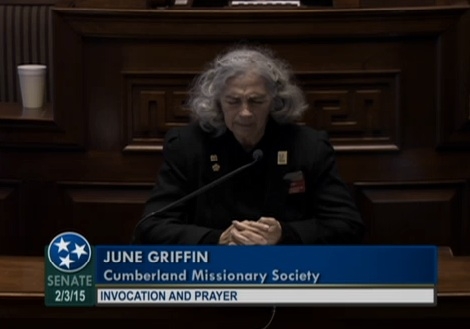
June Griffin, Cumberland Missionary Society, praying      invocation opening Tennessee Senate session, 2015.

June Griffin, Cumberland Missionary Society, praying invocation opening Tennessee Senate session, 2015.

Not even Saturday Night Live or Bill Maher could make up.

Open the Link to Christian minister opens Tennessee Senate with prayer and SCROLL DOWN to watch the video of June Griffin’s anti-government Prayer of Invocation opening a session of the Tennessee Senate.

There used to institutions for people like this.  I used to visit the patients there, but those state hospitals were closed years ago. Today they’re sitting legislators or offering the invocation praying for a Christian-American version of ISIL.


Life begins on the other side of despair

It was Jean-Paul Sartre, the French existentialist novelist, philosopher, and playwright, who declined the Nobel Peace Price for Literature in 1964, who said it. “Life begins on the other side of despair.”

Sartre’s statement resonates with those who have stood at the edge of the abyss of the loss of life’s meaning. Some don’t make it to the other side. Some move to the other side of the abyss with no faith but faith in themselves to create meaning they once ascribed to God or some objective moral order. Others arrive on the other side with their inherited faith not only deconstructed, but re-constructed. I am one of the latter.

Reading of the shooting suicide of a 27-year-old Iraq War veteran philosophy student in the library at Mankato State University takes me back to Sartre’s statement about life and despair. Timothy Lee Anderson was an honorably discharged U.S. Army gunner in Iraq. His picture in The Daily Mail shows him in an Iraqi combat zone with his weapon. In the background of the photo, Iraqi women in traditional Muslim dress appear to be crossing the street. How, I ask, does a guy who served as a gunner in the Iraq War choose philosophy as his major when he comes home to the U.S.A.?

Philosophy is not a popular choice these days. Unlike computer science, it’s not job- related. The word ‘philosophy’ derives from two Greek words meaning love (philo) and wisdom (sophia). Philosophy is the love of, and the search for, wisdom.

Wisdom is born of experience, not inheritance. It’s not hard to imagine the dashed, unexamined, inherited convictions of a young Army recruit: a world dependent on American goodness and might; an America with a manifest destiny in the global order; an exceptional nation privileged and responsible, whether by religious or political creed, to bring its blessings to the rest of an ignorant, unenlightened, uncivilized, and sometimes terroristic and defiant world.

Nor is it hard to imagine a soldier’s despair upon return, reflecting on his experience in search of greater wisdom among the philosophers. The early reports of Timothy Lee Anderson’s life experience point to a less than comfortable homecoming with arrests for marijuana and violation of an order for protection. The gun shot he fired at himself on the second floor of the Mankato State University library was a shot of despair, whatever the immediate reasons or circumstances.

The great sorrow is a life that ended too early on the despair side of the yawning abyss of collapsed meaning. It remains to the survivors and the rest of us who look with sadness on Timothy’s tragic departure to learn that claims to religious-national exceptionalism and wisdom go together about as well as bombs and day-care, guns and libraries.

– Gordon C. Stewart, February 3, 2015.


The Man who Knew

He knows who he is! He is not ignorant; he’s smart. He knows the visiting rabbi is both “the Holy One of God” and the one who has “come to destroy us”.

It is because he knows this that he ends up shrieking. He knows better than those around him, all the others who have come at sundown to observe the Friday Shabbat and Torah study.

He takes his customary place among his neighbors in the Capernaum synogogue. He does not expect much to happen. Everyone, including he, knows that he’s a little strange. Off balance, as the kinder of them say.  Not the norm. Both they and he know his place. None of them yet knows Annie Dillard’s advice that worshipers “should wear crash helmets. Ushers should issue life preservers and signal flares; they should lash us to our pews. For the sleeping god may wake some day and take offense, or the waking god may draw us out to where we can never return.” [Teaching a Stone to Talk, Harper and Row, 1982, quoted here from Wikiquote.]

They have no need for crash helmets, life preservers, or signal flares. Like the ones who are better balanced, he likes his safety. He is safe in his customary place among the customary people expecting a customary teaching from a customary teacher who teaches like a copy-editor (a scribe). He expects to leave the same way he has come: bored and boring in the daily-ness of it all.

They look at him. He looks at them. They all yawn.  Until the guest rabbi takes his seat to teach and says nothing. Jesus just looks at them, reading their faces, reading their minds, looking into their hearts. They are uncomfortable with the long silence. He is reading them like a book he’s read too many times.

When finally the rabbi speaks, he astounds them. He reads the Torah and the prophets as living texts, not history. He is alive and expectant. He is not bored or boring. He teaches with authority. He commands the attention of everyone in the room. They want him, but do not want him. They haven’t brought crash helmets. They’ve come for safety.

He catches the eye of the man who’s a little off balance whose frequent uninvited outbursts   long ago placed him in the back row of the assigned seating.  Although the rabbi’s eyes are working the room from left to right and back again, seeing all the faces there, it is as though he is staring at him alone. They are all a bit on edge now, drawn to his voice and the content of his teaching, his unparalleled authority, but they are also becoming nervous that he is messing with them in ways they had not expected.

The man in the back senses this. He knows this, and he begins to twitch and make strange sounds. He is agitated, disturbed, out of his comfort zone, like everyone else.

His face twitching with the familiar tic, he struggles to his feet from his back row seat, shoving from his shoulders the hands of the ushers stationed on either side of him to prevent the man with Tourettes Syndrome from disturbing them and making a fool of himself.

He points at the rabbi and shrieks at him: “What have you to do with us, Jesus of Nazareth? Have you come to destroy us? I know who you are, the Holy One of God.”

Jesus moves from the center to the back row. He tells the body guards to leave him alone. He stands eye-to-eye with him. “Be silent,” he says, “Come out of him” as though speaking not to the man himself but to others who torment him from the inside.

The whole synagogue is on their feet watching. They know that the Tourettes man with the tic and uncontrollable speech has spoken for all of the normal ones as well. “Have you come to destroy us?”

The man screams and convulses, but it is not the man who is convulsing; it is the hostage-takers whose powers are being broken that are convulsing: the fear of losing one’s assigned place, the customary despair and despairing comfort that robs him and all of them of the joy of the extraordinary in ordinary life.

Perhaps the story of “the man with the evil spirit” comes so early in the Gospel of Mark because it is the story of us all. The Holy One of God does come to destroy us as well as heal us. The next time you go to the synagogue for Sabbath rest or to church on a Sunday morning, take a crash helmet and expect something great to happen!

Click Gospel of Mark 1:21-28 for the story on which this sermonic reflection is based.

– Gordon C. Stewart, St. Augustine, FL, February 2, 2015.


My Soul Waits in Silence

A contemplative reflection on Psalm 62 at Saint Augustine Beach, Saint Augustine, FL.

For God alone my soul waits in silence, for my hope is from him. I wait in silence. [Psalm 62:5 NRSV]

I wait in silence.

Withdrawing from the noisy men next door in Saint Augustine, I am like the Hermit Crab crawling into the borrowed snail shell on Saint Augustine Beach.

This is the same beach brave souls dared to integrate in 1964, a place where then there was no place to hide, the public white beach where the Hermit Crabs refused to hide when the billy clubs swing to drive them from the white man’s beach. There are no billy clubs on the beach today but the shouting of the world we call civilized still hurts by ears.

How long will you assail a person,
will you batter your victim, all of you,
as you would a leaning wall, a tottering fence? [Ps. 62:3 NRSV]

The world is noisy. Loud. Cacophonous. Bellowing blasts, bewailing, and bedlam in Beirut, Baghdad, and Boston hurt my ears. Hoping to leave it, I come to the beach where the tides know nothing of the color of my skin, my income, my worries or fears.

For God alone my soul waits in silence,
for my hope is from him.
He alone is my rock and my salvation,
my fortress; I shall not be shaken.
On God rests my deliverance and my honour;
my mighty rock, my refuge is in God.  [Ps. 62: 5-7 NRSV]

Hermit Crab crawling into abaondoned snail shell

Hermit Crab crawling into abaondoned snail shell

At low tide I crawl inside the borrowed shell looking for a respite from the noonday heat, my deliverance, my refuge, my fortress. But, even here, the noise follows me.

The blasts, buzzes, and bellowing echo inside the shell. Silence eludes me. Even here, I am a poor man, a mere breath, walking among the vendors and hawkers, resentful, angry, beset, a man of low estate.

Those of low estate are but a breath,
those of high estate are a delusion;
in the balances they go up;
they are together lighter than a breath.
Put no confidence in extortion,
and set no vain hopes on robbery;
if riches increase, do not set your heart on them. [Ps. 62:9-10 NRSV]

Here I am a breath stripped from the delusions of high estates indulged on the other side of the sand dunes that separate the beach from the street.

I wait in silence.

I ponder the speed outside the Hermit Crab’s temporary home, the abandoned snail shell, the speed that is itself an illusion, a flight of hubris washed away by the tides of time. I remember the race to nowhere, the myths of ownership, invulnerability, control, and superiority that race through the minds of low and high estates alike.

I hear the distant shouts and screams from the integration of Saint Augustine Beach that still plunge the despondent men next door into the oblivion of cheap booze, dope, and, maybe, crack. But the longer I wait and listen, my heart grows strangely calmer. Quieter. More at peace.

I come into the deeper Silence of the Breath once heard by the psalmist.

Once God has spoken;
twice have I heard this:
that power belongs to God,
and steadfast love belongs to you, O Lord.
For you repay to all
according to their work. [Ps. 62: 11-12 NRSV]

In the wordless silence I hear the Word I’ve come to the beach to hear:

“Be still, and know that I am God.” [Ps. 46:10 NRSV]

– Gordon C. Stewart, Saint Augustine, Florida, January 31, 2015