The Waiting Room

The surgery went “as well as could be expected” after two months of undiagnosed illness, but Sepsis is taking over his body, threatening his survival. The next two hours are critical.

His loved ones and friends are gathered in the ICU Waiting Room at Abbott-Northwestern Hospital in Minneapolis.

Several hours earlier, I had observed six Muslim men praying the evening prayer at sundown at the far side of the Waiting Room. Oromo (Ethiopia) men had prayed the evening prayers at sundown, off to the far side of the large Waiting Room.

The men from Orono (Ethiopia), whom I had assumed to be Somali, are now gathered in chairs in the center of the Waiting Room, talking among themselves in Oromo.

When I approach them, intruding into their space, they recognize my presence. They stop talking. “Salaam,” I say. “Salaam,” they respond as if with a single voice and smile. “My friend is very sick. The next two hours are critical. I ask your prayers. His name is Phil.”

They respond as one would expect compassionate people to respond. “We will pray for him.”

I return to the small family area where my fellow Christians are gathered. I tell them the Muslims are praying for Phil. They’re pleased. We chat. Phil and Faith’s pastor eventually leads us in a Christian prayer.

Muslim prayer visitors

Muslim prayer visitors

An hour or so later three of the Oromo men come to our little room. They have come to tell us they have finished their prayers for Phil.

The voices and eyes of the men, led by their Imam, are kind, pastoral, as we say in the church. Full of compassion and concern for us. They have prayed in Arabic a Muslim prayer for healing on behalf of a stranger about whom they know nothing but his need:

“Remove the harm, O Lord of humankind and heal [Phil], for You are the Healer and there is no healing except Your healing, with a healing which does not leave any disease behind.” [narrated into English by al-Bukhaar]

Sometimes we have no choice but to wait. The Muslims from Oromo are waiting with us actively. Would that we all would wait so kindly, so patiently, so actively, and so wisely.

For a split second, I imagine the world as a Waiting Room.

– Gordon C. Stewart, Abbott-Northwester Hospital, Minneapolis, MN, June 12, 2015

Verse – SpEcTaToRs

Is there a day without a sport?
Remember when ABC’s
Wide World of Sports
was just on TV Saturdays…
and for only 90 minutes?
Baseball games were on the radio.
Now ESPN Channels 1-348 are on 24-7.
Just today WORLD CHAMPIONSHIPS are being played and broadcast in
Professional Men’s Basketball,
Professional Men’s Hockey, and
Professional Women’s soccer.
I think there is a sport every minute.

Of course I could be wrong–
I watch only movies via NetFlicks,
37 HD Satellite Channels, BLU-RAY,
or in Theaters with rocking chairs,
cup-holders, 5 gallon popcorn buckets,
300 speakers, and IMAX.

Our grand-children watch small screens
under the covers after lights-out.

– Steve Shoemaker, Urbana, IL, June 11, 2015

Verse – The worst jobs in America

Cleaning toilets
Changing adult diapers
Scraping up roadkill
Killing in a slaughterhouse
Telling family Mom has died
Telling Mom the baby died
Killing unadopted pets
Telling kids their pet has died
Teaching to the test

– Steve Shoemaker, Urbana, IL, June 7, 2015

button against teaching to the test.

button against teaching to the test.

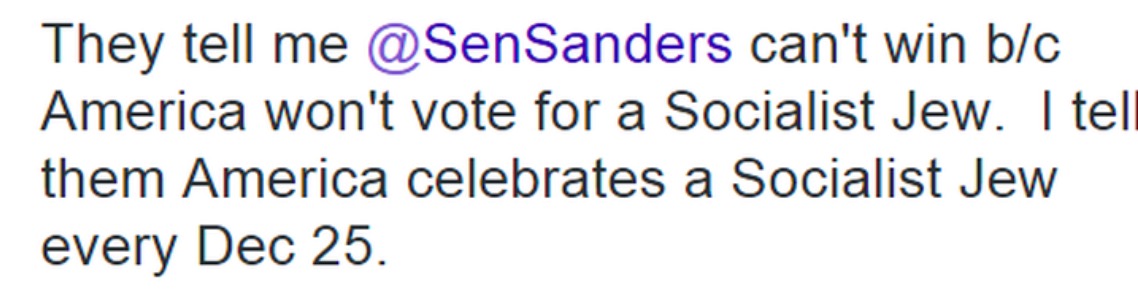
The Socialist Jew

This tweet caught Steve’s attention, as well it should!

Socialist Jew Quote

Socialist Jew Quote

Bernie Sanders and Rand Paul – a Glimpse

Video

I’ve been waiting  for years for Senator Bernie Sanders (I-VT), whose recently announced candidacy for President of the United States is drawing astonishingly large crowds.

Ask him why he’s running and he tells you. And when he does, he speaks with two qualities that too often are estranged from one another: keen intelligence and passionate conviction. His voice resonates with a timber from deep within his soul. He’s not your stereotypical politician. He doesn’t answer questions by running in circles. He’s not afraid to offend potential supporters. He’s as bold as they come. What he’s bold about is common sense. The crowds in Minnesota and Iowa are coming out to meet him because they hear the voice of a truth-teller. No matter that Bernie speaks with a Brooklyn accent.

No other candidate for President during my lifetime has been as clear or concise as Bernie Sanders. Here’s a sample of Bernie engaging Senator Rand Paul (R-KY) on senior hunger back in 2011 before Bernie and Rand threw their names in the hat.

No one knows how far Bernie will go in his bid for the Presidency. But suddenly the mainstream media within the Washington Beltway and the New York Times the sneered at him a week ago are beginning to sense they’d better pay attention.

– Gordon C. Stewart, Chaska, MN, June 2, 2015.


Texas Flood, Ted Cruz, and Zombie games

The other night a professional baseball game was played during a torrential downpour at Target Field in Minnesota. Meanwhile down in Texas, historic level floods were rising.

Senator Ted Cruz, the climate change denier who opposed the bill providing disaster relief to the Northeast following Hurricane Sandy in 2013, was shouting for urgent federal assistance above and beyond ordinary disaster relief.

Back in 2013 when the victims of Sandy were in New York and New Jersey, the Senator from Texas opposed the federal government “wasting” tax payers’ money.

“This bill,” he said, “is symptomatic of a larger problem in Washington—an addiction to spending money we do not have. The United States Senate should not be in the business of exploiting victims of natural disasters to fund pork projects that further expand our debt.”

Now that the scene of the disaster has shifted to Texas, he says, “At a time of tragedy, I think it’s wrong to try to politicize a natural disaster.”

“Amen” to that!

But, then again, according to The Daily Beast on May 28,

At the moment, Cruz is playing “Plants vs. Zombies,” a game where users collect sunlight points to feed plants who fight off waves of zombies; “Candy Crush,” the puzzle game where he claims he’s in the 217th level; and “The Creeps!,” a tower defense game.

One can almost hear the voice of Senator Cruz’s predecessor, Senator Lyndon B. Johnson (D), crying from the grave, wondering how the zombies took over his beloved Texas.

Senator, please join the rest of us in fighting for the plants against the zombie Climate Change denier obstructionists. What’s happened in New York and New Jersey, and what’s happening now in Minnesota, Texas and Oklahoma is not a video game. “Let’s play ball!”

– Gordon C. Stewart, Chaska, MN 55318

JKF’s Birthday and Champagne

It’s normal for a mother to think her newborn child sets the moon. But few, if any, look at their children and say that one day they’ll be President of the United States.

One is left to wonder how it was 98 years ago today in Brookline, Massachusetts when Rose Fitzgerald Kennedy gave birth to her second-born child, John. Rose and her husband Joe were Irish Catholic in a country whose political class was blue-blood Protestant. No Roman Catholic had ever run for the Presidency by the time Rose gave birth to John.

But some mothers and fathers have a way. Welcoming their children into the world with unconditional love, they also encourage great expectations. Love and excellence are not opposites; they go together like the soil in Champagne, and the coveted grapes the soil produces.

President John Fitzgerald Kennedy

President John Fitzgerald Kennedy

John Fitzgerald Kennedy was born to Rose and Joseph Kennedy 98 years ago. They could not have imagined their second-born son would grow up to become the 35th President of the United States of America. But he did.

Few, if any, mothers expect their child to become President of the United States of America. But if unconditional love and great expectations greet a newborn child, almost anything can happen, and, whatever it turns out to be, it will all be good.

– Gordon C. Stewart, Chaska, MN, May 29, 2015.

The Paradox of Pentecost — Presence and Absence

A stranger than strange text for today’s Feast of Pentecost, the day the Church celebrates the coming of the Spirit, the Advocate, reads:

“I tell you the truth: it is to your advantage that I go away, for if I do not go away, the Advocate will not come to you…” [Gospel according to John 16:7].

It is Jesus in John’s Gospel who speaks these words to his disciples. They scratch their heads, like confused children being dropped off at camp against their will. They already sense the homesickness that will come. The thought of being abandoned brings anguish, the foreboding of oncoming forlornness.

The experience of absence, endemic to the human condition, is essential to faith. The feeling of anguished forlornness builds courage, and faith, of one sort or another, with or without an advocate.

Enter Jean-Paul Sartre’s reflections on anguish and forlornness. Fully conscious without religious crutches, I experience the anguish of my responsibility for myself and others, and the forlornness that realizes that I am alone in my decision-making. The decisions are mine along. No one but I am responsible.

Like the disciples, we want it to be otherwise. Some of us pray as though the feelings were a hoax, the Devil’s trickery or God’s pre-ordaining, as though our course were charted by another decision-maker disbelieved by Sartre. But regardless of our faith or faith denials, the truth is that to be human is to know this sense of anguish and forlornness.

Dietrich Bonhoeffer, the brilliant theologian imprisoned and executed by the Third Reich, caught the sense of it in a letter he wrote from a prison cell.

“The only way to be honest is to recognize that we have to live in the world etsi deus non daretur. And this is just what we do see — before God! So our coming of age forces us to a true recognition of our situation visa a vis God. God is teaching us that we must live as [people] who can get along very well without him. The God who is with us is the God who forsakes us (Mark 15:34). God who makes us live in the world without using him as a working hypothesis is the God before whom we are ever standing. Before God and with him we live without God. God allows himself to be edged out of the world and onto the cross. God is weak and powerless in the world, which is exactly the way, the only way, in which he can be with us and help us. Mark 8:17 makes it crystal clear that it is not by his omnipotence that Christ helps us, but by his weakness and his suffering.” [Dietrich Bonhoeffer, Letters and Papers from Prison, pp 219-220, McMillan Company, 1953, translated from German by Reginald H. Fuller.]

Bonhoeffer’s writing acknowledges the anguish and forlornness that precede the disappearance of the divine usurper of human freedom and responsibility. In place of the bad-faith God who keeps her children in diapers, there comes the advantage of Christ’s going away — the arrival of the Advocate who brings the unexpected joy of coming of age.

“I tell you the truth: it is to your advantage that I go away, for if I do not go away, the Advocate will not come to you; but if I go, I will send him to you” [Gospel according to John 16:7].

– Gordon C. Stewart, Chaska, MN, May 24, 2015 – Feast of Pentecost.

The Movement Made the Man (MLK)

Martin Luther King, Jr. did not make the civil rights movement. As Elizabeth Myer Boulton reminds us, it was the movement that made the man. Without the movement there would have been no “I Have a Dream Speech”.

Elizabeth (Liz) Myer Boulton’s spouse, Matthew Myer Boulton, President of Christian Theological Seminary, hosted five McCormick Theological Seminary classmates this past week, including Steve Shoemaker and me.

I returned from Indianapolis and found Liz’s powerful sermon. It reminded me of Kay and my month in Saint Augustine.  It was the unsung local heroes who built the movement, paid the price, and drove the buses to the Poor People’s March on Washington. Martin represented them all.

– Gordon C. Stewart, Chaska, MN, May 23, 2015.

Quote of the day; Stories . . .

Scroll down to read Day Parker’s quote about stories. Anthony de Mello was an Indian Jesuit priest who died of a heart attack at the age of 55. His writings were of some controversy, such that Joseph Ratzinger (who later became Pope Benedict XVI) investigated de Mello’s views 11 years after his death, concluding that some of his writings were “inconsistent with the teachings” of the Faith. The Indian magazine Outlook claimed it was an attempt by Rome to undermine the clergy in Asia and indicative of widening fissures between Rome and the Eastern Church. Like Elie Wiesel, Father de Mello knew that stories, not investigations and pronouncements, are the (appropriate) currency of human contact.