Adolf Hitler’s Appeal to the German People

Radio broadcast, January 31, 1933

Over fourteen years have passed since that unhappy day when the German people, blinded by promises made by those at home and abroad, forgot the highest values of our past, of the Reich, of its honor and its freedom, and thereby lost everything. Since those days of treason, the Almighty has withdrawn his blessing from our nation. Discord and hatred have moved in. Filled with the deepest distress, millions of the best German men and women from all walks of life see the unity of the nation disintegrating in a welter of egoistical political opinions, economic interests, and ideological conflicts.

As so often in our history, Germany, since the day the revolution broke out, presents a picture of heartbreaking disunity. We did not receive the equality and fraternity which was promised us; instead we lost our freedom. The breakdown of the unity of mind and will of our nation at home was followed by the collapse of its political position abroad.

We have a burning conviction that the German people in 1914 went into the great battle without any thought of personal guilt and weighed down only by the burden of having to defend the Reich from attack, to defend the freedom and material existence of the German people. In the appalling fate that has dogged us since November 1918 we see only the consequence of our inward collapse. But the rest of the world is no less shaken by great crises. The historical balance of power, which at one time contributed not a little to the understanding of the necessity for solidarity among the nations, with all the economic advantages resulting therefrom, has been destroyed.

The delusion that some are the conquerors and others the conquered destroys the trust between nations and thereby also destroys the world economy. But the misery of our people is terrible! The starving industrial proletariat have become unemployed in their millions, while the whole middle and artisan class have been made paupers. If the German farmer also is involved in this collapse we shall be faced with a catastrophe of vast proportions. For in that case, there will collapse not only a Reich, but also a 2000-year-old inheritance of the highest works of human culture and civilization.

All around us are symptoms portending this breakdown. With an unparalleled effort of will and of brute force the Communist method of madness is trying as a last resort to poison and undermine an inwardly shaken and uprooted nation. They seek to drive it towards an epoch which would correspond even less to the promises of the Communist speakers of today than did the epoch now drawing to a close to the promises of the same emissaries in November 1918.

Starting with the family, and including all notions of honor and loyalty, nation and fatherland, culture and economy, even the eternal foundations of our morals and our faith—nothing is spared by this negative, totally destructive ideology. Fourteen years of Marxism have undermined Germany. One year of Bolshevism would destroy Germany. The richest and most beautiful areas of world civilization would be transformed into chaos and a heap of ruins. Even the misery of the past decade and a half could not be compared with the affliction of a Europe in whose heart the red flag of destruction had been planted. The thousands of injured, the countless dead which this battle has already cost Germany may stand as a presage of the disaster.

In these hours of overwhelming concern for the existence and the future of the German nation, the venerable World War leader [Hindenburg] appealed to us men of the nationalist parties and associations to fight under him again as once we did at the front, but now loyally united for the salvation of the Reich at home. The revered President of the Reich having with such generosity joined hands with us in a common pledge, we nationalist leaders would vow before God, our conscience and our people that we shall doggedly and with determination fulfill the mission entrusted to us as the National Government.

It is an appalling inheritance which we are taking over.

The task before us is the most difficult which has faced German statesmen in living memory. But we all have unbounded confidence, for we believe in our nation and in its eternal values. Farmers, workers, and the middle class must unite to contribute the bricks wherewith to build the new Reich.

The National Government will therefore regard it as its first and supreme task to restore to the German people unity of mind and will. It will preserve and defend the foundations on which the strength of our nation rests. It will take under its firm protection Christianity as the basis of our morality, and the family as the nucleus of our nation and our state. Standing above estates and classes, it will bring back to our people the consciousness of its racial and political unity and the obligations arising therefrom. It wishes to base the education of German youth on respect for our great past and pride in our old traditions. It will therefore declare merciless war on spiritual, political and cultural nihilism. Germany must not and will not sink into Communist anarchy.

In place of our turbulent instincts, it will make national discipline govern our life. In the process it will take into account all the institutions which are the true safeguards of the strength and power of our nation.

The National Government will carry out the great task of reorganizing our national economy with two big Four-Year Plans:

Saving the German farmer so that the nation’s food supply and thus the life of the nation shall be secured.

Saving the German worker by a massive and comprehensive attack on unemployment.

In fourteen years the November parties have ruined the German farmer.

In fourteen years they created an army of millions of unemployed.

The National Government will carry out the following plan with iron resolution and dogged perseverance.

Within four years the German farmer must be saved from pauperism.

Within four years unemployment must be completely overcome.

Parallel with this, there emerge the prerequisites for the recovery of the economy.

The National Government will combine this gigantic project of restoring our economy with the task of putting the administration and the finances of the Reich, the states, and the communes on a sound basis.

Only by doing this can the idea of preserving the Reich as a federation acquire flesh and blood.

The idea of labor service and of settlement policy are among the main pillars of this program.

Our concern to provide daily bread will be equally a concern for the fulfillment of the responsibilities of society to those who are old and sick.

The best safeguard against any experiment which might endanger the currency lies in economical administration, the promotion of work, and the preservation of agriculture, as well as in the use of individual initiative.

In foreign policy, the National Government will see its highest mission in the preservation of our people’s right to an independent life and in the regaining thereby of their freedom. The determination of this Government to put an end to the chaotic conditions in Germany is a step towards the integration into the community of nations of a state having equal status and therefore equal rights with the rest. In so doing, the Government is aware of its great obligation to support, as the Government of a free and equal nation, that maintenance and consolidation of peace which the world needs today more than ever before.

May all others understand our position and so help to ensure that this sincere desire for the welfare of Europe and of the whole world shall find fulfillment.

Despite our love for our Army as the bearer of our arms and the symbol of our great past, we should be happy if the world, by restricting its armaments, made unnecessary any increase in our own weapons.

But if Germany is to experience this political and economic revival and conscientiously to fulfill its duties towards other nations, a decisive act is required: We must overcome the demoralization of Germany by the Communists.

We, men of this Government, feel responsible to German history for the reconstitution of a proper national body so that we may finally overcome the insanity of class and class warfare. We do not recognize classes, but only the German people, its millions of farmers, citizens and workers who together will either overcome this time of distress or succumb to it.

With resolution and fidelity to our oath, seeing the powerlessness of the present Reichstag to shoulder the task we advocate, we wish to commit it to the whole German people.

We therefore appeal now to the German people to sign this act of mutual reconciliation.

The Government of the National Uprising wishes to set to work, and it will work.

It has not for fourteen years brought ruin to the German nation; it wants to lead it to the summit.

It is determined to make amends in four years for the liabilities of fourteen years.

But it cannot subject the work of reconstruction to the will of those who were responsible for the breakdown.

The Marxist parties and their followers had fourteen years to prove their abilities.

The result is a heap of ruins.

Now, German people, give us four years and then judge us.

Let us begin, loyal to the command of the Field-Marshal. May Almighty God favor our work, shape our will in the right way, bless our vision and bless us with the trust of our people. We have no desire to fight for ourselves; only for Germany.

Source of English translation: Jeremy Noakes and Geoffrey Pridham, eds., Nazism 1919-1945, Vol. 1, The Rise to Power 1919-1934. Exeter: University of Exeter Press, 1998, pp. 131-34.

Source of original German text: “Aufruf der Reichsregierung vom 31. Januar 1933,” reprinted in Hans-Adolf Jacobsen and Werner Jochmann, eds., Ausgewählte Dokumente zur Geschichte des Nationalsozialismus, 1933-1945. Vol. 2, Bielefeld, 1961, no page number (Document 31. I. 1933).


Verse – Church Bells Ringing

Sunday Morning Chimes

Three Church bells ring in Philo,
The Catholic Mass is first,
The Presbyterians
Are next, then Martin
Luther takes his stand.

The steeples point like preachers
To blue sky up above
But storms will soon be coming
If we don’t act with love
And follow that sweet dove.

Yes, Jesus is our teacher,
We hear his bell ring true,
you sound and I am singing
You speak and I speak, too.
Bells ring for me and you.

  • Steve Shoemaker, Urbana, IL, Jan. 10, 2016

How the doubting father’s son became a shouter

A BIBLICAL FATHER-SON STORY: ZECHARIAH & JOHN THE BAPTIST

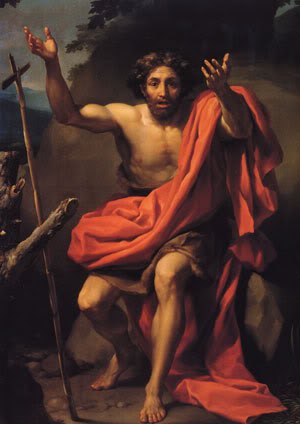
John the Baptist
John the Baptist

Ever wondered why John comes out of nowhere with a fiery message?

He has a bone to pick. Why? With whom? What’s his story?

The Eastern Orthodox Christian tradition preserves a story about John’s father, Zechariah, a Temple priest, sending his wife, Elizabeth, and their son, John, into hiding. Zechariah hides his son to protect him from Herod’s “Slaughter of the Innocents” by which all males below the age of two were to be killed following rumors of a newly-born king, a threat to Herod’s rule.

According to the story told by The Infancy Gospel of James [the mid-Second Century C.E.], John and Elizabeth remain in hiding – far away from their husband and father, Zechariah – until John is five or six years old when Zechariah risks visiting their hiding place. The result is the brutal murder of Zechariah by Herod’s soldiers.

As the son of a Temple priest, John descended from the priestly lineage of Aaron. John was destined to be a Temple priest. Father-son dynamics become more difficult when the father is a public religious figure. Zechariah’s son sounds like an angry preacher’s kid.

When [John] saw the Pharisees and Sadducees coming to be baptized, he said to them, "You brood of vipers, who warned you to flee from the wrath to come? Bear fruit that befits repentance, and do not presume to say to yourselves 'We have Abraham as our father ....'" (Mt. 3:7-9a).

The Pharisees were lay people with a more liberal religious bent than the Sadducees. The Sadducees were Temple authorities and Temple supporters, the folks who aligned themselves with John’s father Zechariah and a conservative reading of the Torah. The Pharisees and the Sadducees were in conflict during the time of John and Jesus. Only the Pharisees survived the later destruction of Jerusalem and the Temple in the Roman-Jewish War of 70 C.E.

By the time the Gospels are written, the Temple had been destroyed. So we have the Temple priests and their supporters, the Sadducees, and John the Baptist in the Gospel of Matthew scolding both the Pharisees, who will carry on their tradition without accepting one of their likely members, Jesus of Nazareth, as the awaited Anointed One (Messiah), and the Sadducees who have disappeared into history.

Whether the Orthodox tradition and The Infancy Gospel of James are taken as historical fact or mythic truth, John’s real fight was with his father and the Sadducees who had compromised Jewish identity and integrity by their accommodations to Rome.

John is certain, bold, and in-your-face. His father, Zechariah, according to Matthew’s Gospel, had doubted the news of John’s conception. As a result of his doubt, Zechariah was struck dumb. He remained unable to speak until Elizabeth had named their son ‘John’, at which point his mouth was opened. “Yes,” said Zecahariah, “his name is John.”

Zechariah had been a doubter; John was no doubter. Zechariah sent John into hiding. The John who returned from safety was no hider. John became a shouter who minced no words. Far from Jerusalem and the Temple, out in untamed space by the Jordan River, he took his stand for the return of his people from the false choice of the pious laity (the Pharisees) and his father’s priestly class (the Sadducees): “You brood of vipers!”

Baby vipers were said to eat their mother’s stomachs. Israel was the Mother whom the Pharisees and Sadducees were eating from the inside out.

John wanted nothing to do with the killing of his Mother or with those who had killed his father. In the interest of protecting his Mother from the vipers, he had run from the Temple into the wilderness, returning to the place where his Mother, Israel, had been born after the Exodus. He did not go into the wilderness to hide. He went out to rescue his Mother from being eaten by her children. When the vipers arrived, he shouted in ways his mute father never did. Yet, in the end he died by the same hands as his father when Herod delivered his head to Salome on a platter.

Like father, like son. His younger cousin Jesus carried on.

  • Gordon C. Stewart, Chaska, MN, January 7, 2015

The Manifestation of Christ: Epiphany

Ever wondered what an authentic disciple of Jesus might look like in 2016 following a year of deadly gun violence? Today is Epiphany when Christians celebrate the manifestation of Christ to the gentiles, remembering the Wise Men who presented their gifts to the Prince of Peace.

President Obama, Jan. 5, 2016

President Obama, Jan. 5, 2016


The Psalter Reading for Epiphany: Psalm 72:1,2,7-14 (NRSV)

Give the king your justice, O God, and your righteousness to a king’s son.

May he judge your people with righteousness, and your poor with justice.


In his days may righteousness flourish and peace abound, until the moon is no more.

May the kings of Tarshish and of the isles render him tribute, may the kings of Sheba and Seba bring gifts.

May all kings fall down before him, all nations give him service.

For he delivers the needy when they call, the poor and those who have no helper.

He has pity on the weak and the needy, and saves the lives of the needy.

From oppression and violence he redeems their life; and precious is their blood in his sight.

  • Gordon C. Stewart, Chaska, MN, January 6, 2016, The Day of the Epiphany on the Western Christian liturgical calendar.


Donald Trump’s Bible

“Vote: the instrument and symbol of a freeman’s power to make a fool of himself and a wreck of his country.” —Ambrose Bierce, The Devil’s Dictionary

“Everything is changing. People are taking their comedians seriously and the politicians as a joke.” —Will Rogers

61c82479a4d640ef3fed3bcfaca3cd16“That’s it! You people have stood in my way long enough. I’m going to clown college!” Homer Simpson.

“It takes two to lie: one to lie and one to listen” Homer Simpson.

“It’s not easy to juggle a pregnant wife and a troubled child, but somehow I managed to fit in eight hours of TV a day.” Homer Simpson.

“When will I learn? The answers to life’s problems aren’t at the bottom of a bottle, they’re on TV!” – Homer Simpson.

Bart: “Grandpa, why don’t you tell a story?” Lisa: “Yeah Grandpa, you lived a long and interesting life.” Grandpa: “That’s a lie and you know it” Grandpa Abraham Simpson [Loser]

“Life is just one crushing defeat after another until you just wish Flanders was dead” – Homer Simpson on his religious neighbor Ned Flanders.


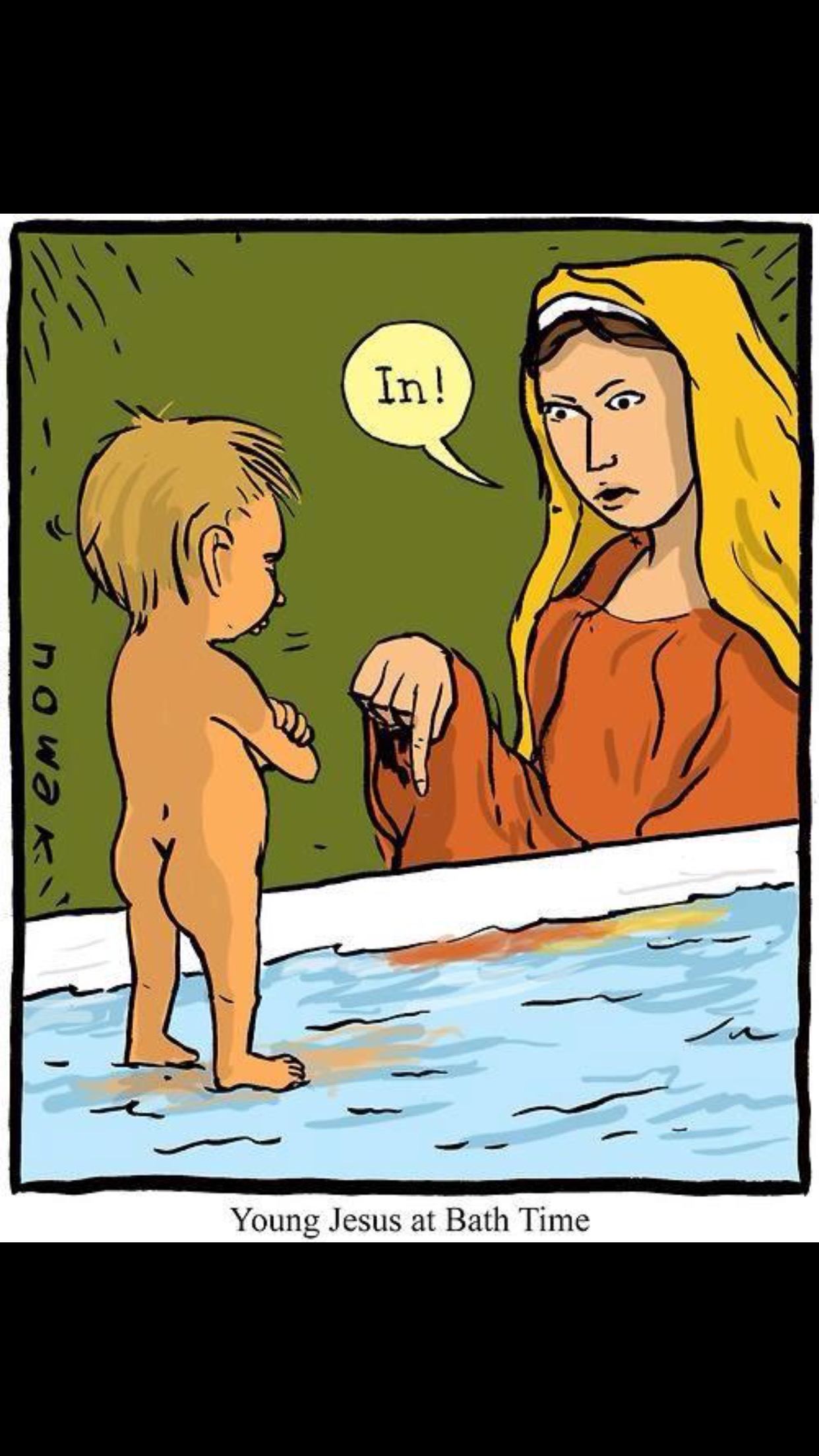
Young Jesus at Bath Time

Image

Young Jesus at Bath Time

Young Jesus at Bath Time

Talking about death and dying

Talking openly about death is a rare thing. We don’t like talking about it. We prefer it go away and stay away, like rain: “Rain, rain, go away. Come again some other day.”

When someone dies, it’s often said they’ve passed, passed away, or passed on, a sentiment dating back to a Greek idea of the immortality of the soul. It was/is assumed the soul at death is set free from its mortal cage to live forevermore.

The likes of Barbara Brown Taylor, of whom I consider myself one, have different idea. “Matter matters,” she says. Flesh and blood matter. Flesh, blood, and matter matter. Christians, following the older view of the Hebrew Bible, do not share the belief in a part of us – a soul – that survives our mortal frame. Instead, we profess a curious hope that affirms the essential goodness of corporal existence. Belief or hope in the resurrection of the body may seem even stranger than the immortality of the soul.

I have no more reason to believe in the resurrection of the body than I do to believe in an immortal soul. Watching the life go out of my dogs, I did not imagine some invulnerable part of them leaving their bodies to pass on to some other state of being. They were dead. I cried. I grieved. I mourned their loss. I never thought I would see them again. If they, or we, had a future, it seems more natural, so to speak, to think of them in their bodies all over again.

But which body would it be? Would Maggie, our West Highland White Terrier-Bichon Frise, be the playful pup or the one with the tumor on her hip? Would I be the 73 year-old me, the new-born me, or the teenager with the raging hormones?

Passing away has always made more sense to me than passing or passing on. “You are dust and to dust you shall return” makes better sense to me. The Earth will go on, as will those I love … for a time … but not forever, so far as any of us really knows. I say the Nicene creed on Sundays and ponder what it means to say “I look for the resurrection of the body and the life of the world to come.” The world to come, so far as I can tell, is the Earth where Cecil the lion doesn’t get killed by a dentist, and the lion and the lamb…and the dentist…lie down together in peace and hurt one other no more.

My friend Steve talks openly about death and dying. “I’m dying,” he says, not with a morose or maudlin sensibility but as a fact. It’s not a great surprise to him. Would he and we prefer the rain to go way and come back some later day? You bet. But it won’t, and even it if would, it would be back some other day. There’s great grace in the acceptance of death and the maturity to speak of it aloud, enjoy old friends when one can, laugh and cry and hug and kiss those one loves.

That we would want something more or fear death as the end is part of being human. The time of death is not time to debate philosophy or theology. It’s time for compassion, and for grace and courage to recognize our creatureliness – the distinction between every creature and the Creator, mortal life and the Immortality, the finite and the Eternal.

– Gordon C. Stewart, Chaska, MN, Dec. 29, 2015

Distribution of Wealth according to the Sages

“An imbalance between rich and poor is the oldest and most fatal ailment of all republics.” –Plutarch, ancient Greek biographer [c. 46 – 120 CE].

“The disposition to admire, and almost to worship, the rich and the powerful, and to despise, or, at least, to neglect persons of poor and mean condition is the great and most universal cause of the corruption of our moral sentiments.” – Adam Smith, Scottish political economist, author, The Wealth of Nations, father of capitalism [1723-1790].

“The poor have sometimes objected to being governed badly. The rich have always objected to being governed at all.” –G. K. Chesterton, English essayist (1874-1936)

“So distribution should undo excess, and each man have enough.” William Shakespeare, King Lear, Act 4, Scene 1.

“In the long run men inevitably become the victims of their wealth. They adapt their lives and habits to their money, not their money to their lives. It preoccupies their thoughts, creates artificial needs, and draws a curtain between them and the world.” – Herbert Croly, U.S. political philosopher [1869-1930].

“No person, I think, ever saw a herd of buffalo, of which a few were fat and the great majority lean. No person ever saw a flock of birds, of which two or three were swimming in grease, and the others all skin and bone.”–Henry George American political economist [1839-1897].

“The greatest country, the richest country, is not that which has the most capitalists, monopolists, immense grabbings, vast fortunes, with its sad, sad soil of extreme, degrading, damning poverty, but the land in which there are the most homesteads, freeholds — where wealth does not show such contrasts high and low, where all men have enough — a modest living— and no man is made possessor beyond the sane and beautiful necessities.” –Walt Whitman [1819-1892].

“We can either have democracy in this country or we can have great wealth concentrated in the hands of a few, but we can’t have both.” –Louis Brandeis, U.S. Supreme Court Justice [1856-1941]

“The form of law which I propose would be as follows: In a state which is desirous of being saved from the greatest of all plagues—not faction, but rather distraction—there should exist among the citizens neither extreme poverty nor, again, excessive wealth, for both are productive of great evil . . . Now the legislator should determine what is to be the limit of poverty or of wealth.”–Plato, Greek philosopher [427-347 B.C.E.]

“He has brought down the mighty from their thrones and exalted those of humble estate; he has filled the hungry with good things, and the rich he has sent away empty.” – Mary, mother of Jesus of Nazareth, Christian Scripture, Gospel of Luke 1:52-53.

  • Gordon C. Stewart, Chaska, MN, Dec. 29, 2015.


An NRA Christmas

But Mary was much perplexed by his words and pondered what sort of greeting this might be. The angel said to her, “Do not be afraid, Mary, for you have found favor with God. Conceal and carry!

Luke 1: 26-28  NRAV [National Rifle Association Version]

  • Gordon C. Stewart, Chaska, MN, Dec. 22, 2015

“Do not be afraid”

A sermonic reflection for the Fourth Sunday of Advent, Dec. 21, 2014, Gordon C. Stewart.

Text: Luke 1:26-38

El_Greco_044-medium-3

The Annunciation {El Greco]

Mary has every reason to fear the appearance of Gabriel. Every demure depiction to the contrary, the Angel Gabriel’s “annunciation” to Mary is no private affair. It’s a public matter of the first order. According to tradition’s lore, Gabriel is the archangel commissioned to destroy the offspring of the rebellious angels and human women. (see below). Mary shrinks back.

“Do not be afraid,” says Gabriel.

Why should she not be afraid? This is not just any angel.

This is the Angel Gabriel, whose trumpet will summon the people, sweep away the occupation forces that substitute their rule for the Kingdom of love and delight. This is an angel of revolution. The Archangel of conflict who inspires both hope and fear.

”Do not be afraid!”

El Greco’s painting of the Annunciation illustrates the problem of textual interpretation. Gabriel’s appearance is not frightening. It’s feminine. Even to the point of appearing perhaps pregnant himself. The great masters did not paint an angel messenger as male, even when his name is Gabriel or Michael, the only two angels named in Holy Scripture.

Gabriel in Hebrew means “God is my Warrior”. Gabriel is a warrior angel, announcing to Mary that she too is to become a warrior, a mother whose birth-giving will lead to conflict with the Empire and the religious authorities who collaborate with it.

As described by New Testament scholar Carol Newsom, any annunciation by Gabriel inspires fear.

In the Book of Daniel, Gabriel is preeminently an angel of eschatological revelation. He is sent to Daniel to explain a vision of ‘the time appointed for the end’ (Dan. 8:15-26)…. Gabriel’s functions are more varied in I Enoch. In the Book of the Watchers (I Enoch 1- 36) he is listed as ‘the one of the holy angels who is in charge of paradise and the dragons and the cherubim (20:2). He is commissioned to destroy the offspring of the rebellious angels and human women (10:9-10)….

In the War Scrolls from Qumran (IQM) the names of 4 archangels, Michael, Gabriel, Sariel, and Raphael, are written on the shields of the 4 towers of the army. The positioning of the 4 archangels around the throne of God or other sacred space has a long subsequent history in both Jewish and Christian tradition…. [Carol Newsom, “Gabriel.” The Anchor Bible Dictionary, Vol. 2]

So why does Gabriel look the way he does in the art museums and literature of Christian interpretation? Why does Gabriel look so benign? And why does Mary look so calm, perhaps even demure, as in El Greco’s Annunciation?

The Jesus story has been neutered. The End Time has been re-interpreted by the Constantinian Church as a paradise beyond time, a state of afterlife, not this life. In no way political. In no way economic. In no way conflictual. Peaceful. Serene. Calm. Quiet. Passive. “Let it be to me according to your word.” Never disquieting. Never disrupting. Never revolutionary.

Gabriel has been transformed, neutered, rendered harmless by the Constantine religion whose adherents can no longer see the conflict between Christ, or his mother, Mary, and his father, Joseph, with the systems of unbridled greed and poverty under which they live. The Gabriel spoken of in most pulpits is not the Angel Gabriel that came to Mary.

We’ve re-created Gabriel in our own image. But though we may tame him in our hearts, our paintings and our sermons, we can erase neither the need to be afraid nor his invitation to fear not. Gabriel’s finger points at us, asking whether we will rally to the trumpet sound, the sound of his coming. We can repaint the young girl Mary as an icon of passive obedience and tranquility. But it will be a different Mary than the courageous one painted by the Gospel of Luke, the one who sings the Magnificat.

Luke and his Mary know that “Do not be afraid!” makes no sense unless there really is something to fear, and that we cannot overcome fear unless we hear Gabriel’s word of favor, “Hail, O favored one! The LORD is with you. Blessed are you among women…You shall conceive….”Do not be afraid…. For with God nothing will be impossible.”

“Then Mary said, ‘Here am I, the servant of the Lord; let it be to me according to your word.’

“Then the angel departed from her” for parts unknown to make his visits down through the ages, making the impossible possible. Word has it he appeared last week in Washington, D.C. and Havana, Cuba to turn the impossible into the possible, a new Order being born from the old.

If you listen with faith, you might hear him. If you look, you will see him.

  • Gordon C. Stewart, Chaska, MN, Dec. 22, 2015