Video: “The Bouquet”

Click HERE for the YouTube broadcast of last Sunday’s sermon at Shepherd of the Hill Presbyterian Church in Chaska, MN. The sermon text is published on this blog as “The Biouquet” and on the Sojourners blog, blogging with Jim Wallis.

Investigation of Trayvon Martin Case

The Churches of Christ Uniting (CICU) – an ecumenical group of churches – issued this statement calling for a full, impartial investigation into the shooting of Trayvon Martin in Sanford, FL.  Members churches of CICU are the Presbyterian Church (USA), the African Methodist Church, the African American Episcopal Zion Church, the Christian Church (Disciples of Christ), the Christian Methodist Episcopal Church, the Episcopal Church, the International Council of Community Churches, the Moravian Church Northern Province, the United Church of Christ and the United Methodist Church.

Click here for the news release by the Presbyterian Church (USA): “Any of our black and brown children could be Trayvon Martin.

“Trayvon Martin and the Hoodies,” my commentary on the matter, was posted here yesterday.

Leave your comment here. And thanks for coming by. Gordon

Cuban Altar Boys, the Pope, and Occupy

Pope Benedict has called for political reform in Cuba. The Cuban government has refused the request.  It continues to insist on one party rule.

Ninety miles away, here in the U.S., we have Occupy because an oligarchy has stolen the rule of the people. (“They may squirm in hearings, but Wall Street oligarchs know who has the power“.) The Supreme Court’s ruling has given the green light for some of the people (i.e. corporations) to rule the airwaves with the unlimited spending that buys elections “of the people, by the people, and for the people.” Which people? Follow the money and you will see the illusion that America is a democracy. We have hoods over our heads.

We’re an oligarchic society. For all intents and purposes we live under the rule of the few, for the sake of the few. Fewer and fewer of the crumbs in Jesus’ parable of the poor man Lazarus are falling from the rich man’s table.

Why would Raul and Fidel Castro, two former altar boys, and the Cuban Communist Party refuse to open up the Cuban political system?

One need only review the history of Cuba prior to the revolution for their reasoning. I’ve had this conversation. I had it in 1979 in Cuba, and I had it in 1966 in Czechoslovakia behind the Iron Curtain. See yesterday’s post (The Wafer and th Loaf: the Pope and Raul Castro)

The Iron Curtain was altogether different from the Cuban embargo. The Iron Curtain was raised from the other side of the fence. It was put up by what we then called the Eastern Bloc, not by us in the West, while the Cuban embargo, the Iron Curtain meant to strangle the success of the socialist experiment, was built by the U.S.  Against all odds, Cuba has survived without access to the world’s largest market 90 miles to the north.  Somehow or other, against all odds, Cuba defended itself successfully against the giant to the north’s invasion at Playa Giron, “the Bay of Pigs”. It has lived ever since in fear of its northern neighbor, especially its ex-patriot Cuban business class in Florida that led the Bay of Pigs Invasion. Now Pope Benedict is urging the Cuban government to open up the political process, to expand political freedom.

Partly it’s a matter of perception.

Here in the West we decried the Iron Curtain as the means of dictatorial regimes to keep people in East Germany from fleeing to West Germany. To us the Berlin Wall was a prison wall intended to keep people from fleeing to freedom.  As seen by the Czechoslovakian family with whom I lived during the summer of 1966 and by the students at the university in Bratislava, the Iron Curtain served an altogether different purpose. It wasn’t to keep them in. It was to keep us out. They believed in the egalitarian society they were hoping to create. The Wall had been raised to wall out the corrosive influences of Western materialism, the power of money that is capitalism, the culture of greed, the survival of the fittest, the culture of selfishness.

Today Cuba is poor. Or is it? How do we measure poverty…or wealth?

Prior to the Cuban revolution led by Fidel Castro and Che Guevara, two former altar boys, Cuba was the U.S.’s source of sugar. The sugar came from sugar plantations owned by American Sugarwhose American elites and their Cuban partners gathered for lavish vacations on the white sands of Varadero Beach.  The American one-percent was reaping the profits and lying on the beach with their Cuban corporate friends at Varadero. It made no difference to them that the literacy rate of the Cuban people was among the lowest in the world.  The vast majority of the people could neither read nor write. It didn’t seem to matter to the elites or to Batista, the Cuban dictator whose government they had bought and paid for.  The vast majority of Cubans – those who spent their days cutting sugar cane on the large plantations, peasants who scratched out a living with a few chickens and pigs, and those who worked in the tourist industry in Havana and at Varadero Beach – had no health care, no dental care, and no safety net other than the Church’s charity. It was an island of economic injustice relieved by episodic acts of religious charity.

In short, Cuba was an oligarchy.

If Cuba “opens up” the way the Pope and most Americans believe they should, Cuba will very quickly become again the place it was before the former altar boys came down from the mountains to ousted Batista and American Sugar.

Is Cuba poor? Is America poor?  Cuba has had universal health care for longer than the US. Has had the Civil Rights Act. No one goes without seeing a doctor.  Its literacy rate is one of the highest in the world because of its government’s commitment to education and literacy for all its citizens.  Here at home a conservative U.S. Supreme Court is weighing arguments that could turn back America’s closest thing to universal health care, and the literacy rate is dropping, the prison population is mushrooming with school dropouts who can’t read or write. Those who can afford it, move their children out of the public schools into private schools.  The gap between the haves and have-nots widens every day. And the people on Wall Street who keep the rest of us living in the illusion that our future security rests with the interests of the oligarchy is as tall and thick as it ever was.

During his trip to Cuba Pope Benedict not only called for reforms in Cuba. His words also pointed north to the U.S. and the system that enshrines private capital and greed rather than God as the central principle around which Western societies are organized.  Pope Benedict denounced the ills of capitalism, as he has done repeatedly.

Benedict bemoaned a ‘profound spiritual and moral crisis which has left humanity devoid of values and defenseless before the ambition and selfishness of certain powers which take little account of the true good of individuals and families.’” (Nicole Winfield and Andrea Rodriguez, Huffington Post, 3/27/12).

The calls to open up the political system, on the one hand, and to end the ills of capitalism, on the other, are twin calls that echo 90 miles to the north as well as across Cuba.  We live in a closed system where the ills of capitalism turn the Constitutional rights and freedoms of a representative people’s democracy into a money game, a single-party oligarchy in which the one-percenters put hoods over our heads while they look forward to the installation of another Batista, the day when the can join their friends again on the white sands of Varadero Beach.

Trayvon Martin and the Hoodies

The Washington Post updates the story of 17 year-old Trayvon Martin’s death in Florida with an interview with Trayvon’s parents, Sybrina Fulton and Tracy Martin.

Family picture of Trayvon Martin“Martin and Fulton said they are moved by the outpouring of support from people across the nation. They said they were particularly touched by  the actions of Rep. Bobby L. Rush (D-Ill.), who on Wednesday donned a gray hoodie and sunglasses and spoke from the floor of the House of Representatives about the need for a full investigation of the death.

“I applaud the young people all across the land who are making a statement about hoodies, about the real hoodlums in this nation, specifically those who tread on our law wearing official or quasi-official cloaks,” Rush said on the House floor.

“Racial profiling has got to stop,” he said. “Just because someone wears a hoodie does not make them a hoodlum.”

As he spoke those words, he removed his suit jacket and lifted the hood over his head. Rep. Gregg Harper (R-Miss.), presiding over the floor as Rush delivered his remarks, began to gavel almost immediately. Shouting over Rush, who began to recite Bible verses, Harper said the congressman was out of order for donning the hood. Rules bar House members from wearing hats in the chamber. Rush was then escorted from the floor.

Race and hoods in America never go away. Hoodies have a long history. Sometimes those who wear the hoods wear them by choice; sometimes the hoods are put over their heads. Occasionally those who wear them are ushered out while they recite Bible verses…or sing a hymn, like the 38 Dakota men hanged in a mass execution following “the Sioux Uprising,” as they called it then in 1862, at  Mankato, Minnesota.

Douglas A. Lindner provided this eye-witness account in The Dakota Conflict Trials:

In Mankato, at ten o’clock on December 26, thirty-eight (one person was reprieved between the date of Lincoln’s order and the execution) prisoners wearing white muslin coverings and singing Dakota death songs were led to gallows in a circular scaffold and took the places assigned to them on the platform.  Ropes were placed around each of the thirty-eight necks.  At the signal of three drumbeats, a single blow from an ax cut the rope that held the platform and the prisoners (except for one whose rope had broke, and who consequently had to be restrung) fell to their deaths.  A loud cheer went up from the thousands of spectators gathered to witness the event. The bodies were buried in a mass grave on the edge of town.  Soon area doctors, including one named Mayo, arrived to collect cadavers for their medical research

Last night a Lakota friend filled out the story. According to Wally Ripplinger, the men on the gallows were singing a Dakota hymn, as they had done throughout the day. They were singing in unison, under their hoods, of their impending release into Paradise. It might have sounded something like this. Click below to listen.

I cast my vote with the Dakota and Lakota singers, Trayvon Martin, the lynched victims of hooded Klansmen, and the rebellion leader (mis-labeled by tradition as “the thief” – he was not a thief!) executed along with Jesus, who heard the words of divine mercy that would be remembered long after a Roman public execution: “Today you will be with me in Paradise.”

The Wafer and the Loaf: the Pope and Raul Castro

I woke up this morning to read “Pope calls for ‘justice, peace, freedom and reconciliation’ in Cuba. He was greeted by Cuban President Raul Castro, who promised religious freedom in his Communist nation.”  What follows is my reflection on this piece in light of three weeks in Cuba in 1979..

Curious. The headline and the story are curious.

Pope Benedict arrives in Santiago, Cuba. In Mexico he has just criticized Cuba’s Marxist model as obsolete and has called for a future of “justice, peace, freedom and reconciliation” in Cuba.

The President of Cuba, Raul Castro, welcomes the pontiff to Cuban soil.

The media focuses on the Pope’s call for change in Cuba, on the one hand, and Mr. Castro’s promise of  religious freedom in Cuba, as though the latter were a new development.

In 1979, on the heels of the Catholic Bishops Conference in Puebla, Mexico, I spent three weeks in Cuba, one of 75 churchmen and theologians invited by the Evangelical Theological Seminary of Matanzas, Cuba and the Presbyterian-Reformed Church of Cuba.

Most of the guests were from Central and South America. Others were from France, East and West Germany, Rumania, the Soviet Union, Mozambique, Angola, South Africa, Zimbabwe. There were four of us from the U.S: Professors Harvey Cox, , Robert McAfee Brown and a tag-along practicing pastor and college chaplain from Wooster, Ohio.

What do I remember most about that trip? Five memories:

________________________________

1) Approaching Cuba from the air, looking down at this island 90 miles from the coast of Florida, asking how this little David had managed to slay Goliath at the Bay of Pigs, and wondering what was so threatening to us that the U.S. government continued to punish it with an economic embargo. I felt like a bully. Guilty. Ashamed. Humble.

2) Getting sick on a collective farm, sitting under a tree after drinking a complementary glass of banana juice. I was quickly tended to by Cuba’s medical and pharmaceutical system. They continued to check on me until all was well. Everyone gets health care.

3) The Cuban pastors’ response to a long breast-beating speech by Robert McAfee Brown, one of the foremost theologians in the U.S.  Brown spent 45 minutes in a biblically based sermon apologizing to the Cubans, a kind of cathartic confession in full public view. I was with him all the way. The Cuban response? Stop that. You didn’t do this. The American people haven’t done this to us. Your government has. Wallowing in guilt won’t help you and it won’t help us. We all need to find ways to promote justice and peace in our own contexts. We are all here as friends, brothers and sisters in Christ.

4) Walking through the streets of Matanzas in the evening. Children playing freely in the streets. Windows and doors wide open. Neighbors talking and laughing with next-door neighbors. This could not be staged. This was the real Cuba.  As Harvey Cox, the charming professor from Harvard Divinity School who is fluent in Spanish, led the three of us through the streets, children followed him like the Pied Piper. Harvey would laugh with them and they with him. We would sing and walk. It was playful, like nothing that was happening back home.

5) A conversation with Communists on the veranda of the home of the President of the seminary. Raul Castro was among them. They were there to welcome us to Cuba. They also wanted to talk theology and society. They wanted to know what we really believed about God, about the Kingdom of God, and about social justice and economic equality. I don’t remember his name now, but I do remember the long one-on-one conversation during that cocktail hour with a member of the Communist Party. He had grown up Roman Catholic but was no longer a believer. The Church, he said, had kept the people in their place before the revolution. The Party had raised them up to believe in themselves. The Church had given them a wafer; the Party gave them bread, real food, real nutrition. The Church proclaimed the Kingdom of God after you die; the Party proclaimed a society of justice and peace that could be achieved in this world.

He asked what I thought. I told him that the version of Christian faith that he had described was not my faith. It was something else, but it was a very popular distortion of the life and teaching of Jesus. I told him that I shared his hope, that what he called “the classless society” I called the Kingdom of God, and that, to the extent that we were each working for the elimination of poverty, the end of starvation, and the health and joy of all God’s children, we were working toward the same goal under different names.  I rehearsed my history of Christian-Marxist dialogue dating back to seminary and the summer of 1966 living in Bratislava, Czechoslovakia as the Experiment in International Living Chicago Ambassador to Czechoslovakia. I told him of Josef Hromadka, the Czech theologian who had begun this dialogue because, said Hromadka, there was only one reason that the Bolshevik Revolution was atheistic: the sin of the Church. Its failure to align with the poor rather than the rich. The Church and the Czar had become of one cloth, just as he had been describing. The Church was giving people nothing but a wafer; the bread would come only after death. Lenin and Trotsky were insisting that to be genuinely human was to eliminate the economic structures that produce poverty and despair and that delay the distribution of real bread until an afterlife. Like Marx, they saw religion as the opiate of the people, the ideological blanket that blinded people to their earthly reality. But the biblical Kingdom is not about the Church, it’s about the new society in which the love of God reigns everywhere. It’s the NEW city, the new Jerusalem, and, in that new city, there is no longer any temple. There is no longer any need for the church because the Kingdom has come.”

The man from the Party’s eyes were wide.

I asked the man on the veranda where he thought his hope for such a society came from. “I don’t know,” he said, “I think it’s just part of being human.” “Yes,” I said, “but why? How’s that hope get there? Why should we hope unless there is something in being itself, something in the deepest part of us, that holds out the promise of its fulfillment, an inner sense that beckons us beyond the present conditions? The name for me is God.  None of us has ever seen God, yet I see God in Jesus of Nazareth, a worker, a carpenter, preacher of the Kingdom of God. I hear in your visions an echo of the Sermon on the Mount. I get the clearest sense of it when we share the meal at the Lord’s Table, the sign of the Kingdom.  The Kingdom will not come by Prometheus stealing fire from the gods. We have to work for it, but we also ‘wait for it with patience.’”

“Thank you, I’ll have to think more about that. You sound like Jose.” There’s a long pause. “Well…We’ll have to wait and see. I guess only time will tell who’s right,” he said. Like Harvey and the kids on the street that evening, we shared a good laugh, shook hands, and moved on to another conversation.

_____________________________

It’s now 33 years later and I’m reading about Raul Castro’s “promise” of religious freedom, the very same Raul Castro who was on the veranda at the seminary, who graciously welcomed the guy with the wafers to Cuban soil, except for kissing his ring. Priests and lay people from throughout Cuba throng to the site. None of them is hungry for bread.

Curious…for a country with no religious freedom. Don’t you think?

The Religious Parade: Unreal and Real

Click HERE to read and view the photos of religion on the campaign trail in Michael Gerson’s opinion piece in this morning’s Washington Post. Comment below to generate the discussion her.  But…before you do…ponder Steve Shoemaker‘s “The Donkey”  sent to me this morning in preparation for Palm/Passion Sunday.

THE DONKEY (A Children’s Verse)

The coats the folks are throwing down

sure make it hard for me to walk

especially carrying this clown

whose feet are almost to the ground.

“Hosannah King!” is all the talk,

but this guy seems to be as poor

as I am–no one could mistake

him for a Royal–he’s just a fake!

They wave palm branches, and they roar,

but my long ears can hear the real

parade across the city square:

the General, the Priests, the score

of war horses–the whole grand deal.

This pitiful parade will fail

to save a soul, and soon the yell

will change from “Hail!” to…”Kill!”

The Bouquet

Re-posted by Sojourners’ blog, “God’s Politics with Jim Wallis” March 27, 2012.

Most every Sunday Ruth or Lily Janousek hands me a drawing on the way out the door. I have quite a collection.  Lily and Ruth are budding theologians. They may not know that about themselves, but that’s what they are: budding theologians – they do theology, they do their best to speak of God.

They draw pictures of God and us. Like the one from last Sunday. The drawing of a bouquet with the words:

“God doesn’t loves us as a flower but as a bouquet”

Right then and there, standing at the door last Sunday, I knew I had the sermon for the next week in my hand.

Ruth’s drawing took me back some years ago when I had the great privilege of serving as the summer minister for Saint Timothy’s Memorail Chapel in Silver Cross, Montana, a ghost town with four residents where they would bring the world’s greatest preachers!  One of the four residents of Silver Cross was the 92 year old Eliza who lived up the hill, perhaps the length of a football field, from Saint Timothy’s . Every Sunday morning Eliza would cut the wildflowers in her yard, arrange them into a beautiful bouquet and place them on the altar for worship. Now I get a drawing from eight year old Ruth, younger version of the 92 wilting theologian, Eliza.

“God doesn’t love us not as a flower but as a bouquet.”

I wonder who the flowers are in this bouquet, the Kingdom of Heaven, as Jesus speaks of it in the Beatitudes of the Sermon on the Mount (Matthew 5:1-14) or, the Body of Christ, as Paul speaks of it in First Corinthians.

As in Ruth’s drawing and Eliza’s Sunday morning arrangements, a bouquet is made up of a variety of flowers. Individual flowers come in a single size and shape, eac with its own color. In a bouquet, these different colors, shapes and sizes complement and contrast with one another to make something altogether beautiful in the hand of a skilled florist.

Ruth may be a rose and Lily a sunflower, Bob might be a purple Iris, and I might be…a Milkweed or a thistle or a twig of red oshier – but put us all together and we become something more than who we are.

God loves us as a bouquet. We are God’s bouquet. We are the flowers; God is the florist; we belong in God’s bouquet.

Could this be what Jesus is talking about in the Sermon on the Mount?  Could the collection in Jesus’ Beatitudes be the bouquet, the Kingdom of Heaven?

Listen to the florist’s strange list of flowers in this bouquet:

Blessed are the poor in spirit;

Blessed are those who mourn;

Blessed are the meek,

Those who hung and thirst after righteousness,

The merciful, the pure in heart,

The peacemakers,

Those who are persecuted,

Those who are slandered against for doing what’s right.

“You are the city set on a hill that cannot be hid. the bouquet that cannot be ignored.”

Until this morning, I had always thought of these individual beatitudes as a description of the individual life of the disciple of Jesus. But to think of them that way is depressing because it’s unachievable.

In a former pastorate I used to visit four young men in psychiatric institutions whose demented states of mind I was sure were rooted in some way to their failure to measure up to this impossible spiritual standard. Each of them was a professor’s son. Each of them had been raised on a missionary style of Christianity. Each of them had been raised to feel sorry for the persecuted, the meek, the poor, the oppressed. And each of them, as we walked the grounds of the psychiatric hospital in Mansfield, would talk as though he should be able to save the world from its pain. Each of them seemed to believe that purity of heart meant being like Jesus – which meant to them incessant suffering, guilt, and sorrow.

Each of these brothers bore the marks of the Beatitudes. Each was poor in spirit. Each hungered and thirsted for justice. Each was merciful. Each was pure in heart. Each felt persecuted for pursuing what was right in a world that didn’t care or didn’t know. Each of them felt slandered for doing what their parents – and Jesus – had taught them to do.

But there was one quality that was missing: the quality of meekness…

So long as they lived in the illusion that they, as individuals. were responsible for the world as It was, or that each of them alone was responsible for ridding the world of its suffering, each of them was lost in the lonely world of a flower without a bouquet. So long as they embraced the twisted missionary moralism of their distorted Christian upbringings, they would suffer the horrors of shame and loneliness.

Now, I know, of course, that each of the four brothers I visited back then were mentally ill. They didn’t choose to be in the state psychiatric institution. But I also knew their parents. And I knew the church in which they had been raised. It came as no surprise to me that there seemed to be a profound connection between what I was hearing from the homes and the church of their upbringing and what I was hearing form their sons in the psychiatric hospital.

I have to admit to sharing in the twisted spirituality that saw the Beatitudes as a list of requirements for the Christian life. It’s made me sick along the way.

But this morning, in light of Ruth’s yellow card from last Sunday, I’m seeing them differently.

“God loves us not as a flower but as a bouquet.”

Not every flower in God’s bouquet is poor in spirit. Not every one of us is in mourning. Some of us got up this morning with smiles on our faces and a song in our heart. Not every one of is meek.  Not everyone came here this morning hungering and thirsting for righteousness – some of us came out of habit; some of us came for comfort, some of us came to sing some hymns. Some of don’t know why we came. Not everyone is known by acts of mercy – we come with grudges and desires for retribution. Not everyone is pure in heart or a peacemaker. And almost of none of us is being persecuted as advocates for social justice.

But TOGETHER all of those blessed people are here in God’s Bouquet.

Makes me wonder whether Jesus had read the Bhagavad Gita, the Hindu scriptures of India written two to five centuries before he preached the Sermon on the Mount in Palestine. Listen to its familiar ring, and let the Florist place you in the vase of God’s remarkable Bouquet.

“I am the Self…seated in the heart of every creature. I am the origin, the middle, and the end that all must come to.

“All your thoughts, all your actions, all your fears and disappointments, offer them to me, clear-hearted; know them all as passing visions.

“Thus you free yourself from bondage, from both good and evil karma; through your non-attachment, you embody me, in utter freedom.

“I am justice; clear, impartial, favoring no one, hating no one. But in those who have cured themselves of selfishness, I shine with brilliance.

“Even murderers and rapists, tyrants, the cruelest fanatics, ultimately know redemption through my love, if they surrender

“To my harsh but healing graces. Passing through excruciating transformations, they find freedom and their hearts find peace within them.

“I am always with all beings; I abandon no one. And however great your inner darkness, you are never separate from me.

“Let your thoughts flow past you, calmly; Keep me near, at every moment; trust me with your life, because I am you, more than you yourself are.”

Seeing the crowds, Jesus went up on the mountain, and when he sat down, his disciples came to him. And he opened his mouth and taught them, saying:

Youtogether – are the salt that preserves the earth from its own self-destruction.

“You – together – are the city set upon a hill that gives light to the world.”

We together – each and all – are God’s bouquet. God loves us as a bouquet!

Sermon: “Blogging on the Cross”

Sermon, Shepherd of the Hill Presbyterian Church, Chaska, MN March 18, 2012.

Click HERE for the YouTube re-broadcast.

The Surrogate Voice

Some moments last a lifetime.

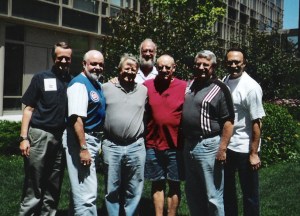
Chicago Seven - Dale Hartwig in red shirt

My friend Dale has Parkinson’s. He has boarded a train in Michigan (he’s now in a long-term care center there) to be with “The Chicago Seven” – the seven former classmates who gather annually at McCormick Theological Seminary. This year, Dale’s speech is hard to comprehend. He is reduced to listening. Death and dying are sitting at the table.At the morning reflection and round-table sharing, Dale is sitting to my right. When his turn comes, we look at Dale. There is an awkward silence. He hands me something. He wants me to read aloud what he’s written. I read his words aloud.

Gordon C. Stewart  – written in thanksgiving for the Chicago Gathering, 2004:

“THE SURROGATE VOICE”

The surrogate voice reads on,

the author sits and sobs

wrenching tears from primal depth:

from some abyss of joy or nothingness…or both.

The author’s sighs and piercing sobs

arrest routine,

invoke a hush,

dumb-found the wordy room.

He cannot speak,

his Parkinsons’ tongue tied,

his voice is mute, in solitude confined,

all but sobs too deep for words.

Another now becomes his  voice

offering aloud in a dummy’s voice

the muted contribution

in poetic verse the ventriloquist’s voice has penned.

The abyss of muted isolation ope’d,

his words, re-voiced aloud,

hush the seven to sacred silence,  all…

except from him, their author.

Whence comes this primal cry:

From depths of deep despair and death,

from loneliness, or depths of joy

We do not know.

The surrogate voice reads on

through author’s signs and sobs,

through his uncertain gasps for air

and our uncertain care.

The iron prison gates – the guards

of his despair – unlock and open out

to turn his tears from prison’s hole

to tears of comrade joy.

His word is spoken, his voice is heard,

a word expressed

in depth and Primal Blessing,

pardoned from the voiceless hell.

The stone rolls back,

rolls back, rolls back,

from the brother’s prison’s tomb,

the chains of sadness snap and break!

At one, at one, we Seven stand,

in Primal Silence before the open tomb,

as tears of loss, of gain, of tongues released

re-Voice unbroken chords of brotherhood.

 All moments are sacred. Some last a lifetime.

It’s Raining, It’s Pouring

Today, three years to the day after Katherine’s (“Katie’s”) death (May 9, 2010), we inter her cremains, an appropriate time to re-post the effect of Katie’s illness along the way. This is a re-posting of a piece written along the way of Katie’s illness.

I wrote this piece when we learned that my stepdaughter Katherine’s incurable Leiomyosarcoma had taken a turn for the worse. In memory of Katherine (“Katie”) Elizabeth Slaikeu Nolan.

Gordon C. Stewart   Feb. 11, 2009

It’s raining, it’s pouring
The old man is snoring
He went to bed and he bumped his head
And couldn’t get up in the morning

It’s a day like that.  I bumped my head on the illness of a 33 year-old loved one.  It’s raining sadness. I’m having trouble getting out of bed in the morning.

Terminal illness has a way of doing that unless you believe in miracles of divine intervention or you have extraordinary powers of denial.

My spirituality has become increasingly like that of Rebbe Barukh of Medzobaz, an old Hasidic master in Elie Wiesel’s tale of Four Hasidic Masters and Their Struggle Against Melancholy.  When he prayed the customary Jewish prayer, “Thank you, Master of the Universe, for your generous gifts – those we have received and those we are yet to receive” – he would startle others with his weeping.  ‘Why are you weeping?” one of them asked.  “I weep,” he said, “in thanksgiving for the gifts already received, and I weep now for the gifts I have yet to receive in case I should not be able to give thanks for them when they come.”

For my family at this critical time, the real miracle has already occurred – the shared gift of love – and it will come again in ways I cannot now anticipate when the last page of the final chapter of our loved one’s life is over.

The miracles are more natural, nearer to hand.  Although I don’t believe in selective divine intervention, I am on occasion a sucker for denial – except on days like this when it’s raining and gray and I’ve bumped my head on the hard fact that cancer is ransacking my loved one’s body.  A certain amount of denial, too, is a blessing in disguise, one of God’s generous gifts to keep us sane when the rain pours down and clouds are dark.

Faith comes hard sometimes.  In college mine was challenged and refined by Ernest Becker‘s insistence that the denial of death lies at the root of so many of our problems.  My faith has been refined along the way by the courage of Albert Camus and Jean-Paul Sartre to face the meaninglessness of the plague, the faith and courage of Dietrich Bonhoeffer and Paul Tillich who stuck their fingers in the gears of Nazism, and the humble witness of Mother Teresa working in the slums of Calcutta with more questions than answers and some anger at God.

The job of faith, as I see it, is to live as free as possible from illusion with a trust in the final goodness of Reality itself, despite all appearances to the contrary.  Faith is the courage and trust to look nothingness in the eye without blinking or breaking our belief in the goodness of mortal life.

When I look into my loved one’s eyes I see that courageous kind of faith that defies the cancer to define her, and a resilient spirit that makes me weep tears of joy over the gifts we’ve already received and the ones we have yet to come.

It’s still raining and it’s still pouring, but I refuse to snore my way through this.  I’ve bumped my head on the news of a loved one’s terminal illness, but I’m getting up in the morning.

POSTSCRIPT March 21, 2012

Conversation yesterday about “The List” posted on Bluebird Boulevard:

Karen:

My mother died of cancer eight years ago. Her loss is still visceral. She is in every bird I see.

Me:

The morning of Katherine’s memorial service Kay, Katherine’s mother, was standing by the large picture window gazing out at the pond in our back yard. Out of nowhere, it seemed, two Great Blue Herons flew directly toward the window and swooped upward just before they got to the house. “She’s here. That’s Katie,” said Kay without a second’s hesitation. On her last day of hospice care, Kay and I each remarked that her face looked like a baby bird. I’m a skeptic about such things. I’ve always been, and always will be, a  doubting Thomas. My assumptions and conclusions come the hard way. But on the day the herons flew directly at Kay from across the pond, I saw it with my own eyes…and HAD to wonder.

Within a minute a third Great Blue Heron perched on the log by the edge of the pond and stood alone for a LONG time.  It reminded me of a gathering on the steps of the State Capitol in Saint Paul following the tragic deaths of school children at Red Lake, MN. The crowd stopped listening to the speaker. They were looking up. “What’s going on?” I asked Richard, the Red Lake American Indian advocate and my co-worker at the Legal Rights Center.org. “Eagles,” he said. “Where?” “WAY up. They’re circling.”

I learned later that the eagles were also circling at that same moment over the grieving families gathered at Red Lake. I asked American Indian colleague what he took it to mean. “We don’t ask. That’s the white man’s question,” he said. “We just accept it. We live in the mystery.”