Unknown's avatar

About Gordon C. Stewart

I've always liked quiet. And, like most people, I've experienced the world's madness. "Be Still! Departure from Collective Madness" (Wipf and Stock Publishers, Jan. 2017) distills 47 years of experiencing stillness and madness as a campus minister and Presbyterian pastor (IL, WI, NY, OH, and MN), poverty criminal law firm executive director, and social commentator. Our cat Lady Barclay reminds me to calm down and be much more still than I would be without her.

Chicken Sh*t Sermons and Polite Company

America’s four-year presidential election cycle poses a unique challenge for churches, synagogues, and mosques, and for their priests/ministers, rabbis, and imams.

Retired after years behind the pulpit, I now take my rightful place in the pew. I come to pray, sing the hymns, listen to the Scripture readings, and hope for a word from the pulpit that speaks a powerful Word into the wordy world that has hurt my ears all week.

Like author Annie Dillard, I wear a crash-helmet to worship. I expect something to happen. I expect to be “in an accident” with the Word of God, a word that rattles my bones, awakens me from lethargic acquiescence, and—as it did to Isaiah in the temple in the year that old king Uzziah died,—fills the house with the smoke of divine majesty, shakes the foundations, and elicits Isaiah’s response. “Here am I. Send me. (I have a crash-helmet.) Send me!”

I don’t go to worship to escape. Nor do I go for a partisan rally. I go on Sunday morning for worship—to make what the psalmist called “a joyful noise to the LORD”, my only rock and salvation, and to celebrate the gospel’s transforming assurance and challenge which my own troubled heart and mindI cannot produce for myself. I need the worshiping community. I need public worship that cuts through the partisan babel that saturates America’s anxious public life. Divine worship is a public event.

But religious institutions and their leaders live on the razor’s edge between public engagement and spiritual irrelevance.The tax code’s 501c(3) status recognizes the importance of religious traditions and institutions to the health of the body politic. It also prevents them from endorsing candidates for public office, which poses an interesting dilemma for leaders adherents.

The last two weeks, worship has been down in the church I attend. I’ve wondered why.

Research shows that worship attendance soars on Sundays following national tragedies like 9/11. People need a word to console and strengthen them. In the midst of a national election campaign the likes of which we’ve never seen, one might logically suppose attendance would rise, not fall. Unless . . . .

“Unless what?” I ask myself. Unless a church’s leaders are ignoring the faithful who come into the pews wearing crash-helmets? Or unless, perhaps, the people expect from the pulpit the rancorous echoes of partisan righteousness? Or, perhaps, the worship experience itself is failing to awaken the ears of worshipers to hear the chorus Isaiah heard in the Temple in the year that the political order was at stake: “Holy, Holy, Holy Lord! God of power and might. The whole Earth is filled with your glory. Hosanna in the highest!”

I’m old. I still expect something momentous — something I don’t yet expect — to happen during worship.

The Rev. Dr. John Fry, who taught our preaching class at McCormick Theological Seminary, introduced us to crash-helmets long before Annie Dillard put the metaphor in writing. Senior Minister of Chicago’s First Presbyterian Church, John would later be summoned before The U.S. Senate Government Operations Committee’s Permanent Investigations Subcommittee, chaired by John L. McClellan (“The McClellan Committee”) because of allegations related to civil disturbances in south Chicago.

John had reached beyond the church walls to develop a relationship of trust with the gang that ruled the streets. It was John’s work that resulted in the Blackstone Rangers surrendering their guns, which were then locked in the church safe awaiting the pending truce among the Rangers, their rival gang, the Disciples, the Chicago Police Department, and the U.S. Treasury Department. When the Chicago Police Department broke terms of the agreement by shooting a disarmed gang member, the street quickly returned to its old established order. The McClellan Committee laid the responsibility, in part, on the doorstep of the Rev. Dr. John Fry and the board of First Presbyterian Church-Chicago.

The first session of our seminary preaching class is etched in our memories. John pulled the chairs into a circle to critique the student sermon we had just heard in the chapel. We commended the preacher re: matters of form, not substance: a fine introduction, good development, and solid conclusion. Then John asked,”You want to know what I think? That was a chicken sh*t sermon. The gospel cuts with a knife! Anyone who does that again in this class will get an ‘F’” We were all like chickens with our heads cut off, but we never forgot the difference between real preaching and :chicken sh*t.

John’s words have rung in our ears for 52 years. Now I sit the listening side of the pulpit, relieved of that onerous responsibility but still waiting for a word that cuts through the crap. Sometimes it comes; sometimes it doesn’t.

When it doesn’t come from the pulpit, it still comes through the Scriptures. Or it comes from a line tucked away in the Eucharistic Prayer (the prayer that precedes the Sacrament of Holy Communion), as it did yesterday:

“At the meal tables of the wealthy where he (Christ) pled the cause of the poor, he was always the guest. Unsettling polite company, befriending isolated people, welcoming the stranger, he was always the guest.”

That little line, along with the communion itself , spoke a clear word to a distressed heart and mind.. The polite company was disturbed by Christ the guest, and the service ended with a Dismissal that seemed to place Isaiah’s age-old response to God’s glory— “Here am I.Send me!” on the worshipers’ lips anew during a presidential campaign that is anything but holy:

“Take us out into the world to live as changed people because we have shared the Living Bread and cannot remain the same. Ask much of us. expect much from us, enable much by us, encourage many through us. May we dedicate our lives to your glory.”

  • Gordon C. Stewart, Chaska, MN, October 17, 2016.

Steve Shoemaker “Last” verse

“The Man Who Loved the Graves”

– Steve Shoemaker, April 24, 2012

When I was just a young and naive pastor,

an old man in the congregation

would always arrive long before the rest

of the people at the grave site. He’d shun

the funeral, but haunt the cemetery…

Standing by the open grave, he’d state

his opinion of the deceased and share

with me the type, style and brand of casket

he’d told his wife he wanted when he died.

As the morticians say, he “predeceased”

his spouse, and when we met to plan, she tried

to grant his wishes to the very last

She blessed their common gravestone with her tears,

but smiled through life for many happy years…

NOTE: Steve predeceased Nadja, the love of his life all the way back to high school.

Tonight at 7:00 p.m. CST, Nadja and a host of Shoemaker relatives and friends will gather at First Presbyterian Church of Champaign, Illinois for Steve’s memorial service followed by a dessert potluck to smile “for many happy years.”

Blessed are the dead who die in the LORD, for they rest from their labors, and their works follow them: A Sin a Week: Fifty-two Sins Are Described Here in Loving Detail for Folks With the Inclination and Ability to Do Wrong, but Who Have Run Out of Bad Ideas  Order a copy in honor of Steve and for some good ideas!

-Gordon C. Stewart, Chaska, MN, October 15, 2016


“Global conspiracy” – Psychology 101

What psychological vocabulary best describes the belief that one is the target of a global conspiracy?

“Wait! Wait! Don’t tell me!”

P a _ _ _ _ _ _ i d?

N a _ _ _ _ _ _ _ _ i c?

D e _ _ _ _ _ _ _ a l?

S o _ _ _ _ _ _ i c?

  • Gordon C. Stewart, Chaska, MN, October 14, 2016

Steve Shoemaker and his hearse

Searching through the archives following Steve’s death last Monday, his verse “Kissing in a Hearse”- originally posted July 1, 2016 – cried out for republication. Knowing of his eventual demise with pancreatic cancer, his humor was always bigger than a hearse, a continuing gift to his family, friends, and readers.

Verse – Kissing in a Hearse

1947 Pontiac hearse

Steve’s Hearse

Only college seniors were allowed
cars on campus in those ancient days.
Four guys, Juniors, searched car lots and found
just the thing, a ’47 hearse,
Pontiac, straight 8, just fifty bucks
each. A Senior said he’d claim the beast
legally was his. Quadruple dates
were the thing: one couple in the seat,
driving, six would lounge on pillows where
caskets usually rode. Of course, at times
two young people would kiss, death be damned.

Steve Shoemaker, Urbana, IL, July 1, 2016

  • Reposted October 13, 2016 in thanksgiving for Steven Robert Shoemaker (December 19, 1942 – October 10, 2016).

Limerick on Chicago Cubs

For the Cubs 1-0-7 long years
Crying No-Series-Winner sad tears.
Yes, I live far away,
But soon on that great day
Baby Bruins will sure hear my cheers!

– Steve Shoemaker (1943-2016).

Views from the Edge published Steve Shoemaker’s Limerick on Chicago Cubs one year before his untimely death October 11, 2016. He wrote it in honor of Harry Lee Strong, another long-suffering Cubs fan.

Tonight the Cubs meet Cleveland for the 2016 World Series. We republish it in hopes of World Series victory shouts!

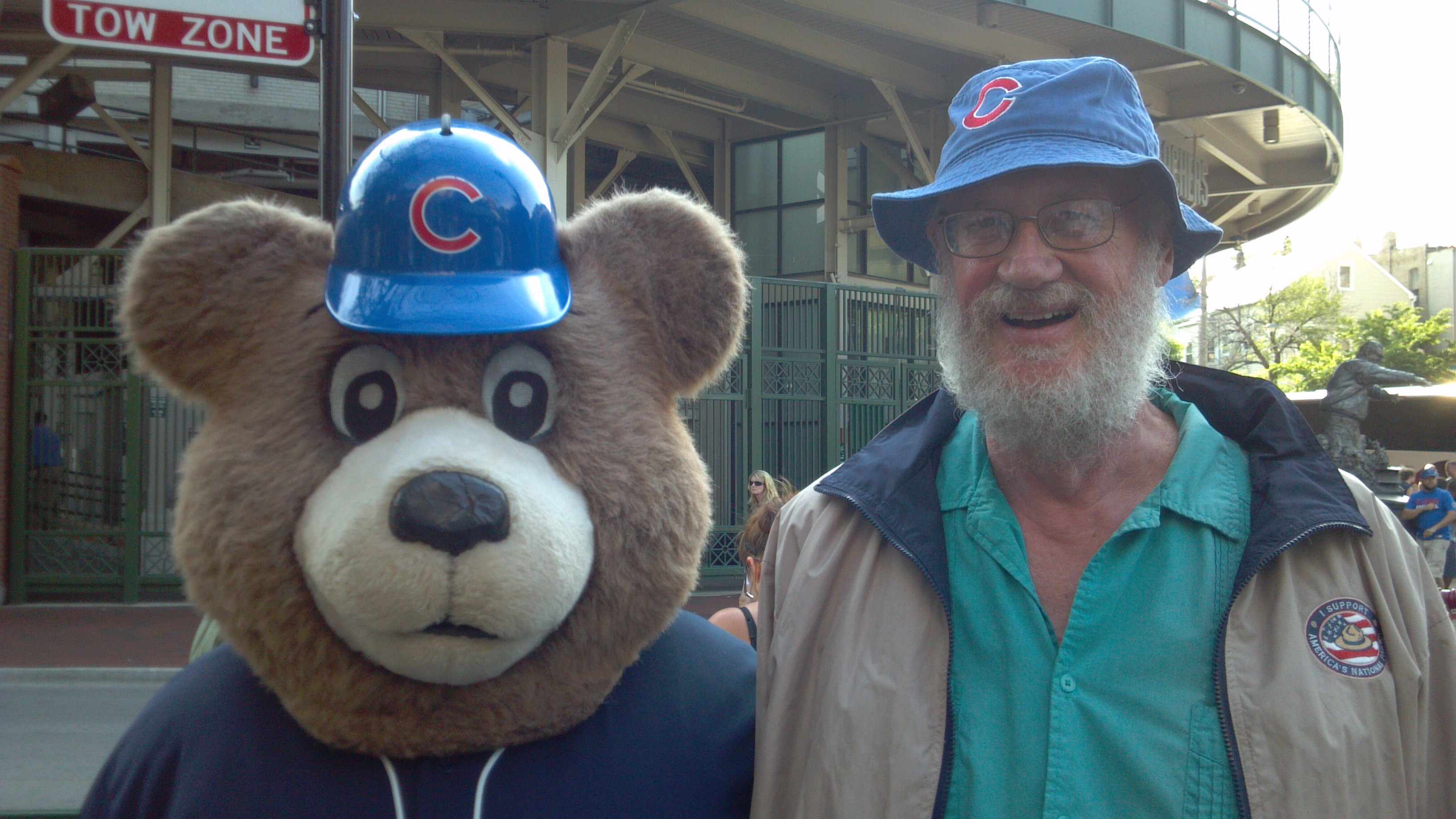
Steve with Chicago Cubs mascot.

Steve with Chicago Cubs mascot, during trip to Wrigley Field with seminary friends Harry Lee Strong, Don Dempsey, Bob Young, Wayne Boulton, and Steve’s blogging buddy.

Last night the “Baby Bruins” had an improbable (dare we say ‘miraculous’?) come-from-behind ninth-inning victory over the San Francisco Giants in San Francisco. Now they’re one step away from the World Series.

The day after Steve’s death, I think I heard the beginning of a full-throated bass cheer from Urbana, as well as from Harry’s home in Prescott, Arizona. Two cheers for the Cubs; three cheers for Harry Lee, and four cheers for Steve!

  • Gordon C. Stewart, Chaska, MN, October 12, 2016. Updated October 24, 2016.

Steve Shoemaker at Peace

With deep sadness but with great thanksgiving for his life and friendship, we share Steve’s CaringBridge post for readers of Views from the Edge:

Daddy died last night on October 10th, the anniversary of his own father’s death.

He is survived by his wonderful wife of 51 years, Nadja, two marvelous children, Daniel and Marla (as well as their spouses, Rachael and Craig), and two fabulous grandchildren, Carter and Grace.

Born and raised in Urbana, he played trombone and basketball at Urbana High School, while also wooing his future wife, Nadja. He then attended Wheaton college, where he participated in pranks, such as padlocking the chapel doors before a service. After becoming more serious about his studies (and receiving an ultimatum from his wife), he received a Master of Divinity Degree and Master of Sacred Theology Degree in 1969 from McCormick Theological Seminary in Chicago. In a further pursuit of education, he then earned a PhD in Religion from Duke University in 1979.

Steve Shoemaker served as pastor at Pittsboro and Mount Vernon Springs Presbyterian churches in Pittsboro, NC, as well as campus pastor at North Carolina State University and McKinley Presbyterian Church in Champaign. He finished his career as Director of the University YMCA at the University of Illinois. For many years, Steve also taught one course a semester in Religious Studies at either Parkland College or The University of Illinois.

Devoted to his community, Steve served as Chair of the Committee for the Homeless, Co-Chair of the Men’s Emergency Shelter Steering Committee, member of the Dr. Martin Luther King Committee, member of the Muslim Committee, and served on the Champaign County Board, the United Way Board, and the local ACLU Board. He was also an active Urbana Rotary Club member since 1982 and acted as president in 2013.

With a passion for writing, particularly poetry, Steve was nominated for Illinois Poet Laureate in 2003 and has been published in a plethora of journals ranging from Christian Ministry to Judaism. After his cancer diagnosis, he published his first book titled “A Sin A Week.” He has also received thousands of Likes for poems posted through social media. In addition to the printed word, Steve reached out to the community through his weekly radio program, Keepin’ The Faith on WILL AM 580, which provided interviews and discussions highlighting relevant social topics.

Steve donated his rich bass voice to various choirs and was a member of the Real Fire band. He also donated his time to be an integral part in the lives of others as he joined couples in marriage, performed funerals, and provided counseling and support (while never accepting payment).

However, to this writer, Steven Robert Shoemaker’s greatest accomplishment was his role within his family. In over 50 years of blissful marriage, he modeled how to sincerely love and respect another. He gave corsages, coached soccer, and cooked Cheese Surprise. He took his children out of school to see baseball games and go to museums. And although his children did not always recognize it in the moment (as they were dragged to organ concerts or tours of Frank Lloyd Wright houses), Steve Shoemaker demonstrated how to embrace life (Fly kites! Eat dessert first!) and how to make the world a better place.

Despite a host of shortcomings, including but not limited to leaving used toothpicks around the house and eating other people’s chocolate bars, Steve was an accomplished author, compassionate pastor, devoted leader, and loving husband and father. He is greatly missed.

Memorial gifts may be made to the University YMCA, 1001 S. Wright Street, Champaign, IL 61801.

Services will be arranged and announced as soon as possible.

There is a deep stillness in the Stewart household this morning. Even when I know death is coming, it still stops me in my tracks. The world is a smaller today.

  • Gordon C. Stewart, Chaska, MN, October 11, 2016

Donald Trump Has Ended His Candidacy

Views from the Edge published this piece April 1, 2016. Perhaps tonight Mr. Trump will use the national spotlight to announce to the world that he’s not a politician. Never was. Never will be. He’s too good to stay in this race.

Gordon C. Stewart's avatarViews from the Edge

Orange hair and rude speech are colorful. When a presidential candidate speaks off the cuff in street language, he’s colorful. Like the class clown in junior high school, he’s entertaining. In class, or under the big tent of the three ring circus, the clown captures everyone’s attention. You never know what he’ll do next. He’s colorful.

But sometimes clowns go too far; they push the boundaries of propriety. When a clown offends the crowd, he becomes not only colorful but odoriferous, and nothing can empty a room like an offensive odor. When a clown pretending to be a world leader, wise and substantive, declares that women who have abortions should be punished, but he’s not yet sure how, everyone in the crowd – pro-life and pro-choice alike – is offended by the flatulence.

Today Donald Trump announced the end of his campaign for the GOP nomination. Speaking from the steps…

View original post 74 more words

When caught with a hand in the cookie jar

How will Donald Trump present himself in tomorrow night’s presidential town hall meeting?

A) Attempt to compare himself favorably with Bill Clinton, alleging worse comments to Hillary’s husband on the golf course?  It’s just what guys do when guys are alone, and Bill’s more lewd than I am.

B) Allege, as he has already, that Hillary has had a relationship/relationships outside of marriage? “Hillary is no angel!”

C) Apologize in the manner of the evangelical advisor, declaring that the event in 2005 was before he had a spiritual awakening, and that the issue now is forgiveness for a past indiscretion?

D) Make eyes for Moderator Martha Raddatz . . .  or Anderson Cooper?

E) Come out as a recovering sex addict?

F) None or some of the above? “None of the personal stuff matters. It’s about Making America Great Again! It’s about restoring America’s right to grope the world again. It’s about winning again. All the complainers and accusers are losers! They’re all pussies!”

The question now is not how big are his hands, but how big is his base?

  • Gordon C. Stewart, Chaska, MN 55318

Fall

Leaves are falling. The sap is finished running. Flowers fade — red,  green, yellow, purple falling into brittle brown.

Each season reflects the eternal motion of the seasons we sense within ourselves. Over a lifetime we move from the temporary wrinkles of the newborn babe to the well-worn lines and wrinkles of aging. We love to look at babies; old folks not so much.

In 1857 Adalbert Stifter pondered this in Der Nachsommer (The Post-Summer) published in English under the title Indian Summer:

“Great beauty and youth capture our attention, excite a deep pleasure; however, why shouldn’t our souls gaze at a countenance over which the years have passed? Isn’t there a story there, one unknown, full of pain or beauty, which pours its reflection into the features, a story we can read with some compassion or at least get a slight hint of its meaning? The young point toward the future; the old tell of a past.”

Fall is the favorite time for many of us. At my age, I no longer wonder why.

  • Gordon C. Stewart, Chaska, MN 55318

Time is what we have

“What is time?” asked the 11 year-old son of his father.  Finally, the father, who was supposed to know about such things, offered the briefest of answers. “Time is what we have.”

The answer  begged for more explanation, but it spoke out loud the frailty and wonder of the human condition. What is time? It’s what we have but, like everything else mortals have, or think we have, time runs out. Time is like the sand in the hour-glass. It sifts slowly through the funnel from top to bottom until there is nothing left. Dust to dust, ashes to ashes. Remember that you are dust, and to dust you shall return.

The relation of time to eternity is the relation between mortality and immortality. Our hour-glass contains eternity but it does not define it or confine it. We experience eternity in the now of time as we look at the heavens on a starry night, feel a gentle breeze or the rush of a mighty wind, or watch the shorelines of human construction eroding, pushing back the illusion of ownership and control of nature and of time.

My poet friend and Views from the Edge colleague Steve Shoemaker is coming to the end of his time. After many decisions that prolonged his life far beyond the original prognosis, he opted last Saturday to give way to time. Steve chose to spend whatever days are left at home at Prairie Haven on the plains of Illinois.

The news came less than a week after five old friends who call ourselves the Dogs traveled from Texas, Arizona, Illinois, Indiana, and Minnesota to gather one last time with Steve at Steve’s room in the care center. We barked and growled watching the first presidential debate. We laughed. We sang some hymns. We prayed with and for Steve, Nadja, and their children, Daniel and Marla. We prayed for ourselves. The time was right.

When news arrived only days later that Steve had opted to end further medical treatment to go home, the conversation with my 11 year-old son years ago and Steve’s verse “When to Stop Praying” (April 2, 2016) came quickly to mind. The prayer now is for an end of striving. An end of pain. “Pray for my peace, not my life.” The end of time.

  • Gordon C. Stewart, Chaska, MN, October 5, 2016.