I've always liked quiet. And, like most people, I've experienced the world's madness. "Be Still! Departure from Collective Madness" (Wipf and Stock Publishers, Jan. 2017) distills 47 years of experiencing stillness and madness as a campus minister and Presbyterian pastor (IL, WI, NY, OH, and MN), poverty criminal law firm executive director, and social commentator. Our cat Lady Barclay reminds me to calm down and be much more still than I would be without her.
— “Morning Mist Over the Creek” by Steve Shoemaker, Urbana, IL Feb. 6, 2013
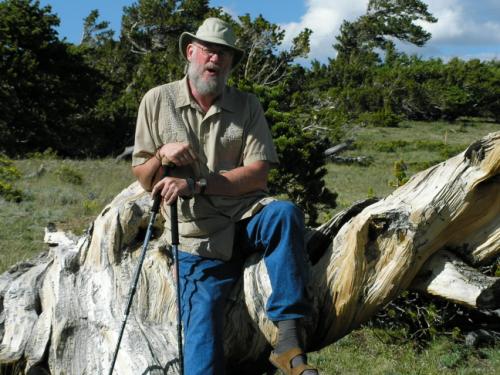
Steve Shoemaker (RIP) was the Views from the Edge colleague whose verses and poems, written in the middle of the night, were sent to “his publisher” from his iPhone before dawn. Five of Steve’s verses/poems are republished in Be Still! Departure from Collective Madness. At six-feet eight inches, he towered above the crowd. In this photo, his 6’8″ frame rests on a 1,000+ year-old Bristlecone Pine above the tree line. – GCS
“Poetry is the impish attempt to paint the color of the wind.” –Maxwell Bodenheim, quoted in Ben Hecht’s play Winkelberg (1958).
This sermon was written for a congregation of one the first Sunday after stepping out of the pulpit five years ago.
STAY AWAKE!
First Sunday in Advent, 2014 Texts: Isaiah 64:1-9 Mark 13:24-37
“And what I say to you I say to all: Keep awake.” [attributed to Jesus, Gospel of Mark 13:37].
It’s hard to stay awake in times like these. To be conscious includes grief, helplessness, anger at the state of the nation and world, and the stupidity of the human race.
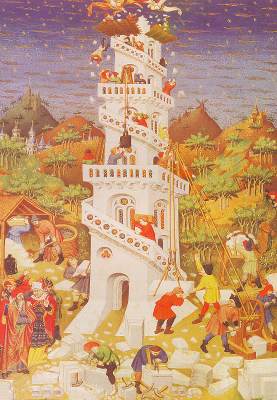
“Heaven and earth will pass away, but my words will not pass away” is supposed to bring comfort but it doesn’t, unless the heaven and earth of which Jesus speaks are the ones our pride has created. The imaginary ones. The heavenly and earthly projects that rise out of human insecurity as in the Genesis story of Babel, the story of what never was but always is, according to which the building of the ideal city is interrupted and the tower “with its top in the heavens” is “left off”. But the Word – the story about it – has not passed away. It endures. As fresh today as it was when first shared around a campfire as a way of telling each generation the respective places of God and man (humankind).
Fourteen years after the World Trade Towers collapsed in NYC, a new tower, “One World Trade Center” – taller, stronger, bolder – stands where the old towers fell on 9/11. One World Trade Center, symbolizes a resurrection of the crashed myth. Standing a few blocks from Wall Street, where the global economy is reconstructed every day, One World Trade Center resurrects the myth of national supremacy, benign goodness, and virtue of the American economic system.
We could have left Ground Zero empty of monoliths. Turned it into a memorial and monument to the error of pride, a turning away from global arrogance. A repentance from the economic-military-religious complex that has expropriated the oil fields in the Middle East, assassinated the elected President of Iran in 1958, installed the Shah in his place, ignored the human rights of Palestinians, supported and installed western-friendly oligarchies and strong men in Saudi Arabia, Iraq (Saddam Hussein), Libya (Muammar Gaddafi), and Egypt (Hosni Mubarak) until, except for Saudi Arabia, they turned against us.
Instead of listening to the word that does not pass away, we Americans, to the sorrow of New Yorkers like Michael Kimmelman (NY Times, Nov. 29, 2014), opted for the old words and worn-out scripts that had failed us. The Democratic Spring in Libya, Egypt, and Tunisia did not do what the NeoCon exporters of Western democracy had imagined. It unleashed a seething volcano of anti-American resentment. Meanwhile, Afghanistan, Iraq, and Syria, have become desert quagmires – Vietnams without the jungles.
Eisenhower’s last speech to the nation warning of an emerging military-industrial complex is all but forgotten as One World Trade Center stands like a phoenix raised up…and up…and up from the ashes, symbol of global dominance resurrected from the horrifying deadly collapse of 9/11.
Words and symbols are everything in this world.
Mr. Kimmelman opines, “But it [i.e. the World Trade Center] never really connected with the rest of Lower Manhattan. There had been talk after Sept. 11 about the World Trade Center re-development including housing, culture and retail, capitalizing on urban trends and the growing desire for a truer neighborhood, at a human scale, where the windswept plaza at the foot of the twin towers had been.”
It’s all about human scale. A plaza. Not a tower with its top in the heavens.
Staying awake is hard. Being attuned to what is not passing away takes faith. It takes hope. Maybe even love.
“From the fig tree learn its lesson: as soon as its branch becomes tender and puts forth its leaves, you know that summer is near.” [Mark 13:28]
Jesus often seems to have said that the word we need to hear is spoken by nature. Learn from the fig tree. It waits through the dormant season to become tender again, to put forth its leaves toward summer and the production of figs. Nature is calling. Nature is our home. Nature is what is – the real heaven and earth – the word that will not pass away, the word that will survive when we are gone. We need to love nature again. Awaken to nature. Re-imagine ourselves as part of nature, “creatures” among the multitude of creatures. Our words will pass away, even the best of them. Our Creator’s will not.
During this most puzzling of seasons – the Season of Advent, the season of wakeful, wait-ful anticipation of a Coming in fullness – I find myself crying out like Isaiah. It feels something as though “you have hidden your face from us, and have delivered us into the hand of our iniquity.” [Isaiah 64:7]
“O that you would tear open the heavens and come down, so that the mountains would quake at your presence—as when fire kindles brushwood and the fire causes water to boil– to make your name known to your adversaries, so that the nations [the ethnoi in NT Greek, i.e. the peoples] might tremble at your presence!” [Isaiah 64:1-2]
The “nations” have always been God’s adversaries, closed in on themselves, puffed up, defensive against intruders foreign and domestic, plunderers of nature and other nations, hostile to the foreigner, both human and Divine.
In this season of “economic recovery” when the poor continue to get poorer, the rich get richer, and the middle class shrinks, and the climate change clock ticks closer to midnight, deliver us, Good Lord, from “the hand of our own iniquity”.
Remember, “O LORD, you are our Father; we are the clay, and you are our potter; we are all the work of your hand.” [Isaiah 64:8]
This word is the only word that lasts. Stay awake, my soul. Stay awake to the whole of it – all of it: the sorrow and the grief of it, the loneliness of it, the anger of it, the guilt of it, the finger pointing out and away and the finger pointing back at me, a nation to myself, and the presence of the Potter – and my soul will be well, new and fresh every morning.
Gordon C. Stewart, Be Still! Departure from Collective Madness (Wipf and Stock, 2017) available on Amazon in kindle and paperback, Chaska, MN, First Sunday of Advent, November 30, 2019.
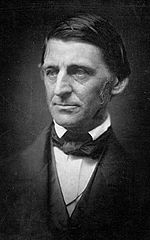
“Every violation of truth is not only a sort of suicide in the liar, but is a stab at the health of human society,” wrote Ralph Waldo Emerson in “Prudence,” Essays: First Series (1841).
I imagine Emerson quietly applauding Fiona Hill boldly calling out the false narrative that stabs at the health of democracy in her testimony before the U.S. House Intelligence Committee’s Trump impeachment inquiry.
U.S. National Intelligence expert on Russia begs U.S. House Intelligence Committee members to stop spreading the Russian intelligence false narrative about Ukrainian interference in the 2016 U.S. election.
PARTISAN PROPAGANDA: THE BIG LIE
“The great masses of people . . . will more easily fall victim to a big lie than to a small one.”
Adolf Hitler, Mein Kampf (1924), 1.10.
MAKING THE WIND APPEAR SOLID
“Political language . . . is designed to make lies sound truthful and murder respectable, and to give an appearance of solidity to the wind.”
George Orwell, “Politics and the English Language,” Shooting the Elephant (1950).
TRUTH AND FALSEHOOD
“Man can certainly keep on lying (and does so), but he cannot make truth falsehood.”
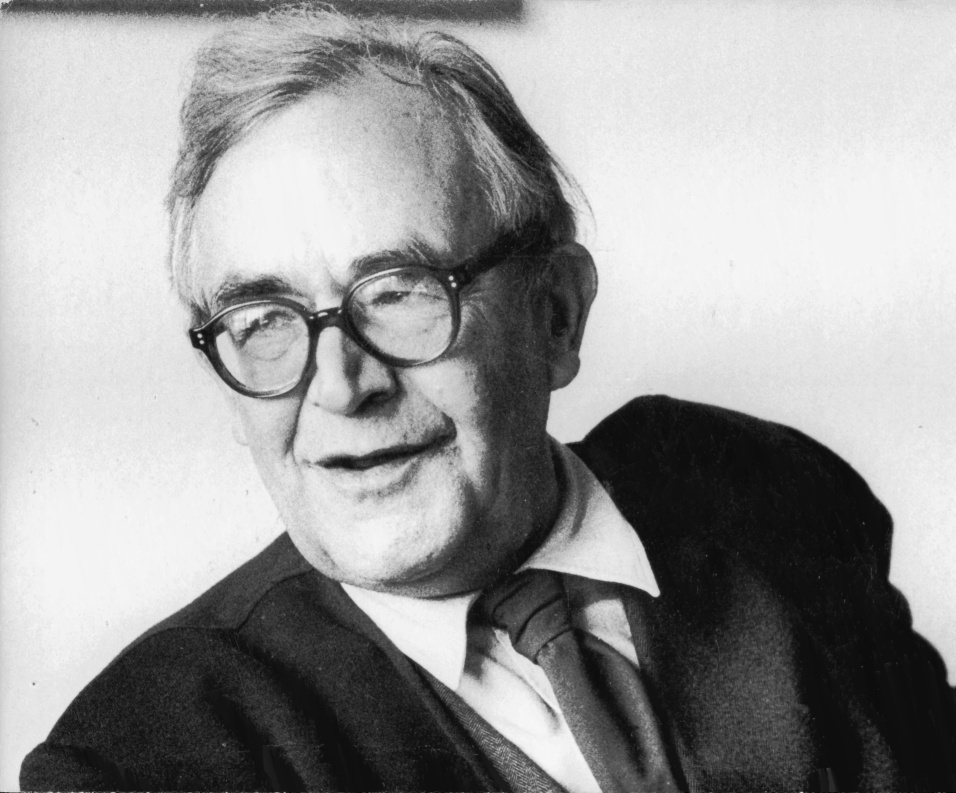
Karl Barth quoted in The New York Times obituary, December 11, 1968.
TRUTH NEEDS NO PROPAGANDA
If there has always been propaganda in some form, from the time of the modest newspapers of the seventeenth century it has developed with a new speed and to a new degree, as new and more effective instruments have been found and brought into use. One should note that the truth needs no propaganda and does not engage in it. As the truth, it simply speaks for itself and opposes falsehood. Propaganda is a sure sign that what is at issue is not the truth but an ideology which needs it, to whose nature it corresponds, and which is not ashamed to make use of it.
Karl Barth, “The Lordless Powers,” The Christian Life, translated by Geoffrey W. Bromley, p.227.
Propaganda and National Security
Continued promotion of a self-serving false narrative under the guise of patriotic concern for national security puts American national security at risk.
A subsequent Views from the Edge commentary will explore what Karl Barth‘s “lordless powers” and Christian scripture calls “principalities and powers.”
Gordon C. Stewart, November 23, Chaska, MN, Nov. 23, 2019.
Guys don’t do sleepovers. Or so I thought reading A Plan this morning . . . until I stopped to think.
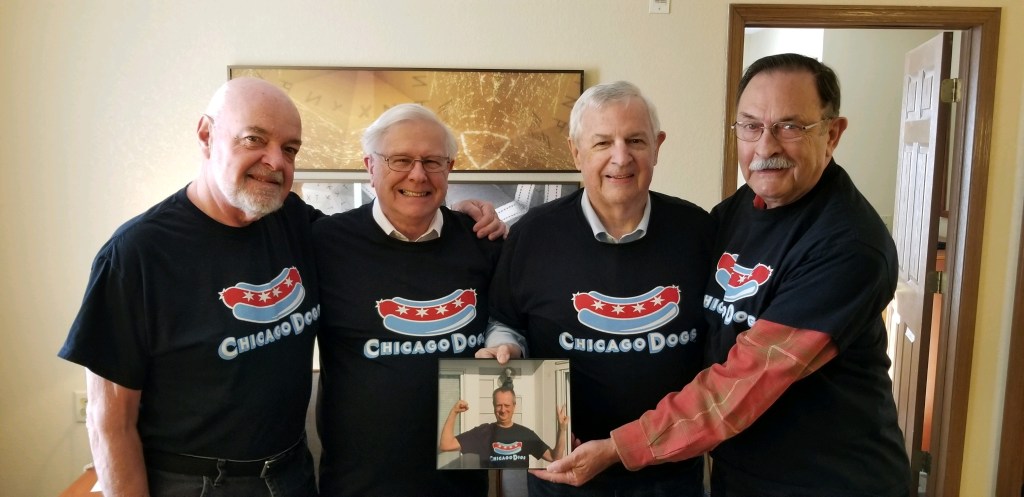
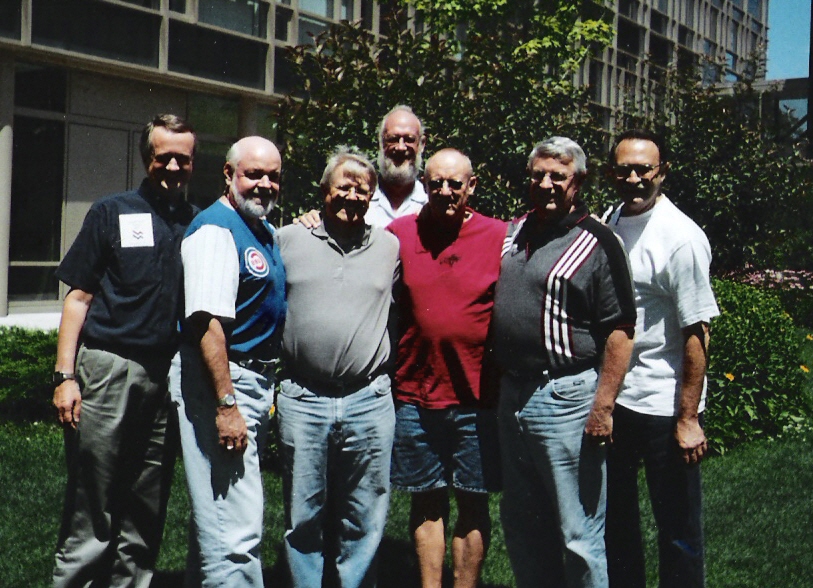
Four (4) ‘Old Dogs’ (seminary classmates who have maintained friendship through the years) do five-night sleepovers every year. Once there were seven (7). Now there are four (4).
Four ‘Old Dogs’ (L to R): Harry, Gordon, Don, Bob, with photograph of Wayne (RIP).
THE ‘GATHERINGS’
We arrive at the annual ‘Gatherings’ limping on replaced knees with hips and memories in need of repair, bearing matches to light the fire, a Book of Common Prayer, and a Fifth or two . . . to make four equal seven again.
There’s nothing like a sleepover celebration with old friends. Some are confident that the departed — Wayne, Steve, and Dale — are still with us around the fire. Others need the help of a Fifth or a few Seven-and-Sevens to get four to equal seven.
Original ‘Chicago Seven’ Gathering (L to R): Old Dogs Wayne Boulton, Harry Strong, Yours Truly, Steve Shoemaker, Dale Hartwig, Don Dempsey, Bob Young.
What I had come to know (by feeling only) was that the [GATHERING]’s true being, you might say, was a sort of current, like an underground flow of water, except that the flowing was in all directions and yet did not flow away. When it rose into your heart and throat, you felt joy and sorrow at the same time, and the joining of times and lives. To come into the presence of the [Gathering] was to know life and death, and to be near in all your thoughts to laughter and to tears.
Wendell Berry, “A Gathering,” Jayber Crow, p. 205-206.
“Mr. Trump did not directly tell me to lie to Congress. That’s not how he operates. He doesn’t give you questions, he doesn’t give you orders, he speaks in a code. And I understand the code, because I’ve been around him for a decade.”
— Michael Cohn, Feb. 27, 2019 testimony before Congress.
SPEAKING IN CODE
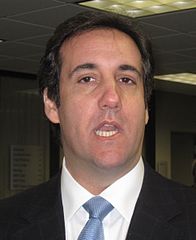
Although Michael Cohen knew of his boss’s business dealings in Russia, Mr. Trump often said in Michael’s presence that he had no business ties in Russia. Michael, his lawyer-fixer for 10 years, understood what he meant. It wasn’t a statement of fact. It was code for an order: Deny any connection with Russia.
“They’ve got him — credible witnesses, documents, and who knows what else. In all my years as a prosecutor, I’ve never seen such an open-and-shut case.” — U.S. Attorney General Elliot Richardson’s announcement to President Nixon of the results of the federal investigation of bribery. The case was resolved with a quid pro quo: Quid: Vice President Agnew would resign with a plea “no contest”; Quo: the Vice President would not go to prison.
Today is the day after an exhausting day for many Americans. It’s the day after the day that began with congressional impeachment hearings and ended with the latest presidential candidates debates. The day after our heads spun seems a good day to reach back to taste the sweetness of wisdom.
THE ART OF WORLDLY WISDOM
Never exaggerate. It is a matter of great importance to forego superlatives, in part to avoid offending the truth, and in part to avoid cheapening your judgment. Exaggeration wastes distinction and testifies to the paucity of your understanding and taste. Praise excites anticipation and stimulates desire. Afterwards when value does not measure up to price, disappointment turns against the fraud and takes revenge by cheapening both the appraised and the appraise. For this reason let the prudent go slowly, and err in understatement rather than overstatement. The extraordinary of every kind is always rare, wherefore temper your estimate.”
A lifelong aversion to anything ‘orthodox’ kept me away from G.K. Chesterton’s Orthodoxy before inheriting a copy from the library of my late friend Wayne. Wayne was neither orthodox nor Orthodox, but there it was — Orthodoxy — with passages he had marked and indecipherable comments he had written in the margins.
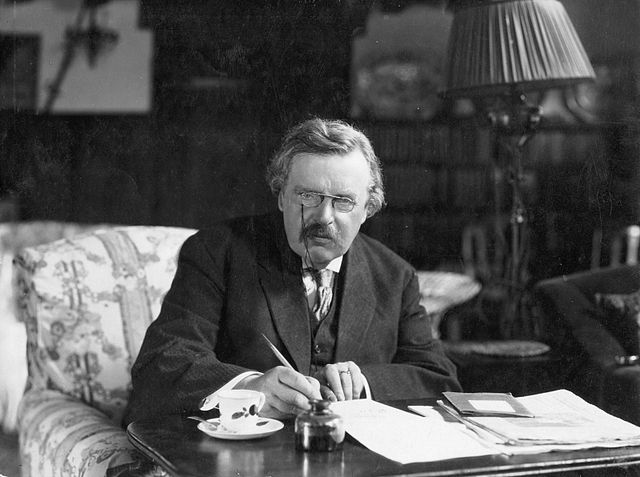
G. K. Chesterton at work
The Arrogant Oligarchy of the Living
“Tradition means giving votes to the most obscure of all classes, our ancestors,” wrote G.K.Chesterton in a book I’d never read until my friend Wayne died. “It is the democracy of the dead. Tradition refuses to submit to the small and arrogant oligarchy of those who merely happen to be walking around.” — G.K. Chesterton, “The Ethics of Elfland,”Orthodoxy (1908).
I’ve often had the sense of this oligarchy and find it treacherous. Not only because it’s arrogant and oligarchical, but because it is foolish and destructive. Tradition is not the enemy of vitality. Nor is it the enemy of free thought nor science.
Without tradition we are like by-the-wind sailors, the jellyfish who have no way to propel themselves, thrown this way and that by the tides and storms. Jellyfish go with the flow without conscience, memory, or agency to create a better future.
Collecting the Fragments: Egoism and Altruism
“There is a huge and heroic sanity in which moderns can only collect the fragments. There is a giant of whom we see only the lopped arms and legs walking about. They have torn the soul of Christ into silly strips, labeled egoism and altruism, and they are equally puzzled by His insane magnificence and His insane meekness. They have parted His garments among them, and for his vesture they have cast lots; though the coat was without seam woven from the top throughout.” — G.K. Chesterton, “The Ethics of Elfland,” Orthodoxy.
The Seamless Coat Woven from the Top
“Lopped arms and legs walking about.” What an image! The soul of Christ torn into silly separate strips of egoism and altruism. Chesterton had a way with words — images that jar the senses of what is real, pushing the by-the-sea sailors in a direction we did not expect.
The Democracy of the Living and the Dead
“All democrats object to [anyone] being disqualified by the accident of birth; tradition objects to their being disqualified by the accident of death. Democracy tells us not to neglect a good man’s opinion, even if he is our groom; tradition asks us not to neglect a good person’s opinion, even if he is our father. I, at any rate, cannot separate the two ideas of democracy and tradition; it seems evident to me that they are the same idea.” — Chesterton, “The Ethics of Elfland,” Orthodoxy.
Honoring the Great Ancestors and Great Grandchildren
My seven years at the Legal Rights Center — a public defense corporation founded in 1970 by the American Indian Movement and African-American civil rights activists — moved this by-the-sea sailor to think again about freedom and tradition.
We inherit a tradition from the ancestors and are responsible for passing the treasure (i.e., the tradition) to the next generation. In times of decision-making, American-Indian culture universally calls us to consider the previous seven generations and the seven generations that will follow: the democracy of the dead, the living, and those who come after us. This tradition of America’s First Nations, like the Reformed Christian tradition, looks back, looks ahead, and looks up for the re-weaving of the strips. The coat without seam was, is, and always will be woven from the top.
Wayne’s name is scribbled in pencil at the top of the title page of Orthodoxy. This year Wayne no longer lives to protest and resists the arrogant oligarchy of those who happen to be walking around. He has joined the blessed democracy of the dead.
Last Friday was not the Ides of March, but it may have been the day the soothsayer warned Julius Caesar of the consequences of overstepping the Roman Republic’s limits to executive power.
According to Plutarch, on his way to the fateful meeting of the Roman Senate on the Ides of March, Caesar passed the seer, mocking his fortune-telling with a confident sneer: “The Ides of March are come.”
“Aye, Caesar,” said the seer, “but not gone.”
That same day in 44 BCE the soothsayer’s warning was confirmed. As many as 60 senators ended the threat to turn the Roman Republic into an eternal dictatorship.
THE DAY OF THE SOOTHSAYER
Events last Friday echo the soothsayer’s warning:
Maria Yovanovich, the nonpartisan diplomat of impeccable character summarily recalled from her duties in Ukraine with no explanation, honored the House Intelligence Committee’s subpoena to appear for testimony at the Committee’s impeachment inquiry hearing;
The president who had suddenly dismissed Ms. Yovanovich just as suddenly smeared her reputation with a tweet while she was testifying before the Committee;
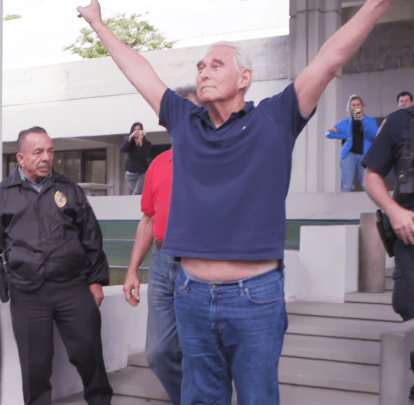
Roger Stone, the career dirty-trickster and long-term friend and mentor of Donald Trump, architect of the 2016 “Make America Great Again” campaign strategy and tactics, was convicted by a jury on all seven counts of making false statements, obstruction, and witness tampering;
President Trump tweeted:
“So they now convict Roger Stone of lying and want to jail him for many years to come. Well, what about Crooked Hillary, Comey, Strzok, Page, McCabe, Brennan, Clapper, Shifty Schiff, Ohr & Nellie, Steele & all of the others, including even Mueller himself? Didn’t they lie?”
Donald J. Trump tweet during Maria Yovanovich testimony, November 15, 2019.
ROGER STONE’S RULES
Roy Cohn and Roger Stone are the the political dirty-trickster mentors who who trained Donald Trump in the Machiavellian rules for how to succeed in business and politics.
The following are a few of “Stone’s Rules” as he shared them in the documentary film Get Me Roger Stone:
“Hate is stronger than love”
“Unless you can fake sincerity, you’ll get nowhere in this business”
“Politics isn’t theater. It’s performance art. Sometimes, for its own sake”
“White shirt + tan face = confidence”
“Hit it from every angle. Open multiple fronts on your enemy. He must be confused, and feel besieged on every side.
“Never turn down the opportunity to have sex or be on TV.” (attributed to Gore Vidal)
“Nothing is on the level”
“It’s better to be infamous than never famous at all.”
CONGENITALLY INCAPABLE
Presidential historian Jon Meacham spoke within hours of the president’ latest tweety. “My sense,” he said, “is that we have a president who is congenitally incapable of seeing beyond his own self-interest. And what these witnesses have done is proven that while he wants to build a wall at the border, he has no interest in building a wall around our elections.” (The Beat, Friday, Nov. 15.)
ARE THE BOYS (THE KING’S MEN) STILL THERE?
“A political leader must keep looking over his shoulder all the time to see if the boys are still there. If they’re not, he’s no longer a political leader.” (NYT obituary for Bernard Baruch, June 21, 1965.)
Bernard Baruch Obituary, New York Times, June 21, 1964
The impeachment inquiry is about much more than a sitting president’s continuance or removal from office. It’s about the survival of the Constitution of the American Republic in an era when an entire political party has substituted the habits of Stone’s Rules for the sworn duty of every elected member of Congress “to support and defend the Constitution of the United States of America.”
“Admit nothing. Deny everything. Launch counterattacks. Attack, attack, attack. Never defend. Distract, distract, distract!” is a heinous violation of the Oath Office.
Is it too much to hope that soothsayer’s warning will result in coming to our senses? If not, we may be left to hope John Arburthnot was right that “political parties die at last of swallowing their own lies.”
Last week I asked a psychiatrist friend whether he has been seeing increased levels of stress in his patients. “Yes,” he said, “Universally.”
As the impeachment inquiry hearings begin today, we are divided and angry. But we’re all under stress, and we’re all Americans. When we’re stressed, we do strange things. Some of us clam up. Some of us scream and shout. Some of us need company. Which led me to think again this morning about the stress test waiting room and a World War II veteran named Bill. I’m wondering what Bill might say.
Bill in the Stress Test Waiting Room
He sits by himself in the hospital waiting room.
“Where you from?” he asks, as if welcoming the stranger who’s come to his home for a stress test.
“Chaska.”
“Where?” he asks over the whine from his hearing aids.
I’m not anxious to strike up a conversation. I’m here for a stress test. I’m an introvert. Chatting with strangers when I’m gathering myself when I’m under stress, waiting for a stress test, is the last thing I want.
His gowned wife, fresh off the treadmill, returns from her stress test.
“This is my wife, Jane. She’s a lot younger than I am. I’m 96.”
“Ninety-four,” says the younger wife. “We’ve been together 15 years.”
“Chaska’s the county seat,” says Bill. “That’s where i was sworn in.” (Clearly, he’s an extrovert. He feels better when he has guests.)
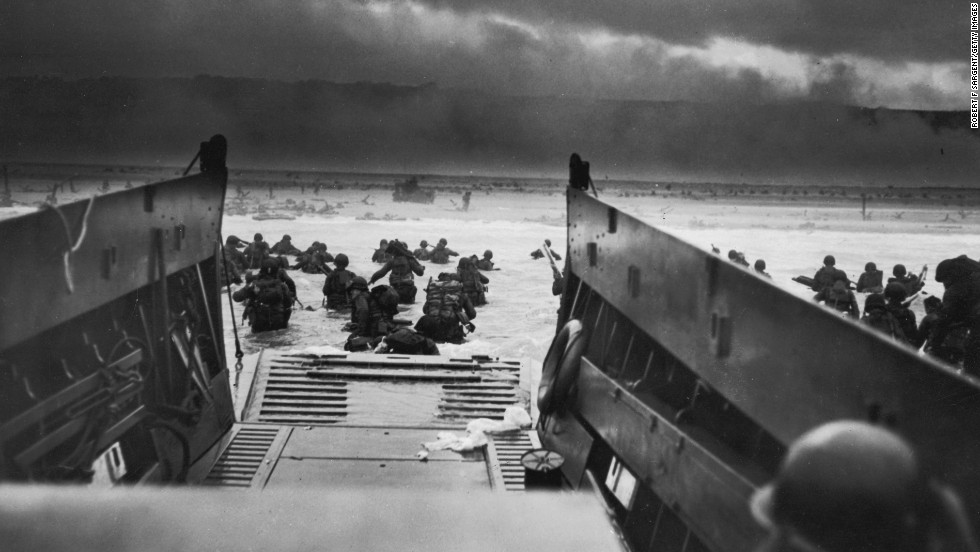
“World War II?”
“February 6, 1942. Eighty of us. A lot of guys from Chaska.”
“Where’d you serve?”
“He was part of D-Day,” answers Jane. Bill’s head sinks toward his lap. His chin begins to quiver. A long pause follows.
D-Day, WWII.
“Only 15 of us came back.”
“Were you injured?”
“No,” he says, forming his hands in prayer and looking up. “I don’t know why.” He falls again into silence.
Fort Snelling National Cemetery, Minnesota
Bill’s body is with us, but he’s not here. He’s back at Normandy Beach on D-Day.
“That’s a lot of death,” I say. “A lot of killing. A lot of loss.”
He looks up, nods, and drops his head again.
“Post-traumatic Stress,” I say quietly to Jane. “I’m a pastor. I’ve seen it so many times with Vietnam War and Iraq War veterans.”
“I think so,” she says. “He still can’t talk about it after all these years.”
The technician calls my name. “Mr. Stewart?”
As I stand to leave the stress test waiting room, Bill reaches up to say good-bye with a firm handshake and friendly smile for the whippersnapper from Chaska.
Robert Davis of Clarkston has an outpatient stress test run by exercise physiologist’s Richard Andrevzzi and Donna McCollom in the Royal Oak hospital.
I leave the waiting room and get on the treadmill, reminded that there is stress and there is stress, knowing that mine bears no comparison to Bill’s and thankful for a few moments with a 94 year-old who has every reason to think he’s 96.
Today and tomorrow, as I zoom in on the televised public hearings on impeachment, I’m wondering what Bill would say.
An earlier Views from from the Edge post featured a brief summary of an unusual step: a Board of Trustees’ $27.6M action plan to redress institutional entanglement in institutional slavery and ongoing institutional racism. Here’s the full press release from Princeton Theological Seminary (founded in 1819) in Princeton, New Jersey.
Princeton Theological Seminary in 1879
PRESS RELEASE, Princeton, NJ, October 18, 2019
PRINCETON, N.J., October 18, 2019 – Princeton Theological Seminary’s Board of Trustees unanimously endorsed the implementation of a multi-year action plan to repent for its ties to slavery. The approved series of new initiatives, ranging from increased student financial assistance to curriculum changes to added support for the Center for Black Church Studies, is a direct response to a report the Seminary published in October 2018 after conducting a two-year historical audit.
“The report was an act of confession,” says John White, dean of students and vice president of student relations. “These responses are intended as acts of repentance that will lead to lasting impact within our community. This is the beginning of the process of repair that will be ongoing,” says White.
White served as chair of the historical audit recommendations task force, which included trustees, faculty, administrators, students, and alumni, who led a deliberative process to provide opportunities for the campus community to discuss and respond to the audit report. The task force hosted more than 25 events, meetings, and conversations on the campus in the previous academic year. Feedback gathered from students, faculty, administrators, and alumni was incorporated in the recommendations presented to the Seminary’s board. The Board of Trustees also conducted a year-long process of study.
“From the beginning,” says White, “the Board of Trustees has encouraged a thorough process of understanding our history that would lead to meaningful response.”
With an immediate rollout of the plan and continuation through 2024, the Seminary intends to make meaningful and lasting change with the more than 20 approved initiatives, including:
Offering 30 new scholarships, valued at the cost of tuition plus $15,000, for students who are descendants of slaves or from underrepresented groups
Hiring a full-time director of the Center for Black Church Studies
Hiring a new faculty member whose research and teaching will give critical attention to African American experience and ecclesial life
Changes in the Seminary curriculum, including a required cross-cultural component and integrating into the first-year curriculum for every master’s student sustained academic engagement with the implications of the historical audit
Designating five doctoral fellowships for students who are descendants of slaves or from underrepresented groups
Naming the library after Theodore Sedgwick Wright, the first African American to attend and graduate from Princeton Seminary
Naming the Center for Black Church Studies after Betsey Stockton a prominent African American educator in Princeton during the antebellum North and a Presbyterian missionary in the Sandwich Islands (present-day Hawaii). Prior to gaining freedom, Stockton was owned by the chair of Princeton Seminary’s Board of Trustees.
Enhancing community partnerships and supporting historically disenfranchised communities in and around Princeton
Ensuring every member of the Princeton Seminary community understands its history
A committee has been established to oversee the implementation of the plan and will regularly report progress to the board. The program costs for the responses represent a commitment of more than $1 million annually on an ongoing basis. To sustain this programming in perpetuity, $27.6 million will be reserved in the endowment.
“The Seminary’s ties to slavery are a part of our story. It is important to acknowledge that our founders were entangled with slavery and could not envision a fully integrated society,” says Princeton Seminary President M. Craig Barnes. “We are committed to telling the truth. We did not want to shy away from the uncomfortable part of our history and the difficult conversations that revealing the truth would produce.”
The historical audit uncovered that the Seminary did not own slaves and its buildings were not constructed with slave labor. Yet, the Seminary benefited from the slave economy, both through investments in Southern banks in the mid-19th century and from donors who profited from slavery. Also, founding faculty and leaders used slave labor at some point in their lives. Several of the first professors and board members were deeply involved in the American Colonization Society, which advocated sending free blacks to Liberia.
“Our response to the historical audit is the beginning of our community’s journey of repair as we seek to redress historic wrongs and to help the Seminary be more faithful to our mission as a school of the church, both now and in the years to come,” says Barnes. “We are taking tangible action to write a new chapter in our story.”
CONFESSION AND REPENTANCE: VIEWS FROM THE EDGE COMMENTARY ON CONTEXT OF PRESBYTERIAN ETHOS
A Prayer of Confession of Sin for “what we have done” and “what we have left undone“– like the one below — is an essential component of Presbyterian Church (USA) services of worship. We do it every Sunday as a habit.
Merciful God, we confess that we have sinned against you in thought, word, and deed, by what we have done, and by what we have left undone.
We have not loved you with our whole heart and soul and mind and strength.
We have not loved our neighbors as ourselves.
In your mercy, forgive what we have been, help us amend what we are, and direct what we shall be, so that we may delight in your will and walk in your ways, to the glory of your holy name.
Sometimes a habit is more than habitual. Sometimes we mean what we ask: “help us amend what we are, and direct what we shall be….” Sometimes, with God’s help, we do it.
Gordon C. Stewart, Presbyterian Church (U.S.A) Minister of Word and Sacrament H.R., Chaska, MN, November 12, 2019.




![Statue of Julius Caesar Via dei Fori Imperiali
Leomudde [CC BY-SA 4.0 (https://creativecommons.org/licenses/by-sa/4.0)]](https://gordoncstewart.com/wp-content/uploads/2019/11/julius_caesar_via_dei_fori_imperiali_2.jpg?w=320)




 Views from the Edge