Frederick Buechner’s invitation to “listen to your life” is wise counsel any day, but especially the day after a jarring dream has screamed about what the psalmist called “the sins of my youth.”
The psalmist was lucky. The sins for which he prayed for release happened in his youth; mine are the less innocent ones of adulthood. But the final plea is the same: “Remember not the sins of my youth and my transgressions; remember me according to Your love, and for the sake of Your goodness…” (Psalm 25:6).
Dreams have a different way of remembering. They have a logic of their own, a logic of the unconscious fetching from the hidden reservoir of past experience the guilts and griefs we sought to drown from conscious awareness. Dreams remind us that nothing is lost. Sometimes a dream is its own kind of prayer — the Spirit bearing witness within our spirits; a kind of holy groaning — to be remembered “according to Your love, and for the sake of Your goodness” rather than according to our sins and transgressions.
Franz Kafka
Franz Kafka wrote in a letter to his father, “Life is more than a Chinese puzzle.” Kafka knew that life is at least that — a perplexing puzzle. The pieces of one’s life are hard to fit together into a cohesive whole, perhaps because some of them have shapes and sharp edges we can’t remember or refuse to recognize.
Sometimes these pieces appear in a dream according to a different logic of the deeper listening that remembers us according to a Goodness greater than our own. Only by such grace could the psalmist imagine the recovery of integrity, i.e., the re-integration of the disparate parts of his life history: “Let integrity and uprightness preserve me, for my hope has been in You” (Psalm 25:20).
“Listen to your life…because in the last analysis, all moments are key moments, and life itself is grace” (Frederick Buechner, Now and Then).
A father sometimes knows his son better than his son knows himself. Occasionally — but rarely — he knows him better than the boy’s mother. Parental conversations leading to decisions about a troubled child’s welfare are private. But the outcomes of such decisions sometimes become a matter of public record.
Mary Anne
Imagine, for instance, a conversation between Fred and Mary Anne about their difficult son whose behavior at school was bringing shame to the family name. Mary Anne, a Scottish-born immigrant raised in a small fishing village on the Outer Hebrides’ Isle of Lewis, was aghast at her son’s rude behavior.
A product of her Scottish Presbyterian heritage, Mary Anne had a high sense of right and wrong, and a low sense of human nature — and of the British crown. “Fred,” she said, “I’m a Scot. We don’t like the Queen! Donald thinks he’s a king! I don’t like that! I didn’t raise my son to be a Brit, let alone a monarch!”
“Mary Anne,” said Fred, “it is troubling and he’s troubled. He needs discipline. He needs boundaries. If we don’t act soon, he’ll be sent off to reform school by the end of the year.”
“Fred, if your strict discipline here at home hasn’t reformed him,” said Mary Anne, ”a reform school won’t do any better. I think we need to think outside the box. I can’t take it anymore. I’m tired of his insults, and the faces he makes. He makes fun of my work with kids who have cerebral palsy and adults with disabilities. They’re not ‘crips’ and ‘morons’! And I’m not ‘illegal’. He thinks he’s the Queen! If you don’t agree with him, you’re just a Scot from the Outer Hebrides, a chamber maid working in his palace.”
“Well, dear, we haveto remember that you were working as a maid when we met at the dance. Donald knows right where to get you. He knows your Achilles heel. He’s taken that ability with him to school and that’s what’s getting him in trouble: finding people’s sore points, their weaknesses, calling them names. The only times he responds to my discipline is when I call him a name.”
“Like what, Fred? I can’t hear your conversations from the kitchen.”
“I hesitate to tell you. I don’t want to hurt your feelings more than he’s already hurt them. I’ve tried different names. Some work. Some don’t. We’re Americans now. America won World War II. We beat the Axis powers. I thought calling him ‘Adolf’ or ‘Benedetto’ might get to him, but he didn’t take it as an insult. He took it as a compliment. He’s a chip off the old block. He likes being strong like Hitler and Mussolini. But . . . I’m sorry, dear, but it’s true — he hates it when I call him ‘Scottie’! He thinks Scots are sissies — crossdressers, guys running around in tartan skirts and knee socks. Sorry to say, dear, Donald’s not proud to be a MacLeod.”
“That breaks my heart, Fred! I know he doesn’t respect his heritage. He doesn’t respect me. He treats me like dirt. He treats me the same way he treats girls and bullies boys who are vulnerable at school.
“There’s only one answer I can see, Mary Anne. A military academy. I put in a call to the Superintendent New York Military Academy this morning. He’s agreed to take him on probation on condition that we not interfere with their discipline. We can visit once a month on the weekend and take him to church.”
“He doesn’t like church, Fred. He hated confirmation class. He says church is for losers.”
Norman Vincent Peale
“I know. We won’t take him back to First Pres. Jamaica is changing. All our neighbors are leaving First Pres. I’ll drive him into Manhattan to hear Norman Vincent Peale. We’re dealing with some hard facts, Mary Anne. So is Donald. He needs some positive thinking. Like Dr. Peale says, ‘Any fact facing us is not as important as our attitude toward it, for that determines our success or failure. The way you think about a fact may defeat you before you do anything about it. You are overcome by the fact because you think you
“Norman Vincent Peale is President Eisenhower’s favorite preacher, Mary. Who knows? If someone like Donald learns to face facts by thinking positively about himself, he could become president.”
“God forbid, Fred! How could we have raised a son like that?”
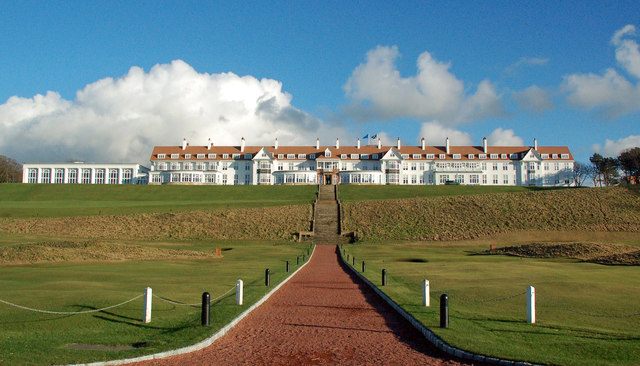
Years later, the son returned to Scotland. Over dinner he paid tribute to his mother at the Turnberry Hotel of his Turnberry Golf Club.
This Fourth of July we retreated from the parades and fireworks to the wilderness cabin by the wetland. Although the trumpeter swans left several weeks ago, heading north to Canada for friendlier, cooler climes, the loons and hooded mergansers are still our nearest neighbors — along with the newest arrivals: Yellowjackets!
Last night was quiet. The only sounds were the bull frogs, the loon calls and the faint rustling of the aspen leaves heard through the screen doors and windows. The only light came from the soft rays of the setting sun. It was peaceful. Quiet. Natural. Until the sun went down and the sound and flashes of firecrackers from distant neighbors preferring a noisy celebration of bombs bursting in air lit up, and echoed across, the wetland from afar.
As we were wondering how the loons and mergansers were managing the Fourth of July, we turned on the lights inside the cabin, and were joined by a Yellowjacket that had made its way through the screens that protect us from unwanted neighbors. While the fireworks exploded and flashed outside, the Yellowjacket was drawn to the reading light next to my chair. Reaching for the flyswatter, I took a swipe but missed, and then another before losing sight of the invader. Until, wham! I felt the sting through my shirt!
Suddenly I wished I had a Fifth on the Fourth!
Gordon C. Stewart, on the wetland, the Fifth of July, 2018.
Dennis Aubrey’s writing is as fine as his photography, fathoming the depth and height of the human experience. This Via Lucis piece on the power and complexity of memory shouted out to be shared on Views from the Edge.
Recognizing truth is a matter of experience because it involves distinguishing the real from the illusory. Experience itself is a product of memory. And memory is even more complex than truth. And so the pattern gets more multi-faceted the deeper we look, like one of Mandlebrot’s mathematical phantasms. What appears at first simple becomes infinitely complicated and intricate.
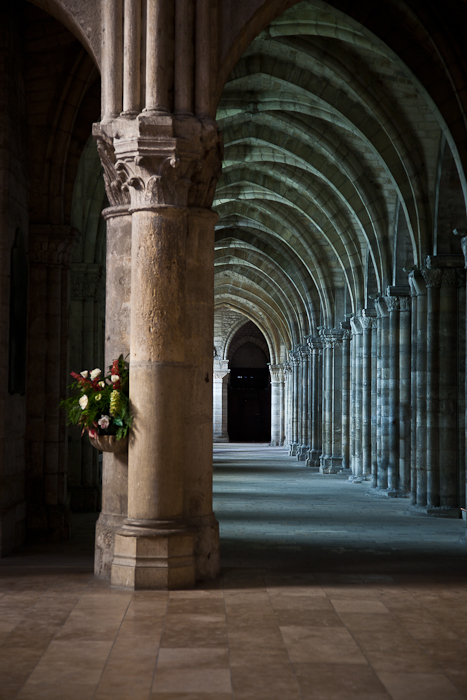
Side aisle, Basilique Saint Remi, Reims (Marne) Photo by PJ Aubrey
Some memories we remember as dreams, in the present tense; others as historical phenomena that stay safely in the past. Some memories carry their meaning with them. Others mean something because of their relationship with something that occurred in the past. Others depend on the future to reveal their significance. This is the web that is woven back and forth, across and through time.
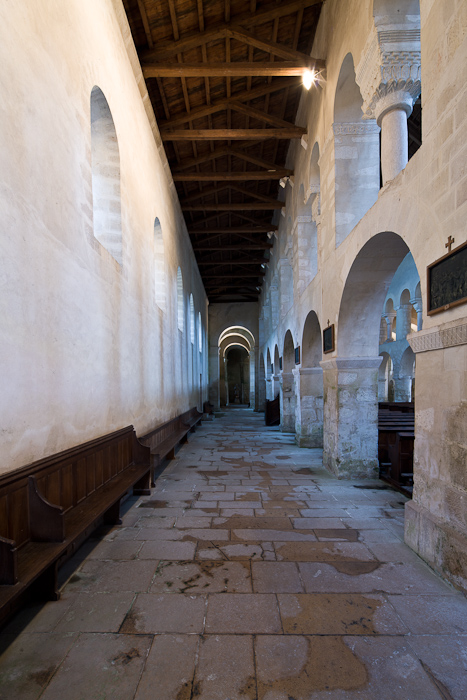
North side aisle, Eglise Saint-Étienne, Vignory (Haute-Marne) Photo by Dennis Aubrey
A friendly young man at the Burger King — I don’t eat Whoppers; I drive to the Burger King in rural Minnesota for the free WiFi — draws my attention. “What’s going on?” he asks, staring at the television monitor behind me and my MacBook Air. I assume he is responding to the breaking news I’d heard moments before on the drive from the cabin to the Burger King — the shooting of journalists in the office of an Annapolis newspaper. He is. He shakes his head; I shake mine. Then the words spill out. “I guess this is what happens when the press is targeted as public enemy number one.” He shakes his head again and walks away.
A few minutes later he returns to speak his support for the Second Amendment and the president. “All this gun stuff . . . we’ve always had guns in school and stuff, only now the media’s making a big deal of it. They’re blowing it up.”
We’re coming up on July 4th weekend. Celebrating the nation’s independence feels different this year. America is different. It’s the First Amendment that is at risk, not the Second.
An Independent Press: the Fourth Estate
The free press, sometimes called “The Fourth Estate” — the people’s independent watchdog of government — has saved us from our worst selves many times. It was the Fourth Estate that brought into our living rooms Edward R. Murrow’s news broadcast that stopped Senator Joseph McCarthy’s pernicious attacks on the integrity of American citizens whose political stripe wasn’t his. It was the Fourth Estate’s publishing of the Pentagon Papers that exposed the dirty secrets behind the Vietnam War, leading Lyndon Baines Johnson to become a one-term president. It was the Washington Post’s publication of Woodward and Burnstein’s investigative report on the Nixon administration’s break-in of Democratic headquarters at the Watergate Hotel that led to the impeachment and resignation of Richard Nixon.
The Fourth Estate exists as the instrument of the people to hold accountable those we elect, and the government agencies they are responsible to oversee on our behalf. The First Estate (the executive branch) and the Second Estate (the legislative branch) have often been critical of the Fourth Estate. Because the U.S. Constitution’s First Amendment guarantees freedom of the press from state control, the Third Estate (the judicial branch) has protected it from the other two branches of government. The Supreme Court has been the court of last resort to protect free speech from Presidents and other elected officials who have been wary of it.
Weary and Wary
There is a world of difference between wariness and assault. The current occupant of the Oval Office has used the nation’s Bully Pulpit to stir up good people like the guy at the Burger King to believe the minority party, once referred to as the “loyal opposition,” is out to destroy their freedom under the Second Amendment. Public perception has been altered. The public enemy no longer is communism, as it was in the McCarthy period. The target is much more in clear public view: the Washington Post, the New York Times, CNN, NBC, CBS, PBS. Every member of the Fourth Estate except FOX News and — who would ever have imagined it? — The National Enquirer. Joe McCarthy is smiling.
A civil society has quickly become less civil. The Bully Pulpit we once expected to give voice to the unity that underlies our pluralism (e pluribus unum); appeal to “the better angels of our nature” (Lincoln); respect the public and private institutions that make us who we are; and mourn tragic events such as today’s shooting in Annapolis, is used to create the public perception that the president’s critics are America’s enemies. This is an abrupt departure from the commonly accepted norms and expectations for civil discourse on which I being raised.
Increasingly, we tend to shout in anger or fall silent. Between the anger and the silence stands a chasm of despair. To some, America is becoming great again. To others, America in 2018, feels more like the aftermath of a coup d’état than a moment of celebration.
The Birth-er Movement: Black Lives Can’t Be President
The young man at the Burger King was an adolescent when Donald Trump funded the Birther movement alleging that Barack Obama, America’s first black president, was illegitimate, a charge not based in fact, “faux” news that stirred the latent fear of poor white Americans to believe President Obama was out to take away their rights. Long before the Electoral College elected him President, Donald Trump had a bully pulpit of his own, and he bullied many into believing the lies about the need to rescue the country from the alleged black Muslim socialist who wanted to take away our guns —until the day he suddenly declared, without apology for his error, that President Obama had been born in the U.S.A, as though the Oracle of truth had spoken definitively — years after his false claim movement had accomplished its aim.
The Third Leg of the Stool
Earlier today, before news of the shooting of journalists in Annapolis, the free press informed the American public of U. S. Supreme Court Associate Justice Anthony Kennedy’s decision to retire, leaving the vacancy on the Court for the President to nominate and the Republican Congress to give, or withhold, its consent and confirmation. The Founders’ intention of a nonpartisan, independent Third Estate — the third leg of the stool of checks and balances that keeps the American democratic republic from falling — was idealistic, to be sure, but an independent judiciary is essential to the architecture of the U.S. Constitution.
As we prepare for this Fourth of July observance, we do well to remember the architecture meant to preserve the nation by means of legislative and judicial boundaries that constrain a bully from running away with the country. Doing my best to be hopeful, I still wonder: can a Whopper accomplish a coup d’état without bloodshed — within the architecture of the American democratic republic?
The Fourth of July 2018 celebration goes down hard. Hold the onions!
Gordon C. Stewart at the Burger King, July 2, 2018.







 Views from the Edge