We used to pass notes while in school,
The teachers said “No! There’s a rule!”
But students today
Will have their own say:
A smart phone helps them play the fool!
- Steve Shoemaker, Urbana, IL, August 29, 2015

We used to pass notes while in school,
The teachers said “No! There’s a rule!”
But students today
Will have their own say:
A smart phone helps them play the fool!
We’ve learned always to call them Disciples–
that special class of more-than-human ones
who followed Jesus long ago. Apples
to cumquats, them to us. Even with flaws,
are far beyond what we could ever be.
They all would end as martyrs–be called Saints–
all holy men of God, who faithfully
would spread the word through all the continents.
…
The Bible called them “students,” and the name
for Jesus, “Teacher” — “Rabbi.” Could we learn
to be like them if we would take the same
more modest title? In first grade could earn
a star for listening, for playing fair,
for cleaning up our messes, learn to share.
– Steve Shoemaker, Urbana, IL, March 25, 2013
A small, white dairy barn had stood alone upon that hill for years.
The town had grown around it. Now a university professor, architect,
will try and see if he can build a church for students there.
…
They have almost no money. But they are Reformed, still Puritans with
simple tastes:
a concrete floor will do with folding chairs, clear windows open to
the light, the street, the passers-by, invite all in. They meet
…
around a table, pulpit, bowl, and hear the word. The room is filled
with song and prayer– the walls, inside and out, like milk are white.
Up high, no steeple, but a box of light, a cupola like on a barn:
just right…

Hessel Park Church
– Steve Shoemaker, Urbana, IL, September 2, 2012
From students, teachers should receive
much money: for the smart believe
they learned so much–and from the dull
because they raised unholy Hell.
(after Isocrates, 5th C., BCE)
– a Chreia
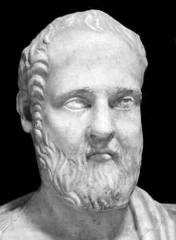
Isocrates, Greek teacher and rhetorician
A chreia in classical Greek culture was a brief, useful (“χρεία” means useful) anecdote attributed by the author to a particular character. In this case it was in honor of Isocrates, an honored rhetorician.The chreiai are remembered primarily for their role in classical Greek education, a system known as paideia in which wisdom was the goal. Children were introduced to simple chreiai almost as soon as they could read. These chreiai served as the means of character formation and the increase of wisdom for living in a civil society.
Later in their education, as they prepared to practice rhetoric (the art of discourse, both written and spoken), these chreiai served as the basis for formal eight paragraph essays in which the student elaborated on the subject of a chreia. The student would praise, paraphrase, explain, contrast, compare, provide an example, make a judgment, and, in conclusion, exhort the reader.
Thanks to my fellow student Steve for sending “after Isocrates.” In honor of my teachers – Gordon Kidder, Mrs. Martino, Mr. Thompson, Ms. Manlove, Harold Miller, Helen Semar, Esther Swenson, Ted Campbell, Lew Briner, Tom Parker, Krister Stendahl, my father and mother – I’m going to write an eight paragraph essay on this chreia.
 Views from the Edge