
In the Strife of Truth with Falsehood

Get ready for the verbal assaults.The PAC ads. The disinformation and misinformation media campaigns funded by big money with big interests that know how powerful words are.

Words are POWERFUL! Sometimes those of us who stand in pulpits doubt that our words matter. But reading this paragraph in Timothy Egan’s NYT,Deconstructing a Demagogue,”reminds me of just how powerful words are:

Back in 1994, while plotting his takeover of the House, Gingrich circulated a memo on how to use words as a weapon. It was called “Language: A Key Mechanism of Control.” Republicans were advised to use certain words in describing opponents — sick, pathetic, lie, decay, failure, destroy. That was the year, of course, when Gingrich showed there was no floor to his descent into a dignity-free zone, equating Democratic Party values with the drowning of two young children by their mother, Susan Smith, in South Carolina.

Today, if you listen carefully to any Gingrich takedown, you’ll usually hear words from the control memo.

And that’s just the beginning of the story of how language is used and abused for purposes of social manipulation. Gingrich knew that language is “A Key Mechanism of Control.”  Those who are well-schooled in theology and politics know that language is the primary mechanism of mind control: truth becomes falsehood and falsehood becomes truth; beauty becomes ugliness and ugliness becomes beauty; goodness becomes evil and evil becomes goodness, twisted by the language of innuendo and word association.

The cynicism that pervades the American electorate is due, in part, to this demagogic use of language. Words are precious things. Holy things. Sacred things. When they get twisted, they become vulgar and profane, one might even say ‘demonic’ in the sense in which Paul Tillich defined ‘demonic’: the twisting of the good. “The claim of something finite to infinity or to divine greatness is the characteristic of the demonic” (Paul Tillich, “Life and It’s Ambiguities,” Systematic Theology, Vol. 1, p. 102).

Paul Tillich, “The Courage to Be”

Paul Tillich was one of the first university professors fired during the Third Reich in 1933. At the invitation of Reinhold Niebuhr, he came to America where he taught at Union Theological Seminary in the City of New York, Harvard Divinity School, and the University of Chicago. Tillich and his academic colleagues in theology, philosophy, and ethics (Willem Zuurdeeg, Martin Niemoller, Karl Barth, Dietrich Bonhoeffer, and Elie Wiesel) left us a rich legacy of linguistic analysis of the language of demagogic use of language.They speak with authority because they each paid a price for their opposition to it.

There are those who say that Hitler won his war after all. His ingenious use of language and rhetoric is the substance of Language: a Key Mechanism of Control. Newt Gingrich is not Adolf Hitler. And we are all well-advised to be very careful with contemporary references to him, the Third Reich, or the Holocaust. Yet the language that once led a nation regarded as “the most sophisticated culture” to swallow the toxin of twisted truth is with us still. The demonic poison how rules the day in America, peddled as cure and candy by candidates bought and sold by the private corporate powers whose PAC ads control the airwaves.

Words are sacred. And those who abuse them enter into the darkness of the demonic twistings that led James Russell Lowell to write the hymn lyrics I sang as a child:

Once to every man and nation Comes the moment to decide, In the strife of truth with falsehood…. Though the cause of evil prosper, Yet t’is truth alone is strong; Though her portion be the scaffold, And upon the throne be wrong;, Yet that scaffold sways the future, And, behind the dim

unknown, Standeth God within the shadows, Keeping watch above His own. – James Russell Lowell, 1945, “Once to Every Man and Nation”

The PAC ads are coming. Plug your ears…or…better yet, listen carefully, listen critically. Then speak out “in the strife of truth with falsehood.”
It’s Raining, It’s Pouring

Today, three years to the day after Katherine’s (“Katie’s”) death (May 9, 2010), we inter her cremains, an appropriate time to re-post the effect of Katie’s illness along the way. This is a re-posting of a piece written along the way of Katie’s illness.

I wrote this piece when we learned that my stepdaughter Katherine’s incurable Leiomyosarcoma had taken a turn for the worse. In memory of Katherine (“Katie”) Elizabeth Slaikeu Nolan.

Gordon C. Stewart   Feb. 11, 2009

It’s raining, it’s pouring
The old man is snoring
He went to bed and he bumped his head
And couldn’t get up in the morning

It’s a day like that.  I bumped my head on the illness of a 33 year-old loved one.  It’s raining sadness. I’m having trouble getting out of bed in the morning.

Terminal illness has a way of doing that unless you believe in miracles of divine intervention or you have extraordinary powers of denial.

My spirituality has become increasingly like that of Rebbe Barukh of Medzobaz, an old Hasidic master in Elie Wiesel’s tale of Four Hasidic Masters and Their Struggle Against Melancholy.  When he prayed the customary Jewish prayer, “Thank you, Master of the Universe, for your generous gifts – those we have received and those we are yet to receive” – he would startle others with his weeping.  ‘Why are you weeping?” one of them asked.  “I weep,” he said, “in thanksgiving for the gifts already received, and I weep now for the gifts I have yet to receive in case I should not be able to give thanks for them when they come.”

For my family at this critical time, the real miracle has already occurred – the shared gift of love – and it will come again in ways I cannot now anticipate when the last page of the final chapter of our loved one’s life is over.

The miracles are more natural, nearer to hand.  Although I don’t believe in selective divine intervention, I am on occasion a sucker for denial – except on days like this when it’s raining and gray and I’ve bumped my head on the hard fact that cancer is ransacking my loved one’s body.  A certain amount of denial, too, is a blessing in disguise, one of God’s generous gifts to keep us sane when the rain pours down and clouds are dark.

Faith comes hard sometimes.  In college mine was challenged and refined by Ernest Becker‘s insistence that the denial of death lies at the root of so many of our problems.  My faith has been refined along the way by the courage of Albert Camus and Jean-Paul Sartre to face the meaninglessness of the plague, the faith and courage of Dietrich Bonhoeffer and Paul Tillich who stuck their fingers in the gears of Nazism, and the humble witness of Mother Teresa working in the slums of Calcutta with more questions than answers and some anger at God.

The job of faith, as I see it, is to live as free as possible from illusion with a trust in the final goodness of Reality itself, despite all appearances to the contrary.  Faith is the courage and trust to look nothingness in the eye without blinking or breaking our belief in the goodness of mortal life.

When I look into my loved one’s eyes I see that courageous kind of faith that defies the cancer to define her, and a resilient spirit that makes me weep tears of joy over the gifts we’ve already received and the ones we have yet to come.

It’s still raining and it’s still pouring, but I refuse to snore my way through this.  I’ve bumped my head on the news of a loved one’s terminal illness, but I’m getting up in the morning.

POSTSCRIPT March 21, 2012

Conversation yesterday about “The List” posted on Bluebird Boulevard:

Karen:

My mother died of cancer eight years ago. Her loss is still visceral. She is in every bird I see.

Me:

The morning of Katherine’s memorial service Kay, Katherine’s mother, was standing by the large picture window gazing out at the pond in our back yard. Out of nowhere, it seemed, two Great Blue Herons flew directly toward the window and swooped upward just before they got to the house. “She’s here. That’s Katie,” said Kay without a second’s hesitation. On her last day of hospice care, Kay and I each remarked that her face looked like a baby bird. I’m a skeptic about such things. I’ve always been, and always will be, a  doubting Thomas. My assumptions and conclusions come the hard way. But on the day the herons flew directly at Kay from across the pond, I saw it with my own eyes…and HAD to wonder.

Within a minute a third Great Blue Heron perched on the log by the edge of the pond and stood alone for a LONG time.  It reminded me of a gathering on the steps of the State Capitol in Saint Paul following the tragic deaths of school children at Red Lake, MN. The crowd stopped listening to the speaker. They were looking up. “What’s going on?” I asked Richard, the Red Lake American Indian advocate and my co-worker at the Legal Rights Center.org. “Eagles,” he said. “Where?” “WAY up. They’re circling.”

I learned later that the eagles were also circling at that same moment over the grieving families gathered at Red Lake. I asked American Indian colleague what he took it to mean. “We don’t ask. That’s the white man’s question,” he said. “We just accept it. We live in the mystery.”

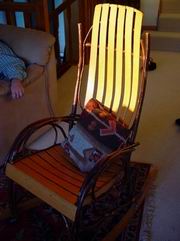
On and off my rocker

My Rocking Chair

My Amish Rocker

“WHY, in a world filled with yelling and screaming, would you ‘PREACH’? Are you off your rocker?”

I can’t help it. I’m a preacher. I have to preach. But it’s the time in the rocking chair that matters most, times when I sit in Jacob Miller’s Amish rocker preparing for Sunday that I love the most. Jacob made the rocker just for me in his Amish shop in Millersburg, Ohio on a farm that spoke volumes about peace and love.

I approach the pulpit in fear and trembling, knowing that it is sacred space where people expect to hear a different kind of word, its sacredness only as real as the humanity that walks into it. The requirements of preaching result in a daily discipline: a fresh cup of strong coffee with the Scriptures in one hand the newspaper in the other.

We live in a crazy world where religion is a source of great sorrow as well as a source of joy. Religion divides and religion unites. It opens us up to the Other, or it walls us off. It broadens us or narrows us.  It increases our circulation or it constricts our arteries.

Not long ago American Christians seemed to take for granted that Christianity and our country were simply flip sides of the same coin (a curious blending of the Judeo-Christian idea of an “elect” people and the national misappropriation of Jesus’ “city set upon a hill”  as a light to the other nations). That bogus idea is dead, but the news is still reaching our ears, like the news of the town crier in Frederich Nietzsche’s The Gay Science:

Have you heard of that madman who lit a lantern in the bright morning hours, ran to the market place, and cried incessantly, “I seek God! I seek God!” As many of those who do not believe in God were standing around just then, he provoked much laughter…Whither is God,” he cried. “I shall tell you. We have killed him – you and I.   All of us are murderers…. God is dead.  God remains dead. And we have killed him….

– Friedrich Nietzsche, The Gay Science (1882), Section 126.

That god is already dead, but the message is still reaching our ears. The death of this god “clears the decks for the God of the Bible,” wrote Dietrich Bonhoeffer in a letter from a prison cell July 18, 1944 before his execution by the Third Reich:

Christians range themselves with God in his suffering; that is what distinguishes them….  As Jesus asked in Gethsemane, “Could ye not watch with me one hour?” That is the exact opposite of what the religious man expects from God. Man is challenged to participate in the sufferings of God at the hands of a godless world. He must therefore plunge himself into the life of a godless world, without attempting to gloss over its ungodliness with a veneer of religion or try to transfigure it. He must live a ‘Worldly” life and so participate in the suffering of God. He may live a worldly life as one emancipated from all false religions and obligations. To be a Christian does not mean to be religious in a particular way, to cultivate some particular form of asceticism (as a sinner, a penitent or a saint), but to he a man. It is not some religious act which makes a Christian what he is, but participation in the suffering of God in the life of the world.

Dietrich Bonhoeffer, Letters and Papers from Prison

I’m no Dietrich Bonhoeffer. But his words and life frame the way I look at the world. To whatever extent the sermons and commentaries that appear here reflect Bonhoeffer’s spirit, I am grateful to him and to others who have shaped my ministry: Ted Campbell, Paul Louis Lehmann, Lewis Briner, William Sloan Coffin, Jack Stotts, William Stringfellow, James Cone, Sebastian Moore, and a host of others. When my attempts fail to keep faith with their examples, they reflect my shortcomings and foibles. If and when any of them manages to speak a Word through my human frailty, it is because I have stood on their shoulders on the watchtower, grasped again by the Spirit of the Living God.

“I will take my stand to watch, and station myself on the tower, and look forth to see what G-d will say to me, and what G-d will answer concerning my complaint. And the LORD answered me, ‘Write the vision; make it plain…so those who run may read it. For still the vision awaits its time….'” (Habakkuk 2:1-3a)

Jacob Miller’s Amish rocker is my watchtower. A cup of coffee, Habakkuk, and the morning newspaper. Thank you, Jacob, for the place to be on your rocker when I’m about to go off mine!