
Two Birds of the Secret Heart

59476eb9d98ab50256137e216d23f129--scripture-art-psalms

“Create in me a clean heart, O God…” is a well-known prayer from the Psalms.  It’s context — its back-story — is not so familiar.

Psalm 51 is a prayer attributed to David. It is not a quiet prayer. It is a wrenching, sobbing prayer, the words tumbling from David’s mouth in halting phrases and stammers with tears flooding his eyes, streaming down his cheeks.

The Inward Being

“Behold, You seek truth in the inward being;
therefore teach me wisdom in my secret heart.” (Psalm 51:6)

Is the secret heart the deepest place in us, the place where God is: the equivalent or synonym for “the inward being” – a poetic parallelism of Hebrew poetry? Or is it, perhaps, the secret place where we hide from God: the hiding place where we go off to a different heart than the Divine heart? Or could it be both at the same time?

David’s secret heart is dirty and he knows it. He cannot wash the stain of blood from his hands. “Wash me thoroughly from my iniquity,” he cries out, “and cleanse from my sin! For I know my transgressions, and my sin is ever before me.” It is a scene from Shakespeare’s Macbeth:

“Out, damn spot! OUT, I say…. all the perfumes of Arabia will not sweeten this little hand. Oh, oh, oh!”

The Hebrew Psalms are like that. They are not sanitized. They plunge the reader into the conflict between the reader’s inmost being, the true secret heart, you might say – the heart that pumps life into us – and the secret heart of our flight from truth and goodness, the heart of deception and self-deception.

Why is David crying out? What has he done? What is the sin that is ever before him, the blood he can’t wash from his own hands?

A Response to Accusation

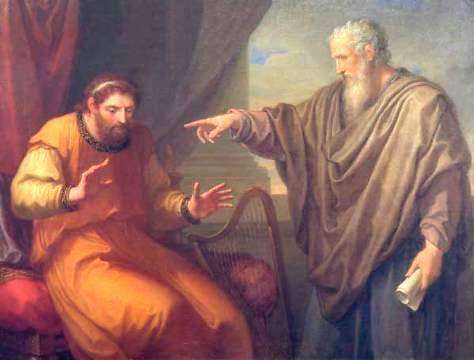
Psalm 51 comes in response to an accusation that has exposed the bloody behavior his secretive heart has produced. It is Nathan, David’s commander on the battlefront, who confronts David with the truth.

Nathan has just returned from the front to tell David that Uriah, the King’s next door neighbor, a man of impeccable loyalty valor, Bathsheba’s husband, whom David’s scheming heart has sent off to war, is dead! His blood is on David! Nathan has spoken the truth to power.

There is no wisdom in David’s secret heart. There is treachery there.

“Purge me!” cries David. Imagine Richard Burton at his most dramatic. “Purge me with hyssop, and I shall be clean; wash me and I shall be whiter than snow!” (Ps. 51:7)

Hyssop, the foliage of an aromatic plant named in the Passover story (Exodus 12:21-27), was used in the cleansing of a leper (Leviticus 4:51).

Two Small Birds

The rite of cleansing centers on two small birds. One bird is killed. The other bird is washed in the blood of the other under the flow of water and the sweetness of hyssop. The one bird dies. The second bird lives.

“Thus he (the priest) shall cleanse the house with the blood of the bird, and with the running water, and with the living bird, and with the cedarwood and hyssop and the scarlet stuff; and he shall let the living bird go out of the city into the open field; so he shall make atonement for the house, and it shall be clean.” (Lev. 14:52-53)

“Deliver me from blood-guiltiness, O God, the God of my salvation” cries Uriah’s killer curled up in a ball, hoping against all hope, “and my tongue will sing aloud of Your deliverance.” (Ps. 51:14)

Release Into the Open Field

David is both birds. He is the one who deserves to die. He is also the one who is living. He lives not because of the secretive heart that had conspired against Uriah, betraying his own inward being – “Against You only have I sinned…” (Ps. 51:4). He lives on because there is more mercy in God (the inward being) than there is sin in him.

“The sacrifice acceptable to God,” he concludes with tears, is “a broken spirit; a broken and contrite heart, O God, You will not despise.”

His body quivers as he imagines himself as the bird released into the open field by mercy alone, “according to Your steadfast love; according to Your abundant mercy.” (Ps. 51:1)

  • Gordon C. Stewart, Chaska, MN, Nov. 27, 2017
The Secret Heart and the Inner Being

Nathan accusing David

Nathan accusing David

“Behold, You seek truth in the inward being;
therefore teach me wisdom in my secret heart.” (Psalm 51:6)

What is the secret heart?

Is it the deepest place in us, the place where God is: the equivalent or synonym for “the inward being” – a poetic parallelism of Hebrew poetry?

Or is it, perhaps, the secret place where we hide from God: the hiding place where we go off to a different heart than the Divine heart?

Or could it be both synonym and antonym at the same time?
_______

Psalm 51 is a prayer attributed to David. It is not a quiet prayer. It is a wrenching, sobbing prayer, the words tumbling from David’s mouth in halting phrases and stammers with tears flooding his eyes and streaming down his face like rivers.

David’s secret heart is dirty and he knows it. He cannot wash the stain of blood from his hands. Nathan has exposed his sin. Nathan’s story-telling has seduced David into the trap where his secret is exposed to his inner being. Nathan has baited David with a story that has aroused David’s anger. “As the LORD lives,” said David to Nathan, ” the man who has done this deserves to die!” And Nathan then said to David, “YOU are the man.”

“Wash me thoroughly from my iniquity,” cries out David in Psalm 51, “and cleanse from my sin! For I know my transgressions, and my sin is every before me.”

It is a scene straight from Shakespeare’s Macbeth:

“Out, damn spot! OUT, I say…. all the perfumes of Arabia will not sweeten this little hand. Oh, oh, oh!”

_____

Hebrew Psalms are like that. The are not sanitized. They plunge the reader into the conflict between the reader’s own inmost being, the true secret heart, you might say – the heart that pumps life into us – and the secret heart of our own flight from truth and goodness, the heart of deception and self-deception.

Why is David crying out? What has he done? What is the sin that is ever before him, the blood he can’t wash from his own hands?

Psalm 51 comes in response to an accusation that has exposed the bloody behavior his secret heart heart has produced. It is Nathan, David’s commander on the battlefront, who confronts him with the truth.

Nathan, relying on a fresh report from the front line of battle, tells David that Uriah, the King’s next door neighbor, a man of valor and impeccable loyalty to King David, whom David had sent off to war to secure Uriah’s wife Bathsheba for himself, is dead! His blood is on David! Nathan has spoken the truth to power. And the way that Nathan has spoken it to the King has taken him into the deepest parts that are at war within himself.

There is no wisdom in David’s secret heart. There is only treachery.

“Create in me a clean heart, O God,
and put a new and right spirit within me.
Cast me not away from Your presence,
and take not Your Holy Spirit from me.”

“Purge me!” cries David. Imagine Richard Burton at his most dramatic. “Purge me with hyssop, and I shall be clean; wash me and I shall be whiter than snow!”

_____

What’s hyssop?

Hyssop is the foliage of an aromatic plant named in the Passover story (Exodus 12:21-27) and used in the cleansing of a healing and cleansing of a leper (Leviticus 4:51).

The rite of cleansing involves centers on two small birds. One bird is killed. The other bird is washed in the blood of the other under the flow of water and the sweetness of hyssop. The one bird dies. The second bird lives.

“Thus he (the priest) shall cleanse the house with the blood of the bird, and with the running water, and with the living bird, and with the cedarwood and hyssop and the scarlet stuff; and he shall let the living bird go out of the city into the open field; so he shall make atonement for the house, and it shall be clean.” (Lev. 14:52-53)

“Deliver me from bloodguiltiness, O God, the God of my salvation” cries Uriah’s killer curled up in a ball, hoping against all hope, “and my tongue will sing aloud of Your deliverance.”

_____

David in Psalm 51 is both birds.

He is the one who deserves to die. Yet he is also the one who lives. He lives not because of the heart that had conspired against Uriah and betrayed his own inward being – “Against You (God) only have I sinned…” (Ps. 51:4). He lives because there is more mercy in God (the inward being) than there is sin in him.

“The sacrifice acceptable to God,” he concludes, the tears still streaming down his face, but calmer now, “is a broken spirit; a broken and contrite heart, O God, You will not despise.”

His body quivers as he imagines himself as the bird released into the open field by mercy alone, “according to Your steadfast love; according to Your abundant mercy.” (Ps. 51:1) The inner being – his Deeper Being – has taught his released him for wisdom.

The “Tragedy” of Sandy Hook

macbethIf philosophical parsing of the meaning of Sandy Hook was inappropriate just a few days ago, it is mandatory now.

The slaughter of these dear little ones and their teachers was a moment of terrible and terrifying insanity. When Adam put on his body armor and turned his mother’s guns on his own mother and Sandy Hook, insanity broke out to bring grief that chilled the bones of everyone in America.

Today there are calls for gun control and mental health services, and those calls make perfect sense as practical responses, but they will not fix the problem.

There is a more profound collective insanity that pervades our culture and our nation. It’s a tragedy in the sense of the old Greek and Shakespearean theater: a fatal flaw that is doing us in.

Sandy Hook was the latest symptom of the American tragedy: our worship of safety – arming ourselves to the nines – turns out to the death of us.  The idolatry of safety is the worship of death itself.

A five year old boy in Minneapolis is playing with his two-year-old brother in their parents’ bedroom. He finds a loaded pistol under their father’s pillow, points it at his brother as one would point a toy gun. His brother is dead. The surviving five-year-old and his parents will never be the same – because a father sought to keep his family safe with the pistol under his pillow.

A mother in Newtown has guns in the home she shares with the disturbed son she loves and seeks to protect from a cruel world. Like so many others in America, the guns were purchased either for safety or for sport, but the results are the antitheses of safety or fun.

Whether in our bedroom at home or in the nation’s Capitol, when the insurance of safety rises to the top of the pyramid of values, death ascends as the power that destroys, the fatal flaw in a natural human instinct toward safety and security.

Freedom and safety are basic human needs. They are American values. Each is important. But neither freedom nor safety is God. Neither one is worthy of enshrinement by itself, and the two of them mixed together make for a Molotov cocktail thrown back into our own bedrooms, at the Sandy Hook Elementary School, Baghdad, and anywhere else that the concern for safety releases the tragic flaw of the Greek theater, Shakespeare, and the American theatre of the absurd.

Pieta - Michaelangelo

Pieta – Michaelangelo