A Song for each kind of day

Scheduling Calendar - differrent kinds of days

Scheduling Calendar - different kinds of days

Two years ago during my step-daughter’s final months with terminal cancer, I spent three days in quiet reflecton at Saint John’s Abbey in Collegeville, MN.Worshiping with the Benedictines was part of the structure of my day, the chants and readings opening space for fresh air to enter my angry soul…except for…the Psalms. Outrageously violent, vindictive, intolerant, self-righteous…horrible expressions of emotions I had gone there to revoke.

One day following morning prayer, I asked my Benedictine spiritual guide “Why do you read them aloud? Over and over again. They’re horrible.”

“Yes,” he replied, “because they’re real.” And words to this effect: “All those emotions are in us. Every one. Only if we recognize and remember can hate be transformed into love, fear into trust, self-centeredness into compassion. The gospel makes no sense unless it is a word spoken directly into these parts of ourselves we wish weren’t there, the sides of us we deny or from which we take flight into illusions of perfection.”

The words of another Benedictine, Dom Sebastian Moore of Downside Abbey in England, had hit the mark once before during the greatest personal crisis of my life – a time filled with the greatest joy and the greatest sorrow at the very same time. The words are heavily underlined in my copy of Moore’s The Crucified Jesus Is No Stranger. They were a lifeline to a drowning man.

“We have to think of a God closer to our evil than we ever dare to be. We have to think of God not as standing at the end of the way we take when we run away from our evil in the search for good, but as taking hold of us in our evil, at the sore point which the whole idealistic thrust of man is concerned to avoid.”

Or, as Steve concludes his poem, “there is a Psalm for each one of our days.”  Here’s the poem.

“A Song for Each Kind of Day”

Steve Shoemaker, April 12, 2012


One Hebrew word for “god” was “jah.”

(It was a time of many words

for god–and many gods.)  To say

“hallel” was for all to sing praise,

so HALLELUJAH meant “Praise God!”

(or “Thanks to you, oh God!”– for some

words could be truly translated

more than one way.


And so, a Psalm, or Song, that offered thanks or praise

might well be paired with a lament:

a cry of pain from one who prays

for help, relief, from gods who sent

disaster.  (But, of course, some Psalms

wisely acknowledged that some wrongs


were caused by those who sang the songs!)

There is a Psalm for each one of our days…

The Sin of “American Exceptionalism”

Last night I watched Mitt Romney at a campaign rally in my home town, Broomall, Pennsylvania. What I saw sent chills down my spine. Demagoguery was on display. The people from my home town applauded the scolding of American President for apologizing. No apology for the tragedy of an American soldier(s) walking into the homes of families in Afghanistan to kill. No apology for … well…for ANYTHING. America is the greatest country in the history of the world. We should make no apology, said Mr. Romney.

In light of that speech, I am reposting this piece first published in February. It’s Holy Saturday for me. The one who lay dead on this day was killed, without apology, by The Myth of Roman Exceptionalism. The Roman Empire is long gone. But the myth never goes away. Only the name of the nation changes. Here’s the piece:

Jacket of “My People Is the Enemy”

“The stairway smelled of piss….This [a tenement apartment in East Harlem] was to be my home.  I wondered, for a moment, why. Then I remembered that this is the sort of place in which most people live, in most of the world,  for most of the time. This or something worse. Then I was home.”  – William Stringfellow, My People Is the Enemy: An Autobiographical Polemic.

I’ve been holding my breath, wrestling with whether to speak aloud what I hear and see.

I’m a disciple of Jesus, a Christian, in the debt to the bold witness of the late William Stringfellow, lay theologian. I’m also a religious pluralist. I believe with Chief White Calf of the Blackfeet that there is not just one way, there are many sides to the mountain and many paths on which the Divine Mystery is experienced.

I have learned over the years to respect the multiplicity of ways different sides of the mountain experience the living God. I work hard to understand my Hindu, Buddhist, Muslim, and Jewish neighbors. I often experience these discussions as encounters with God whose vastness, like the ocean, is so much greater than any of the tea cups in which we hold a few drops of the sea.

I also know that some forms of religion are just plain nuts. The religion of Jim Jones whose followers drank the purple Kool Aid in shared suicide in the jungle of Guyana is only the most ludicrous example of why we need to join comedian Lewis Black’s raging objection to political distortions of the truth: “You can’t just make s—t up!” Religion represents the best and the worst of the human psyche (the Greek word for ‘soul’).

Joseph Campbell, among others, long ago opened the aperture on my theological camera. He helped me to see that what we are all dealing with, on all sides of the mountain, is myth, the human spirit’s uniquely creative meaning-making activity that expresses both the grandeur and the terror of finite experience. Myth is not the opposite of truth; it is the story that points us beyond ourselves to the transcendent and the eternal.

My way of looking at the world is shaped by a vast variety of voices. Among them are Fyodor Dostoevsky, Friedrich Nietzsche, Franz Kafka, Jean-Paul Sartre, Albert Camus and Dietrich Bonhoeffer, whose experiences of the horror of the absence of God caused them to poke their fingers in the eyes of prevailing religious traditions whose tidy moral worlds turn God into a cosmic sadist.

Any religion worth its salt in the 21st century has to pass through the existential protests of these thinkers and of the shrieks and cries that still echo across the world from Auschwitz and Buchenwald that poke holes in every theory of a morally ordered universe. The Garden of Eden was lost a long time ago and, in the wake of the closing of the gates to it, any religion has to take account of the human history that looks much more like the trail of tears paved by Cain’s slaying of Abel than like two innocent people in Paradise before the fall.

Yet there is a deep longing for something more tangible, more trustworthy than myth. Something one can touch, see, feel, smell – a story that is not a story but fact. The longing is strongest when we experience great uncertainty and insecurity.

With this perspective, I have been looking again at the fastest growing religion in America, Mormonism, and the Church of Jesus Christ of the Latter Day Saints (LDS).

My first experience with the Mormons came quite by accident thirty years ago. I was riding a bus in New York City on my way uptown to visit African-American theologian James Cone at Union Theological Seminary in Harlem when I noticed the sign “Mormon Visitation Center.”  Already stressed by an unfamiliar transit system and feeling quite alone, I decided to get off the bus and take the tour.

Unlike the streets outside that were filled with trash and lit by flashing neon signs, the Visitation Center was spick-and-span. Everything was in perfect order, complete with a hologram of a Mormon family in a tranquil woods sitting in a circle, listening to the white upper-middle-class family’s father sitting on a stump higher than the other members of the family, reading from the Book of Mormon to an enthralled wife and two perfect, obedient, happy children. The hologram elicited two responses. One was amazement. I had never seen or even heard of a hologram. The other was a sense of outrage at the perpetration of a promise that was, in short, nothing but a hologram, the illusionary projection of someone’s idea of Eden that would strike a chord with visitors who long for the lost woods of the Garden of Eden. It offered a world of perfection: orderly, tidy, white, rural – nothing like the urban world on the street outside – the antidote to the realities and complexities of life in New York City.

When I left the Mormon Visitation Center it never crossed my mind that the Mormon vision or mythology would become the fastest growing mythology in America in the 21st Century. I was relieved to get back on the bus on my way to Harlem.

I ask myself now why this is so. I look again at Mormon beliefs and practices to try to understand.

In Mormon teaching, the Garden of Eden was a historical place, and it was not in the Mesopotamian Valley by the Euphrates River, as in the original biblical myth of Genesis. It was in North America…in Missouri.

“According to Joseph Smith [Mormonism’s founder] the Garden of Eden was located in Jackson County, Missouri and following his expulsion from the Garden, Adam traveled northward to a place near modern-day Gallatin, Missouri. Mormon Apostle Orson Pratt stated that the name Adam-ondi-Ahman “is in the original language spoken by Adam, as revealed to the Prophet Joseph” (Journal of Discourses 18:343) – Bill McKeever, Mormon Research Ministry.

It is to this very spot of physical geography that Jesus will return at the Second Coming. None of this is in the realm of myth. It’s fact. You can go there to touch it and  walk on it, knowing that Adam was there long before you and that, after you have walked there, it will prove to be the epicenter of the universe, the very spot where Christ will return.

Why is the Mormon myth gaining such traction in America? And why would I break the code of silence, the well-advised reticence to those of us who share White Calf’s belief that the Divine Mystery is known differently on different sides of the mountain?

Some things are too important to leave unaddressed. The Mormon mythology is quintessentially American.

The myth that America is the center of transcendent goodness and power, the world’s epicenter, the original Garden of Eden and the place of Christ’s return, the people of “Manifest Destiny”, the one exception to the rising and falling of empires and nations, is losing its hold on us at home and abroad. We are losing our sense of innocence. Yet there lurks the nostalgia for the secure home provided by the illegitimate marriage of Jesus’ gospel of the Kingdom of God with America, “the City set upon a hill” of Jesus’ Sermon on the Mount and of John Winthrop’s sermon to English settlers on their voyage to the new world.

As Nietzsche knew, such gods don’t die easily, even when they’re already dead. When the town crier takes his lantern into the darkened town square at midnight crying “God is dead! God is dead!” in Nietzsche’s Thus Spake Zarathustra, the rest of the town regarded him as a madman. But it would be only a matter of time before the news would reach their ears.  It was the god of Western civilization that Nietzsche’s madman pronounced dead.

When something dear to us dies, especially when it is the prevailing religious myth of a nation about its own holiness and invulnerability, we become like starving people who continue to look in the same old bare cupboard for bread.

What better place to go than the reassurance that America is still the center – the ancestral home of a real man named Adam, who came complete with his own (now lost language, the special place to which Jesus (who visited the lost tribe of Israel in the Americas between his resurrection and bodily ascension into heaven) will return? When the Christian story the story is concretized to a finite, mortal place, it power as myth – pointing us beyond ourselves to the transcendent and the eternal – is not only lost but turned on its head.

There are many sides of the mountain, and it behooves all of us to approach people of different religious traditions with open ears and open minds. But approaching another’s religious beliefs respectfully does not require that we pretend not to see what we see or that we conclude that all religions are really the same or that one opinion is as good as another in the free market of religious truth claims. “You can’t just make stuff up!”

Let me say without hesitation that what I see in Mormonism is but the most exaggerated illustration of the idolization of the nation that includes so much of the American churches of whatever stripe where the nation is enshrined as God and where patriotism is the unspoken highest virtue with the cross wrapped in a flag.

The American wars of foreign intervention in Vietnam, Iraq, and Afghanistan could not have happened without this widespread faith in American goodness and exceptionalism. It is the cardinal sin that afflicts us across all denominational and religious lines. Whenever the Jesus executed by the Roman Empire becomes the Imperial King of a new empire, those who continue to hear the shrieks and cries of the world that suffers – and who continue to smell the piss on the stairway in the place we call “home”- are obliged to break the silence, violate the code, and get back on the bus to Harlem.

The Wafer and the Loaf: the Pope and Raul Castro

I woke up this morning to read “Pope calls for ‘justice, peace, freedom and reconciliation’ in Cuba. He was greeted by Cuban President Raul Castro, who promised religious freedom in his Communist nation.”  What follows is my reflection on this piece in light of three weeks in Cuba in 1979..

Curious. The headline and the story are curious.

Pope Benedict arrives in Santiago, Cuba. In Mexico he has just criticized Cuba’s Marxist model as obsolete and has called for a future of “justice, peace, freedom and reconciliation” in Cuba.

The President of Cuba, Raul Castro, welcomes the pontiff to Cuban soil.

The media focuses on the Pope’s call for change in Cuba, on the one hand, and Mr. Castro’s promise of  religious freedom in Cuba, as though the latter were a new development.

In 1979, on the heels of the Catholic Bishops Conference in Puebla, Mexico, I spent three weeks in Cuba, one of 75 churchmen and theologians invited by the Evangelical Theological Seminary of Matanzas, Cuba and the Presbyterian-Reformed Church of Cuba.

Most of the guests were from Central and South America. Others were from France, East and West Germany, Rumania, the Soviet Union, Mozambique, Angola, South Africa, Zimbabwe. There were four of us from the U.S: Professors Harvey Cox, , Robert McAfee Brown and a tag-along practicing pastor and college chaplain from Wooster, Ohio.

What do I remember most about that trip? Five memories:

________________________________

1) Approaching Cuba from the air, looking down at this island 90 miles from the coast of Florida, asking how this little David had managed to slay Goliath at the Bay of Pigs, and wondering what was so threatening to us that the U.S. government continued to punish it with an economic embargo. I felt like a bully. Guilty. Ashamed. Humble.

2) Getting sick on a collective farm, sitting under a tree after drinking a complementary glass of banana juice. I was quickly tended to by Cuba’s medical and pharmaceutical system. They continued to check on me until all was well. Everyone gets health care.

3) The Cuban pastors’ response to a long breast-beating speech by Robert McAfee Brown, one of the foremost theologians in the U.S.  Brown spent 45 minutes in a biblically based sermon apologizing to the Cubans, a kind of cathartic confession in full public view. I was with him all the way. The Cuban response? Stop that. You didn’t do this. The American people haven’t done this to us. Your government has. Wallowing in guilt won’t help you and it won’t help us. We all need to find ways to promote justice and peace in our own contexts. We are all here as friends, brothers and sisters in Christ.

4) Walking through the streets of Matanzas in the evening. Children playing freely in the streets. Windows and doors wide open. Neighbors talking and laughing with next-door neighbors. This could not be staged. This was the real Cuba.  As Harvey Cox, the charming professor from Harvard Divinity School who is fluent in Spanish, led the three of us through the streets, children followed him like the Pied Piper. Harvey would laugh with them and they with him. We would sing and walk. It was playful, like nothing that was happening back home.

5) A conversation with Communists on the veranda of the home of the President of the seminary. Raul Castro was among them. They were there to welcome us to Cuba. They also wanted to talk theology and society. They wanted to know what we really believed about God, about the Kingdom of God, and about social justice and economic equality. I don’t remember his name now, but I do remember the long one-on-one conversation during that cocktail hour with a member of the Communist Party. He had grown up Roman Catholic but was no longer a believer. The Church, he said, had kept the people in their place before the revolution. The Party had raised them up to believe in themselves. The Church had given them a wafer; the Party gave them bread, real food, real nutrition. The Church proclaimed the Kingdom of God after you die; the Party proclaimed a society of justice and peace that could be achieved in this world.

He asked what I thought. I told him that the version of Christian faith that he had described was not my faith. It was something else, but it was a very popular distortion of the life and teaching of Jesus. I told him that I shared his hope, that what he called “the classless society” I called the Kingdom of God, and that, to the extent that we were each working for the elimination of poverty, the end of starvation, and the health and joy of all God’s children, we were working toward the same goal under different names.  I rehearsed my history of Christian-Marxist dialogue dating back to seminary and the summer of 1966 living in Bratislava, Czechoslovakia as the Experiment in International Living Chicago Ambassador to Czechoslovakia. I told him of Josef Hromadka, the Czech theologian who had begun this dialogue because, said Hromadka, there was only one reason that the Bolshevik Revolution was atheistic: the sin of the Church. Its failure to align with the poor rather than the rich. The Church and the Czar had become of one cloth, just as he had been describing. The Church was giving people nothing but a wafer; the bread would come only after death. Lenin and Trotsky were insisting that to be genuinely human was to eliminate the economic structures that produce poverty and despair and that delay the distribution of real bread until an afterlife. Like Marx, they saw religion as the opiate of the people, the ideological blanket that blinded people to their earthly reality. But the biblical Kingdom is not about the Church, it’s about the new society in which the love of God reigns everywhere. It’s the NEW city, the new Jerusalem, and, in that new city, there is no longer any temple. There is no longer any need for the church because the Kingdom has come.”

The man from the Party’s eyes were wide.

I asked the man on the veranda where he thought his hope for such a society came from. “I don’t know,” he said, “I think it’s just part of being human.” “Yes,” I said, “but why? How’s that hope get there? Why should we hope unless there is something in being itself, something in the deepest part of us, that holds out the promise of its fulfillment, an inner sense that beckons us beyond the present conditions? The name for me is God.  None of us has ever seen God, yet I see God in Jesus of Nazareth, a worker, a carpenter, preacher of the Kingdom of God. I hear in your visions an echo of the Sermon on the Mount. I get the clearest sense of it when we share the meal at the Lord’s Table, the sign of the Kingdom.  The Kingdom will not come by Prometheus stealing fire from the gods. We have to work for it, but we also ‘wait for it with patience.’”

“Thank you, I’ll have to think more about that. You sound like Jose.” There’s a long pause. “Well…We’ll have to wait and see. I guess only time will tell who’s right,” he said. Like Harvey and the kids on the street that evening, we shared a good laugh, shook hands, and moved on to another conversation.

_____________________________

It’s now 33 years later and I’m reading about Raul Castro’s “promise” of religious freedom, the very same Raul Castro who was on the veranda at the seminary, who graciously welcomed the guy with the wafers to Cuban soil, except for kissing his ring. Priests and lay people from throughout Cuba throng to the site. None of them is hungry for bread.

Curious…for a country with no religious freedom. Don’t you think?

Verse for Today

One:  God, remind me of my neighbor,

take away my pride.

Two:  God, remind me of my power,

don’t let me run and hide.

Steve Shoemaker, sent this morning, March 26, 2012

A Sermon on Suffering

The post of my friend Steve Shoemaker’s poem “Murillo’s Christ after the Flagellation” and the comments that you posted prompted the sermon I delivered this morning at Shepherd of the Hill Presbterian Churchin Chaska, MN. The sermon never would have happened without your thoughtful, penetrating comments on the earlier post. THANK YOU. Here’s the sermon.

THE FLAGELLATION

“Now the men who were holding Jesus mocked him and beat him; they also blindfolded him and asked him ‘Prophesy! Who was it that struck you?’ And they spoke many other words against him and reviled him.”  Gospel of Luke 22:63

Two months ago I created a blog. One of my seminary classmates, Steve Shoemaker, wrote the other day to say that he was impressed by how prolific I was. I thought maybe he meant “wordy” until he said that my productivity embarrassed his laziness as a poet. So, he said, “Here’s the deal I’ve made with myself. For every piece you put up on your blog, I’ll write a poem.” Steve is 6’8 and a basketball player in college. Clearly, he hasn‘t lost his competitive spirit.

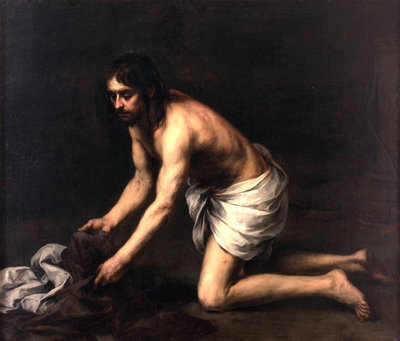
A poem arrived last Friday. It’s a reflection on a painting by sixteenth century Spanish artist Bartolomé Esteban Murillo. In the painting, Jesus is bent over on all fours after he being mocked and beaten.

Christ after the Flagellation

Steve’s poem, “Murillo’s Christ after the Flagellation” changed the direction of the sermon this morning.  Here’s the poem.

The human had been tied to the whipping

post, a pillar that had been used many

times before by the Romans (and ages

earlier by the Greeks–but for a much

different purpose). Now, his pale skin looks

translucent (should it not have been darker,

with more blood?) His mother recalled his bris.

They had both cried then, too.

A strong young man, broad back, thick arms, now on

hands and knees, but head raised with eyes open:

seeing a cross that’s even worse ahead…

Still, unflinching, resigned–no, determined

to go on, face more pain, indignities,

shame, even death (there is no sign of God.)

Shortly there arrived a brief comment from a blogger who blogs about the daily struggle with mental illness.

“This poem brought tears to my eyes.”

Score one for my friend Steve.

Later in the day another comment arrived on the blog in response to Steve’s poetry. Like the first comment, this one also comes from someone with a history of some kind of long-term suffering. It reads as follows.

I have a response to the stories of Christ’s beating that often leaves others aghast. So brace yourselves:

He was beaten for several hours, or a day or two? Big deal. Those of us who have suffered years of abuse and terror know what real suffering is.

I don’t find focusing on Jesus’ suffering, or any of that 12 stages of the cross crap, to be helpful at all. I find it to be insulting. As if there is something noble and glorious about suffering. Nope, not a damn thing to recommend it. I know that Jesus voluntarily placed himself in the position for that to happen. So? Doesn’t help.

Please, fellow readers, don’t think that I am an isolated one, or few. There are lots and lots of us feeling this way.

The world is full – FULL – of people who have suffered much worse for decades or lifetimes. Think of people who live in North Korea. Or poor girls growing up in India. Or young girls in Fundamentalist Church of the Latter Day Saints settlements who get married off to much older men and are then raped daily for the rest of their lives. Jesus’ few days of humiliation are nothing in comparison.

The Lenten/Easter season is my favorite church season because I am reminded of how deeply I am loved and how quickly I am forgiven. Jesus’ brief beating plays no role in that….

The writer is hardly alone in his thinking about this. What do we say about those whose tenures of torture and suffering far exceed the relatively short period of Jesus’ suffering?  Is focusing on Jesus’s suffering and the stations of the cross insulting to those who have suffered, and continue to suffer, for decades or for a lifetime?

How would you reply to the writer?

Here’s how I responded:

Your thoughtful response calls for an equally thoughtful reply. So I’ll try.

The cross, in my theology, in no way minimizes or disrespects the suffering of others. Nor does it say, as it is too often understood by sacrificial atonement theology, that suffering itself is noble or glorious. The cross was an instrument of Roman torture and execution. The Jesus who was tortured and executed, as were thousands of his Jewish contemporaries, is not somehow God masquerading in human flesh. That being said, moving the cross to the sidelines of Christian faith and reflection is, in my view, a mistake. Well meaning because it reacts against the twisted theology that understood it to be separate from, and above, all other human suffering, but mistaken nonetheless.

When I look at the cross, I see all these people. And I see myself there as both the crucified and the crucifier. What I see in the crucifix is total abandonment. “My God, my God, why have you forsaken me!” And in some way I hear not only the cry of Jesus but the cry of the God Dietrich Bonhoeffer described as the Divine Center we push to the edge of the world.  I see in the Christ-event the tragedy and the hope of the divine-human encounter.

Sebastian Moore (The Crucified Jesus Is No Stranger and The Inner Loneliness) and Joseph Campbell awakened me to this richer Christology. Moore: “We have to think of God as closer to our evil than we ever dare to be. We have to think of God not as standing at the end of the way we take when we run away from our evil in the search for good, but as taking hold of us IN our evil, as the sore point which the whole idealistic thrust of man is concerned to avoid

“Redemption through the blood of Christ is (wrongly!) interpreted as the bending of Reality itself to man’s great dream of himself. And it is exactly the reverse. It is the ending of the dream. It is the beautiful collapse of the whole enterprise. It is the invasion of man by himself, with God at the center as love.” (Bolding added  for emphasis.)

Closer to home, another great theologian, my wife, Kay, reflected on the cross the other night at a Lenten series on “The Place of the Cross”:

“The Apostle Paul used to talk about all of his theology in terms of transformation at the foot of the cross. If a theological insight couldn’t go to the foot of the cross and be transformed there, then it wasn’t of God. This darkness is not for lightweight faith statements or testimonies. The annihilation of all goodness and all love which takes place in the action of one human being in violence to another human being—it cannot be redeemed by any other force but God’s pure love. That is a faith statement that lives inside a vacuum until manifested. There is no meeting of love and abandonment, they are mutually exclusive realities. We are lost. Period. And if God is to find us, then it is all about God’s initiative.”

From today’s perspective, Moore’s language is too gender- specific, not inclusive. But the substance of his Christology is totally inclusive. We’re all there. Anything short of that either drifts off into a new utopian project or into some new rendition  of the power of positive thinking. The power of Christian theology is its gravitas: it doesn’t turn away.

I told the blogger, “Love to hear more…. Hope we can keep the conversation alive.”

Hours later, an email arrived from the second blogger who had watched “The Leper” on the blog saying s/he was moved and grateful for the sermon.

If I could sit down in a coffee shop or in a living room by the fire to continue the conversation, this is what I would say.

The cross of Jesus does not minimize other suffering. It casts a light backward and forward into all darkness for all time. From inside the light we see the darkness of all human violence and abuse, and at the foot of the cross, we look up to realize that the protest against the suffering we impose on others and our own self-imposed suffering – our own reviling of others and our reviling or ourselves — is not just our protest. It is God’s. It is the suffering of God at the hands of a godless world. And the word for “they reviled him” is the same as the word “blasphemed” him.  Whenever we treat others cruelly, or treat ourselves cruelly, we blaspheme God. We are reviling and whipping the back of God.

From Jesus’s cry to God – “My God, my God, why have you abandoned me?” – there comes an echo from the heavens: “My children, my children, why have you abandoned me? My children, how could you forsake Me?”

The cross calls for an end to the reviling of others and our own sorry self-flagellation, as though those we revile, or we ourselves, would be or should be beyond love’s reach.

Who is the “the human tied to the whipping post”? Who puts her there?

Will you join the suffering of the God who wants it all to stop? Will you rejoice in the inevitable, eternal reach of God’s love and redeeming grace?

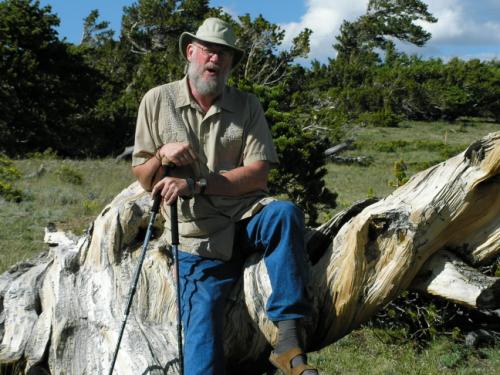
Footnote: Here is Steve, the poet, among the Bristle Cone Pines at 11,000 feet in Colorado:

Steve Shoemaker

..

A fellow student at McCormick Theological Seminary in Chicago, we’ve continued the friendship for 47 years. A published poet, Steve was the Senior Minister of the McKinley Presbyterian Church and Director of the McKinley Foundation (campus ministry) at the University of Illinois for many years. He hosts “Keepin’ the Faith” on WILL, Illinois Public Radio,. He and his wife, Nadja, a research biologist, live in a geo-thermally-heated house on the prairie outside Urbana, IL where his neighbors often spot Steve’s kites riding the winds of the prairie skies.

On and off my rocker

My Rocking Chair

My Amish Rocker

“WHY, in a world filled with yelling and screaming, would you ‘PREACH’? Are you off your rocker?”

I can’t help it. I’m a preacher. I have to preach. But it’s the time in the rocking chair that matters most, times when I sit in Jacob Miller’s Amish rocker preparing for Sunday that I love the most. Jacob made the rocker just for me in his Amish shop in Millersburg, Ohio on a farm that spoke volumes about peace and love.

I approach the pulpit in fear and trembling, knowing that it is sacred space where people expect to hear a different kind of word, its sacredness only as real as the humanity that walks into it. The requirements of preaching result in a daily discipline: a fresh cup of strong coffee with the Scriptures in one hand the newspaper in the other.

We live in a crazy world where religion is a source of great sorrow as well as a source of joy. Religion divides and religion unites. It opens us up to the Other, or it walls us off. It broadens us or narrows us.  It increases our circulation or it constricts our arteries.

Not long ago American Christians seemed to take for granted that Christianity and our country were simply flip sides of the same coin (a curious blending of the Judeo-Christian idea of an “elect” people and the national misappropriation of Jesus’ “city set upon a hill”  as a light to the other nations). That bogus idea is dead, but the news is still reaching our ears, like the news of the town crier in Frederich Nietzsche’s The Gay Science:

Have you heard of that madman who lit a lantern in the bright morning hours, ran to the market place, and cried incessantly, “I seek God! I seek God!” As many of those who do not believe in God were standing around just then, he provoked much laughter…Whither is God,” he cried. “I shall tell you. We have killed him – you and I.   All of us are murderers…. God is dead.  God remains dead. And we have killed him….

– Friedrich Nietzsche, The Gay Science (1882), Section 126.

That god is already dead, but the message is still reaching our ears. The death of this god “clears the decks for the God of the Bible,” wrote Dietrich Bonhoeffer in a letter from a prison cell July 18, 1944 before his execution by the Third Reich:

Christians range themselves with God in his suffering; that is what distinguishes them….  As Jesus asked in Gethsemane, “Could ye not watch with me one hour?” That is the exact opposite of what the religious man expects from God. Man is challenged to participate in the sufferings of God at the hands of a godless world. He must therefore plunge himself into the life of a godless world, without attempting to gloss over its ungodliness with a veneer of religion or try to transfigure it. He must live a ‘Worldly” life and so participate in the suffering of God. He may live a worldly life as one emancipated from all false religions and obligations. To be a Christian does not mean to be religious in a particular way, to cultivate some particular form of asceticism (as a sinner, a penitent or a saint), but to he a man. It is not some religious act which makes a Christian what he is, but participation in the suffering of God in the life of the world.

Dietrich Bonhoeffer, Letters and Papers from Prison

I’m no Dietrich Bonhoeffer. But his words and life frame the way I look at the world. To whatever extent the sermons and commentaries that appear here reflect Bonhoeffer’s spirit, I am grateful to him and to others who have shaped my ministry: Ted Campbell, Paul Louis Lehmann, Lewis Briner, William Sloan Coffin, Jack Stotts, William Stringfellow, James Cone, Sebastian Moore, and a host of others. When my attempts fail to keep faith with their examples, they reflect my shortcomings and foibles. If and when any of them manages to speak a Word through my human frailty, it is because I have stood on their shoulders on the watchtower, grasped again by the Spirit of the Living God.

“I will take my stand to watch, and station myself on the tower, and look forth to see what G-d will say to me, and what G-d will answer concerning my complaint. And the LORD answered me, ‘Write the vision; make it plain…so those who run may read it. For still the vision awaits its time….'” (Habakkuk 2:1-3a)

Jacob Miller’s Amish rocker is my watchtower. A cup of coffee, Habakkuk, and the morning newspaper. Thank you, Jacob, for the place to be on your rocker when I’m about to go off mine!

A Journey of Faith into Economics

 – Gordon C. Stewart Feb. 12, 2012

North Philadelphia street scene

Where I grew up Karl Marx was the enemy of all that was good and true. The United States and the Soviet Union were in a dead heat in the Cold War between the Christian and capitalist West, and the atheistic, Communist East. In elementary school we dove under our desks during air raid drills to prepare us for the atomic bomb that would be dropped on Broomall, Pennsylvania, population 1,000. We began the school day reciting the Pledge of Allegiance – “one nation under God” – and a prayer that asked for God’s blessing. In World War II our fathers had beaten back the evil of Nazism. Now, evil was threatening once again from fascism’s opposite, godless Communism. It was either us or them.

It took a while before I asked about the coupling of Christian faith and capitalism or read Marx himself. To read him or to entertain the idea of a classless society was heretical treason, or treasonable heresy. Church and nation were two sides of the same thing. But the more I recited the Pledge of Allegiance, went to worship and youth group,  and became acquainted with the poverty of north Philadelphia, I began to realize that “freedom and justice for all” was, at best, an aspiration, not a fact.  At worst, it was a compelling myth that allowed us to think of ourselves as the chosen whose job was to eliminate evil from a fallen world.

Two summers working as a street worker for the Presbytery of Philadelphia in the poorest neighborhoods rattled my world and shook me to my knees. Every Monday through Friday during the summers of 1961 and ’62, I traveled an hour-and-a-half by bus and subway from my suburban home in Broomall to north Philadelphia and back trying to make some sense of these two very different worlds. How and why did they exist – one white; one black? One materially satisfied; one not? Martin Luther King, Jr. and the civil rights movement were answering that it was because of  the politics and economics of white privilege.

When I read the work of Willem Zuurdeeg, a Dutch philosopher of religion who grew up as part of the underground resistance during World War II, I found the philosophical mind that looked below the surface to the deeper convictions that hold our hearts and minds captive. The rest of the story is too long to tell.

Capitalism, like Communism, is an idol manufactured by the human heart, one of the convictions, often unexamined, that vie for our worship and allegiance. No economic system is now, or ever will be, perfect. Its efficacy and utility are to be judged by what it does to the people who live under its mindset and institutions.  Today, I hear strident voices that sound like the voice of the late Senator Joe McCarthy who turned over the tables looking for America’s internal enemies. I would like it to be said when I am gone that I honored the memories of Edward R. Murrow whose courageous reporting exposed McCarthyism, and of Joseph Walsh, the attorney for the Army who spoke aloud the words that brought an end to the power of the McCarthy Hearings to destroy decent, dissenting American citizens: “Have you no decency, Sir? Have you no decency left?”

Ours is a later time. The issues of our day are complex. But underneath the debates, the “us against them” mindset of World War II and the Cold War is no less alive than it was then. However and wherever McCarthy’s eyes flash while his finger points and his voice rises again, those of us who hear a Deeper Voice must not be silent. The Deeper Voice is the “still small Voice” of conscience and dissent.