
Why is pop culture fascinated with the end of the world?

Minnesota Public Radio’s Public Insight Journalism asked the question after release of the film Seeking a Friend for the End of the Earth. Here’s how I responded.

Ernest Becker’s The Denial of Death makes the case that our culture is death-denying.

One could argue that our fascination with end of the world films and stories is an entertaining and objectified way of dealing with one’s own personal destiny. Every death is “The end of the world.” The end of the world writ large on the planetary screen moves the issue into the world of fiction, fantasy and myth from which, like all cultures before ours, we create meaning in the midst of time.

There are other reasons for our fascination, of course. Supreme among them, in my view, is the dualism and the violence that saturate Western culture: God/Satan, Good/Evil, Moral/Immoral, Saved/Damned, Blessed/Cursed.

It is this misreading of ancient Jewish and Christian texts that makes the will to power the central theme of our time. The late Japanese Christian theologian Kosuke Koyama said that all “sin” has the same root. It is the claim of “exceptionalism.” Under the banner of nationalist exceptionalism’s shameless stealing of the metaphor of “the city set on a hill” away from its proper setting in Jesus’ nonviolent Sermon on the Mount, we assume Western Culture and the U.S.A. to be the Golden City and the agent of divine will. The exercise of that fallacious conviction results in wars of foreign intervention, occupation, and “pre-emptive strikes” in the name of national security.

We have become a national security state. The “end of the world” fascination in our time is heightened by the knowledge that global destruction – nuclear night – is entirely possible. We fear it. We know it. Yet we are also a culture addicted to entertainment where our worst nightmares get projected onto a movie or television screen where we know that what we’re watching is fiction. The fiction is almost always a high-tech version of the old racist and xenophobic dualism my generation grew up on: cowboys and Indians.

Beneath the question of why our culture is fascinated with end of the world is human nature itself. We human beings, like all other animals, are mortal. We may be exceptional in that we are (more) conscious and self-conscious, but first and last, we are animals. We are born. We live. We die.

As conscious animals, we are capable of great feats. We are also, so far as we know, the only animal capable of self-deception, denial, illusion, and species suicide. The denial of death is the great denial, and immortality is the human species’ great illusion.

The fact of death looms over life for each of us existentially and for the species itself from the beginning and in the middle, not just at the end.  Death is our shared destiny. Death is extinction. Our fascination with the end of the world is a strange Molotov cocktail comprised of all of the ingredients of the human condition, most especially the spiritual terror of annihilation, and the illusion of winning. It is the ongoing legacy of the biblical myth of Cain, humanity’s “first-born” who kills his brother Abel, the myth that describes our time and place in history.

If, like in the movie, you had only three weeks left before the end of the world… What would you do?

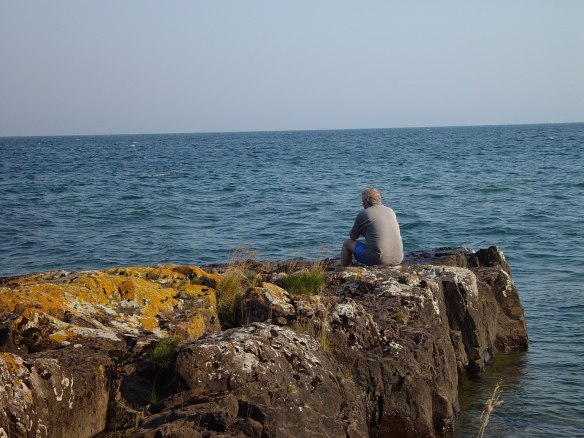
I’d do what I’m doing now only more consciously. I’d continue to write each morning. I’d do my best to live gratefully, attending to beauty in nature and in art (classical music and paintings) and to family and friends. I’d pray more thoughtfully. I’d walk my dogs more joyfully, stop yelling at them for barking, and find a place on the North Shore to look out to the horizon of Lake Superior. I’d eat lobster and Dungeness crab with lots of hot butter and salt, rib-eye steaks, garlic mashed potatoes. I would avoid Brussels sprouts! I’d end each meal with a Maine blueberry pie, flan, or Graeter’s ice cream, and a Makers Mark Manhattan.  Then I’d settle down on the couch next to the love of my life, Kay, by the fireplace, turn off the news, see if we can make a little fire of our own, get anchored again in the Sermon on the Mount, and return to sources of joy and laughter in the poems of Hafiz. I’d give up being intentional/purposive. I’d live in the moment.
A Song from the Cross?

“Before 1400 A. D., all music sung in church was in 3/4 time–the Trinity, you know…” –  OLLI class on Madrigals.

“A Song from the Cross?” – Steve Shoemaker, Urbana, IL, March 22, 2012

On the cross, Jesus sang (maybe) the first words from the XXII Psalm,

(most Psalms were sung by the Jews), “My God, my God, Why have you forsaken me?”

The words showed his humanity:

doubt, fear, loneliness.  That he (perhaps) sang, showed divinity.

These words being in the Bible at all are one more reason we can trust

the Bible to tell us what happened:  if this was made up, it would

have been Psalm XXIII put in his mouth, “The Lord is my shepherd…”

If Jesus sang then, why does the Gospel writer not tell us he did?

I propose because everybody knew then that most Psalms were sung.

And music surrounded Jesus:  angel choirs at his birth, and the

disciples singing a hymn with him at the last supper…

Before my mother died four months ago at (almost) 91, we sang together

old church songs for kids:  “Jesus Loves Me,” “Jesus Loves the Little

Children, All the Children of the World.”

It comforts me to think that Jesus might also have sung before he died…

Silence and Cell Phones

This piece originally aired on “All Things Considered” (Minnesota Public Radio). Click here for an audio connection on the MPR site, or just read the piece.

Driving to work this morning, I suddenly started to pay attention to the drivers in my rear view mirror.  It all started when a large SUV nearly hit me from behind.  The driver was jabbering away on a cell phone.  I’m sure the conversation was important.  Why else would he jeopardize our safety?

For the next fifteen minutes on I35W I conducted my own scientific survey.  All of the drivers had cell phones glued to their ears.

Makes me wonder.  Are we that uncomfortable being alone?  Or do we think we’re so important that the rest of the world can’t get along without us?  Or perhaps we are afraid that the rest of the world WILL get along very well without us – so we need to keep reminding others that we exist because we’re not sure we really do unless someone else is filling the speechless void?  I wonder.

As concerned as we should be about the terrorism of distracted drivers on the highway, I’m more concerned about what our use of cell phones says about us as a people.  We are addicted to outside stimuli. Less and less comfortable with silence. Less and less attuned to wonder. More and more filled with chatter. More wordy – less thoughtful.

Sociologist Eugen Rosenstock-Huessey once observed – before the advent of the cell phone – that for many folks the drive to and from work was the only true “free zone” during their day.  It was time for solitude and reflection, a transitional pause to get your bearings, time to make the transition from home to work and from work to home. These were trips to be celebrated for what they were – opportunities to stand free from the herd – the herd mentality of religion, nationalism and ideology.  They were times to think.

Maybe I’m just getting older.  I am.  And that’s a good thing.  Because I’m getting tired of looking in my rear view mirror at someone with a cell phone stuck in his ear because he can’t stand the silence…or the sound of her own heartbeat.  Someday that beat will stop and there will only be the silence.  Maybe we ought to put down the phone and listen before there’s nothing to hear.

Sorrow Floats: the Healthy Deregulated Capitalism Myth Just Keeps Re-surfacing

Gordon C. Stewart | Thursday, Sept. 10, 2009MinnPost.com

“Sorrow floats.” Perhaps the line from a John Irving novel — in which “Sorrow,” the stuffed family dog preserved by a taxidermist, floats to the surface of the lake after a plane crash — helps explain what is happening in America.

Something dear to the American family died one year ago last September-October. Prior to the series of chilling events of that period, most of us had lived with the illusion of relative economic and financial health. Then Sorrow was rushed to the emergency room for government resuscitation.

Since then our memories of that pre-September 2008 world have taken a turn that families often take at funerals when the eulogies bear little resemblance to the reality of the deceased. We’re quarreling over what was real and what is mythical reconstruction.

Following the plane wreck that takes the lives of the Berry family parents in Irving’s “The Hotel New Hampshire,” the stuffed family pet bobs to the surface of the lake, floating among the wreckage. Sorrow floats. So does the thing we lost last fall.

What died? A ruling assumption

What died last year was the ruling assumption that an unregulated free-market system was the best way to organize an economy and that laissez-faire capitalism is democracy’s natural ally. The market almost crashed. It didn’t crash only because the federal government intervened to prevent a repeat of the crash of 1929. Sometime between mid-September and Oct. 7, when Congress passed its bill to stabilize the financial markets, the myth of the virtue of deregulated capitalism died. It was stuffed by the taxidermy of government intervention, but it still floats.

When a conviction or a myth dies, it doesn’t go away. It continues to bob to the surface. Sometimes, as in the case of the Berry family, the old dog is much easier to love after it is dead. Sorrow — obese, lethargic, and persistently flatulent in its old age — no longer waddles through the dining room to foul the air and ruin everyone’s dinner. In the public psyche, the unpleasant memories of the real life Sorrow give way to the stuffed Sorrow, a thing of nostalgia that lives on … even after it’s dead, and long after the plane has crashed.

Over and over, we forget

Sorrow and its old illusions float every time the reconstructed memory, forgetting the real Sorrow, barks about “socialism.” Sorrow floats every time we shout each other down in town-hall meetings. Sorrow floats every time nostalgia forgets that it was only by government intervention that Sorrow is still around. Sorrow floats every time we forget the voracious appetite, unscrupulous predatory practices, insatiable greed, and the obesity that led to the deaths of Lehmann Brothers, Merrill Lynch and Bear Stearns, not to mention insurance giant AIG and all the banks that had taken the plunge into a market of deregulated derivatives and mortgages that led to the epidemic of home foreclosures, bankruptcies, pension-fund collapses and job losses. Sorrow, the old dog that failed us, still floats and still barks a year after the crash when the mind forgets and nostalgically remembers a system we thought was working in our interest.

Old ideas and convictions die hard. The powerful economic forces that grew fat during the years when government was viewed as the people’s enemy will stoke the fires of public anxiety and anger, taking advantage of the floating Sorrow that reminds us of something that we love more in retrospect than we did the day it died of its own obesity.

The Rev. Gordon C. Stewart is pastor of Shepherd of the Hill Presbyterian Church in Chaska. He is the moderator of Shepherd of the Hill Dialogues and former executive director of the Legal Rights Center. The views expressed in this article are his own and do not represent the views of anyone else.