Fear and Faith

The resurrected
Jesus was a man
and not a Zombie.
He was raised to be
alive, and not both
dead and living when
God seized him by his soul
and set him free.

He was not thirsting
after blood, was no
Vampire, did not become
immortal, but eternally
had life–there is, you know,
a difference… Jesus
spoke and drank and ate

with all his students,
the Disciples, though
they had all run away
when those with sword
and club, the Roman
soldiers, came to show
this upstart Rabbi
Caesar still was Lord.

The undead try to scare,
but Jesus said
“Have peace–you do not need
to be afraid.”

– Steve Shoemaker, Urbana, IL, April 21, 2014

There Is a Longing in Our Hearts

A sermon delivered at Shepherd of the Hill Presbyterian Church in Chaska, Minnesota.

Communio Sanctorum

As a boy I thought of All Saints Day and the Communio Sanctorum, the Communion of Saints, the way I felt about Halloween. It was spooky.

Today it’s no longer spooky. I’m thinking about all the people who have touched my life along the way. Few of them are saints in the sense our culture has come to understand the word, but they were all saints in my book. The extraordinary thing about saints is that they know they are not extraordinary. They refuse to believe they are exceptional.

The people I’m remembering drew little attention to themselves, for the most part. Some of them, like Uncle Dick Lewis, who was an uncle not by blood but by affection only, were people of few words. Uncle Dick stood under the maple tree every Sunday morning waiting for our weekly routine: nothing more than a handshake, the strength of which tested and honored my growing toward manhood. The handshake is the only speech I remember. During the week Uncle Dick’s hands painted houses. On Sunday morning he clasped his hands together after painting a boy into a man under the maple tree.

The place where I grew up was a working class community with a working class church. Its members were house painters, plumbers, carpenters, and bus drivers with a few middle management people sprinkled in, and one generous rich man named George. George and Phoebe always sat in the front row.

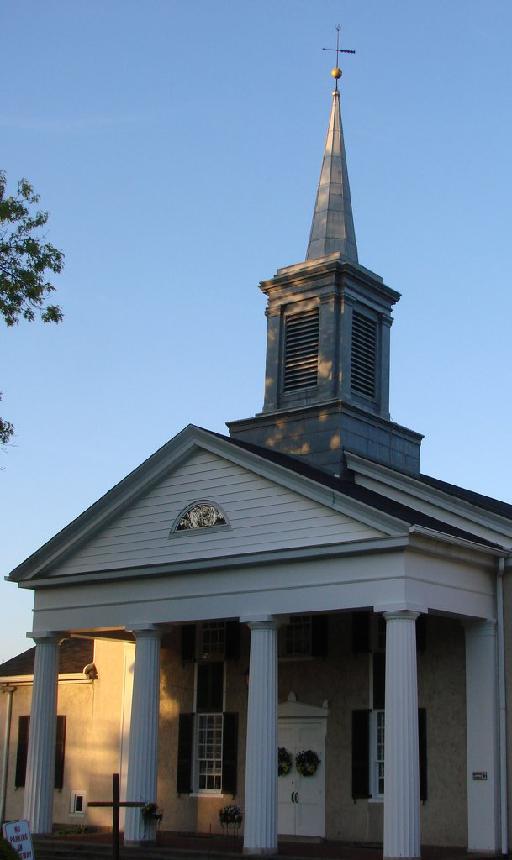
Marple Presbyterian Church, Broomall, PA

Marple Presbyterian Church, Broomall, PA

George decided one day to donate a stained glass window. Although much of the money for the new building had come from George, a stained glass window was inappropriate for Colonial architecture. The church board, with some fear and trepidation, refused the proposed gift. George left the church in a huff. He moved his and Phoebe’s membership to the wealthy church in Bryn Mawr, leaving the carpenters, plumbers, and bus drivers with a clear message: “Good luck. You won’t have George to kick around any more! You’re on your own.”

Karl Marx observed that the rich will do anything for the poor but get off their backs, and that the ruling ideas of any society are the ideas of its ruling class. After George left, they didn’t love Karl, the man everyone at Marple loved to hate, any less than before, but they re-discovered the Beatitudes of Jesus: “Blessed are you poor. Blessed are the meek. Blessed are you who mourn.” Blessed are the peacemakers.”

George was always kind to me in a distant kind of way. He got a chuckle watching the mischievous tow-head preacher’s kid break the rules he didn’t dare break. My only pictures from childhood were taken by Phoebe’s camera. I still see George in his three-piece suit with a big cigar, looking like a statue of William Randolph Hearst, the newspaper magnate – not quite that rich, but likely every bit as lonely before and after the church refused his stained glass window.

Approaching All Saints’ Day this year, I see them all compacted, you might say, into a single communion, the communion of the dead who have left behind every illusion that they were exceptional to the common lot of humankind. I see them gathered again at Marple Church, but gathered differently: George in Uncle Dick’s painter’s coveralls and Uncle Dick dressed in George’s three piece suit smoking George’s Cuban cigar, and Phoebe still taking her snapshots of a community now repaired by the common threads of love and death, dragged kicking and screaming into the Communion of Saints that knows no exceptions.

Sermon – The Divided House

A sermon at Shepherd of the Hill Presbyterian Church in Chaska, Minnesota. It could also be called “Take a Risk – Stand for Something!”

Sermon on Faith and Economics

Video

A Sermon at Shepherd of the Hill Presbyterian Church in Chaska, MN, August 11, 2013.

The Gift of Encouragement

“You’re going to like Via Lucis this morning,” said Kay, as I came down for coffee.

She knows that I share much in common with the Hasidic rabbis described in Elie Wiesel’s Four Hasidic Masters and their Struggle against Melancholy. Like Rabbe Barukh of Medzebozh, anguish is part of my faith and character. “Faith and the abyss are next to one another,” said Barukh to one of his students. There are times, especially lately, when the abyss has been so close that I have considered silence, not speech and not writing, to be the better part of wisdom.

One of the benefits of creating Views from the Edge has been the discovery of Dennis Aubrey and PJ McKey through their blog Via Lucis Photography. Their posts speak to me in the way that little else does, in no small part, I think, because they combine art photography, careful research, and exquisite commentary on the Romanesque and Gothic church architecture. Their work elevates the discussion in a world filled with so many needless words. Their post this morning (click below on “Our Personal Favorites” left me speechless, humbled, and encouraged. Thank you, PJ and Dennis. One of these days we’ll meet face-to-face.

Our Personal Favorites.

An acrostic verse: Missa Solemnis

“Missa Solemnis”

LORD HAVE MERCY begins the Mass
Under the baton of Maestro
Dean Craig Jessop. The last word: PEACE.
Wisdom and beauty from solo
Instrument, the mass choir, voice
Go to the top of Cathedral.

Vast walls of sound show pain also,
Arising from those who are cruel.
Nothing human escapes alto,

Bass and tenor and soprano.
Even a skeptic like Ludvig
Enlisted to create music,
Tries to make out of the tragic:
Hope, faith, love, kindness, and courage.
Overwhelmed by suffering, he
Values still signs of human will.
Even though stone deaf, he can be
Nurturing peace and harmony.

– Steve Shoemaker, Urbana, IL August 7, 2013

EDITOR’S NOTE: Craig Jessop is Dean of the College of the Arts at Utah State University, and former Director of the Mormon Tabernacle Choir.

Andrew Lloyd Webber’s “Pie Jesu” in a Child’s Voice

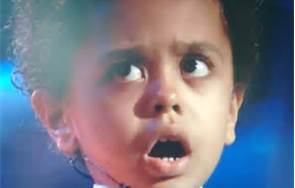
Akim Camara

Akim Camara

This child’s innocence – his eyes, his voice, his face, his courage, his trust – takes us to our deepest selves in the presence of the Sacred. Sit back and watch Akim Camara, hand-in-hand with Carla Maffioletti, singing Andrew Lloyd Webber’s “Pie Jesu”.

“Pie Jesu” means “Merciful/kind Jesus”; in its context in the Latin Requiem Mass, it calls on “the Lamb of God” to show mercy to the suffering. Kindness and mercy are at the heart of spirituality.

The text has an interesting history. The “Pie Jesu” is an ancient motet based on the last couplet of the “Dies Irae” (“Day of Wrath”) that was part of the old Latin Requiem Mass. The Vatican II liturgical reforms removed the “Dies Irae” from the Mass in order to emphasize Christian hope. A number of composers, among them Andrew Lloyd Webber – influenced by Gabriel Faure’s “Pie Jesu” – gave new musical expression to the prayer: “Kind/merciful Lord Jesus, grant them rest. Kind/merciful Lord Jesus, grant them rest eternal.” BTW, Faure’s Requiem includes the “Dies Irae” which has become part of the Good Friday period of meditation at Shepherd of the Hill, not because God is wrathful, but because we so often have reason to cry out “Libera Me!” from the depths of terror and desolation.

Reflections along the way of a terminal illness

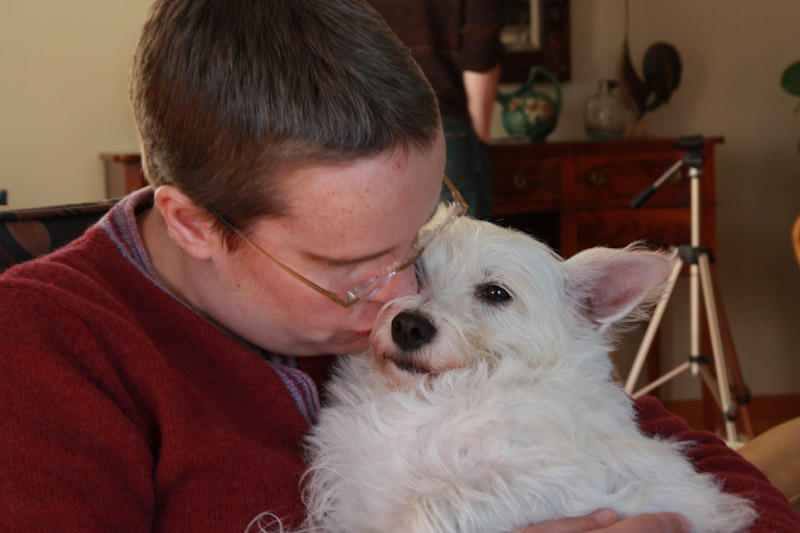
Katie and Maggie sharing a moment of sadness. Maggie knew!

Katie and Maggie sharing a moment of sadness. Maggie knew!

Today, three years to the day after Katherine’s (“Katie’s”) death (May 9, 2010), we inter her cremains.

IT’S RAINING, IT’S POURING” was written the day we learned that Katie’s incurable Leiomyosarcoma had taken a turn for the worse. In memory of Katherine (“Katie”) Elizabeth Slaikeu Nolan.

Gordon C. Stewart Feb. 11, 2009

It’s raining, it’s pouring
The old man is snoring
He went to bed and he bumped his head
And couldn’t get up in the morning

It’s a day like that. I bumped my head on the illness of a 33 year-old loved one. It’s raining sadness. I’m having trouble getting out of bed in the morning.

Terminal illness has a way of doing that unless you believe in miracles of divine intervention or you have extraordinary powers of denial.

My spirituality has become increasingly like that of Rebbe Barukh of Medzobaz, an old Hasidic master in Elie Wiesel’s tale of Four Hasidic Masters and Their Struggle Against Melancholy. When he prayed the customary Jewish prayer, “Thank you, Master of the Universe, for your generous gifts – those we have received and those we are yet to receive” – he would startle others with his weeping. ‘Why are you weeping?” one of them asked. “I weep,” he said, “in thanksgiving for the gifts already received, and I weep now for the gifts I have yet to receive in case I should not be able to give thanks for them when they come.”

For my family at this critical time, the real miracle has already occurred – the shared gift of love – and it will come again in ways I cannot now anticipate when the last page of the final chapter of our loved one’s life is over.

The miracles are more natural, nearer to hand. Although I don’t believe in selective divine intervention, I am on occasion a sucker for denial – except on days like this when it’s raining and gray and I’ve bumped my head on the hard fact that cancer is ransacking my loved one’s body. A certain amount of denial, too, is a blessing in disguise, one of God’s generous gifts to keep us sane when the rain pours down and clouds are dark.

Faith comes hard sometimes. In college mine was challenged and refined by Ernest Becker‘s insistence that the denial of death lies at the root of so many of our problems. My faith has been refined along the way by the courage of Albert Camus and Jean-Paul Sartre to face the meaninglessness of the plague, the faith and courage of Dietrich Bonhoeffer and Paul Tillich who stuck their fingers in the gears of Nazism, and the humble witness of Mother Teresa working in the slums of Calcutta with more questions than answers and some anger at God.

The job of faith, as I see it, is to live as free as possible from illusion with a trust in the final goodness of Reality itself, despite all appearances to the contrary. Faith is the courage and trust to look nothingness in the eye without blinking or breaking our belief in the goodness of mortal life.

When I look into my loved one’s eyes I see that courageous kind of faith that defies the cancer to define her, and a resilient spirit that makes me weep tears of joy over the gifts we’ve already received and the ones we have yet to come.

It’s still raining and it’s still pouring, but I refuse to snore my way through this. I’ve bumped my head on the news of a loved one’s terminal illness, but I’m getting up in the morning.

POSTSCRIPT March 21, 2012

Conversation yesterday about “The List” posted on Bluebird Boulevard:

Karen:

My mother died of cancer eight years ago. Her loss is still visceral. She is in every bird I see.

Me:

The morning of Katherine’s memorial service Kay, Katherine’s mother, was standing by the large picture window gazing out at the pond in our back yard. Out of nowhere, it seemed, two Great Blue Herons flew directly toward the window and swooped upward just before they got to the house. “She’s here. That’s Katie,” said Kay without a second’s hesitation. On her last day of hospice care, Kay and I each remarked that her face looked like a baby bird. I’m a skeptic about such things. I’ve always been, and always will be, a doubting Thomas. My assumptions and conclusions come the hard way. But on the day the herons flew directly at Kay from across the pond, I saw it with my own eyes…and HAD to wonder.

Within a minute a third Great Blue Heron perched on the log by the edge of the pond and stood alone for a LONG time. It reminded me of a gathering on the steps of the State Capitol in Saint Paul following the tragic deaths of school children at Red Lake, MN. The crowd stopped listening to the speaker. They were looking up. “What’s going on?” I asked Richard, the Red Lake American Indian advocate and my co-worker at the Legal Rights Center.org. “Eagles,” he said. “Where?” “WAY up. They’re circling.”

I learned later that the eagles were also circling at that same moment over the grieving families gathered at Red Lake. I asked American Indian colleague what he took it to mean. “We don’t ask. That’s the white man’s question,” he said. “We just accept it. We live in the mystery.”

Loneliness and Love

Video

George Matheson wrote this hymn. Matheson (1842-1906) was one of Scotland’s great preachers. Most people didn’t know that he was blind. When the sister on whom he had depended to be his eyes and his companion was married, he was left alone to fend for himself. He wrote “O love that wilt not let me go” the night he had “celebrated” the joy of her new life. The rendition in the video captures the emotion and the faith of the hymn-writer, whose faith and poetry still encourage later generations in times of personal loss and loneliness.