We never felt so far from him

The Grand Canyon


Dad thought Dave and I were going to hell,

since we had left his fundamentalist

God.  My brother sent me Bertrand Russell,

“Why I am NOT a Christian.”

                                       Atheist,

he–liberal Presbyterian, me–

stood at the rim and watched the rising sun/

paint all the colors far below.  “Maybe

there is a God…” Dave said.  But his was one

cry like “O God!” at orgasm, sincere,

but not a creed.  My faith was mixed with doubt.

              Before he died Dad told his own pastor

to preach to us, his sons, to call us out

at his funeral.  So “Just As I Am”

was played.  We never felt so far from him.

– Steve Shoemaker, Urbana, IL, September 16, 2012

Two Kinds of Religion

“How a Single Voice Threatened to Spark a Forest Fire”

Gordon C. Stewart, September 28, 2010

Minnesota Public Radio (MPR, 91.1 FM) published this commentary after a Florida pastor threatened to burn the Quran. The same Rev. Jones is part of the story of the toxic video that has inflamed the Muslim world today. Some things never change.

Everyone from time to time feels insignificant. As I did, while watching fires burn across the world, lit by the words of one pastor in Florida. I felt like a spectator in the stands watching the game I care about go terribly wrong, a hostage of verbal terrorism uttered in the name of Christ.

I would imagine that the Rev. Terry Jones and his small congregation also had felt insignificant before they announced the 9/11 Quran burning, and that they were stunned when their pastor’s voice, although terribly misguided, lit the forest on fire without ever burning a Quran.  One of their own, one who had felt insignificant, had raised his voice and now had the ear of a commanding general, the secretary of defense and the president of the United States.

The difference between the Rev. Jones and most people is that he has a pulpit.  On any given Sunday he speaks and a few people actually listen.  Most of us do our ranting and raving in the shower, at the water cooler or with like-minded people at the coffee shop, but we don’t much expect anyone to listen.

But as the Jones story developed, those of us with pulpits were feeling no less beside the point.  Then, as I prepared for worship, I was drawn by some old lines about spiritual arson. “Consider what a great forest is set on fire by a small spark. The tongue is a fire … a restless evil, full of deadly poison” and “the seeds of righteousness are sown in peace by those who make peace” (Letter of James 3).

The thought crossed my mind: We could invite a Muslim friend to join me in the pulpit, perhaps my neighbor Muhammad or Abdi or one of their children, whom I meet daily while walking the dogs.  I decided to invite Ghafar Lakanwal, a Pashtun Afghan-American cultural diversity trainer, a Muslim and naturalized U.S. citizen, to bring greetings of peace and share some passages about peacemaking from the Quran in our Sunday worship on 9/12.

Our little church in Chaska welcomed Ghafar, and his words about the spiritual “obligation to learn, not burn” still ring in our ears. Our service drew media attention, and Ghafar’s words were heard on the evening news  and noticed by a stranger in Australia, who sent a message through the church website. “I was touched,” he wrote, “when I read about your recent Sunday service in the news. …  I for one can testify that it has certainly comforted a far away Muslim to know that there are neighbors who will stand together in difficult times.  My salaam [to you].  May we all grow together to attain Allah’s pleasure.”

“Ah!” someone will say. How can any Christian rejoice when the author uses the name “Allah” for God?  But the reaction to the “name” is misbegotten.  It is not the name of God; it’s the Arabic word for what we in English call God.   The forest fire lit in defense of “God” in advance of the anniversary of 9/11 reminds us that two kinds of religion potentially exist everywhere people gather to practice their faith. One kind burns. The other kind learns.  One hates; the other loves.

As James, writing to those who would follow Jesus, put it: “With [the tongue] we bless the Lord and Father, and with it we curse those who are made in the likeness of God. From the same mouth come blessing and cursing. My brothers and sisters, this ought not to be so” (James 3:9-10).  We can set the forest ablaze with our small spark or we can use it to light a candle of hope and peace. But, after the events of this month, none of us can again think that what we say is insignificant.

What do YOU think?

Sit and reflect awhile

Amish Rocking chair

This post requests YOUR views on a hot topic.

“The GOOD Society: Religion and Politics” drew a crowd last night in Chaska.  The panel was a Quaker, a Christian, and a Baha’i. Those who came were Jewish, Protestant, Catholic, Unitarian-Universalist, Lutheran, Disciples of Christ, agnostic, atheist searching together. Add your voice to the discussion.

QUESTIONS FOR YOUR COMMENT:

What is your vision of the GOOD society, the kind of world you believe in?  Here are several answers from last night to whet your appetite.

The kingdom of God realized (Jesus’ prayer, “Thy kingdom come on earth…as it is in heaven”).

What would that look like? What would be different if it was realized?

What are the qualities of that society? A ‘kingdom’ is a society.

The kin-dom of God, the idea of the kingdom without the ‘g’ – the society of universal kinship. “There is only nation: the human family.”

Agree or disagree and why?

The Unites States is a secular republic, not a religious republic. The founders were clear that America was not to be a theocracy. The “wall of separation” between church and state guarantees the free expression of religion.  It also protects the state (government) against any one religion being on the throne, as in Iran, and as had once been the case in the Massachusetts Bay Colony.

What is the role of religion in the shaping of public life and in politics? By “politics” we do not mean “dirty politics” or “partisan politics’; we mean politics as the work of the polis (the people) in determining the values and laws that hold a religiously free society together. For example:

The Minnesota referendum on Marriage illustrates the problem.

What is “marriage”? Who defines it? Is it a religious concept or a civil concept?

Should a constitution be amended to define marriage?

Should the “wall of separation” leave the definition of and celebration of                  “marriage” (however defined) to the church, synagogue, mosque, etc., and instead provide for “civil unions” (legal contracts between two people irrespective of gender)?

All of us have religious/humanist and political traditions that informs us. One of those for me is the “Principles of Church Order” adopted in 1789 at the founding of the Presbyterian Church in the United States meeting in Philadelphia.  The Rev. John Witherspoon, one of the  signers of the Declaration of Independence and President of Princeton University, was also a key player in the Principles of Church Order intended to guide the church’s internal life and its relation to “the civil power”. Three of the eight principles, it seems to me, inform the current discussion.

On Church and State:

“God alone is Lord of the conscience…. Therefore we consider the rights of private judgment, in all matters that respect religion, as universal and unalienable. We do not even wish to see any religious constitution aided by the civil power, further than may be necessary for protection and security, and at the same time, be equal and common to all others.

In short, we live in a secular democratic republic in which “the civil power” does not aid any religion, but protects the free exercise of all religions equally, without privileging one over another.

On the shared search for truth and goodness: That truth is in order to goodness; and the great touchstone of truth, its tendency to promote holiness, according to our Savior’s rule, ‘By their fruits ye shall know them.’ And that no opinion can either be more pernicious or more absurd than that which brings truth and falsehood upon a level, and represents it of no consequence what a person’s opinions are.  On the contrary, we are persuaded that there is an inseparable connection between faith and practice, truth and duty.  Otherwise, it would be of no consequence either to discover truth or to embrace it.

In short: ideas do matter. The search for what I’m calling “the good society” is based on a shared commitment to the search for truth, not just opinion. Some degree of objectivity or what philosopher Gabriel Marcell called “inter-subjectivity”, not just my own subjectivity. My opinion might be that the moon is made of green cheese or that Earth, not the sun, is the center of our solar system. Ideas and opinions have social consequences.  And in all things, the truth exists for the sake of “goodness” – human and environmental wellbeing.

On the exercise of mutual forbearance: That, while under the conviction of the above principle we think it necessary to make effective provision that all who are admitted as teachers be sound in the faith, we also believe that there are truths and forms with respect to which people of good character and principles may differ.  And in all these we think it the duty both of private Christians and societies to exercise mutual forbearance toward each other.

In summary:  In a secular democratic republic, 1) no religion gets to “capture the flag” of the United States of America.  We honor individual conscience as the corrective light that reforms the prevailing ideas of truth and goodness. 2) We seek truth rather than sinking into the swamp of “I’m sorry, that’s the way I feel, and it’s none of your business, and yours is none of mine.” The acceptance of pluralism is not surrender to the swamp of anarchy or the refusal to look at the evidence of science or to engage in the common search for solutions to social problems.  3) Where we differ and disagree, however intensely, we will exercise mutual respect and patience while we work it out together.

Enough for this morning.  Chime in. Let others know what you’re thinking.

Thanks for visiting.

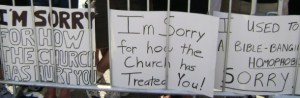
“I’m So Sorry”

Marin Foundation photo of signs at Chicago Pride parade

I’m a pastor. But there are days when I wonder whether I belong in the Christian Church, whether I’m really a Christian. Ever wonder that about yourself? Or have you left the church as a matter of dissent, embarrassment, or protest?

Take the last two weeks. President Obama shares his faith at a National Prayer Breakfast. He declares that we are “our brother’s keeper”. I feel proud. The comments on CNN run heavily against him. Ayn Rand’s “the virtue of selfishness” – not the story of Cain and Abel or the teaching of Jesus – has won the hearts of the people. Rick Santorum tells an Ohio audience that Obama’s agenda is based on “some phony theology, not a theology based on the Bible.” I feel sad…and angry. I read the story about the church court case of the Rev. Jane Spahr, a lesbian Presbyterian minister rebuked for officiating at same-gender marriages, one of them the wedding of Lisa Bove. Lisa was an ordained student elder at the church I served at The College of Wooster. She went on to seminary and was ordained a Minister of Word and Sacrament. I feel proud of Janie and Lisa, their tenacity, their courage, their strong and gentle spirits, their deep faith. I feel sad that the church still doesn’t get it.

I’m embarrassed by how ridiculous the church debate is and how absurd this church family feud looks to the world. I want to withdraw, pull the covers over my head, go to sleep, take a sedative maybe. But I’m also angry. I want to fight. I want to weigh in on the debate. Yet to do so will only continue the polarization, the disrespect for others, the tendency on all sides of a church argument to proclaim with Little Jack Horner, “What a good boy am I!” If I stick my thumb in the pie, I’ll just continue the ludicrous display of Christian arrogance. What to do? To keep silence feels like abdication of conscience. To speak adds my voice to the appearance of the church’s absurdity. But I’m give fan of the Theater of the Absurd and Albert Camus, as well as Jesus.

I decide to stick my thumb in the story. My comment is the first thumb in a hot pie:

“I know Jane Spahr and Lisa Bove as colleagues and love them both. Lisa was a student leader at the Westminste­r Presbyteri­an Church at The College of Wooster where I served as Pastor. Jane is that rare minister of the gospel who has managed to remain gentle and bold, acting in conscience and ecclesiast­ical disobedien­ce without becoming hard or cynical. Lisa is the same. When you’ve been working for GLBT full inclusion as long as Jane and Lisa, that’s a testimony to their soulfulnes­s. For Jane, Lisa, and so many of us, the Bible calls disciples of Jesus to live in love and to be advocates for justice. The Presbyteri­an Church (USA) last year restored an older principle of church order that removes the restrictio­n against ordaining GLBT members. The issue of marriage remains contentiou­s in the church, as it is in the society as a whole. Some pastors have declared that until church and civil law permit them to officiate at same-sex marriages, they will not marry anyone as a witness to justice. Jane and Lisa are sweet, sweet spirits whose lives bear witness to justice, love and peace, working from that inner light of courage, conscience and consolation that keeps them sane and strong.”

Three replies come quickly:

1) “You are a faithful and honest servant of God.  It has taken a long time, but every year there are more like you” (i.e., “What a good boy am I Good boy!”); and

2) “Pastors should know and preach the truth of God’s word. Please read: 1 Tim: 3:1-7 and Titus 1: 5-9  When folks go against the truth of God’s word, then they are following deceit and you should know who the great deceiver is”  (“Bad boy! Bad boy!”)

3) “Let’s hope this church sees the light and retracts the rebuke.  And perhaps even apologizes­.”

Then this morning a classmate sends me this story about an apology: “Christian Group Shows Up to Chicago Gay Pride Holding Apologetic Signs“.

Marin Foundation photo of signs at Chicago Pride parade

I wish I’d been there to hold one of these signs.

I’ve experienced the forgiving hugs of gay and lesbian church members like the guy in the underwear. And when I write comment or a commentary like this one, I hear a little voice inside myself: “Good boy! Good boy!” Then, as soon as I feel the relief, I know I’ve fallen into the very self-righteousness I despise in others. “Bad boy! Bad boy!” and I’m back where I started: “God help us ALL!”

Read the story. Ponder it. Then stick your finger in the pie with a comment here on the blog.

You don’t get to have a non-Jewish Jesus

Gordon C. Stewart     Feb. 14, 2012

“Who was Jesus?” I asked the Jehovah’s Witnesses who had rung the doorbell. Through the upstairs window where I do my writing, I had seen the van pull over across the street and empty out. I thought perhaps there was a family gathering next door until two of them walked up the drive way.

An email response to “Whitney Houston, the Leper, and You” (posted below) reminded me of the conversation that ensued. Here’s the email from Ann in Texas:

“So nice to hear from you and feel your energy out there flushing out injustice and ranging around in the ‘big ideas,’ and formative experiences. Bravo!  Passion writes action… and here’s mine… an odd reaction, I’m sure, but to the leper story, and the overturning of the tables and all the examples we use to cast aspersions on ancient Judaism that help perpetuate in my mind a subtle continuing contemporary anti-Judaism and the continuing need for an Israel that has morphed into “pants” to small to hold it.  Now there’s a view from the edge!”

I share Ann’s concern. I hold my breath every time I preach or write on texts like this, painfully aware of the anti-Semitism that continues in subtle and not-so-subtle forms.

When the Jehovah’s Witness rang the doorbell, I was deep into writing a sermon on planetary stewardship and sustainability in the wake of the B.P. oil “spill” – Deep Water Horizon blow out in the Gulf of Mexico.

The dogs were barking up a storm at the two men standing on their porch. I went down, answered the door, and stepped outside to meet them.

They were kind and gentle people. They wanted me to know that the world was coming to an end. “Yes, I know,” I said, “what do you fellas think about the crisis in the Gulf of Mexico?” They preferred to talk about Jehovah, the Book of Revelation, the end of the world… and Jesus.

“Okay, let’s talk about that. “Who was Jesus?”

“He was the Son of God.”

“And who was the Son of God?”

“Jesus Christ.”

“And who was Jesus Christ?  Christ is not Jesus’ last name. It’s a title. So who was Jesus?”

“The Son of God, Jesus Christ.”

“Let me ask it differently. Who was Jesus of Nazareth?’ Who were his people and what was Jesus’ religion?

“What do you mean?”

“Well, Jesus was a real man, in real time. He lived in a particular time and place. Jesus didn’t suddenly plop down out of the sky. So who was Jesus of Nazareth?

“He was the Messiah, the Christ. He came to bring the new Covenant.”

“And what about the first covenant? What was Jesus’ religion?

“He was a Christian,” they said.

“Jesus was a Christian?! You can’t follow yourself. A Christian is someone who follows the Christ.  Jesus was not a Christian. Jesus was a Jew. And he’ll always be a Jew. You don’t get to make him up like that. We can’t create Jesus in our own image. You don’t get to have a non-Jewish Jesus!”

We talked then about Jesus and the Book of Revelation. We discussed the fact that the Book of Revelation is a literary genre of the first century called “apocalyptic” that was peculiar to that time; that it was written by a disciple of Jesus held prisoner by the Roman Empire on the Isle of Patmos, who was denouncing the imperial claims of the Roman Empire, and proclaiming its end in bizaare images of Jewish Scripture (in Danile and Ezekiel). The Book of Revelation wasn’t, as so many think today, a book of predictions about the future or the end of the world.

“You’ve thought about this a lot,” said one of the men. “You really seem to have spent a lot of time studying this.”

I thanked him for the compliment and responded that although I’ve been thinking about these matters all my life, I still know very little.

At the end of the 45-minute conversation, I told them how much I respected their commitment to their beliefs and their sacrifices of time and money. I took their literature and invited them to think about what Jesus would have us do about the crabs, the oysters, and the oil-soaked birds drowning in oil in the Gulf of Mexico.

If we were all as committed to the healing of the planet and to the care of the poor as my visitors were that day to spreading their message with urgency, the world would be a better place.

Those of us who carry the name “Christian” don’t get to have a Jesus who is a Christian. The only Jesus we get to have was and always will be the Jewish Jesus of Nazareth, whose people have been crucified many times by the anti-Semitic pogroms of those who claim to follow him.

The Jesus who heals the leper also tells the leper to “go and show yourself to the priest and offer the sacrifices that Moses commanded for your cleansing….” Jesus is telling the man to practice his Jewish tradition, but Christian interpreters typically fail to notice the startling clarity of Jesus’ Jewishness. Likewise, any reading that begins with the assumption that Jesus was a Christian mistakes Jesus’  turning over of the money-changers’ tables in the temple as his rejection of Jewish faith and practices rather than the deepest affirmation of the Jewish covenant by which he lived. In faithfulness to the covenant, he protested the abuse of the covenant by the religious leaders of his time who had forsaken their high calling by collaborating with and cozying up to the Roman economic and military powers that occupied Jerusalem – just like today.

Thank you, Ann, for the email that reminded me.

“It’s not easy being real”

Last night I listened to President Obama’s speech on contraception and religion institutionso courtesy of Unedited Politics. I then looked to see if there were comments. There was only one:

“This has nothing to do with so called women’s health, it’s Marxism 101.”

With no elaboration as to how or why the President’s speech or position on women’s health care, on the one hand, and religious liberty, on the other, was Marxism 101, the comment accomplished what such comments nearly always do, until they are challenged. It called someone by a name. End of discussion. No need to explain how or why it’s Marxism. “Bad! Boogie Man! Evil in the White House!! The Marxists are out to get us!”? So I wrote my own comment:

Oh, my! Dear friend, whoever you are, you must never have taken Marxism 101. This isn’t Marxism. It’s the work of a democratic republic – messy, balancing values that sometimes conflict with each other, protecting the rights of the minority against the tyranny of the majority, and guaranteeing equal protection (in this case, health coverage) to all citizens. It’s comments like this – confusing a health care position with Marxism (i.e. communism?) – that divert the discussion and take us back to the darkest time of American history, the Senate Hearings of Sen. Joseph McCarthy that painted decent, patriotic Americans as evil. The President is NOT a Marxist, my friend. Time to rescind the comment for the sake of civil discussion that helps to solve real problems.

The reply came soon after:

Try reading his books and consider the fact that he attended a Marxist church for 20 years.

Again, I replied:

I’ve read Marx. I spent the summer of 1966 in Bratislava, Czechoslovakia as the Chicago Ambassador of the Experiment in International Living. I lived with the Schulz family, all members of the Communist Party. Marxism is more than a figment of my imagination. And the church Obama attended is a CHRISTIAN Church, United Church of Christ, one of America’s historic “mainline” denominations. ABC watched 500 sermon videos and chose to air a one-minute clip from a sermon on one of the Hebrew prophets that led viewers to conclude Jeremiah Wright was a communist. Radical? Yes. Off the wall? Sometimes. But Marxist (i.e. not Christian, not a disciple of the Jesus who turned over the money-changers tables)? No. And to talk about this President as a Marxist is…go back and watch Joe Welsh’s final rebuke to the character assassination campaign of Sen. Joe McCarthy: “Have you no decency, Sir. Have you no decency left?” Please think twice before raising McCarthy’s ghost. It’s ugly.

In 1966 I was certain that my finalist interview with the selection committee of the Chicago Chapter of the Experiment in International Living had disqualified me as a candidate as Chicago Ambassador to Czechoslovakia for the summer of ’66.

“You’re a Christian and a seminarian, asked Paul Harvey. “Why would you want to go to a communist country?”  I responded at some length that I didn’t trust the stereotypical representations of Eastern Bloc countries any more than I would trust their representations of the West. I felt there was propoganda on both sides of the Cold War. I wanted to see for myself.   I also told them that there was a theologian in Czechoslovakia named Josef Hromadka, the father of Christian-Marxist dialogue. I had been reading Hromadka and others and wanted to participate in this discussion. I believed that the Marxist classless society was a rendition of the central biblical message of the Kingdom of God. I came out of the interview and said to another candidate, “Well, I just eliminated myself. Hope you have a great summer.”

To my surprise, they selected me. The generosity of Pan Schultz and Pani Schultzova, their son Vlado and daughter Jana who welcomed me like a member of their own family, conversations with students about Franz Kafka and the existentialists at the university coffee shop, and the ugliness of fellow-American Ambassadors (there were 11 of us) who insisted on ice cubes in their drinks combined to further open the aperture of my camera lens as I look at the world.

I decided long ago not to keep silent when the labels like “Marxism 101” march across the field of my camera. My experience is only mine, but it’s the only experience I have, and God knows how limited it is. But, I decided to to heed Frederich Buechner  counsel – “Listen to your life”, he wrote – and to speak out loud what I see and hear, hoping and praying, as I do every Sunday morning before I dare to preach, that in some inscrutable way, “the words of my mouth and the meditations of all of our hearts will be pleasing in Thy sight, O Lord, our Rock and our Redeemer.”  I’d love to hear your meditations. Leave comment to share.

The Jesus Beyond Our Categories

Steve Shoemaker, host of “Keepin the Faith” (WILL/AM, Illinois Public Media) emailed this morning asking for thoughts about a post on “Protestants for the Common Good: ‘People of Faith Advancing Justice in Public Life'”: Can Christians Be Conservative? – an insiders’ academic debate among contemporary Christian theologian-ethicists. It’s worth a read. Tell me what you think.

Here’s what I wrote:

I’m not sure quite how to respond to the piece or the discussion. Off the top, I would say that Jesus himself didn’t neatly fit any of the four polar categories: conservative/liberal; reactionary/revolutionary. Even more, if the question whether the “authentic Christian” can be a conservative is more than a rhetorical question, it should be immediately dismissed – the question itself means that the answer has already been decided in the negative. Sort of like the question “Can anything good come out of Nazareth?!”

Greenfield’s take on Mark 1 is interesting, but, on first reading, it seems to me to miss the point that John the Baptist’s wilderness movement involved all four dimensions. It was conservative, liberal, reactionary, and revolutionary all at the same time. The trek to the Jordean wilderness was a reaction to the collusion between the local religious and political authorities (e.g. Vichy France?) and their Roman (e.g. Third Reich) occupiers. It was also a revolutionary call for a new social order, “the Kingdom of God is at hand; repent and believe the good news.” The grounds for that claim sprang out of the tradition that John and Jesus were conserving, while liberating it from captivity to the spirit of self-serving gains, idolatrous collaboration, self-righteousness and ethnocentrism. In short, the John-Jesus movement doesn’t fit nicely in any one or two categories.

Everywhere I look in the Gospels, I see a Jesus who doesn’t fit our categories. I still don’t know what to do with him.  “Can a Christian be conservative?” assumes from that outset that to be conservative is to be an “inauthentic” Christian. But even if one believes that conservative views and practices are inimical to the way of Jesus, there is the deeper question that puts that question in proper perspective: “Can a sinner be a Christian?” Only a sinner can be a disciple of Jesus. Some of the sinners and sins are primarily conservative, some liberal, some reactionary, and some revolutionary by disposition and by political persuasion. Most of us are some strange mixture of the four. So I would answer Larry’s question “Can Christian be conservative?” with “You betcha!”  How do I know?  Because it’s the wrong question. I don’t get to choose who is “authentically” Christian anymore than Jesus let his detractors decide.  Moreover, I know conservatives who call themselves Christian who put my stewardship and hands-on work with the poorest of the poor to shame. While I’m calling for the revolution, the conservatives I have in mind spend every Saturday preparing and serving meals at the homeless shelter and every Sunday afternoon after putting up with my sermons visiting people they know in town who are down and out – slipping them $100 bills so the utilities don’t get turned off – while I, having preached the revolution, go out for lunch and then go home for a nap.

William Stringfellow stops us all cold in our tracks with his criticism of the church:

Christ’s is a ministry of great extravagance – of a reckless, scandalous expenditure of his life for the sake of the world’s life. Christ gives away his life. The world finds new life in His life and in His gift of His life to the world. His is not a very prudential life, not a very conservative life, not a very cautious life, not – by ordinary standards – a very successful life. He shunned no one, not even adulterers, not even tax collectors, not even neurotics and psychotics…not even poor people, not even beggars, not even lepers, not even those who ridiculed him, not even those who betrayed him, not even his own enemies. He shunned no one. The words that [describe] the ministry of Christ are…sorrow, poverty, rejection, radical, unpopularity. They are the words of agony. It seems ridiculous to apply such words to the ministry of churches nowadays. Yet where these words cannot be truthfully applied to the ministry of churches today they must then be spoken against the churches to show how far the churches are from being the body of Christ engaged in the ministry of Christ in the world.

For Stringfellow the gospel was the vitality of the Word-made-flesh among the principalities and powers of death in this world. None of us has a corner on that Word. One might say that for Stringfellow there is a fifth category that describes the authentic following of Jesus: the life of ‘resistance’ as articulated in An Ethic for Christians and Other Aliens in a Strange Land and The Politics of Spirituality, books uniquely addressed to the church in the American situation.

The question, it seems to me, is beyond ethics, and it is certainly beyond the false choice between the polar opposites: conservative/liberal; reactionary/revolutionary: Can or should a Christian be conservative, liberal, a reactionary, or a revolutionary? The ethics question rises from the theological-faith question: “Where today do we encounter the vitality of th e Word Made Flesh,and, in that encounter, who and how does God call us to be among the principalities and powers as the sinful, timid, confused, forgiven and redeemed disciples of Jesus

In terms of Christian ethics, as I see it, the answer, depending on the situation, involves all four dimensions supplemented by Stringfellow’s fifth descriptor.

I see elements of all five, for example, in Dietrich Bonhoeffer, who boldly conserved the tradition against the false interpretation of the German Third Reich and its ecclesiastical collaborators and paid the price with bodily resistance. Yes?  No? Maybe?

Look forward to hearing your comments.