About Us: One Little Corner

I’ve always had a sense of living at the edge of the world. It’s not a bad thing. It’s not a good thing. It’s just the way it’s always been for me. But, as I watch and listen from my little corner of the world, something’s changed. I have a growing sense of blah, blah, blah, both others’ and my own.

Ours is an anxious time that cries out for a foothold. Speech is the primary way we establish a foothold in changing times.

“Threatened by nonbeing, by chaos, and meaninglessness, man looks for a foothold in the Imperishable,” wrote Dutch philosopher Willem Zuurdeeg years ago in Man Before Chaos: Philosophy Is Born in a Cry.

Influenced by Zuurdeeg’s work, I look and listen for the footholds – unspoken convictions that rarely get discussed – in the battlefield of ideas “where ignorant armies clash by night” (Matthew Arnold, “Dover Beach“). Just below the words, or between them, lie the ideological, prejudicial, cultural, national, class, political, religious, and economic ideals and convictions (footholds) by which we secure our existence in the face of the threat of nonexistence.

My friend and colleague Steve Shoemaker adds his poetry and verse – unique voice that draws readers to Views from the Edge. Over the years, our number of posts have been about the same with Steve’s being the more popular by far.  The frequency of Steve’s contributions has decreased in the past few months following diagnosis and treatment for pancreatic cancer. His recent posts on death and dying continue the joyful sense of humor and play that draw people to his poetry and verse.

Whether Views from the Edge (VFTE) contributes to thoughtful social criticism and a deeper appreciation of life, or adds more to the blah, blah, blah, is for readers to decide. Like other writers, we just can’t help ourselves!

NOTE: This post About Us is part of an assignment for a three-week course with WordPress.com. I’m also re-doing the tagline and the platform. Thanks for your patience.


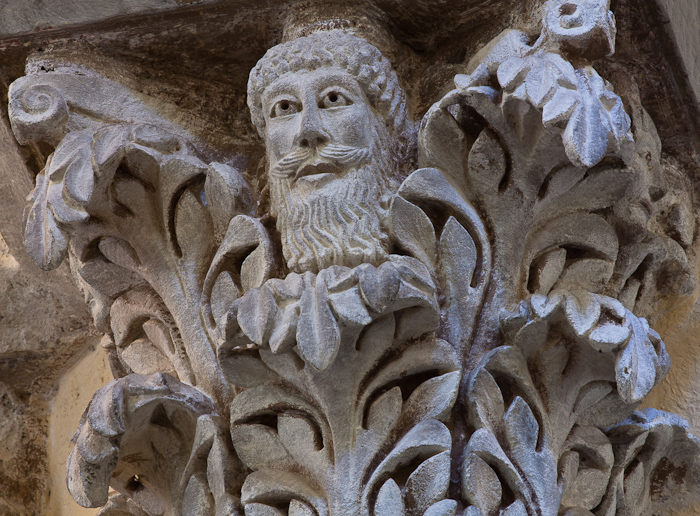
The Green Man

Every generation tends to think of itself as superior to its predecessors. Ours is no different. Sometimes we’re right. Often, we’re wrong. We ignore or don’t know history.

Take, for example, the consciousness of green and climate change – the discovery, or is it the re-discovery, of nature as the context of human life. We tend to think it’s a new consciousness that sets aside the longer consciousness by which the human race justified ravaging the earth.

The Green Man in Clermont-Ferrant, Photo by Dennis Aubrey, Via Lucis Photography

The Green Man in Clermont-Ferrant, Photo by Dennis Aubrey, Via Lucis Photography

But, then, along comes the forgotten Green Man of Romanesque churches build in the Medieval Period, one version of which is featured in Dennis Aubrey’s post “A Green Man in Clermont-Ferrand” on Via Lucis Photography of Religious Architecture.

I turn to Via Lucis whenever I feel the need to get out of my skin, to shed the ignorant arrogance of the 21st Century presumption of progress and superiority.

The whole human story is captured in the various Medieval renderings of The Green Man, the human race fatally mis-perceived as “man over nature” and properly conceived as “man within nature”. 

Gordon C. Stewart, Chaska, MN, January 13, 2016

Four Big Questions – I don’t “get” it

I don’t get it. Or maybe I do, but don’t want to.

Some things jade a person’s spirit.  Like the poisonous, partisan punditry that made a lot of noise responding to last night’s State of the Union Address. Blah, blah, blah; blah, blah, blah!

“I don’t get” why, or how, a thoughtful listener could disparage the FOUR BIG QUESTIONS that framed the President’s speech. 

► “How do we give everyone a fair shot at opportunity and security in this new economy?”

► “How do we make technology work for us, and not against us – especially when it comes to solving urgent challenges like climate change?”

► “How do we keep America safe and lead the world without becoming its policeman?”

► “How can we make our politics reflect what’s best in us, and not what’s worst?”

In the run up to the 2016 Presidential Election, President Obama’s last State of the Union Address spelled out the philosophical-ethical questions that every candidate should be asking and answering. Will we, the citizens – the voters – take the cue? Will we test every candidate for President, the Senate, and House of Representatives to assure ourselves that they “get it”: governing in the United States of America requires thoughtful reflection on complex matters that do not lend themselves to simple solutions or demonizing an opponent.

If we, the people,  don’t “get that”, it won’t be because we can’t. It will be because we prefer the poison of partisan blah, blah, blah.

  • Gordon C. Stewart, Jan. 13, 2016.


A New Government of National Concentration

Video

Adolf Hitler rose to power by playing to the fears, anxieties, and anger of the German people. His strategy was to play the strongman who would fix it, make Germany great again. A nation that had regarded itself as exceptional had lost its way, humiliated by defeat in World War I. Hitler focused that anger at the weakness of the post-World War I Weimar Republic whose inept Chancellor and Reichstag (i.e. Congress) he blamed for the nation’s drift. He blames Marxist thinking and Communists. He declares Christianity to be the religion of the German state. By narrowing and scapegoating, he focuses the people’s fears and anxieties on visible targets. It was only a matter of time before Jews, homosexuals, and gypsies joined the ranks of those to be eliminated in a purified Aryan state.

Notice how quietly, how slowly this speech begins. He waits for the crowd to be quiet before he continues to speak. He is taming them. Mesmerizing them. Training them for Fascism. And when he has brought them to heel, he unleashes a tirade that taps into the people’s volcanic desire for a return to national exceptionalism.

“Those who cannot remember the past are condemned to repeat it.” – George Santayana, The Life of Reason, 1905.

  • Gordon C. Stewart, Chaska, MN, Jan. 11, 2016.

Adolf Hitler’s Appeal to the German People

Radio broadcast, January 31, 1933

Over fourteen years have passed since that unhappy day when the German people, blinded by promises made by those at home and abroad, forgot the highest values of our past, of the Reich, of its honor and its freedom, and thereby lost everything. Since those days of treason, the Almighty has withdrawn his blessing from our nation. Discord and hatred have moved in. Filled with the deepest distress, millions of the best German men and women from all walks of life see the unity of the nation disintegrating in a welter of egoistical political opinions, economic interests, and ideological conflicts.

As so often in our history, Germany, since the day the revolution broke out, presents a picture of heartbreaking disunity. We did not receive the equality and fraternity which was promised us; instead we lost our freedom. The breakdown of the unity of mind and will of our nation at home was followed by the collapse of its political position abroad.

We have a burning conviction that the German people in 1914 went into the great battle without any thought of personal guilt and weighed down only by the burden of having to defend the Reich from attack, to defend the freedom and material existence of the German people. In the appalling fate that has dogged us since November 1918 we see only the consequence of our inward collapse. But the rest of the world is no less shaken by great crises. The historical balance of power, which at one time contributed not a little to the understanding of the necessity for solidarity among the nations, with all the economic advantages resulting therefrom, has been destroyed.

The delusion that some are the conquerors and others the conquered destroys the trust between nations and thereby also destroys the world economy. But the misery of our people is terrible! The starving industrial proletariat have become unemployed in their millions, while the whole middle and artisan class have been made paupers. If the German farmer also is involved in this collapse we shall be faced with a catastrophe of vast proportions. For in that case, there will collapse not only a Reich, but also a 2000-year-old inheritance of the highest works of human culture and civilization.

All around us are symptoms portending this breakdown. With an unparalleled effort of will and of brute force the Communist method of madness is trying as a last resort to poison and undermine an inwardly shaken and uprooted nation. They seek to drive it towards an epoch which would correspond even less to the promises of the Communist speakers of today than did the epoch now drawing to a close to the promises of the same emissaries in November 1918.

Starting with the family, and including all notions of honor and loyalty, nation and fatherland, culture and economy, even the eternal foundations of our morals and our faith—nothing is spared by this negative, totally destructive ideology. Fourteen years of Marxism have undermined Germany. One year of Bolshevism would destroy Germany. The richest and most beautiful areas of world civilization would be transformed into chaos and a heap of ruins. Even the misery of the past decade and a half could not be compared with the affliction of a Europe in whose heart the red flag of destruction had been planted. The thousands of injured, the countless dead which this battle has already cost Germany may stand as a presage of the disaster.

In these hours of overwhelming concern for the existence and the future of the German nation, the venerable World War leader [Hindenburg] appealed to us men of the nationalist parties and associations to fight under him again as once we did at the front, but now loyally united for the salvation of the Reich at home. The revered President of the Reich having with such generosity joined hands with us in a common pledge, we nationalist leaders would vow before God, our conscience and our people that we shall doggedly and with determination fulfill the mission entrusted to us as the National Government.

It is an appalling inheritance which we are taking over.

The task before us is the most difficult which has faced German statesmen in living memory. But we all have unbounded confidence, for we believe in our nation and in its eternal values. Farmers, workers, and the middle class must unite to contribute the bricks wherewith to build the new Reich.

The National Government will therefore regard it as its first and supreme task to restore to the German people unity of mind and will. It will preserve and defend the foundations on which the strength of our nation rests. It will take under its firm protection Christianity as the basis of our morality, and the family as the nucleus of our nation and our state. Standing above estates and classes, it will bring back to our people the consciousness of its racial and political unity and the obligations arising therefrom. It wishes to base the education of German youth on respect for our great past and pride in our old traditions. It will therefore declare merciless war on spiritual, political and cultural nihilism. Germany must not and will not sink into Communist anarchy.

In place of our turbulent instincts, it will make national discipline govern our life. In the process it will take into account all the institutions which are the true safeguards of the strength and power of our nation.

The National Government will carry out the great task of reorganizing our national economy with two big Four-Year Plans:

Saving the German farmer so that the nation’s food supply and thus the life of the nation shall be secured.

Saving the German worker by a massive and comprehensive attack on unemployment.

In fourteen years the November parties have ruined the German farmer.

In fourteen years they created an army of millions of unemployed.

The National Government will carry out the following plan with iron resolution and dogged perseverance.

Within four years the German farmer must be saved from pauperism.

Within four years unemployment must be completely overcome.

Parallel with this, there emerge the prerequisites for the recovery of the economy.

The National Government will combine this gigantic project of restoring our economy with the task of putting the administration and the finances of the Reich, the states, and the communes on a sound basis.

Only by doing this can the idea of preserving the Reich as a federation acquire flesh and blood.

The idea of labor service and of settlement policy are among the main pillars of this program.

Our concern to provide daily bread will be equally a concern for the fulfillment of the responsibilities of society to those who are old and sick.

The best safeguard against any experiment which might endanger the currency lies in economical administration, the promotion of work, and the preservation of agriculture, as well as in the use of individual initiative.

In foreign policy, the National Government will see its highest mission in the preservation of our people’s right to an independent life and in the regaining thereby of their freedom. The determination of this Government to put an end to the chaotic conditions in Germany is a step towards the integration into the community of nations of a state having equal status and therefore equal rights with the rest. In so doing, the Government is aware of its great obligation to support, as the Government of a free and equal nation, that maintenance and consolidation of peace which the world needs today more than ever before.

May all others understand our position and so help to ensure that this sincere desire for the welfare of Europe and of the whole world shall find fulfillment.

Despite our love for our Army as the bearer of our arms and the symbol of our great past, we should be happy if the world, by restricting its armaments, made unnecessary any increase in our own weapons.

But if Germany is to experience this political and economic revival and conscientiously to fulfill its duties towards other nations, a decisive act is required: We must overcome the demoralization of Germany by the Communists.

We, men of this Government, feel responsible to German history for the reconstitution of a proper national body so that we may finally overcome the insanity of class and class warfare. We do not recognize classes, but only the German people, its millions of farmers, citizens and workers who together will either overcome this time of distress or succumb to it.

With resolution and fidelity to our oath, seeing the powerlessness of the present Reichstag to shoulder the task we advocate, we wish to commit it to the whole German people.

We therefore appeal now to the German people to sign this act of mutual reconciliation.

The Government of the National Uprising wishes to set to work, and it will work.

It has not for fourteen years brought ruin to the German nation; it wants to lead it to the summit.

It is determined to make amends in four years for the liabilities of fourteen years.

But it cannot subject the work of reconstruction to the will of those who were responsible for the breakdown.

The Marxist parties and their followers had fourteen years to prove their abilities.

The result is a heap of ruins.

Now, German people, give us four years and then judge us.

Let us begin, loyal to the command of the Field-Marshal. May Almighty God favor our work, shape our will in the right way, bless our vision and bless us with the trust of our people. We have no desire to fight for ourselves; only for Germany.

Source of English translation: Jeremy Noakes and Geoffrey Pridham, eds., Nazism 1919-1945, Vol. 1, The Rise to Power 1919-1934. Exeter: University of Exeter Press, 1998, pp. 131-34.

Source of original German text: “Aufruf der Reichsregierung vom 31. Januar 1933,” reprinted in Hans-Adolf Jacobsen and Werner Jochmann, eds., Ausgewählte Dokumente zur Geschichte des Nationalsozialismus, 1933-1945. Vol. 2, Bielefeld, 1961, no page number (Document 31. I. 1933).



Verse – Church Bells Ringing

Sunday Morning Chimes

Three Church bells ring in Philo,
The Catholic Mass is first,
The Presbyterians
Are next, then Martin
Luther takes his stand.

The steeples point like preachers
To blue sky up above
But storms will soon be coming
If we don’t act with love
And follow that sweet dove.

Yes, Jesus is our teacher,
We hear his bell ring true,
you sound and I am singing
You speak and I speak, too.
Bells ring for me and you.

  • Steve Shoemaker, Urbana, IL, Jan. 10, 2016

The Three Kings [aka Stooges]

Wednesday evening three old friends from Texas, Arizona, and northern Illinois descended on the Shoemaker home in Urbana, IL to sing their own semi-humorous re-write of the traditional Epiphany hymn We Three Kings. They concluded by presenting gold, frankincense, and myrrh to our mutual friend Steve Shoemaker. There’s a video of the trio on Steve’s FaceBook page for those want to watch and sing along. Steve, diagnosed with terminal cancer, is feeling remarkably well – even got up to make oatmeal for the guys the next morning!

EPIPHANY 2016

A Tribute to the Rev. Dr. Steve Shoemaker (Harry Lee Strong)
(Tune: Three Kings of Orient; John Henry Hopkins, 1857)

We three friends from north, south, and west
Gather here as your grateful guests.
Pardon our singing – gifts we are bringing,
Just hoping not to be pests.

O … Husband, father, poet, bard:
How we loathe your journey hard!
If we could, you know we would
Make this damn disease retard!

It’s so good to see you again
Here at home on your Illinois plain,
Still with humor, despite tumors,
Teaching to die is to gain.

O … Talk show host and scholar bright:
Few compete with your great height!
On the air and through your care,
Keepin’ Faith both day and night.

Only God can possibly know
How many lives you’ve enabled to grow:
Words and actions, breaking down factions,
Allowing your light to show.

O … Classmate, preacher, prophet bold:
No respect do we withhold!
From our coffers we now offer
Frankincense and myrrh and gold.

  • Gordon C. Stewart, Chaska, MN, January 8, 2016. Wish I’d been there.

Verse – Mary’s Bastard Child

It’s dark and drear on the way
to Bethlehem where relatives
abound with rooms to spare
to welcome our coming.

Why are the lights all out,
the doors locked, the knocks
unanswered, no candles lit for
us from out of town?

Has news of the coming illegitimate
child scared them off, driven them
way inside bolted doors named fear
and blame and shame?

Has the buzz been mean, the
relatives praying to stay clean
of bedsheets soiled of a bastard
birth and bloody after-birth?

Have the men in town gathered
stones and the women
shrunk back from mid-wifing
Mary’s child into life?

A flop house on the other side
of town welcomes us with fires
outside the barn for black
sheep guests from Nazareth.

  • Gordon C. Stewart, Chaska, MN, January 7, 2016

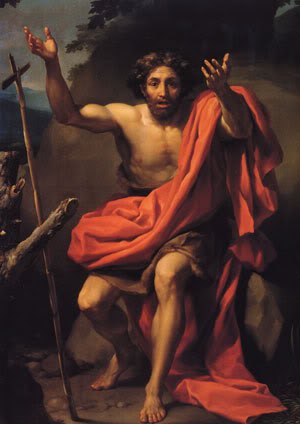
How the doubting father’s son became a shouter

A BIBLICAL FATHER-SON STORY: ZECHARIAH & JOHN THE BAPTIST

John the Baptist
John the Baptist

Ever wondered why John comes out of nowhere with a fiery message?

He has a bone to pick. Why? With whom? What’s his story?

The Eastern Orthodox Christian tradition preserves a story about John’s father, Zechariah, a Temple priest, sending his wife, Elizabeth, and their son, John, into hiding. Zechariah hides his son to protect him from Herod’s “Slaughter of the Innocents” by which all males below the age of two were to be killed following rumors of a newly-born king, a threat to Herod’s rule.

According to the story told by The Infancy Gospel of James [the mid-Second Century C.E.], John and Elizabeth remain in hiding – far away from their husband and father, Zechariah – until John is five or six years old when Zechariah risks visiting their hiding place. The result is the brutal murder of Zechariah by Herod’s soldiers.

As the son of a Temple priest, John descended from the priestly lineage of Aaron. John was destined to be a Temple priest. Father-son dynamics become more difficult when the father is a public religious figure. Zechariah’s son sounds like an angry preacher’s kid.

When [John] saw the Pharisees and Sadducees coming to be baptized, he said to them, "You brood of vipers, who warned you to flee from the wrath to come? Bear fruit that befits repentance, and do not presume to say to yourselves 'We have Abraham as our father ....'" (Mt. 3:7-9a).

The Pharisees were lay people with a more liberal religious bent than the Sadducees. The Sadducees were Temple authorities and Temple supporters, the folks who aligned themselves with John’s father Zechariah and a conservative reading of the Torah. The Pharisees and the Sadducees were in conflict during the time of John and Jesus. Only the Pharisees survived the later destruction of Jerusalem and the Temple in the Roman-Jewish War of 70 C.E.

By the time the Gospels are written, the Temple had been destroyed. So we have the Temple priests and their supporters, the Sadducees, and John the Baptist in the Gospel of Matthew scolding both the Pharisees, who will carry on their tradition without accepting one of their likely members, Jesus of Nazareth, as the awaited Anointed One (Messiah), and the Sadducees who have disappeared into history.

Whether the Orthodox tradition and The Infancy Gospel of James are taken as historical fact or mythic truth, John’s real fight was with his father and the Sadducees who had compromised Jewish identity and integrity by their accommodations to Rome.

John is certain, bold, and in-your-face. His father, Zechariah, according to Matthew’s Gospel, had doubted the news of John’s conception. As a result of his doubt, Zechariah was struck dumb. He remained unable to speak until Elizabeth had named their son ‘John’, at which point his mouth was opened. “Yes,” said Zecahariah, “his name is John.”

Zechariah had been a doubter; John was no doubter. Zechariah sent John into hiding. The John who returned from safety was no hider. John became a shouter who minced no words. Far from Jerusalem and the Temple, out in untamed space by the Jordan River, he took his stand for the return of his people from the false choice of the pious laity (the Pharisees) and his father’s priestly class (the Sadducees): “You brood of vipers!”

Baby vipers were said to eat their mother’s stomachs. Israel was the Mother whom the Pharisees and Sadducees were eating from the inside out.

John wanted nothing to do with the killing of his Mother or with those who had killed his father. In the interest of protecting his Mother from the vipers, he had run from the Temple into the wilderness, returning to the place where his Mother, Israel, had been born after the Exodus. He did not go into the wilderness to hide. He went out to rescue his Mother from being eaten by her children. When the vipers arrived, he shouted in ways his mute father never did. Yet, in the end he died by the same hands as his father when Herod delivered his head to Salome on a platter.

Like father, like son. His younger cousin Jesus carried on.

  • Gordon C. Stewart, Chaska, MN, January 7, 2015

Grandpa’s letter to Ruby

Dear Ruby,

Barclay and I loved playing with you yesterday. I think you enjoyed it too!

You and Barclay aren’t old enough to understand all the things I know. Both of you are only two-and-a-half years old. But, from the looks of yesterday’s play time, you both enjoy life more than Grandpa. Watching you and Barclay do his tricks was such fun!  “Barclay, sit!” “Barclay, down.” “Leave it.” “Roll over.”

You were the alpha dog, the commander-in-chief, Chairwoman of the Joint Chiefs of Staff. To this day, no woman has ever held any of those positions.

But I’m getting ahead of myself. You don’t know all that stuff. You don’t know what an alpha dog is, or a Commander-in-Chief, or Chairwoman of the Joint Chiefs of Staff or President. You’ll learn all that stuff soon enough, and, if this were the world I would like for you, there wouldn’t be any Commanders-in-Chiefs, or Joint Chiefs of Staff. There would be grandchildren like you and Cavalier King Charles Spaniels like Barclay who play together with moms and dads, grandmas and grandpas without worrying about the reasons we have Commanders-in-Chief and Chairwomen of the Joint Chiefs of Staff.

Watching the two of you yesterday made me think about how much of what I know I wish I could un-learn. My head and heart are crammed full of things that don’t belong there, like the time your Great Uncle Bob drank the Drano and had to be rushed to the hospital to have his stomach pumped.

Drano container - POISON

Drano container – POISON

Older people your Uncle Bob and me have drunk the poison of thinking we’re smarter and better than dogs and cats, and trees and birds and blue skies and clouds and rivers and ponds and oceans. We drank the poison. I hope you’ll grow up remembering your play time with Barclay whenever the can of Drano sits on the back of the toilet.

I go to the toilet a lot more these days. You’re still wearing diapers. If you’re lucky you’ll learn from Barclay what my generation never learned: never poop in your own kennel. The world, the planet, is your kennel, Ruby! This whole wide world. We need to take care of it. Enjoy it. Not be mean to it or hurt it.

As you get older, remember how you and Barclay looked right in each other’s eyes and smiled. Remember the love. If you do, the world will be a better place than the one I’m passing on to you. And, when I pass on, remember that our big wonderful kennel doesn’t go anywhere. It just keeps going long after we’ve been here. Be nice to it. Be nice to yourself. Keep playing, and, please, don’t swallow the Drano!

Love you,

Grandpa Stewart