More or Less Connected?

This morning we reply to The Daily Post’s invitation to create a post on the word “connection.”

Because Views from the Edge has been silent the last few days – my only connection has been an Obsessive Compulsive Disorder preoccupation with preparing a book proposal for submission to a publisher – and feeling no urgency to add more punditry dribble to the presidential campaign coverage, my immediate response was the antonym for connection: “separation.”

I’ve been totally connected to the book proposal; almost totally disconnected – separated, walled off – from Kay, Barclay, and the news. I’ve also been less physically present except for short breaks for meals and answering the bell Barclay rings when he needs to go outside to do his duty. I’ve been dutiful indoors with little connection to anything but the book proposal – more connected and more separate all at the same time.

Theologian Paul Tillich translated “sin” as “separation” from the Ground of Being, nature, neighbors, and one’s self. I’ve been living in sin! And, now that I’ve broken the silence in response to the Daily Post’s invitation, I’m going back to sin until the connection with the publisher is finally made – by means of the internet which has managed to produce a new paradox: wider connection and deeper separation than previously imagined.

Temporarily less connected until next Tuesday’s submission…unless Steve connects with a poem,

Gordon


A Reflection on Terrorism

mccrackin_376x500

Copyright 1996 The Cincinnati Enquirer

A sermonic reflection on Luke 13:1-9

Ordinary citizens are not terrorists, are we?  We didn’t bring down the World Trade Center, kill and maim marathon runners and spectators at the Boston Marathon, or kill innocent co-workers in San Bernadino. The Rev. Maurice McCrackin answered that we are and we have, for reasons we’ll explain later.

Mac was informed by today’s Gospel reading (Luke 13:1-9) where Jesus addresses terrorism and urges his hearers to turn. “Unless you all repent, you will all … perish.”

It happens when some people inform Jesus “about the Galileans whose blood Pilate has mingled with their sacrifices.” The speakers seem to be contrasting the Galileans – known for their armed resistance to Roman rule, i.e. guerilla warfare – and the Jerusalemites.
Remember, Jesus himself is a Galilean!

The non-Galileans are putting him to the test. As he so often does so ably, Jesus, the Galilean Jewish rabbi, begins strangely by appearing to agree with their anti-Galilean prejudice. He asks whether these violent Galileans were any different from the rest of the Galileans. One can almost hear the applause from the more sophisticated, non-terroristic Jerusalemites.

Then he quickly shifts their attention to a scene in Jerusalem. He asks them if the eighteen saboteurs “upon whom the tower of Siloam fell, and slew them, do you think they were worse sinners than all others in Jerusalem?”

“No,” he says, “but unless you (plural) repent, you will all likewise perish.”

Sometimes reading a familiar text in a form much closer to the original context of Jesus’ linguistic-religious-cultural-political-economic context serves to awaken us to hear it differently.

Now … there were some present reporting to Rebbe, Melech HaMoshiach about the men of the Galil whose blood Pilate mixed with their zevakhim (sacrifices).

And, in reply, Moshiach said, Do you think that these men of the Galil were greater chote’im (sinners) than all others of the Galil, because they suffered this shud (misfortune)?

Lo (no), I say, but unless you make teshuva, you will all likewise perish.
Or do you think that those shmonah asar (eighteen) upon whom the migdal (tower) in Shiloach fell and killed them, do you think that they were greater chote’im (sinners) than all the Bnei Adam living in Yerushalayim?

Lo (no), I tell you, but unless you make teshuva, you will all likewise perish.
And Rebbe, Melech HaMoshiach was speaking this mashal. A certain man had an etz te’enah (fig tree) which had been planted in his kerem, and he came seeking pri (fruit) on it, and he did not find any. [YESHAYAH 5:2; YIRMEYAH 8:13]

So he said to the keeper of the kerem, Hinei shalosh shanim (three years) I come seeking pri on this etz te’enah (fig tree) and I do not find any. Therefore, cut it down! Why is it even using up the adamah (ground)?

But in reply he says to him, Adoni, leave it also this year, until I may dig around it and may throw fertilizer [dung] on it,

And if indeed it produces pri in the future, tov me’od (very well); otherwise, you will cut down it [Ro 11:23].

The Orthodox Jewish Bible (OJB) Copyright © 2002, 2003, 2008, 2010, 2011 by Artists for Israel International.

The ‘mashal’ (a familiar proverb or parable) he re-interprets is already part of his and his hearers’ self-understanding from Isaiah 5:2 and Jeremiah 8:13:

Jesus is speaking about collective social life – politics, economics, religion, resistance, keeping the faith – a whole society, a culture, a nation. He is calling for thorough-going societal transformation – turning from blaming others (the Galileans) to looking in the mirror to see the log that is in every eye: the underlying pervasive violence in our way of being in the world, taking up “ground” on this beautiful planet.

In Hebrew Scripture the human species, Adam, is derived from Adamah – earth, soil, dirt, ground. Humans, created in the image of God,  are to produce sweet figs. But the Owner of the vineyard with the barren fig tree shows two traits: deep disappointment – “Why is it even using up the ground?” – and an over-riding patience that allows it more time to produce the sweet figs it was intended to bring forth from the dirt (adamah).

As I look out the window this morning to the world outside, I feel a tiny shiver of God’s frustration and long-suffering. I read the paper, read my emails, look in the mirror, and take my morning shower wondering what it will take before we see the violence of terrorists in ourselves.

The Rev. Maurice McCrackin is the one soul I know who really dared to live what Rabbi Jesus preached about teshuvah (repentance).  Mac was Pastor of St. Barnabas Presbyterian Church, by far the poorest church in the poorest section of Cincinnati, until he was removed. But it wasn’t his daily work among the poor that brought him attention. Mac was a war tax resister. He refused to pay federal taxes -not because he didn’t believe in taxes. He did! In the name of crucified Jesus, the Prince of Peace, Mac refused to join in funding a “defense” budget that was, in fact, a war budget that supported state-sponsored international terrorism. “Ordinary citizens aren’t terrorists, are we?” Mac said we are, and, in the name of Jesus, the Prince of Peace,  and he was carried off to jail again and again and again. “To give financial support to war while at the same time preaching against it is, to me, no longer a tenable position.” His spirit was as free as anyone I’ve ever known.

Now … there were some present reporting to Rebbe, Melech HaMoshiach about the men of the Galil whose blood Pilate mixed with their zevakhim (sacrifices).

And, in reply, Moshiach said, Do you think that these men of the Galil were greater chote’im (sinners) than all others of the Galil, because they suffered this shud (misfortune)?

Lo (no), I say, but unless you make teshuva, you will all likewise perish.

How shall we make teshuvah?

  • Gordon C. Stewart, Chaska, MN, Feb. 27, 2016

“Making America ‘Great’ Again!”

Donald Trump’s refrain begs for interpretation. What does he mean by ‘great’? Is there a synonym for ‘great’ in Trump’s speech and demeanor?

“Make America the BULLY again!”

Mr. Trump – Mr. You’re Fired! – acts like a bully and talks like a bully. “We’re going to make America great again! You’re going to love it!”

Need we say more? Yes, we do. Because people are falling for it.

imposters-of-godImagine the voice of William Stringfellow coming from the same stage as Mr. Trump:

“The sheer arrogance of the idolatrous claims of nations, perhaps especially those possessed of enormous economic and military strength, is so starling that the fascination of men (sic) with idolatry can be explained in no other conceivable manner than as moral insanity….

“More than one President of the United States, not to mention other lesser orators, have propounded, with sober face, the theme that America’s extraordinary power evidences an erstwhile holy dispensation and constitutes God’s partisanship for American dominance in the world.”- William Stringfellow, Imposters of God: Inquiries Into Favorite Idols, Wipf & Stock Publishers, 2006. [Imposters for God was original written as a confirmation curriculum for confirmands in the Episcopal Church in America.]

  • Gordon C. Stewart, Presbyterian minister, Chaska, MN, Feb. 27

Verse – Ol’ Fuzzy Head

The nurse said I had “Chemo Brain”,
From writing, I just should refrain;
But I have the notion
That writing’s the potion
To retrain the brain to be sane.

  • Steve Shoemaker, two days after Chemo treatment, Urbana, IL, Feb. 26, 2016

A Sense of Decency

Pernicious Predatory Political Practices, published here this afternoon exposing a series of right-wing pernicious, predatory mailings preying on Senior Citizens, takes some of us back to Senator Joseph McCarthy’s tactics of fear and character assassination, and the famous line that stopped him in his tracks in 1944. Imagine the American people asking the same question to every political candidate this Super Tuesday:

“You’ve done enough. Have you no sense of decency, sir, at long last? Have you left no sense of decency?” – Joseph Welsh, Special Counsel for the Army

  • Gordon C. Stewart, Chaska, MN 55318

Reader Comment:

“McCarthy, Wisconsin’s Jr. Senator didn’t respond. Trump & Cruz respond F. Y. Of course Rubio, the empty suit distinguished by ambition and absenteeism, was calculating his next slur on his ‘feckless’ President Obama. Had breakfast yesterday with retired Chair of History Department. His view is close to Ezra Klein’s Germany 1933. Scapegoating, authoritarianism, desperate and uneducated voters. Hitler won.” Jim

Pernicious Predatory Political Practices

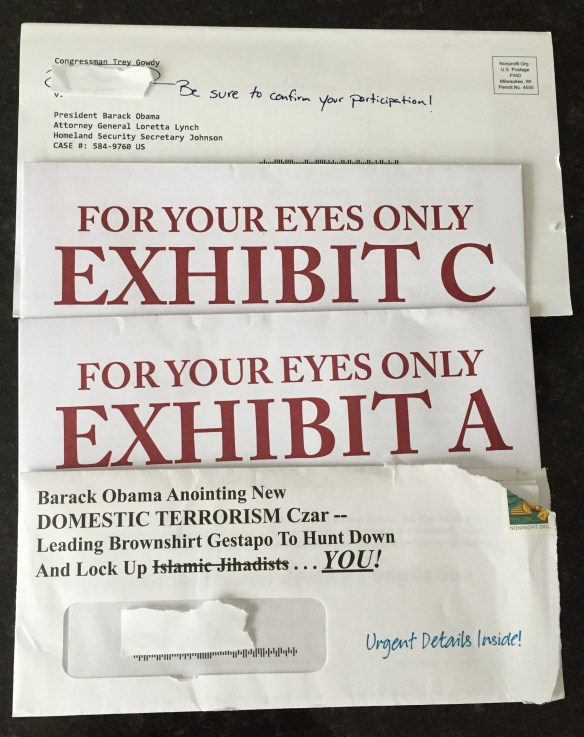
An 85 year-old friend calls with a bit of panic in his voice. “I think I’ve gotten myself into something in Washington,” he said. He’s getting mailings that look he’s part of a lawsuit.

We meet for coffee to look over the mailings. He shows me the piece that worries him. It’s a law suit. It strikes him as very official. [See the return address in the top envelope below: Congressman Trey Goudy and my friend’s name  v. President Barack Obama, Attorney General Loretta Lynch, and Homeland Security Secretary Johnson]. It has a case number: 584-9760 US.

Trey Goudy

Trey Goudy (R-SC) is Chair of the Congressional Committee on Benghazi, the one who was criticized by the next-in-line to be Speaker of the House, Kevin McCarthy (R-CA), because the committee was driven by a partisan political agenda. The letter speaks with urgency and asks for money to prosecute the case.

Next He pulls from his satchel a long tube from The National Campaign to Guarantee Social Security “warning” him of cuts to his Social Security benefits and possible elimination of Social Security. Only near the end of the three page letter does the campaign identify liberals as the enemies of Social Security. The letter solicits a sum of $200 before March 10 when the National Campaign to Guarantee Social Security’s creditors expect them to pay past bills.

National Campaign - SS

Most of the mailings have the same return address:  1600 Diagonal Road, Suite 600, Alexandria, VA, the offices of the Federation of Responsible Citizens.

A search of the Federation of Responsible Citizens and other mail solicitors that target seniors led us to this podcast and article aired by Minnesota Pubic Radio in Dec., 2013.

http://www.mprnews.org/story/2013/01/03/news/mediscare-fundraising-mailers

My friend and I consulted with the MN Attorney General’s Office. We were told to tear up any such mailings. “Just throw them away. You’ll see this slow down or stop after the election.” But what about the millions of seniors who at one time made a small contribution to some such mailing, believing it was in their best interest to do so? Is there a lawsuit out there to stop this pernicious predatory political practice? Someone please say yes.

  • Gordon C. Stewart, Chaska, MN, Feb. 26, 2016

Term Limits: solution or problem?

Would setting limits to the number of terms a Congressperson can hold office help solve the problem in Washington, D.C.? Term limits is one proposed remedy for fixing Congress. Get rid of the career politicians! Fresh faces would be closer to the people they represent, set a new tone, and get things done.The idea has its appeal.

We’re tired of gridlock,but is putting fresh faces in the U.S. Congress – or the White House – all it’s cracked to be?

Sen. Tom Cotton, R-Ark. (AP Photo/Carolyn Kaster)

Sen. Tom Cotton, R-Ark. (AP Photo/Carolyn Kaster)

Senator Tom Cotton (R-AK) rode into the Senate on a high horse, penned a letter to the government of Iran opposing the Obama Administration’s diplomatic efforts with Iran, and secured the signatures of 46 of the 53 Republican Senatorial colleagues. In March 2015 the newly elected Senator appeared on Face the Nation to make his case for Iran’s creeping influence in the Middle East, declaring,

“They [the Iranians] already control Tehran.”

Did he say “Tehran” – the capitol of Iran, the Tehran of the Persian Empire dating back 5,000 years?

Yes, he did. Either the Senator came to the Senate clueless about geography, history, the sensitivities of a tense geopolitical world, and the traditions of how foreign policy is conducted in the United States, or, worse, he just doesn’t care. Neither is acceptable for a member of the United States Senate. The Senate is the body with the longer terms (six years compared to 2 for the House of Representatives) because of the Founders’ wisdom. Those who wrote the Constitution knew the value of continuity, as well as change.

In the much more complex world of the 21st Century, the case for longevity, not term limits, is an argument for wisdom.

Citizens who have served as city councilors, state legislators, or board members of local organizations, colleges and universities know how long it takes to get up to speed. Those who are most effective learn to keep their mouths shut while learning how to drive a vehicle they’ve never driven before in the company of more experienced drivers who know the rules of the road.

The advantage of long-standing service in the U.S. Congress or of a Presidential candidate with longer experience and long-term memory is that they’ve been around long enough to know the history, however differently they interpret it on different sides of the political aisle.

And then…there’s Donald Trump who has NO experience in elected office. If you need a nudge to think about it, remember the ambitious Senator Cotton on Face the Nation.

  • Gordon C. Stewart, Chaska, MN, Feb. 25, 2016

Two Religions everywhere

Any and all religions are divided between two types. One shouts; the other listens. One makes war in the name of God; the other makes peace in the name of God. One kills its enemies; the other prays for its enemies.

Both types are found within each of the three Abrahamic religions. The sacred texts of Judaism, Christianity, and Islam can be interpreted either way. Sections of the Hebrew Bible and the New Testament – the Book of Revelation, for instance – lend themselves to interpretations that shout, go off to war, and kill in the name of a warrior God. The same is true of the Qu’ran.

Apocalyptic fear or expectations – end of the world theology – light the fires of fear and hatred.

Richer by Far this morning invites us to pause and ponder the deepest truth about ourselves and others.

“The acceptance of oneself is the essence of the whole moral problem and the epitome of a whole outlook on life. That I feed the hungry, that I forgive an insult, that I love my enemy in the name of Christ – all these are undoubtedly great virtues. What I do unto the least of my brethren, that I do unto Christ. But what if I should discover that the least among them all, the poorest of all the beggars, the most impudent of all the offenders, the very enemy himself – that these are within me, and that I myself stand in need of the alms of my own kindness – that I myself am the enemy who must be loved – what then? As a rule, the Christian’s attitude is reversed; there is no longer any question of love or long-suffering; we say to the brother within us ‘Raca,’ and condemn and rage against ourselves. We hide it from the world; we refuse to admit ever having met this least among the lowly in ourselves.” Carl Jung, Modern Man in Search of a Soul.

Apocalyptic theology of whatever sort ignores the deepest truth about ourselves. Martin Niemoller, the German churchman who resisted Hitler gives the succinct word to ponder.

“It took me a long time to learn that God is not the enemy of my enemies. He is not even the enemy of His enemies.” Martin Niemöller

What does God look like?

As a child, I wondered what God was like. I was told God was like Jesus. But I couldn’t see Jesus; neither could the artists who painted God and Jesus. They just made up what they looked like. I never got an answer to what God looks like, or what God sounds like.

All these years later young children ask me the same questions:

“What does God look like? What language does God speak? How do we know it’s God?”

Recently a kind of answer came while speaking with a neurosurgeon at a hospital in Ukraine.

Imagine you’re a fly on the wall in the neurosurgery floor of a hospital. All the patients have had, or will soon have, brain surgery. You observe the neurosurgeon make his daily rounds, going from room to room – just as you would expect anywhere in the world.

But this isn’t anywhere in the world. Something’s different here. This hospital is an embattled region on the eastern border of Ukraine… and the patients under this doctor’s care aren’t just any patients. Some of them are enemy soldiers. The patients are from both sides of the war.

One Russian soldier with a bullet still in his head occupies Room 401. Next door in Room 403 is a Ukrainian soldier, recovering from surgery. One speaks only Russian; the other speaks Russian and Ukrainian.

Like many other citizens in this city in the Donbass Region of Ukraine, the neurosurgeon speaks fluent Russian and Ukrainian. He communicates equally well with the Russian and Ukrainian enemy soldiers.

The surgeon walks into the Russian soldier’s room. He greets him in Russian: “Dobroye utro [Good morning], Vladimir, how are you feeling this morning?”

“Khorosho” [Good], says Vladimir.

He goes next door to Room 403. He greets Alexei in Ukrainian: “Dobroho ranku, [Good morning] Alexei. How’s the headache this morning?”

“Ne take dobre!” [Not so good], says Alexei.

Both the Russian and Ukrainian soldiers trust that the doctor lives by a different code than the geopolitical code of conduct that has landed them – two former enemy combatants – in the same hospital next door to each other.

__________________
What does God look like? What language does God speak?

As Japanese theologian Kosuke Koyama noted, God speaks more than one language. God speaks many languages. Maybe God looks and sounds like a multilingual brain surgeon making rounds in the war-zone hospital taking the bullets out of the heads of enemy combatants.

  • Gordon C. Stewart, Chaska, MN 55318


TED Talk: Want to be Happy? Be Grateful

This morning we introduce readers to the work of David Steindl-Rast, O.B. by means of this TED Talk on the relationship between happiness and gratitude.

  • Gordon C. Stewart, Chaska, MN 55318.