Idealism and Terror

When one thinks of idealism, Martin Luther King, Jr. or Gandhi comes to mind. Moral and spiritual giants who stand for ideals that make the world a better place. We think of Idealism as good in the face of evil, or of ideals lifting us up from the dirt of reality, purifying life from its toxins. Ah, but there lies the fatal flaw in idealism itself.

George Will’s Washington Post opinion piece “A Murderer’s Warped Idealism” looks afresh at idealism and evil, not just evil masquerading as idealism, but idealism as a source and form of evil itself.

Will’s commentary zooms in on Adolf Eichmann, executed at midnight 1961 for his role in the German State’s systematic extermination of 6,000,000 Jews. During the trial in Jerusalem Eichmann minimized his role in the Holocaust, presenting himself as a thoughtless functionary carrying out the orders of his superiors.

Referring to newly discovered writings by Eichmann which form the backbone of a new book by German philosopher Bettina Stangneth, Will writes:

Before he donned his miniaturizing mask in Jerusalem, Eichmann proclaimed that he did what he did in the service of idealism. This supposedly “thoughtless” man’s devotion to ideas was such that, Stangneth says, he “was still composing his last lines when they came to take him to the gallows.” (Bolding added by Views from the Edge)

Eichmann and Hitler were not without ideas or ideals. They were not thoughtless. Nor were they irrational, as those who believe that reason can sea us believe. They were idealists who sought to lift up a super race, burning away the world’s impurities as their deranged hearts conceived of them.

The late Dom Sebastian Moore, O.S.B. shone a different light on idealism and the remedy for human madness. He put it this way in The Crucified Jesus Is No Stranger:

“We have to think of a God closer to our evil than we ever dare to be. We have to think of [God] not as standing at the end of the we way take when we run away from our evil in the search for good, but as taking hold of us in our evil, at the sore point which the whole idealistic thrust of man is concerned to avoid.”

We are, says Moore, “conscious animals scared of our animality and seeking to ennoble ourselves.”

Eichmann, Himmler, and Hitler were idealists. Nationalist extremists are idealists. Racial and religious extremists are idealists. ISIL is idealist. American exceptionalism is idealist. Whether behind the banner of the State, or of religion, gender, ideology, scientism, or rationalism – idealistic terrorism lives to rid the world of evil as its adherents understand it, projecting evil as “the other” while fleeing “the sore point” that we conscious animals seek to avoid.

Only the God who meets us at the sore point of our shared animality can save us from fantasies. In his last book, Remembered Bliss ((Lapwing Publications: 2014), Dom Sebastian told the reader, “I’m ninety-six, and for most of my life I’ve been a monk. My life as a monk has been, for the most part, the search for God as real.” RIP.


Finding Our Tree

We walk the rows of silent trees,
some smell of resin, some of lime
or lemon–six varieties.
Young families rush, we take our time,

enjoy the shades of green, the feel
of needles, sharp or soft into
our mittens. We will cut the real
tree with the saw, then shake a few

brown needles to the frozen ground.
At home the Christmas tree will light
the room and spread love all around
to neighbors who will catch the sight

of the one tree that spoke to you
and said, “It is for you I grew.”

– Steve Shoemaker, Urbana, IL, Nov. 18, 2014

Prayer

“She saw him standing in the parlor with his beautiful old head bowed down…praying looks just like grief. Like shame. Like regret.”
Lila, p. 95, Marilynne Robinson, 2014

Head bowed is the posture of humility, the position of a supplicant, petitioner, intercessor, or giver-of-thanks that looks to the eyes of the misinformed like grief or shame or regret. There is certainly all of that in those who pray, but it’s so much more, so much deeper, so much more reassuring.

We are often our own worst enemies. Every experience of the Beloved causes the head to bow and a tear to fall.

The Election: What Now? My Quandry

Rabbi Arthur Waskow of the Shalom Center granted permission to re-publish this morning’s reflection. It begins with a quote from Henry David Thoreau:

“Cast your whole vote,
Not a strip of paper merely.”

Dear friends,

During this week since the election, I have been living in a quandary.

The root of my quandary is my affirmation of these spiritual truths as applied to “political” events:

  • Ecology, the fullest expression of our science, teaches that if any species exerts total control over any eco-system — tries to gobble up all the nourishment in sight — it destroys the eco-system – and itself.
  • Torah teaches that we must love our neighbors as ourselves, and that we must grant the earth its rhythmic rest — or suffer disastrous floods, famines, exile.
    Democracy is an experiment in increasing interhuman compassion, community, and cooperation.
  • Ecologic sanity is an experiment in increasing interspecies compassion, community, and cooperation.

It seems to me that our recent election, dominated by huge gobs of money in the service of generating even huger gobs of money, marginalized both democracy and eco-sanity.

Part of me wants to believe that politics is always a game of waves — –– that a wave of attacks on democracy today will bring a wave of creative affirmations of democracy tomorrow. That the defeat of pro-democracy candidates (even in states where pro-democratic referenda won big) was an accident of abysmally low voter turnout (the lowest percentage since 1942), and that the progressive movement will recover in 2016.

On the other hand, part of me believes that at this moment in US history the whole system is broken, because extreme inequality of wealth and the dominant power of global corporations has smashed all the organs intended to protect and advance democracy.

And this part of me believes that this brokenness is driving not only America but all our planet into an enormous crash – a dead end where we cannot wait for the next wave of the old system, but instead must give birth to something entirely new. Beyond the kinds of elections we have now, beyond the economic structure built on fossil fuels during the past 250 years.

Not backward into feudalism but forward into new forms of eco-democratic community.

From the first perspective, what needs to happens next is more grass-roots organizing of the well-worn style, combined with a much bolder, clearer progressive populist message. The People vs. Wall Street.

From the second perspective, the meaning of this last election was taught 165 years ago in the midst of a growing crisis over slavery: “Cast your whole vote, not a strip of paper merely, but your whole influence. A minority is powerless while it conforms to the majority; it is not even a minority then; but it is irresistible when it clogs by its whole weight.” – Henry David Thoreau, “On Civil Disobedience”.

Which answer to my quandary is “right”? To get beyond my quandary – OUR quandary! – let’s start from basics:

Both our spiritual/religious traditions and the findings of modern science teach that community, connection, cooperation – in that dangerous four-letter word, LOVE –- are required for human beings and our planet to be healthy and life-giving.

It’s true that Control — in Buber’s language, I-It as distinct from I-Thou — is a necessary part of life. But when Control becomes so overwhelming that community, compassion, are erased –- disaster follows.

Triumphalism, like the “triumphs” of Pharaoh in enslaving people and the very earth his country lived in, becomes self-destructive.

Mentioning Pharaoh reminds us of an historical as well as moral truth:When Control becomes overwhelming, it self-destructs and a new form of society is born.

  • When the ancient Egyptian and Babylonian Empires over-reached, shattering the societies of early Western Semitic tribes, the new social form we know as Torah was born.
  • When the Roman Empire over-reached, it shattered Biblical Judaism – so that Christianity and Rabbinic Judaism and (a little later) Islam were born.
  • Now the machinery of Modernity has over-reached, and all the classic social forms of the last millennia have been shattered. Something new needs to be born. Is being born.
    For Control and Power to limit themselves so as not to over-reach –- is elementary wisdom, even simple sanity.

But this election was a triumph for the practice of insisting on Total Triumph — Big Money, Big Corporations, choking Earth’s atmosphere, heating Earth’s oceans, depriving the poor, the young, the Black, the Brown of the right to vote while giving the rich millions of extra votes in the form of hundreds of millions of dollars spent on elections.

More important – this election was a defeat for defeatists. Defeat for those who refused to stand up against these policies of Top-Down Power. Defeat for a President and a Party that has practiced preemptive surrender to Big Money since it took office in 2009. Defeat for those “liberals” who whimpered about Obamacare instead of proclaiming its undeniable though limited success.

By their timidity they were thinking to appeal to “moderates” — but instead they convinced these moderates that even the timidly progressive President and Party must be a failure.

Many of these same defeatists will behave as if 2016 can be won by the same defeatism that lost in 2014. They will point to mechanics: more Republicans up for grabs in the Senate, a respected woman candidate for President who is a pro-Wall Street “moderate,” more turn-out in a Presidential year.

But even their best efforts will be given to lessen disaster. The basic structure – enormous inequality in wealth, free use of that wealth in politics, the purchase of the Supreme Court by anti-democratic forces — will remain the same, and because of their own defeatism they will remain defeated, prisoners within it.

Even if they “win” the 2016 election, their “winning” will really conceal a more basic defeat — as it did for Obama in 2012.

Yet — preventing the worst is still desirable. Resistance to the worst attacks on democracy could begin right now: Not waiting for the next election, or even the next Congress to convene in January. What would that take?

(This is the first half of an exploration of the quandaries we face from a spiritually rooted perspective on the last elections. The second half is available at our website at https://theshalomcenter.org/content/election-what-next-my-quandary, and will also be in your in-box in the next few days.)

———————————

Thank you Rabbi Arthur Waskow for connecting the dots of faith, politics, economics, and the sacredness of the Earth.

Click HERE for the Shalom Center website.

The Throes of Creation – Tomorrow I write

http://en.wikipedia.org/wiki/Writer#mediaviewer/File:Leonid_Pasternak_001.jpg

The Throes of Creation – Leonid Pasternak

I’m newly retired.

Today was rough. All day.

Didn’t want to get up, semi-awake, my mind become a subatomic particle collider of memories, facts, people – confused, whirling, disoriented.

Got up, had coffee, but couldn’t write. Didn’t want to. Didn’t want to do anything.

Searched the emails, rummaged through the morning paper for something of interest. Nothing.

This house is dark in the morning. Not just at 5:00 a.m. It’s dark all morning. No sun. And the skies are cloudy. Gray. Like my spirit. Purposeless. Alone. Disinterested. Blah.

It’s the first taste of retirement. The congregation is gone, or, rather, I am gone from them. I miss them. I am without role. Without work. Without routine. No longer a shepherd. Nor am a sheep within a flock. Adrift. Aimless. Dead to what was. Unclear about what is or will be. I am alone.

Except for Barclay who doesn’t get it. He want’s to play. It’s just another day. Go out. Come in. Get the ball. Drop the ball at Dad’s feet. Play ball with Dad, eat food, play some more, go out, wonder why Dad isn’t paying attention and why we’re not getting exercise when there’s such nice snow outside.

Barclay drove me nuts today. Not his fault. He’s a dog. He knows nothing about retirement, nothing yet about aging, about hearing loss, about depression.

Barclay knows nothing about the Mayflower, the Pilgrims, the Puritans, the Congregationalists or the Presbyterians. He’s lucky. He carries no existential guilt, no multigenerational trauma, only the Now. Only the present. Sit. Roll Over. Get the ball. Heel. Treat. “Good Dog.”

I realize that today is Veterans Day and I think of my father, the Chaplain who shipped out for the South Pacific when I was a year-and-a-half old. I hear the train whistle near our house here in Chaska and remember being on the train with my mother after his ship left Los Angeles, the horror of being alone hearing and watching my mother’s inconsolable sobbing in the birth of the night train on the cross-country trip home to Boston. I hear the whistle and feel forlorn.

I remember years later being in the Lebanon Valley Hospital at the age of 14, two hours from home, and 15-minutes from losing a kidney from a football accident. It didn’t strike me as strange then that my parents weren’t there. Strange that their absence didn’t strike me as strange. I just thought they were busy. Now I wonder why they were not there. My mother didn’t drive. Why did my father not come until he arrived a week later with the ambulance driver to take me home? I was alone, forlorn, and thought it was normal. What could have been more important at the church or in the family than being there for their son who was in serious condition in a distant hospital?

The role – his robe – defined my father until the end of his life. It defined him. For most of my adult life it defined me. Until the sullying of the robe and the eight years without it at the Legal Rights Center. At LRC I learned to live without the robe among the criminal defendants and the lawyers and community advocates who pled their cases before the court. I lived the life of a “retired” pastor, a shepherd without a flock.

It’s that time again. I am not unprepared for this thing called retirement. But I realize tonight: I’ve been there. I need no robe to be the person I am and always was. A Stewart, a Titus, and an Andrews with a long ancestral history of dealing with life and death, flight and fight, denial and courage, faltering faith and faithfulness, cruelty and kindness, beheading blocks and pardons.

It’s time for the pardon. Time to let go of the past. Time to let go of the robe. Time to be open to the freshness of a life as it was at the beginning: naked and glorious, crying out for meaning and the wonder of anything at all.

Tomorrow I write!

Writer’s block

The first few days of retirement have been a writer’s wasteland. Then I found a saved draft of Steve Shoemaker’s verse. It was as though it was waiting for just this time. Maybe tomorrow I’ll feel like throwing something away.

Write something, anything

(Was it Malcolm Muggeridge who said if
you can’t write something good, write something
bad that you can throw away.)

How do I know what I think till I see what I say?

Can ideas be feelings or colors or moods,
or must letters and spaces reveal the mind?

Type on an iPhone, computer or pad:
words, sentence, phrases–the good and the bad.

Drivel, insight, cliche, Truth–
symbol, allegory, tall-tale, lie;
future, memory, made-of-whole-cloth,
fiction, non-fiction, poetry.

Muses, Graces all have wings–they flit and fly away.

– Steve Shoemaker, Urbana, IL

Catcallers and young bucks

Verse – Animals

She felt like prey when men
she did not know
would call to her as she
would walk to work.
With head held high she would
not even show
she heard, but soon would hear
another jerk

whistling or clucking–one
would even bark…
Her dress was modest, no
short skirt, tight pants,
décolletage. Guys tried
to make their mark
still, would persist, ignore
her resistance.

She had kept rabbits as
a girl and knew
what happened when you put
a female inside
the cage of a young buck.
The four-month doe
was circled, bitten, kissed,
then he would ride.

Rabbits were bred to breed–
can human males
let women choose when to
be animals?

– Steve Shoemaker, November 3, 2014

prochoice

Woke up this morning with my mind

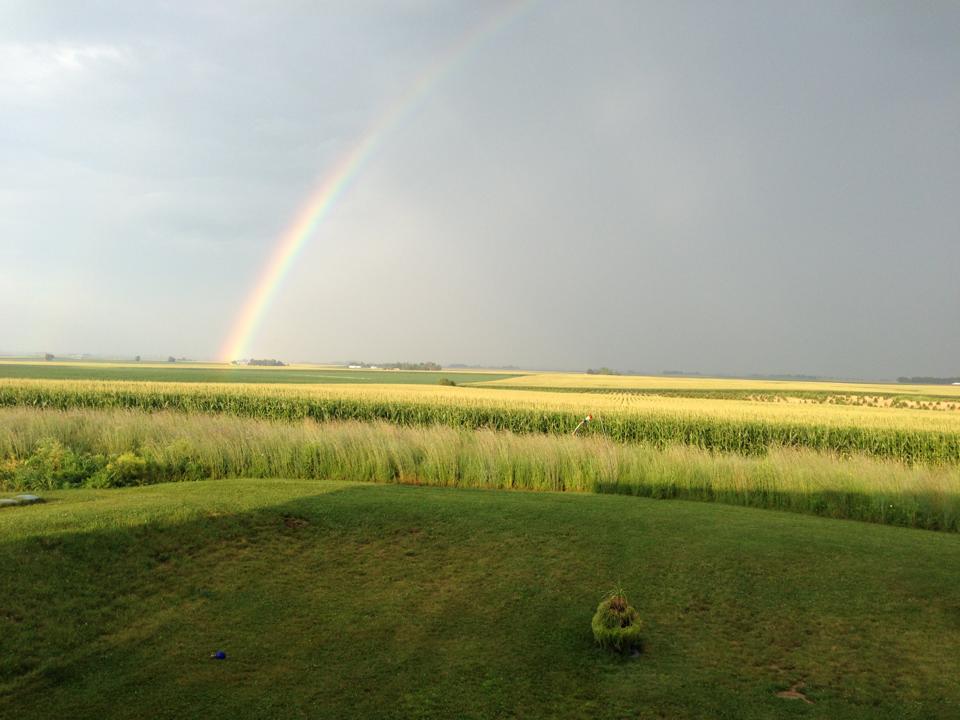
Rainbow over the IL prairie.

Rainbow over the IL prairie.

A song was singing in my head again this morning.

I don’t invite the songs. They come like old friends arriving at the door without explanation.

This morning the old friend was a Civil Rights Movement song, but I wasn’t marching.

“Woke up this morning with my mind stayed on freedom.”

The marching song my generation sang with Dr. Martin Luther King, Jr. has a different feel this morning. It feels personal. Soothing. Joyful.  Like relief. Not so much aspirational as descriptive of the less ambitious, less burdened, less anxious state that sometimes comes with age. I still pray for the greater freedom, but my step feels lighter this morning. No marching boots. No climbing boots. Just a pair of slippers to go with the freedom of retirement where aspiration for mountain-climbing surrenders to appreciation of the rainbow on the sun-lit plain.

Woke up this morning with my mind
Stayed on freedom
Woke up this morning with my mind
Stayed on freedom
Woke up this morning with my mind
Stayed on freedom
Hallelu, Hallelu, Hallelujah.

I’m walking and talking with my mind
stayed on freedom
I’m walking and talking with my mind
stayed on freedom
I’m walking and talking with my mind
stayed on freedom
Hallelu, Hallelu, Hallelujah.

Ain’t nothing wrong with my mind
Stayed on freedom
Oh, there ain’t nothing wrong with keeping my mind
Stayed on freedom
There ain’t nothing wrong with keeping your mind
Stayed on freedom
Hallelu, Hallelu, Hallelujah.

I’m singing and praying with my mind
Stayed on freedom
Yeah, I’m singing and praying with my mind
Stayed on freedom
Hallelu, Hallelu, Hallelujah.


The Meaning of Fulfillment

“At 66, I find myself feeling fulfilled. I didn’t expect this, and don’t know quite what to make of it.”

The words belong to Emily Fox Gordon in the October 25 New York Times. Click HERE to ponder “The Meaning of Fulfillment” for your life and the lives of others.

DWI Straddling the Center Line

Extra DWI Patrols this Weekend. Drive Sober. The message began to appear yesterday, Halloween, above the Interstate Highways in Minnesota.

It reminds me of a funny story.

Years ago, as my friend Ron remembers it, he and his parents were driving home from a relaxed dinner at the Nagy’s, the newly arrived Hungarian refugee family. Mr. Nagy was a gourmet chef accustomed to offering guests the best libations along with a delicious professionally prepared home-cooked meal.

Ron’s father, John, was not much of a drinker, maybe a beer once in a while, but nothing more. John got a little happy at the Nagy’s.  Driving home with young Ron in the back seat and his wife Helen in the passenger’s seat, John was straddling the center line on a two-lane, two-way street just a few blocks from home when Helen criticized his driving. Helen was a force to be reckoned with. “John! You’re drunk. You’re over the line. You’re wandering over into the wrong lane. You’re going to get us killed!”

“Helen,” said John, “it’s obvious you don’t know the law. There’s a law here in Pennsylvania. After 10:00 p.m. you can straddle the white line.”

Telling the story to my friend Steve and me last year, Ron could hardly get through the story. We’ve been friends since Kindergarten in Broomall, Pennsylvania. Today Ron is in ICU in a Pennsylvania hospital following emergency surgery straddling the center line.

Prayers surround you, Ron. I remember your story like it was yesterday.