Life begins on the other side of despair

It was Jean-Paul Sartre, the French existentialist novelist, philosopher, and playwright, who declined the Nobel Peace Price for Literature in 1964, who said it. “Life begins on the other side of despair.”

Sartre’s statement resonates with those who have stood at the edge of the abyss of the loss of life’s meaning. Some don’t make it to the other side. Some move to the other side of the abyss with no faith but faith in themselves to create meaning they once ascribed to God or some objective moral order. Others arrive on the other side with their inherited faith not only deconstructed, but re-constructed. I am one of the latter.

Reading of the shooting suicide of a 27-year-old Iraq War veteran philosophy student in the library at Mankato State University takes me back to Sartre’s statement about life and despair. Timothy Lee Anderson was an honorably discharged U.S. Army gunner in Iraq. His picture in The Daily Mail shows him in an Iraqi combat zone with his weapon. In the background of the photo, Iraqi women in traditional Muslim dress appear to be crossing the street. How, I ask, does a guy who served as a gunner in the Iraq War choose philosophy as his major when he comes home to the U.S.A.?

Philosophy is not a popular choice these days. Unlike computer science, it’s not job- related. The word ‘philosophy’ derives from two Greek words meaning love (philo) and wisdom (sophia). Philosophy is the love of, and the search for, wisdom.

Wisdom is born of experience, not inheritance. It’s not hard to imagine the dashed, unexamined, inherited convictions of a young Army recruit: a world dependent on American goodness and might; an America with a manifest destiny in the global order; an exceptional nation privileged and responsible, whether by religious or political creed, to bring its blessings to the rest of an ignorant, unenlightened, uncivilized, and sometimes terroristic and defiant world.

Nor is it hard to imagine a soldier’s despair upon return, reflecting on his experience in search of greater wisdom among the philosophers. The early reports of Timothy Lee Anderson’s life experience point to a less than comfortable homecoming with arrests for marijuana and violation of an order for protection. The gun shot he fired at himself on the second floor of the Mankato State University library was a shot of despair, whatever the immediate reasons or circumstances.

The great sorrow is a life that ended too early on the despair side of the yawning abyss of collapsed meaning. It remains to the survivors and the rest of us who look with sadness on Timothy’s tragic departure to learn that claims to religious-national exceptionalism and wisdom go together about as well as bombs and day-care, guns and libraries.

– Gordon C. Stewart, February 3, 2015.


In Memoriam: the MSU Philosophy Student

“The life of the dead is placed in the memory of the living.” – Cicero

The philosophy student who shot himself in the library at Mankato State University yesterday could have been me many years ago. Or is it “could have been ‘I’”? I or me is a question of grammar without much consequence. Philosophy is a question of meaning. Grammarians don’t shoot themselves. Some philosophers do.

I know nothing about the 27-year-old philosophy major at MSU. I don’t need to know more for tears to fall while reading the Star Tribune news report over morning coffee.

A Minnesota State University Mankato student shot and killed himself Monday afternoon in the campus library.

Police were called about 4 p.m. to the library after receiving a report of a suicidal man. After searching Memorial Library, police found the 27-year-old man, a junior philosophy student, on the second floor. Police said he turned the gun on himself and shot.

Police said no one else was in any danger during the incident.

The library was open Monday evening but with access only to the lower level, first and third floors.

I feel sick. It’s sad enough when anyone takes his or her life. It’s sadder still, at least for me, to learn that he was studying philosophy and that he appears to have found a solitary place on the second floor, perhaps among the stacks in the philosophy section of the library, as I imagine it.

He was a junior, as I was when the course in contemporary philosophy plunged me into deep despair. Psychology majors might have called it depression because it looked like that on my face. But there’s a difference between depression and existential despair.

Jean-Paul Sartre’s Being and Nothingness, No Exit and The Flies, and Franz Kafka’s Metamorphosis and The Trial were like nothing I had ever read or heard. They blew my mind to smithereens, leaving me very much alone with the sense of nothingness.

By the time I hit the books in the library that junior year, I ate, drank, and slept philosophy. Of the 18 hours of courses I had decided to carry, only the philosophy course seemed important. Raised in a Christian home, I had always prayed, more or less, giving thanks and asking for blessings on those I loved and the less fortunate. But now prayer seemed a cruel hoax, “bad faith” as Jean-Paul Sartre put it. Why I would return from class and kneel down beside my bed not for “now I lay me down to sleep” but to tell God to go to hell is one of the great ironies, a question grammarians cannot answer.  Had I had a gun that afternoon, my roommate might have found me on the floor in Room 301 of Carnegie Hall.

I know nothing of the circumstances or state of mind of the 27-year-old MSU philosophy student. Perhaps no one will ever know for sure. It may be that his experience bears little or no resemblance to mine all those years ago. It’s not for me to know.

I don’t even know your name, but I sure do feel you! And I feel for those who mourn your loss. “That God does not exist, I cannot deny,” wrote Sartre, “That my whole being cries out for God, I cannot forget” – Jean-Paul Sartre.

Almighty God, Father of mercies and giver of comfort: deal graciously, we pray, with all who mourn; that, casting all their care on You, they may know the consolation of Your love. [The Book of Common Prayer]

Rest in Peace

– Rev. Gordon C. Stewart, Chaska, Minnesota (an hour from Mankato), Feb. 3, 2015.

Preaching to Myself

The longer I live, the less I know. The less I have lived, the more I think I know.

“Knowledge puffs up; but love builds up.”(I Cor. 8:1b)

These words seem strange to those of us who value education. But peeking into the internal squabble within the First Century CE Corinthian church (First Corinthians 8:1-13) may also give us an unexpected peek into ourselves in 2015.

There is a tension between knowledge and love. The better educated among us see the relation between knowledge and love as complimentary. Love and knowledge grow together into ever expanding circles of freedom, like snakes shedding their skins and lobsters shedding their shells for bigger skins and shells that can hold their more mature selves.

Yet we are sometimes scornful of the less educated, the concrete thinkers, the legalists who are certain about what little knowledge they have. We are quick to join Paul’s opinion that “Anyone who claims to know something does not yet have the necessary knowledge ….” (I Corinthians 8:2). A little knowledge is a very dangerous thing. True education leads not only to increasing knowledge but to increasing awareness of one’s own vast ignorance.

We think of Copernicus and Galileo who challenged the prevailing knowledge, and those who judged them for their unbelief, a new “knowledge” that has changed the human view of our place in a vast, expanding universe. Or we think of Darwin and the Scopes Trial – the showdown between the knowledge of evolution and the ignorance of the creationists. We think of the difference between enlightened biblical scholarship that interprets Scripture through the eyes of love’s expansion and the biblical inerrantists who insist that the Bible be taken literally, such that the book is closed on matters of human sexuality.

“‘All of us possess knowledge.’ Knowledge puffs up; but love builds up.” 

Paul makes a masterful move here in the chess game of the knowers. He says that all the “knowers” know little, and that those who know more – the stronger in faith – are in greater danger than those who know less – the weaker in faith.

He is writing to the strong, the ones who are more advanced in the knowledge of the liberty to which Christ has set them free. “But take care that this liberty of yours does not somehow become a stumbling block to the weak.” Knowledge itself puts us on trial, the trial of humility, the trial of love. Paul calls for the stronger to be humble lest what they assume to know become the new idolatry that places Christ’s weaker followers on the cross of educated privilege.

The Christian claim of faith is not our knowledge, no matter how great or small. The claim of the disciples of Jesus is God’s knowledge of us. It is God’s knowing us that is the heart of faith for followers of the crucified, risen Christ. It is God’s knowledge -the wisdom of love – into which we are baptized as novices. One might even say, we die to every claim but love.

We are saved by grace through faith, not by works. For the likes of me and my progressive friends and colleagues in the Presbyterian Church (USA) and for members of the church who are choosing to leave the PC(USA) because of what they regard as excessive liberty, knowledge sometimes becomes the new “works” that substitute for justification by grace.

To be justified (i.e. made “right” with God) by grace through faith, as Paul understood it, represents a 180 degree repentance, a reversal of the direction and flow of the human-divine encounter from us to God to from God to us. Paul later speaks of the practical implications of love with respect to all claims of knowledge:

“And if I ….understand all mysteries and all knowledge, and if I have all faith, so as to remove mountains, but have not love, I am nothing.” (I. Co. 13:2)

“Love is patient and kind; love does not envy or boast; it his not arrogant or rude. It does not insist on its own way; it is not irritable or resentful; it does not rejoice at wrongdoing, but rejoices with the truth. Love bears all things, believes all things, hopes all things, endures all things.” (I Corinthians 4-7)

I am among those who remain puzzled by what to do. It’s far from simple. Paul’s description of the Christ-like life is centered, but it’s not simple. The patience and kindness come hard when faced with what I am sure are the weaker, more homophobic folks whose view of Scripture supports their opposition to the full inclusion of LGBTQ members. I boast of a greater knowledge based on love. In the name of love, I become arrogant. I am rude. I have a short fuse. I want to separate myself and the more enlightened from the less enlightened, the weaker, as Paul might say. In their presence I quickly become irritable, resentful of their presence in the Body of Christ. I do not bear all things. I do not believe all things, hope all things, endure all things. I do not believe that if I understand all mysteries and have all knowledge but have not love, I am nothing.

Though Paul was writing his letter to the tumultuous church at Corinth in the middle of the First Century CE, his words still speak. They arrive unexpectedly like a surgeon’s scalpel removing a cancer for the sake of the Body of Christ. The gospel cuts with a knife, but it is always for the sake of healing, a dying to ego for the sake of the resurrected Body of Christ.

Gracious Lord, by your healing mercy, keep me in the knowledge of Your love.

– Gordon C. Stewart, Sunday, Feb. 1, 2015.

My Soul Waits in Silence

A contemplative reflection on Psalm 62 at Saint Augustine Beach, Saint Augustine, FL.

For God alone my soul waits in silence, for my hope is from him. I wait in silence. [Psalm 62:5 NRSV]

I wait in silence.

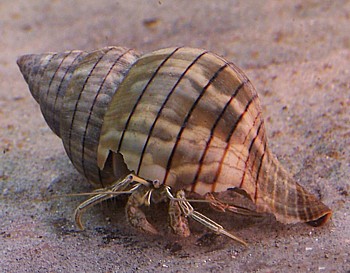
Withdrawing from the noisy men next door in Saint Augustine, I am like the Hermit Crab crawling into the borrowed snail shell on Saint Augustine Beach.

This is the same beach brave souls dared to integrate in 1964, a place where then there was no place to hide, the public white beach where the Hermit Crabs refused to hide when the billy clubs swing to drive them from the white man’s beach. There are no billy clubs on the beach today but the shouting of the world we call civilized still hurts by ears.

How long will you assail a person,
will you batter your victim, all of you,
as you would a leaning wall, a tottering fence? [Ps. 62:3 NRSV]

The world is noisy. Loud. Cacophonous. Bellowing blasts, bewailing, and bedlam in Beirut, Baghdad, and Boston hurt my ears. Hoping to leave it, I come to the beach where the tides know nothing of the color of my skin, my income, my worries or fears.

For God alone my soul waits in silence,
for my hope is from him.
He alone is my rock and my salvation,
my fortress; I shall not be shaken.
On God rests my deliverance and my honour;
my mighty rock, my refuge is in God.  [Ps. 62: 5-7 NRSV]

Hermit Crab crawling into abaondoned snail shell

Hermit Crab crawling into abaondoned snail shell

At low tide I crawl inside the borrowed shell looking for a respite from the noonday heat, my deliverance, my refuge, my fortress. But, even here, the noise follows me.

The blasts, buzzes, and bellowing echo inside the shell. Silence eludes me. Even here, I am a poor man, a mere breath, walking among the vendors and hawkers, resentful, angry, beset, a man of low estate.

Those of low estate are but a breath,
those of high estate are a delusion;
in the balances they go up;
they are together lighter than a breath.
Put no confidence in extortion,
and set no vain hopes on robbery;
if riches increase, do not set your heart on them. [Ps. 62:9-10 NRSV]

Here I am a breath stripped from the delusions of high estates indulged on the other side of the sand dunes that separate the beach from the street.

I wait in silence.

I ponder the speed outside the Hermit Crab’s temporary home, the abandoned snail shell, the speed that is itself an illusion, a flight of hubris washed away by the tides of time. I remember the race to nowhere, the myths of ownership, invulnerability, control, and superiority that race through the minds of low and high estates alike.

I hear the distant shouts and screams from the integration of Saint Augustine Beach that still plunge the despondent men next door into the oblivion of cheap booze, dope, and, maybe, crack. But the longer I wait and listen, my heart grows strangely calmer. Quieter. More at peace.

I come into the deeper Silence of the Breath once heard by the psalmist.

Once God has spoken;
twice have I heard this:
that power belongs to God,
and steadfast love belongs to you, O Lord.
For you repay to all
according to their work. [Ps. 62: 11-12 NRSV]

In the wordless silence I hear the Word I’ve come to the beach to hear:

“Be still, and know that I am God.” [Ps. 46:10 NRSV]

– Gordon C. Stewart, Saint Augustine, Florida, January 31, 2015


Basking in the Light – “What a good boy!”

Video

Apologies to you who foolishly stopped by today looking for something serious! We’ve been thinking about lesser things the last few days.

Like about cats and dogs and humans. It started with a verse from Steve Shoemaker about an old man and his dog, followed by a humorous fight between cat-lovers and dog-lovers on the social media site that begins with an ‘f’ and ends with a ‘k’. Then came Steve’s verse about his old cat, the Queen Cat, and this morning’s “Kennel-Mates, After Work” about a young Irish Wolfhound (Steve) and a tabby cat (Nadja). A few hours later the video of Sleepy Head Barclay reached us through cyberspace from back home in Minnesota.

While Kay and I are basking in the sun in St. Augustine, FL, Barclay the Soccer Dog had some quiet time this morning under an artificial SAD (“Seasonal Affect Disorder”) light back home in cold Minnesota. The voice belongs to his older sister Kristin. We’re not into philosophy, theology, politics, or global news this morning. I hope your world is lighter peeking behind the curtain of intimacy, you break into a smile for 35 seconds.

Kennel-mates, After Work

At first when they paired-off, the dog and cat
would fight when they got home from work. His bark

was silent almost the whole day, and that
made the young Irish wolfhound want to speak

so badly he would arf and yowl when she
came through the door. The tabby, though had heard

enough already, thank you, from the three
cats and five dogs in her small lab, and would

soon scratch at him “Can’t you leave me alone?!”
Their love made them negotiate, in time:

he gave her thirty minutes to wind down,
and then would softly smooth her fur… When tame,

she’d purr, and they would share their different days:
his reading, her solving squabbles between

the strange and varied, feisty animals
at work. Neither the dog nor cat was mean

at heart. There didn’t have to be a spat
each day…even between a dog and cat.

– Steve Shoemaker, Urbana, IL, Jan. 30, 2015

Ever wish you were a dog?

The voice in this video is Barclay’s favorite sister, Kristin, who’s “babysitting” while Barclay the soccer dog’s parents are away. Sometimes I wish I could turn on a dime and have this much fun entertaining myself. Listen for the “Woof!” in reply to Kristin’s “Good boy!”  We miss you, little guy!


Verse – Old Age and Dogs

When my dog’s on a trail I can’t see,
And I call him to sit by my knee,
It never takes long,
His idea is just gone,
And with age it now happens to me!

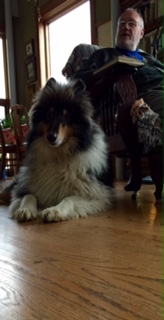
Steve and his constant companion

Steve and his constant companion

– Steve Shoemaker, Urbana, IL, Jan. 28, 2015

NOTE: Steve and Nadja’s Collie enjoys the tall fields behind the Shoemaker home on the Illinois prairie, but his ears are tuned for his tall friend’s invitation. I [Gordon] would include his name, but I’ve forgotten.


Verse – The Laundromat – Pittsboro, N.C., 1969

She was young, white, and pregnant

when they moved

south. She had worked for Civil

Rights for blacks

up north. So seeing two doors

as she faced

the laundromat obscured

the sordid facts

of legal segregation

just before.

“Oh please, Ma’am, take your clothes

over next door,”

the old black woman said.

“Will you have trouble

if I stay?” “Please, Ma’am,

do as I say…”

The young woman had not

heard “Ma’am” before

from someone older, so

she turned her face —

embarrassed for her race –

and went next door.

– Steve Shoemaker, Urbana, IL, Jan. 27, 2015

NOTE: While working on a Ph.D. in Religion at Duke University, Steve pastored two yoked Presbyterian Churches: the 88 member Pittsboro, N.C., (pop. 1,500 then), and Mt. Vernon Springs (55? members) 30 miles west in rural Chatham County. Nadja drove from the Manse in Pittsboro 30 miles north to do Microbiology research at Duke. Son Daniel was born in March, 1970.

Keystone XL Pipeline and Prairie Roots

The Keystone XL pipeline is more than a pipeline. It’s a rich man’s pipe dream that calls to mind an alternate view of reality itself: the psalmist’s tree with deep roots planted by the rivers of waters. Poets speak truth.

Blessed is the man
who walks not in the counsel of the wicked,
nor stands in the way of sinners,
nor sits in the seat of scoffers;
but his delight is in the law of the Lord,
and on his law he meditates day and night.
He is like ia tree
planted by streams of water
that yields its fruit in its season,
and its leaf does not wither.
In all that he does, he prospers.
The wicked are not so,
but are like chaff that the wind drives away.

– Psalm 1, ESV Bible

Say no to Keystone! Say it for the prairie. Say it for water. Say it for yourself. It’s good for big oil. Good for Congressional Representatives and Senators funded by big oil and and big money. Bad for the environment. Bad for national and global policy shift to renewable sources of energy. The Keystone XL lobby is, in the long run, like chaff which the wind drives away. Let the people say, “Amen!”