Me: God, Why?
God: No, I ask the questions…
Me: Ok, what are your questions?
God: Don’t ask.
- Steve Shoemaker, from Mayo Clinic, Rochester, MN, Dec. 5, 2015

Me: God, Why?
God: No, I ask the questions…
Me: Ok, what are your questions?
God: Don’t ask.
How many people have to die before we get it? Howard Beale captures the feeling following the San Bernardino shooting and all the massacres that came before it:
Isn’t it time we had a reasonable conversation about what the Second Amendment meant by “arms”? The strictest constitutional interpretation would lead in one of two directions: 1) every citizen has a right to a single shot rifle, or 2) every citizen has a right to “arms” — as in the weapons of war, like the bombs that failed to detonate in San Bernadino.
How many people have to die before….?
Thanks to the Chaska Herald for publishing this Opinion commenary last Thursday in advance of the grand opening of Chaska’s redeveloped site, a source of contention and controversy.
PARK PERCEPTION VERSUS REALITY by Gordon Stewart
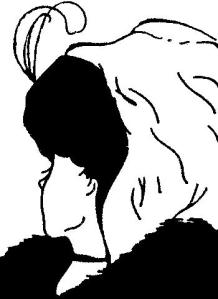
“Illusion”- W. E. Hill
Wednesday, Dec. 2 — after a hard public debate over Fireman’s Park — the newly developed site, with its event center, curling center, Crooked Pint Ale House, and redeveloped park will open its doors to a divided public.
They say perception is nine-tenths of reality. Listening to the public discussion about redevelopment over the past few years, the old adage helps explain the differences in how various Chaska residents view Chaska’s most prominent street corner.
In teaching psychology, a particular drawing of a woman is used to illustrate the power of perception. Every member of the class is asked to look at the same picture. Some see the beautiful face of a young woman wearing a fancy hat with a plume. Others see a mean old woman with an enormous chin and the kind of nose that belongs next to a witch’s brew in fairy tales.
How could different people see the same reality so differently? Or were they seeing different realities? Some who saw the beautiful young woman could not perceive the old woman. Likewise, those who saw the mean old woman could not see the beautiful young woman. Objectively speaking, both women were in the picture waiting to be perceived.
What we see is shaped by memory and experience.
During the debate before the final decision on its redevelopment, many of us perceived the corner as a beautiful park under assault. The memory was of a pristine Firemen’s Park, a lovely open-space created in honor of Chaska’s firemen, green space surrounding the historic clayhole. It was where we went as children or teenagers to swim, fish, or enjoy a family picnic.
Others had a different impression of the corner. Our memory was the truck manufacturer that stood on the corner, an eyesore that struck visitors more like the witch in the psychology class picture. Passersby did not see a beautiful park or green space; they saw a site with no aesthetic sensibility. It was not a corner to be proud of, and it had nothing to do with Firemen’s Park.
No one seems to have remembered what the corner looked like 10 years ago. It would be hard for anyone to look at that the corner of Highway 41 and Chaska Boulevard and say it was beautiful.
Reality may be nine-tenths perception. But the other one-tenths also counts. Sometimes the buried memory lies in the one-tenth we don’t recall.
One of my first days in Chaska in 2006 I stopped in at the downtown Dunn Bros for a cup of coffee. I asked the young person behind the counter to tell me about Chaska. “Which Chaska?” he replied. “Old Chaska or new Chaska?” I was surprised; I didn’t know there were two. He explained that I was in old Chaska; new Chaska was up the hill.
In American general perception — sad though it may be — new means young and vibrant, like the beautiful young woman. Old means over-the-hill and dying.
All across America, downtowns are either crumbling with boarded-up businesses or they are being successfully redeveloped to preserve, re-populate, and energize them in ways that overcome the old-new divide.
The promise of the new site is that younger people from far and wide will be drawn by its beauty for curling, a pint of ale and a hamburger with a beautiful view of the clayhole, maybe a fishing rod, and a stroll on the new walkways around the old park.
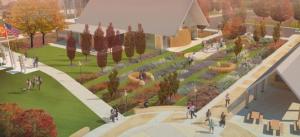
Chaska redevelopment at corner of Chaska Blvd. and State Highway 41
As one of Chaska’s more un-athletic residents, older in age but newer to the city, I’ll be there Wednesday, where the forgotten eyesore stood, to learn a new sport that won’t threaten my health and celebrate the renewed promise of a thriving “old Chaska.”
“Our Call to Support Refugees from Syria and the World”
NOTE: Views from the Edge has added colored highlights to the text.
Presbyterian Church (U.S.A.) congregations have supported refugee resettlement since the refugee crisis created by World War II. The 160th General Assembly (1948) of the Presbyterian Church in the United States of America stated, “The United States should pass legislation to bring in at least four hundred thousand displaced persons during the next four years. … As they arrive, our church people should stand ready to open their homes and provide work for these unfortunate victims of war” (Minutes, PCUSA, 1948, Part I, p. 204). The people from the pews who approved that policy did so because they knew that scripture calls us to shelter the homeless (Isaiah 58:6–12) and welcome the stranger (Matthew 25:31–46).
The call is no less necessary today. Nearly 60 million people are displaced by war and persecution; 30 million of those displaced are children (UNHCR). The crisis in Syria alone has displaced 11 million (UNHCR). Families are risking their lives and fleeing their homes to seek safety. They are spending months journeying, sleeping outside, paying smugglers for safe passage, and praying for a future for their families in a place that is safe from conflict.
They fear and flee many of the organizations that we also fear: ISIS, Boko Haram, Mara 18, Los Zetas. Right now governors are attempting to block the resettlement of Syrian refugees into their states because members of ISIS are sometimes Syrian. Ask yourself, should a victim’s shared nationality with perpetrators of violence exclude them from protection in this country?
Entering the U.S. as a refugee is not a quick or easy process. Refugees are the single-most scrutinized migrant group to enter the U.S. They undergo rigorous screening by multiple security agencies at multiple times during their pre-arrival processing (U.S. Committee for Refugees and Immigrants). This process can take more than two years. Once they arrive in the United States, they continue to be screened every time they leave and reenter the country and when they apply for employment cards, green cards, or naturalization.
The risk is low and the humanitarian need is great. While, technically, governors cannot dictate where the federal government resettles refugees, the State Department only resettles refugees in areas where they know communities will thrive (USA Today). Governors are saying for their states, “No room at this inn.” Now is the time for the faith community to speak up on behalf of refugees, from all countries. Do not let the noise of a fearful few drown out compassion, facts, and logic. Answer the call to act prayerfully and recommit as an individual, congregation, or mid council through co-sponsorship, volunteer hours, and donations through your local resettlement agencies. Then send or personally deliver a letter, like the one at pcusa.org/immigration, to your governor about the kind of society we should be. If you personally deliver your letter, please take photos and post on Facebook and Twitter using the hashtags #ChooseWelcome and #RefugeesWelcome. …. Thank you!
The front page of today’s Champaign-Urbana News-Gazette carries a feature article on Steve Shoemaker, as in Views from the Edge with Gordon and Steve. This photo of “Welcome the Stranger” includes a note from Steve’s daughter, one in which Steve’s friends heartily concur.

Steve Shoemaker: “Welcome the Stranger”
What would happen if the children wrote all the prayers? Children age 3 through 5th Grade at Trinity Episcopal wrote The Prayers of the People used in worship the last few weeks. Each prayer was followed by a brief reflective silence. One of the children led the prayers.
Let us pray for our neighbors and our neighborhood.
Let us pray for our families and friends: our mommies and daddies, our grandparents and great-grandparents.
Let us pray for the world and the universes.
Let us pray for our pets and the animals of the world: Millie, Cokie, puppies and cats.
Let us pray for those who have illnesses, our sick grandparents, heart disease, cancer, and memory loss.
Let us pray for those going through rough times, mentally and physically.
Let us pray for those who have died everywhere and those who have died that are close to us.
Let us pray for everyone.
[The Prayers of the People concluded with a prayer written by the priest who works with these little ones:]
Holy and gracious God, we are too often blinded by trivial matters. May our attention be diverted now from these things, and may we become as little children, trusting and seeking with love to cross bridges we have not crossed in the past.
Amen!

Statue of Liberty, NY, NY
“Send these, the homeless, tempest-tossed to me, I lift my lamp beside the golden door!” – Emma Lazarus, Jewish American author; inscription, Statue of Liberty, New York, New York
“Send these, the [Christian] homeless, tempest tossed to me, I lift my lamp beside the golden door!” – Sen. Ted Cruz
Click “Ted Cruz’s Religious Test for Syrian Refugees” for Amy Davidson’s November 16 article in The New Yorker.
While the world holds its breath after the attacks in Paris, we’ve searched for hymns that express in music a word worth hearing.
“O God of Earth and Altar” expresses a sense of prayerful resilience and supplication.The lyrics, written by G.K. Chesterton in 1906, were revised, in part, by Jane Parker Huber to address global terrorism:
“From all that terror teaches, From lies of pen and voice, From all the easy speeches That make our hearts rejoice, From sale and profanation of honor and the sword, from sleep and from damnation, deliver us, good Lord.”
Already U.S. governors have made “easy speeches” about not accepting any Syrian refugees in their states, although it is not within their jurisdiction to decide. And, while we pray, the arms industry is preying on war’s alarms to increase production, sales and profits in the name of our safety and security.
Here’s “O God of Earth and Altar” sung to Chesterton’s original lyrics.
News from Paris and Beirut reminds us of the history of Lac qui Parle, the Dakota Creation Song, that still speaks hope to a violent world. Thirty-eight Dakota men sang it in its original Dakota language – Wakantanka taku nitawu – before their executioners took them to the gallows in Mankato, MN in 1862. The threat of death did not deter them from affirming the goodness of creation.
“Many and great, O God, are Thy things, Maker of Earth and Sky; Thy hands have set the heavens with stars, Thy fingers spread the mountains and plains. Lo, at Thy word, the waters were formed; Deep seas obey Thy voice
“Grant unto us communion with Thee, Thou star-abiding One; Come unto us and dwell with us: With Thee are found the gifts of life. Bless us with life that has no end, Eternal life with Thee.
[Joseph R. Renville, Dakota, 1842; paraphrased translation, R. Philip Frazier, 1929 and 1953]
 Views from the Edge