Surreptitious Illegal Activity

Featured

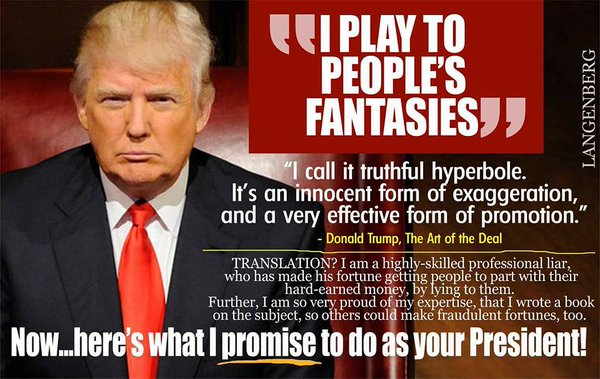
The terroristic threats of Ms. Ruby Freeman and her daughter, Wandrea “Shaye” Moss, in Fulton County, Georgia did not come directly from Rudy Giuliani. “America’s Mayor” of 9/11 fame did not tell anyone in particular to do anything in any particular way at any particular time or place. He neither directed nor suggested the phone calls, emails, and text messages that threatened the two Georgia election workers he claimed were “surreptitiously passing around USB ports as if they’re vials of heroin or cocaine.” They were “engaged in surreptitious illegal activity.”

Stochastic Terrorism

“Proud Boys, if you’re listening, stay back and stand down.” The Proud Boys and the Oath Keepers stayed back and stood down until the president’s tweet invited patriotic American to the Capitol January 6 to “Stop the Steal”. “Be there! It will be wild!” 

“There’s a lot of people here willing to take orders. If the orders are given, the people will rise up.” “Our president wants us here,” says a man from a livestream video standing within the Capitol building, “we wait and take orders from our president.’” “We have to have peace,” says President Trump to the January 6 marauders, “So go home, we love you, you’re very special.”

Ego and Dominance

Featured

Like weaker gorillas dominated by the latest chest-thumper, we keep doing it. Chest-pounding is part of gorilla culture. It’s just the way gorillas are. It’s a way they communicate to maintain order in a family. It’s in their DNA.

Looking at us in 2023, I wonder whether human beings are much different.

Chest-thiumping

What’s “this”?

Hearing a U.S. Senator declare “We can’t allow this to stand!” following Special Counsel Jack Smith’s announcement of the DOJ indictment of the former U.S. president, one might think that the thing which “we can’t allow to stand” referred to the alleged criminal behavior for which Mr.Trump’s has been charged.

But that’s not the “this” (the thing we cannot allow to stand). It was, as Mr. Hawley saw it, the continuing investigations and indictments, the prosecutions that are persecuting the leader of his party.

Questions

The questions are farther reaching than how and why a U.S. Senator and Officer of the Court, sworn by oath to uphold the rule of law and the U.S. Constitution, would disparage the judicial system which is exercising its duty to the Constitution. The more vexing question is how and why so many American citizens concur with Mr. Hawley.

No Time to Waste

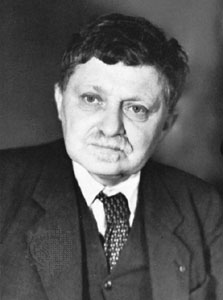
Psychologists, sociologists, and historians will offer a variety of insights for decades yet to come, but some of us can’t wait that long. I turn to historians, analytical philosophers, and theologians who have sought to understand the dynamics of illusion, anxiety, fear, and collective madness. Among them are Gabriel Marcel and Willem Zuurdeeg. Each sought for understanding during a chest-pounding momenet.

Gabriel (-Honoré) Marcel and Willam Zuurdeeg

Gabriel (-Honoré) Marcel (1889–1973), the French existentialist philosopher, playwright, and author of Homo Viator, Being and Having, and The Mystery of Being, proposes a dist between the self as ego and the self as person. The self as ego is a poseur, an actor, performing on stage, playing to the audience among whom the poseur himself is the central figure.

“I attract the attention of others so that they may praise me, maybe, or blame me, but at all events that they may notice me. In every case, I produce myself.”

Gabriel Marcel

Whereas, for the ego, other people exist as a mirror of one’s greatness, a person sees others of value in and of themselves. The ego sees others as objects to be manipulated; the person sees others as she has come to understand herself as responsible and accountable in a community.

Beyond the reach

Philosopher of Religion Willem Zuurdeeg reminds us of Marcel’s warning against identifying ego with evil and personhood with goodness. So long as the ego remains shut up in itself as the prisoner of its own feelings, desires, fears and anxiety, it is beyond the reach of evil as wall as good. It is not yet awake to reality. “There is no doubt that direct judgment cannot be applied to such beings,” says Zuurdeeg.

Like Sleepwalkers

Marcel goes on to say what none of us wants to hear. “Each of us, in a considerable part of his [one’s] life, is still unawakened, that is to say that he (sic) moves on the margin of reality like a sleepwalker.”

Beside the Wetland Pond

Featured

Getting up at the break of day is not unusual. I get dressed and take the steps down from the loft to make the coffee. But this daybreak was different. Through the window of the A-frame cabin loft, I catch sight of the tops of two long white necks. I rush to the window to see a Trumpeter Swan pen and cob…and six cygnets parading across the yard. The next day they were nowhere to be found.


Below the Window

morning with the swans, GCS, May 24, 2023

slender snow-white necks
pass below the window of
the a-frame next to the 
wetland pond where the
trumpeter swans build their
borning home each year
while the red-wing blackbirds 
feast on cotton-candy puffs
the cat’n-nine-tails serve
for breakfast each spring
and the loons dive and
rise to feed their young by 
the land we think we own.

no “no trespassing” signs
mark the land where the two-
leggeds come when the 
Illusion of meta-verses 
where wetlands never shrink 
or die leave us yearning for 
this wondrous place where a 
trumpeter swan pen and cob
proudly march their young 
across the dmz between reality
and madness craning their 
necks to guard their cygnets 
from the two-leggeds looking
through the lofty windows.

Puff

the day after, GCS, March 25, 2023

there was no parade today
below the windows — no cob
or pen, no line of six cygnet
trumpeter swans — on our
side of the dmz, not a feather
left behind. An early morning
mournful loon cry warbles
across the pond a psalmic 
lament for the soul-mates who
return each year to build a nest 
to hatch and train the next 
newborn from primordial depths.

far from the wrecks of time where
drones with artificial intelligence
bulls-eyes drive the world insane —
perhaps somewhere in moscow 
or miami a strong-man thirsts for 
a place like this where cygnets,
cobs and pens play by the wetland 
no one owns where instead of 
drones with eyes that cannot not see -- 
no bully or bomb breaks the hush
when the red-wing blackbirds 
swoop and sing an ode to joy.

Gordon C. Stewart, author of Be Still! Departure from Collective Madness (2017, Wipf and Stock), 49 brief meditations on faith, life, and the news; July 24, 2023.

The American Future

Featured

On his way to the Theatre of Pompey, where he would be assassinated, a haughty Julius Caesar passes the seer who had warned him that harm would come to him on the Ides of March. “Well, the Ides of March are come,” says Caesar, mocking the seer. “Aye, they are come,” says the seer, “but they are not gone.”

By the end of the Ides of March in 44 BCE, Caesar’s power over the Roman Republic had come to a cruel end at the hands of the Roman Senate. Although the GOP would have us believe otherwise, Tuesday’s federal indictment of former president Donald Trump was not an assassination. It was a day of accountability under the rule of law. Caesar’s voice fell silent. Donald Trump’s has not.

Of characters without character

It was miraculous. It was almost no trick at all…to turn vice into virtue and slander into truth, impotence into abstinence, arrogance into humility, plunder into philanthropy, thievery into honor, blasphemy into wisdom, brutality into patriotism, and sadism into justice. Anybody could do it; it required no brains at all. It merely required no character.

Joseph Heller, Catch-22

Conversing with Milo

“Will you commit tonight to accepting the results of the 2024 election?” asked the CNN town hall moderator, Kaitlan Collins. “Yes, if I think it’s an honest election, absolutely, I would.” Moderator follow-up: “Will you commit to accepting the results of the election regardless of the outcome?” Answer: “Do you want me to answer it again? If I think it’s an honest election, I would be honored to. And, right now, we are so far ahead of both Democrat and Republican. And you know what? If I don’t win, this country is going to be in big trouble. It’s so sad to see what’s happening.”

“If I think…

“If I think…” is not new. One expects to hear such “ifs” in the lock-down hospitals for the criminally insane, or in the fiction section of the library. Decades of serving churches and a public defense law office brought me face-to-face with the likes of Milo Minderbender. None of them had access to nuclear codes. These patients created their own worlds, but they lived within confined quarters in the real world. Aside from the nuclear codes, former daily national security briefings, command of the global spotlight, wealth, lawyers, multiple playmates, Donald Trump seems undistinguished from similar souls suffering from the worlds in their heads. He is its center. His wants, wishes, and desires —and his alone — define reality. He is, in fact, the weak man, the needy man, the sick man who puffs himself up to as a “man’s man,” the Strong Man with authority to separate truth and falsehood, good and evil. He is the star who can do whatever he wants — in a lingerie section of an upscale department store, on an airplane, or in a Moscow hotel suite— whose charm persuades masses of people that January 6 insurrectionists are patriots deserving of pardon.

“Hell rages round us” — Paul Tillich then and now

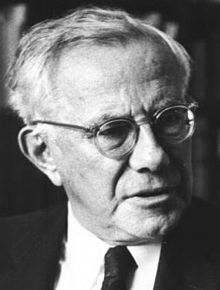
“Hell rages round us. It’s unimaginable!” wrote a young German Army chaplain in a letter to his father from the trenches of Verdun during World War I. “It’s unimaginable.” The young chaplain was Paul Tillich. During the Nazi party rise to power, Tillich served as Professor of Philosophy at University of Frankfort.

On April 13, 1933 — 10 weeks after Adolf Hitler became Chancellor —Tillich was among the first professors ousted from their teaching positions as “enemies of the Reich.”From that time forward, Tillich made his mark on American cultural history with teaching positions at Union Theological Seminary in New York City, Harvard, and the University of Chicago. His descriptions of sin as hubris and as estrangement led Time magazine to feature him on its cover in 1959. Paul Tillich left the world more than a memory or a legacy. His legacy has fresh legs. It walks the streets of the estranged nation America has become.

The cuckoo’s nest: 2023 and 1933

Hell again rages around us in ways once considered unimaginable. No two historical circumstances are identical, but some moments in time bear an uncanny resemblance. The social, cultural, political, economic, spiritual estrangement is as much the challenge now as it was when a deranged Strongman turned Germany into a cuckoo’s nest where morning becomes night, the yearning for the good is twisted into evil, where the fear of death turns life into stone, reality into delusion, faith into demagoguery, courage into cowardice, capacity into carnage.

Shakespeare and One Flew Over the Cuckoo’s Nest

“When Shakespeare was writing,” said Ken Kesey of One Flew Over the Cuckoo’s Nest, “he wasn’t writing for stuff to lie on the page; it was supposed to get up and move around.” The Ides of March are come and gone. It’s June now. The Ides of June are come…but they are not gone.

Gordon C. Stewart, Be Still! Departure from Collective Madness (2017 Wipf and Stock), 49 brief commentaries on faith and the news; Brooklyn Park, MN; June 15, 2023, the Ides of June.

An Old Parable too Fresh for Comfort

Featured

Confused and confusing

My head is swirling. I can’t keep up. My relationship with the news is like my 17 year-old son’s description of an older married couple he’d just met: “She’s confused, and he’s confusing.” The world is confusing, I’m confused, and it’s about to get worse. Macular degeneration has not yet affected my reading, but, according to my ophthalmologist, it likely won’t be long before I’ll need new glasses.

To see more clearly

For just as eyes, when dimmed with age or weakness or by some other defect, unless aided by spectacles, discern nothing distinctly; so, such is our feebleness, unless Scripture guides us in seeking God, we are immediately confused. — 16th Century CE French reformer Jean Calvin.

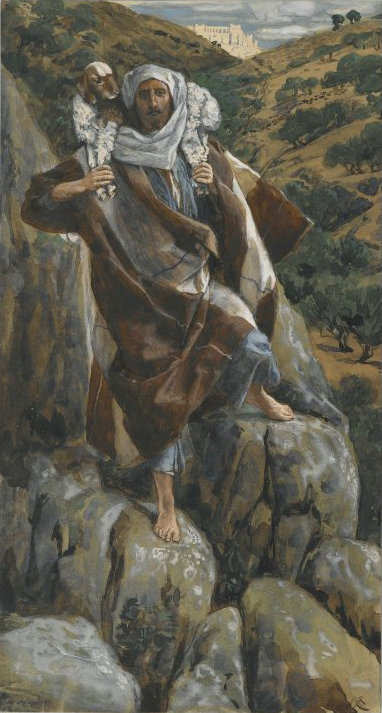
The parable of the sheep, the shepherd, thieves and bandits provides a way of looking at what is happening now, as well as then. Jesus’ parables exceed the boundaries of time and place. 

Very truly, I tell you, anyone who does not enter the sheepfold by the gate but climbs in by another way is a thief and a bandit (John 10:1).

Very truly, I tell you…

The introduction to the parable, “Very truly, I tell you,” commands my attention. Truth has fallen out of favor. Falsehood is in vogue. To tell the truth is suspect. If  honesty prevailed in 2023, many leaders would begin, “Very falsely, I tell you,” before they set off to undermine truth with self-serving partisan speeches, rallies, alternative facts, and agendas.

The Shepherd, thieves, and insurrectionists

The circumstances in which these words are addressed are much like our own. Parables are like that. They exceed the boundaries of time and place. The sheep (people) are threatened by religious leaders (thieves) who have twisted their faith traditions, on the one hand, and bandits (armed nationalist insurrectionists), on the other. Both thieves and bandits are climbing over the stone wall into the sheepfold. The words κλεπτης (thief) and ληστης (robber, brigand, bandit) call for deeper understanding. English translations — “thief” and “robbers” — appear to be a needless repetition, but they are not the same. The κλεπτης  is a thief; the ληστης is an insurrectionist.

The Thief

The thief is a burglar, a bad shepherd. Fourth Ezra, a non-canonical work of the second century CE, catches the sense of it. “Do not desert us [the sheep] as a shepherd does [who leaves] his flock in the power of harmful wolves.” The thief in Jesus parable robs the people’s sacred tradition in collusion with the occupying power, the wolf, the Roman empire. When Jesus  drives the moneychangers from the Temple, his fury is with the deeper theft— the robbery of the people’s sacred tradition. “Get them out of here! Stop turning my Father’s house into a house of trade!” (John 2:16)

The bandit

The bandit is different from the thief. The ληστης is not a κλεπτης ! The thief (κλεπτης) is malleable. He adapts, as circumstances require. That bandit (ληστης)  does not. The last thing a kleptomaniac wants is a ruckus! That bandit (ληστης) makes a ruckus. The ληστης is armed and dangerous, ready to do whatever it may take to get his country back.

The one who enters by the gate is the shepherd of the sheep. The sheep hear his voice. He calls his own sheep by name and leads them out. When he has brought out all his own, he goes ahead of them, and the sheep follow him because they know his voice.

Reckless assumptions

A shepherd’s voice is calm. Its assuring tone and cadence allay anxiety, fear, and panic. The sheep expect a thief or bandit to climb over the wall at night or in broad daylight. They will see it with their eyes and hear it with their own ears. 

They will not follow a stranger, but they will run from him because they do not know the voice of strangers.

But what if the stranger impersonates the shepherd’s voice? What if the sheep do not hear the difference between the shepherd’s voice and the imitative voice? What if the shepherd has been away? What if anxiety dulls the flock’s hearing and clouds its vision, such that the desire for security weakens its defenses against impostors? What if they mistake the thief (κλεπτης) for the good shepherd who enters, and leads them out, through the gate?

The thief comes only to steal, slaughter, and destroy. I came that they may have life and have it abundantly. (Jn. 10:10, NRSVA)

Penultimate thoughts

Although, with age, my eyesight is dimming, my knowledge antiquated, and my soul heavy with weakness and defect, an old pair of spectacles helps me see more clearly beneath and beyond the dazzling displays of wealth and power. I’m stunned that we can be so foolish, but I’m not shocked. The parable of the Good Shepherd zooms in on reality. It leaves me asking who I will follow before all goes dark.

Most disturbing to this old preacher are clergy colleagues who, laying aside their spectacles, on Palm Sundays, lead anxious, fearful flocks in the parade, waving palm branches for Barabbas (Bar [Son] of Abba [Father]), the alternative savior thief and insurrectionist who swears he’s been robbed.

No one can serve two masters. Either you will hate the one and love the other, or you will be loyal to the one and have contempt for the other. You cannot serve God and wealth. (Matthew 6:24, CEB)
Gordon C. Stewart, Be Still! Departure from Collective Madness (2017, Wipf and Stock), 49 short essays on faith and the news; Brooklyn Park, MN, May 2, 2023.

“Liar! Liar! Pants on Fire!”

Featured

Same day — different field trips

The day Congressman Jim Jordan took his House Judiciary Committee on a field trip to NYC, Elijah’s kindergarten teacher took the five year-olds on a field trip to the Science Museum in Saint Paul, Minnesota. Mr. Jordan’s committee went to NYC to hold a “field hearing” to expose the failure of the “pro-crime, anti-victim” policies of Democrats like Manhattan District Attorney Alvin Bragg. Elijah’s kindergarten class rode a school bus without the federal law enforcement that protects congressional committee field hearings.

Different daily drills

The visit to the Science Museum meant time out from the daily safety drills that prepare the kindergartners for what to do when a shooter shows up at their school. Mr. Jordan and his committee didn’t take a break from practicing their daily rope-a-dope drill of how to evade responsibility for the guns that are sending kids on a one way trip to the morgue.

Photo of message to parents during Uvalde school shooting
Message to Robb Elementary School parents of students several hours following the shooting.

Body language: pants on fire

Mr. Jordan’s conflicting answers to the repeated question whether and when he talked with the president on Jan. 6, 2021 are captured in this video. Watch the body language that accompanies his words.

CNN post showing Rep. Jim Jordan’s differing answers about the January 6, 2021 insurrection

Under ordinary circumstances, Jim Jordan fires words at the pace of an AR-15 magazine. The Jim Jordan we see in this video stammered, and his stammering was accompanied by something I found more telling — his body language. He was hitching his pants up.

Promoting a radical political agenda

New York City “has lost its way when it comes to fighting crime and upholding the law. Here in Manhattan, the scales of Justice are weighted down by politics. For the district attorney justice isn’t blind — it’s about advancing opportunities to promote a political agenda — a radical political agenda.”

Rep. Jim Jordan, Chair of US House of Representatives Judiciary Committee

Getting it right while getting it wrong

Mr. Jordan got it wrong. NYC’s crime rate is lower than most other American cities. It is also, however, the city whose district attorney, Alvin Bragg, had just indicted Donald Trump on 34 criminal counts for lying about not keeping his pants up.

But Mr. Jordan also got it right. His accusations of others describe himself and his party. He and the Judiciary Committee had travelled to NYC to promote their own political agenda — a radical political agenda — the conspiracy of power that lit the match of the January 6 insurrection and “the Big Lie” that never dies.

Gordon C. Stewart, Be Still! Departure from Collective Madness (2017 Wipf and Stock), 49 brief (2-4 pages) commentaries on faith and life; Brooklyn Park, MN, April 28, 2023.

Two Personal Reflections on Despair and Faith

Featured

This post comes in two parts. The first was written Holy Saturday (the day between Good Friday and Easter); the second was written yesterday, the second Sunday of Easter.

The Silence of Holy Saturday

Everything falls into silence today. Jesus is crucified, dead, and buried behind the heavy rock of a borrowed tomb. Armed guards stand on either side of the stone that secures the tomb; the governor’s seal — the occupying empire’s official seal —warns against tampering with this tomb. The seal is unbroken; everything else is broken.

Holy Saturday is the day after the victory of death on the Hill of Skulls. There is no Easter. No reason to trust that the clouds will blow over, the sun shine through, the shivering stop. Life is frozen stiff. Only the loneliness within my frozen self remains.

To protect themselves against the fear of death, two bullies twist truth into lies, and station their guards to keep the rock in place and the seal unbroken. The piercing of his side; thorns cutting into his skull; the ridicule of vision; the soldiers’ taunts to come down to prove he is the king he never claimed to be; the cynic-sneer that takes the place of innocence; the barren blindness to what was once my sense of beauty; the indictment of hope and trust; the gnarling of beauty, truth, and goodness into tangled knots that are neither truthful nor social, hammer in my head from Moscow, Mar-a-Lago, and now from the state house of Tennessee.

My soul is not still today. The stone has not been moved. The seal stays put. Only Pilate’s questions and sneer remain:”So you’re a king!” “What is truth?”

Thomas and his Twin

I’m a lot like Thomas. Neither of us was there to verify what others told us. We were not in the room when the others reported that the crucified Jesus had come through their locked door. Thomas wasn’t into ghosts. Neither am I. Although my grandmother claimed the old house on Church Lane was haunted by a previous resident named ‘Gus’, and although I often heard the creaking steps outside my bedroom, I’ve always been like Thomas. I’ve never believed in Gus or the Jesus-ghost other apostles say they’d seen and heard.

My Holy Saturday experience this year was just my latest recurring argument with my grandmother and with the surviving apostles who made up fairytales to keep us from doing what Judas did when despair and guilt overwhelmed him.

I like fairytales. I love Wendy, Peter Pan, and Tinker Bell, but I don’t confuse them with the way things are. Neither Wendy’s wand or Jiminy Cricket could wish upon a star and make the Pied Piper drop by Gus’s house to rid the rats that scampered through the walls at night.
This year reminded me of that; it’s the year of the rats, another year of the plague with no Pied Piper to lead the rats out of town. In 2023, there is no longer anywhere that is out of town.

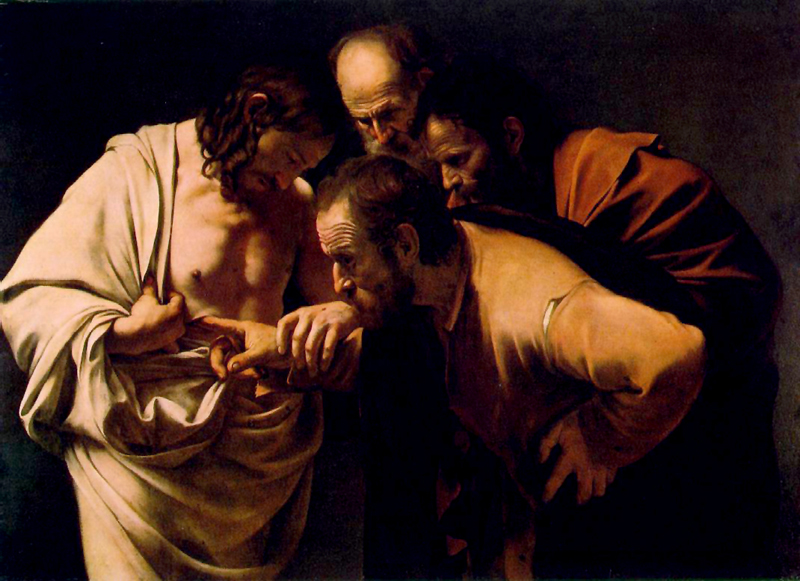
Thomas is called ‘The Twin’ with no further explanation or elaboration. People of my ilk carry Thomas’ DNA! We’re Thomas’ identical twin. When Thomas arrives at the upper room to join the other surviving apostles, a week has passed. The difference between Thomas and Judas is that despair has not yet severed Thomas’ sense of connection. Loneliness, not belief, drives him back to what remains of his circle of friends. All hope is gone for Thomas. There is only the grieving: the sounds of nails being driven into Jesus’ hands, the horror of a soldier thrusting a spear into his side, the shouts of mockery and insult, his final declaration that it was over. His Lord is dead and buried, never to return. His friends have told him that things are not as they seem. The rock, they said, had been rolled back, the imperial seal broken, the guards lay on the ground like dead men, an encounter with Mary as a gardener, instruction to meet him in Galilee. All of it a fairytale!

The Incredulity of Thomas – Carravagio

“Put your finger here; reach out your hand”

What happens to Thomas and others like him is more tangible than magic wands and pixie dust. “Put your finger here and see my hands. Reach out your hand and throw it into my side” is not an ethereal invitation. To be a disciple of Jesus means not only to see and hear, but to touch his physical wounds. The new community is born of his wounds and their transformation, commanded to throw ourselves into the sufferings and open wounds from which blood and water still flow. Resurrection is not pixie dust.

In the world it is called Tolerance, but in hell it is called Despair…the sin that believes in nothing, cares for nothing, seeks to know nothing, interferes with nothing, enjoys nothing, hates nothing, finds purpose in nothing, lives for nothing, and remains alive because there is nothing for which it will die.

Dorothy Sayers

Gordon C. Stewart, Be Still! Departure from Collective Madness (2017, Wipf and Stock), 49 short meditations on faith and the news; Brooklyn Park, MN, Second Sunday of Easter, April 16, 2023

Are you a king?

Featured

Parody and paradox

Over the years, every Palm Sunday has spoken in ways I did not expect. Today is no different. I no longer fixate on the question whether Palm Sunday happened or is the narrative artistry of Gospel writers. That question no longer interests me. Whether an historical event, or the Gospel writers’ way of looking back on who Jesus was and is, the entry into Jerusalem is filled with parody and paradox. While Caesar’s troops ride into Jerusalem on tall white stallions, Jesus rides in on a donkey as a crowd welcomes his coming with palm branches, the symbol of Jewish resistance to Roman occupation. They are looking for the long-awaited king, the Messiah, who would put an end to national humiliation by a foreign occupation. Jesus was the warrior-king whose purpose was to restore the nation’s glory.

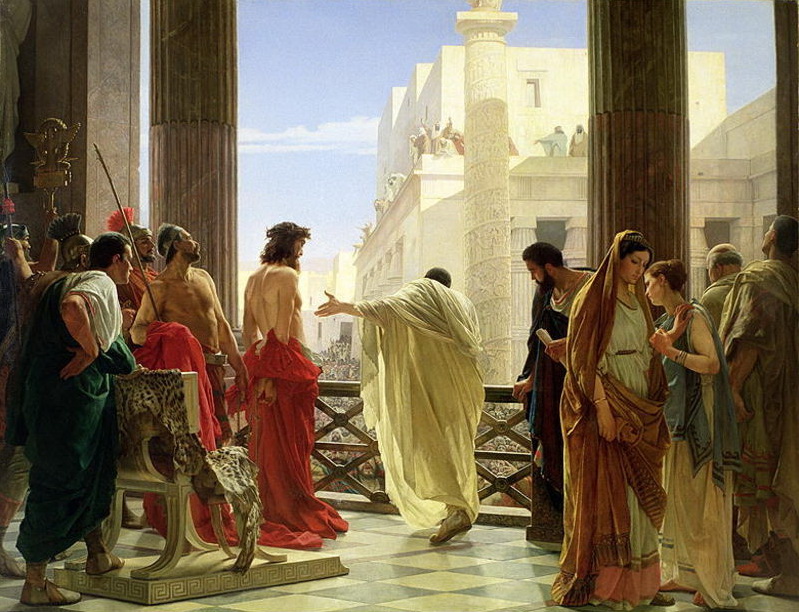
Pontius Pilate with his Prisoner - Antonio Ciseri
Ecce homo – “Here is the man”

This year, Palm Sunday drew me to Jesus standing before Pilate. “Are you a king, then?” or “So, you are a king, then!” begs the question of Jesus’ understanding of himself. Jesus’ response is as paradoxical as his ride into Jerusalem: “You have said so.”

Mistaken identity?

“You, Pilate, and Caesar, and my compatriots — not I — have said so!” This refusal to claim royal authority is what captured my attention this year. I imagine Donald Trump responding to Judge Juan Merchan’s question tomorrow when the judge unseals the indictments.

“So, you are a King?” “Damn straight! I’m the king who will make America great again.” “But, Mr. President, we don’t have kings in this country.” “Take a look outside, Your Dishonor. Count the crowd! Count the flags, the AK-15s, the gas masks, the helmets, and battering rams; look at the Proud Boys, the Oath Keepers, the Michigan Wolverines, the Congressmen, who know who I am. You can indict me, but you can’t judge me without my consent, and, if you convict me of what I did not do, all hell will break loose.”

Paradox: two indictments — opposite responses

At his arrest, Jesus makes a telling reply, a question and a declaration. “Have you come out with swords and clubs to arrest me as though I were a bandit? Day after day I sat in the temple teaching, and you did not arrest me,” he says. Then comes the parody of the Roman legions who occupied Jerusalem: if he wishes to defend himself, twelve legions of angels would stand with him.

‘Legion’ is the Latin (Roman) word for a Roman military unit, a battalion of some 2,000 soldiers. Jesus’ “twelve legions” do not bear arms; they are angels (messengers), not soldiers, and their number (24,000) far outnumbers the Legions that occupy Jerusalem. Furthermore, Jesus is not to be mistaken for a ‘bandit’ (i.e., an armed insurrectionist). Jesus sees himself as a teacher of Wisdom and Truth. Even when charged with a capital offense, Jesus of Nazareth, the Christ, makes no claims for himself other than as a teacher. It’s quite a contrast with an indictment in the age of QAnon.

What kind of person can charge another person, in this case a former President of the United States, who got more votes than any sitting President in history, and leading candidate (by far!) for the Republican Party nomination, with a Crime, when it is known by all that NO Crime has been committed, & also known that potential death & destruction in such a false charge could be catastrophic for our Country? Why & who would do such a thing? Only a degenerate psychopath that truely [sic] hates the USA, 2023!

Donald Trump, Truth Social, March 24, 2023.

“Then you are a king!” said. Pilate. “You say that I am a king,” he answered, “for this reason I was born and have come into the world, to testify to the truth. Everyone who belongs to the truth hears my voice” (John 18:37).

Within hours, on what we now call Good Friday, the Jesus who bore the cross of truth cried out a plea for mercy: “Father, forgive them, for they know not what they do.”

Gordon C. Stewart, Be Still! Departure from Collective Madness (2017 Wipf and Stock), 49 two to four page meditations on faith and public life; Brooklyn Park, MN, April 2, 2023.

The Valley of the Bones

Featured

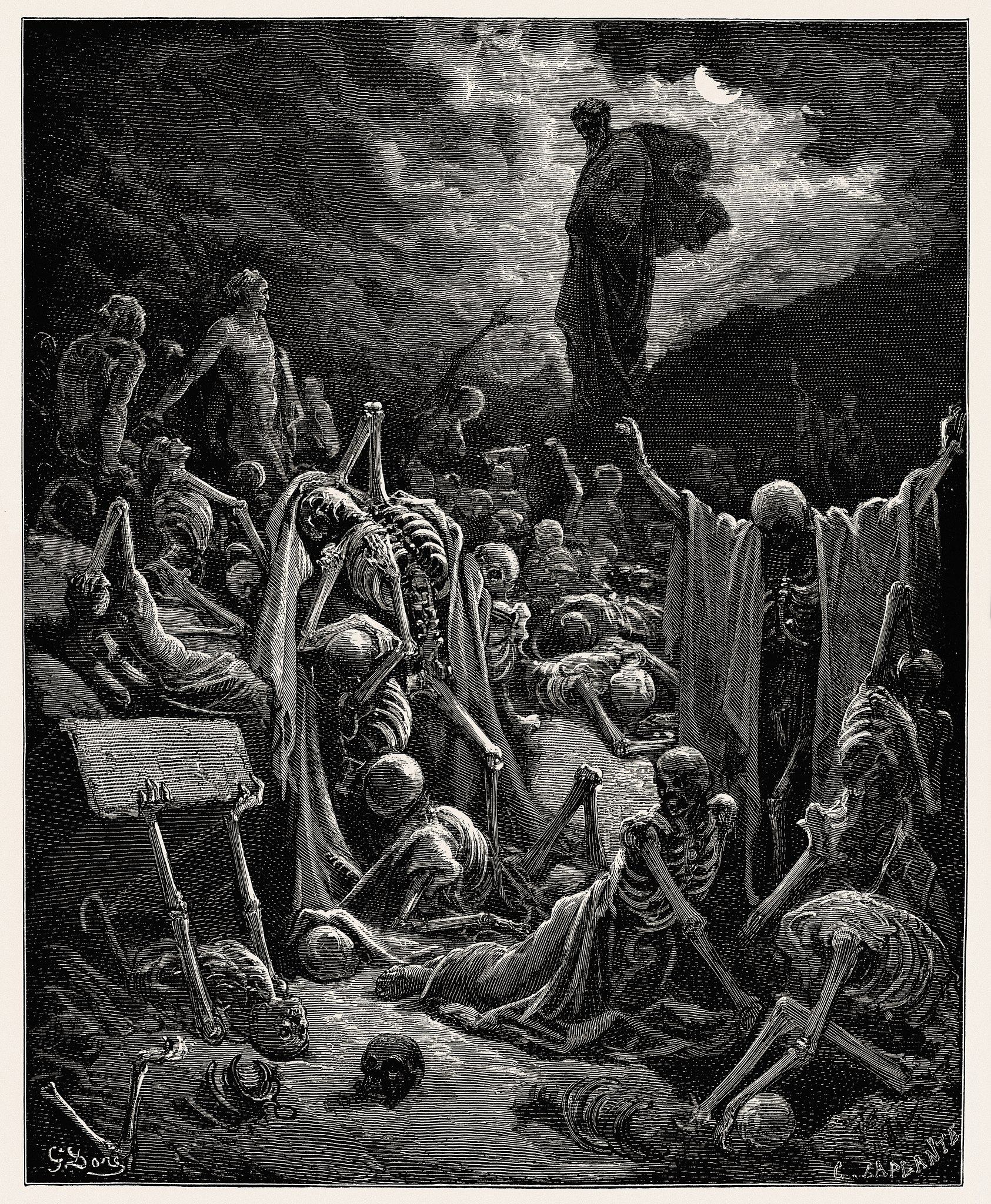
In these times, Ezekiel’s valley of the bones comes to mind. The valley is full of bones. The bones are everywhere, and they are very dry. There is no hope. A Voice speaks from the midst of the valley: “Mortal, can these bones live?” I answer, “No. They’re dead. They’re all dead!’’ To which the Voice responds, “Of course they are. They’re dead, but don’t you see? They are you. You and your people are the bones in the valley” (Ezekiel 37).

Gustave Doré, Vision of the Valley of the Bones (1866)

Like Ezekiel, I look in despair at my country and kindred. Ezekiel’s dry bones were his people in exile, far from their homeland. I’m a stranger in my own country, the valley of the bones, with little reason to no hope for a transformation.

Fresh bones are thrown into the valley every day. The remains of three nine-year-old children and three of their teachers in Nashville are the latest to hold our attention, until tomorrow another man, woman, or child repeats the horror somewhere else, while our children and grandchildren go through drills to protect themselves in the event the next gunman comes to their schools.

The land of the fearful

The assault weapons carried by American soldiers in Afghanistan and Iraq, and the culture of war — “kill-or-be-killed” — have come home to roost, turning schools, shopping malls, synagogues, churches and mosques into valleys of death and destruction in Ukraine and places like Nashville. The “land of the free” has become the land of the fearful; the home of hucksters and cowards. not the home of the brave. The assault weapons that killed nine-year-old Evelyn Dicephalus, Hallie Scruggs, and William Kinney and their teachers were not stolen; they were bought and sold legally.

Asking questions — speak what is real

Evelyn, Hallie, and Billy won’t blow out 10 candles on their next birthdays. They cannot ask the man who has failed to represent them in Congress whether he might now think twice before sending another Christmas card picturing his smiling family, each brandishing an AK-15, or why, moments after they were shot and killed, he said nothing can be done to “fix it,” noting that he homeschools his children. Evelyn, Hallie, and Billy can’t ask him what goes haywire in his brain that allows him to sport an AK-15 on his lapel on the floor of Congress, and shed tears and express surprise and horror at what happened at the school in the district he represents.

Understanding ourselves

Answers to how America arrived at the valley of the bones in 2023 are as many as the disciplines that study such matters: psychology, sociology, history, biology, genetics, economics, philosophy, anthropology, and, yes, religious studies and theology. I look through the lens of theological anthropology — mortals and mortality (death) understood in light of that which does not die—the Immortal, the Eternal, the Encompassing within which every mortal lives and dies.

Guns don’t kill?

“Guns don’t kill; people do.” Seriously? Guns don’t kill? AK-15s don’t kill? A firearm in the hands of “God-fearing, law-abiding citizens” won’t kill? Guns do kill; assault weapons slaughter, massacre, and tear bodies into body parts.

I’d like to say I don’t get it, but I think I do. The bones in Ukraine are added to the valley every hour by a mortal’s worship of himself and his nation. The idolatry of self and nation is no different in America. What’s the difference between “Make America Great Again” and “Make Russia Great Again?” How did the party of Lincoln (“Honest Abe”) become the party of John Wilkes Booth? Why do elected Representatives and Senators wear AK-15s on their lapels and take the floor to block legislation that would put legal boundaries around the freedom to bear arms under the Second Amendment? Guns don’t kill; elected officials do. Guns don’t kill; liars and cowards do. Guns don’t kill; bullies do. Guns don’t kill; ideologues do. Guns don’t kill; those who mistake themselves as more than mortal do.

From folly to wisdom

For people like me there is no better explanation for such horror than the violation of the First Commandment that Moses brought down from Mount Sinai. The sense of it is this: “You are not the center of the universe. You are mortal. You are born and you will die. You are not infinite. You are finite. To worship yourself is folly.

Photo of Hiker Above the Sea of Fog by Friedrich, Caspar David ,ca. 1817.

I scratch my head and wonder why the obvious isn’t obvious. The valley of the bones makes me weep. Nothing I do will turn us from this madness. The dry bones in Ukraine will not rattle, come together, and stand again, as in Ezekiel’s vision. But my faith tradition insists, against all evidence to the contrary, that the Word is more powerful than an AK-15, and the Immortal greater than a mortal.

Gordon C. Stewart, Be Still! Departure from Collective Madness (2017 Wipf and Stock), Brooklyn Park, MN, April 1, 2023.

CHRISTIAN NATIONALISM

Featured

There is no such thing as Christian nationalism. It’s an oxymoron. Come to think of it, so are Jesus and those who confuse Jesus with power. “You are a king, then?” asks Pilate. Jesus responds, “You have said so!” You, not I, say so. The Gospels of Matthew and Luke paint pictures of Jesus alone in the wilderness, where the Satan (the Twister/the Liar) puts him to the test. “All these (nations) I will give you, if you fall down and worship me,” says the Twister. Jesus does not bow down, and for that, he is crucified. Jesus refuses to be a king. “I have come to bear witness to the truth,” says Jesus to Pilate. The idea of a Christian nation has no biblical footing. It’s a hoax. It’s a lie.

Refusal of Special Privileges

My faith tradition has no desire to achieve religious supremacy or special privilege. The organizational meeting of the Presbyterian Church in this country adopted eight Preliminary Principles. The FIRST principle declared the following views about religion and the civil authorities:

We consider the rights of private judgment, in all matters that respect religion, as universal, and unalienable: we do not even wish to see any religious constitution aided by the civil power, further than may be necessary for protection and security, and, at the same time, equal and common to all others.

First preliminary principle, adopted in 1789 by the first general Assembly of the Presbyterian Church in America

Parable about Here and Now: the Last Judgment

In Jesus’ parable of the last judgment, the King (the Sovereign) will gather all the nations and separate the goats from the sheep. It is no accident that national identity plays no part in the division between sheep and goats. The only thing that matters to the Sovereign is compassion. Period!

It’s a parable, of course, not a peek into the end of time. It’s about now. Jesus’ parable turns every nationalist claim on its head. The question is the same for all the nations: what are you doing for “the least” among you — the hurting among you, people in the cellar of the tower?

The sheep have no idea there is a reward. They just do it. The goats complain that, if only the Sovereign had told them the rules of the game, they would have fed the hungry, given drink to the thirsty, welcomed the stranger, clothed the naked, visited the sick and imprisoned. If you had just told us, we would have done it.

No claim to national exceptionalism stands the test. Christian nationalism is an oxymoron. No questions are asked about belief or religion. There is no, “Have you accepted Jesus Christ as your Lord and Savior?” No, “What church do you belong to. No, “What’s your religion, your belief system?” There is one criterion. Only one: COMPASSION. “Insofar as you have done it to the least of these….”

Gordon C. Stewart, public theologian, Be Still! Departure from Collective Madness (2017, Wipf and Stock), Brooklyn Park, MN, March 14, 2023.