In the Strife of Truth with Falsehood

Get ready for the verbal assaults.The PAC ads. The disinformation and misinformation media campaigns funded by big money with big interests that know how powerful words are.

Words are POWERFUL! Sometimes those of us who stand in pulpits doubt that our words matter. But reading this paragraph in Timothy Egan’s NYT,Deconstructing a Demagogue,”reminds me of just how powerful words are:

Back in 1994, while plotting his takeover of the House, Gingrich circulated a memo on how to use words as a weapon. It was called “Language: A Key Mechanism of Control.” Republicans were advised to use certain words in describing opponents — sick, pathetic, lie, decay, failure, destroy. That was the year, of course, when Gingrich showed there was no floor to his descent into a dignity-free zone, equating Democratic Party values with the drowning of two young children by their mother, Susan Smith, in South Carolina.

Today, if you listen carefully to any Gingrich takedown, you’ll usually hear words from the control memo.

And that’s just the beginning of the story of how language is used and abused for purposes of social manipulation. Gingrich knew that language is “A Key Mechanism of Control.”  Those who are well-schooled in theology and politics know that language is the primary mechanism of mind control: truth becomes falsehood and falsehood becomes truth; beauty becomes ugliness and ugliness becomes beauty; goodness becomes evil and evil becomes goodness, twisted by the language of innuendo and word association.

The cynicism that pervades the American electorate is due, in part, to this demagogic use of language. Words are precious things. Holy things. Sacred things. When they get twisted, they become vulgar and profane, one might even say ‘demonic’ in the sense in which Paul Tillich defined ‘demonic’: the twisting of the good. “The claim of something finite to infinity or to divine greatness is the characteristic of the demonic” (Paul Tillich, “Life and It’s Ambiguities,” Systematic Theology, Vol. 1, p. 102).

Paul Tillich, “The Courage to Be”

Paul Tillich was one of the first university professors fired during the Third Reich in 1933. At the invitation of Reinhold Niebuhr, he came to America where he taught at Union Theological Seminary in the City of New York, Harvard Divinity School, and the University of Chicago. Tillich and his academic colleagues in theology, philosophy, and ethics (Willem Zuurdeeg, Martin Niemoller, Karl Barth, Dietrich Bonhoeffer, and Elie Wiesel) left us a rich legacy of linguistic analysis of the language of demagogic use of language.They speak with authority because they each paid a price for their opposition to it.

There are those who say that Hitler won his war after all. His ingenious use of language and rhetoric is the substance of Language: a Key Mechanism of Control. Newt Gingrich is not Adolf Hitler. And we are all well-advised to be very careful with contemporary references to him, the Third Reich, or the Holocaust. Yet the language that once led a nation regarded as “the most sophisticated culture” to swallow the toxin of twisted truth is with us still. The demonic poison how rules the day in America, peddled as cure and candy by candidates bought and sold by the private corporate powers whose PAC ads control the airwaves.

Words are sacred. And those who abuse them enter into the darkness of the demonic twistings that led James Russell Lowell to write the hymn lyrics I sang as a child:

Once to every man and nation Comes the moment to decide, In the strife of truth with falsehood…. Though the cause of evil prosper, Yet t’is truth alone is strong; Though her portion be the scaffold, And upon the throne be wrong;, Yet that scaffold sways the future, And, behind the dim

unknown, Standeth God within the shadows, Keeping watch above His own. – James Russell Lowell, 1945, “Once to Every Man and Nation”

The PAC ads are coming. Plug your ears…or…better yet, listen carefully, listen critically. Then speak out “in the strife of truth with falsehood.”

The Sin of “American Exceptionalism”

Last night I watched Mitt Romney at a campaign rally in my home town, Broomall, Pennsylvania. What I saw sent chills down my spine. Demagoguery was on display. The people from my home town applauded the scolding of American President for apologizing. No apology for the tragedy of an American soldier(s) walking into the homes of families in Afghanistan to kill. No apology for … well…for ANYTHING. America is the greatest country in the history of the world. We should make no apology, said Mr. Romney.

In light of that speech, I am reposting this piece first published in February. It’s Holy Saturday for me. The one who lay dead on this day was killed, without apology, by The Myth of Roman Exceptionalism. The Roman Empire is long gone. But the myth never goes away. Only the name of the nation changes. Here’s the piece:

Jacket of “My People Is the Enemy”

“The stairway smelled of piss….This [a tenement apartment in East Harlem] was to be my home.  I wondered, for a moment, why. Then I remembered that this is the sort of place in which most people live, in most of the world,  for most of the time. This or something worse. Then I was home.”  – William Stringfellow, My People Is the Enemy: An Autobiographical Polemic.

I’ve been holding my breath, wrestling with whether to speak aloud what I hear and see.

I’m a disciple of Jesus, a Christian, in the debt to the bold witness of the late William Stringfellow, lay theologian. I’m also a religious pluralist. I believe with Chief White Calf of the Blackfeet that there is not just one way, there are many sides to the mountain and many paths on which the Divine Mystery is experienced.

I have learned over the years to respect the multiplicity of ways different sides of the mountain experience the living God. I work hard to understand my Hindu, Buddhist, Muslim, and Jewish neighbors. I often experience these discussions as encounters with God whose vastness, like the ocean, is so much greater than any of the tea cups in which we hold a few drops of the sea.

I also know that some forms of religion are just plain nuts. The religion of Jim Jones whose followers drank the purple Kool Aid in shared suicide in the jungle of Guyana is only the most ludicrous example of why we need to join comedian Lewis Black’s raging objection to political distortions of the truth: “You can’t just make s—t up!” Religion represents the best and the worst of the human psyche (the Greek word for ‘soul’).

Joseph Campbell, among others, long ago opened the aperture on my theological camera. He helped me to see that what we are all dealing with, on all sides of the mountain, is myth, the human spirit’s uniquely creative meaning-making activity that expresses both the grandeur and the terror of finite experience. Myth is not the opposite of truth; it is the story that points us beyond ourselves to the transcendent and the eternal.

My way of looking at the world is shaped by a vast variety of voices. Among them are Fyodor Dostoevsky, Friedrich Nietzsche, Franz Kafka, Jean-Paul Sartre, Albert Camus and Dietrich Bonhoeffer, whose experiences of the horror of the absence of God caused them to poke their fingers in the eyes of prevailing religious traditions whose tidy moral worlds turn God into a cosmic sadist.

Any religion worth its salt in the 21st century has to pass through the existential protests of these thinkers and of the shrieks and cries that still echo across the world from Auschwitz and Buchenwald that poke holes in every theory of a morally ordered universe. The Garden of Eden was lost a long time ago and, in the wake of the closing of the gates to it, any religion has to take account of the human history that looks much more like the trail of tears paved by Cain’s slaying of Abel than like two innocent people in Paradise before the fall.

Yet there is a deep longing for something more tangible, more trustworthy than myth. Something one can touch, see, feel, smell – a story that is not a story but fact. The longing is strongest when we experience great uncertainty and insecurity.

With this perspective, I have been looking again at the fastest growing religion in America, Mormonism, and the Church of Jesus Christ of the Latter Day Saints (LDS).

My first experience with the Mormons came quite by accident thirty years ago. I was riding a bus in New York City on my way uptown to visit African-American theologian James Cone at Union Theological Seminary in Harlem when I noticed the sign “Mormon Visitation Center.”  Already stressed by an unfamiliar transit system and feeling quite alone, I decided to get off the bus and take the tour.

Unlike the streets outside that were filled with trash and lit by flashing neon signs, the Visitation Center was spick-and-span. Everything was in perfect order, complete with a hologram of a Mormon family in a tranquil woods sitting in a circle, listening to the white upper-middle-class family’s father sitting on a stump higher than the other members of the family, reading from the Book of Mormon to an enthralled wife and two perfect, obedient, happy children. The hologram elicited two responses. One was amazement. I had never seen or even heard of a hologram. The other was a sense of outrage at the perpetration of a promise that was, in short, nothing but a hologram, the illusionary projection of someone’s idea of Eden that would strike a chord with visitors who long for the lost woods of the Garden of Eden. It offered a world of perfection: orderly, tidy, white, rural – nothing like the urban world on the street outside – the antidote to the realities and complexities of life in New York City.

When I left the Mormon Visitation Center it never crossed my mind that the Mormon vision or mythology would become the fastest growing mythology in America in the 21st Century. I was relieved to get back on the bus on my way to Harlem.

I ask myself now why this is so. I look again at Mormon beliefs and practices to try to understand.

In Mormon teaching, the Garden of Eden was a historical place, and it was not in the Mesopotamian Valley by the Euphrates River, as in the original biblical myth of Genesis. It was in North America…in Missouri.

“According to Joseph Smith [Mormonism’s founder] the Garden of Eden was located in Jackson County, Missouri and following his expulsion from the Garden, Adam traveled northward to a place near modern-day Gallatin, Missouri. Mormon Apostle Orson Pratt stated that the name Adam-ondi-Ahman “is in the original language spoken by Adam, as revealed to the Prophet Joseph” (Journal of Discourses 18:343) – Bill McKeever, Mormon Research Ministry.

It is to this very spot of physical geography that Jesus will return at the Second Coming. None of this is in the realm of myth. It’s fact. You can go there to touch it and  walk on it, knowing that Adam was there long before you and that, after you have walked there, it will prove to be the epicenter of the universe, the very spot where Christ will return.

Why is the Mormon myth gaining such traction in America? And why would I break the code of silence, the well-advised reticence to those of us who share White Calf’s belief that the Divine Mystery is known differently on different sides of the mountain?

Some things are too important to leave unaddressed. The Mormon mythology is quintessentially American.

The myth that America is the center of transcendent goodness and power, the world’s epicenter, the original Garden of Eden and the place of Christ’s return, the people of “Manifest Destiny”, the one exception to the rising and falling of empires and nations, is losing its hold on us at home and abroad. We are losing our sense of innocence. Yet there lurks the nostalgia for the secure home provided by the illegitimate marriage of Jesus’ gospel of the Kingdom of God with America, “the City set upon a hill” of Jesus’ Sermon on the Mount and of John Winthrop’s sermon to English settlers on their voyage to the new world.

As Nietzsche knew, such gods don’t die easily, even when they’re already dead. When the town crier takes his lantern into the darkened town square at midnight crying “God is dead! God is dead!” in Nietzsche’s Thus Spake Zarathustra, the rest of the town regarded him as a madman. But it would be only a matter of time before the news would reach their ears.  It was the god of Western civilization that Nietzsche’s madman pronounced dead.

When something dear to us dies, especially when it is the prevailing religious myth of a nation about its own holiness and invulnerability, we become like starving people who continue to look in the same old bare cupboard for bread.

What better place to go than the reassurance that America is still the center – the ancestral home of a real man named Adam, who came complete with his own (now lost language, the special place to which Jesus (who visited the lost tribe of Israel in the Americas between his resurrection and bodily ascension into heaven) will return? When the Christian story the story is concretized to a finite, mortal place, it power as myth – pointing us beyond ourselves to the transcendent and the eternal – is not only lost but turned on its head.

There are many sides of the mountain, and it behooves all of us to approach people of different religious traditions with open ears and open minds. But approaching another’s religious beliefs respectfully does not require that we pretend not to see what we see or that we conclude that all religions are really the same or that one opinion is as good as another in the free market of religious truth claims. “You can’t just make stuff up!”

Let me say without hesitation that what I see in Mormonism is but the most exaggerated illustration of the idolization of the nation that includes so much of the American churches of whatever stripe where the nation is enshrined as God and where patriotism is the unspoken highest virtue with the cross wrapped in a flag.

The American wars of foreign intervention in Vietnam, Iraq, and Afghanistan could not have happened without this widespread faith in American goodness and exceptionalism. It is the cardinal sin that afflicts us across all denominational and religious lines. Whenever the Jesus executed by the Roman Empire becomes the Imperial King of a new empire, those who continue to hear the shrieks and cries of the world that suffers – and who continue to smell the piss on the stairway in the place we call “home”- are obliged to break the silence, violate the code, and get back on the bus to Harlem.

“Good” Friday?

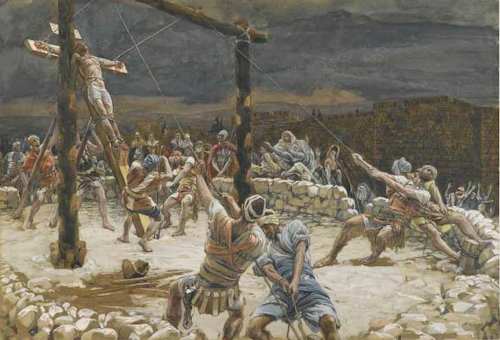
It’s Good Friday. Why would anyone call it “GOOD”? Today the Roman Empire executed Jesus. Beat him, stripped him, mocked him, jeered at him, hoisted him intot he air on cross, threw dice for the purple royal robe in which they had clothed him, pierced his side with a soldier’s spear, heard him cry from the cross, “Eloi, Eloi, lema sabachtani!” “My God, my God, why have you forsaken me!” Why would anyone in their right mind call this horror “GOOD”?

The raising of the cross - James Tissot

Sebastian Moore, O.B, speaks to this in The Crucified Jesus Is No Stranger (Seabury Press, 1977).

The meaning of the Christ-event is that in it the wrestle of man with his God-intended self is dramatized and led through the phases of rejection, hatred, crucifixion, destruction, surrender, new life. Oscar Wilde said, “each man kills the thing he loves.” Those who stop short of evil in themselves will never know what love is about. They will never receive the crucified. – p. 37

The human race thinks it can go on with all its Narcissistic human normalities, of war, of politics, of religion, and that somehow the vast other side of the picture will look after itself. So in opting for “himself as conscious”, man is opting for an ultimate solitude.

And ultimate solitude is death. It is to be cut off from the tree of life, and to wither. – pp. 69-70

For your further reflection, this poem received today from Steve Shoemaker.

Good Friday?

What makes this Friday Good is not what Rome

did to Jesus: torture, false witnesses,

and finally capital punishment.

In all regimes these standard practices

preserve the powerful, but then foment

disgust, infamy,  abroad– shame at home.

The dying one, the empty tomb was good

only if we are justified by trust,

mysteriously by God’s grace made whole.

The goodness cannot stay with us, it must

be passed on to the world–this is our role.

The Good is recalled in the feast:  soul food.

In a few moments I will host the Good Friday meditation – readings from the Gospels, long silences, the movements of Garbriel Faure’s Requiem…silence…reading… until it all soaks in.

I can’t get to Easter by by-passing the cross. Click  to hear the music.

MLK Assassination: A Memory

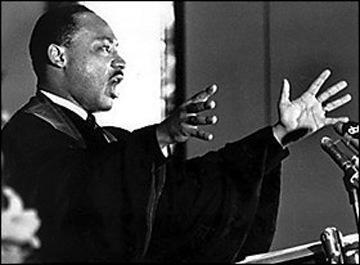
The Rev. Dr. Martin Luther King, Jr.

Forty-four years ago today the Rev. Dr. Martin Luther King, Jr. was assassinated in Memphis, Tennessee. Read this morning’s Washington Post story.I was with about 200 teenagers from “the projects” in Decatur, Illinois when the news broke. First Presbyterian Church and the Office of Economic Opportunity had partnered to create a youth program at the church. Charles Johnson, a former Blackstone Ranger from Chicago, and I (the 29-year-old Assistant Pastor) jointly administered the program.

We were in the church basement when the voice rang out from the steps, “Dr. King’s been shot! Dr. King’s been shot!” The room was filled with shock and anger. Some of the kids preferred Malcolm X to Dr. King, but on that night it didn’t matter. The room was united, overwhelmed by tragedy, another violent act of racial hatred.

Dr. King’s assassination came two months after the release of the report of the President’s National Advisory Commission on Civil Disorders (the “Kerner Commission”) that had concluded:

Our nation Is moving toward two societies, one black, one white—separate and unequal.”

The conclusion of the Kerner Report about police violence had been demonstrated on the church parking lot two weeks before Dr. King’s assassination. On that night Decatur police officers, without warning, had stormed into the crowd of black kids in the church parking lot at the end of the evening program. They came waving billy clubs and spraying mace. I was there. I saw it. Forty store windows in downtown Decatur were broken out that night. A number of the kids were arrested.

While the Decatur Chief of Police and I squared off with our different accounts of the events on the front page of The Decatur Herald, the board of First Presbyterian Church, which included a prominent sitting Judge, stood united and firm. We would not close the program, as the Chief was demanding.

First Presbyterian Church, Decatur, IL

When the voice announced that Dr. King had been shot, the adult leaders of the program had reason to fear the worst. Quickly we rounded up tape recorders. We made an announcement inviting the kids into smaller circles, spread out throughout the church building, that would give each and all of them time to talk.  We announced that, in light of what had happened two weeks before, we wanted their voices to be heard by the Chief, the Mayor, and the members of the Decatur City Council. We were all outraged; the feelings needed to be spoken and shared.There was no violence in Decatur that night. There was no riot.

The tapes were edited and played for the city officials.

The program continued without further interruption.

The Spirit of Martin Luther King, Jr. prevailed. And it still does.

America’s Future: Restorative Justice

Click HERE for “Ending student expulsions: Minneapolis Public Schools, Legal Rights Center partner for restorative justice.”

Public Schools face daunting challenges. Unlike private schools that can select their students, the public schools are just that – they belong to all of us, they educate the whole population, not just the cream that is skimmed from the top. Urban schools systems like the Minneapolis Public School System provides education to the poorest of the poor, the middle class, and wealthier families committed to public education.

In Minneapolis alone, the students coming into the schools speak over 80 different languages from as many different cultures. What happens in the public schools will determine America’s future.

The restorative justice partnership between the Minneapolis Public Schools and Legal Rights Center is a natural. Legal Rights Center, Inc. (LRC) was founded in 1970 by four leaders of the American Indian and African-American communities in Minneapolis, and a lawyer named Doug Hall. Clyde and Peggy Bellecourt, Syl and Gwen Davis, and Doug Hall gave birth to a law firm that belongs to the people, a non-profit law office staffed by community advocates and street lawyers who work for the people of the street.

Michael Friedman, the current Executive Director of LRC, continues the tradition of the spirit and heart of these founders.

Douglas Hall, Founding Director, Legal Rights Center, Inc.

During the last decade of Doug Hall’s life, I served as Executive Director of LRC. Kay and I spent many hours, days, and weekends with Doug and Mary on their farm near Wabasha, MN. Doug had become convinced that restorative justice offered the best hope for empowering and repairing communities affected by multi-generational violence and trauma. In his last years, Doug gave birth to the Minnesota Restorative Justice Campaign and served as its chair for three years.Michael Friedman, the board and staff of LRC are carrying the torch for Doug and Mary Hall, Clyde, Peggy, Syl, and Gwen.

The day of Doug’s memorial service, his daughter Claire walked through the woods to the small clearing where the family had buried Doug’s ashes. There were four stones pointing in the four directions. In the center were Doug’s remains. A bald eagle sat in the center of the stones on Doug’s ashes. While his ashes remain there on the farm, his legacy and spirit are soaring in the new partnership to stop the prison train before it gets on the tracks…in the school system.

America’s Future

This morning Robert Perschmann wrote this in reply to “Next Up: IRAN” (posted here yesterday) and “The House We Live In” (posted on Monday). He gave permission to publish it here. Robert is a student of history. His reflection is thoughtfully provocative.

Gordon, I visualize the reading of the riot act to new American presidents. I can hear the part about how dependent the economy is on war. I can hear the argument about needing decades to prepare the economy for no war. What a serious view of the future is needed if we hope to change this. I think that Obama is closer to visualizing the change than any previous president. A few things that come to mind:

2008

It is natural to want to forget what we have been through… the massive financial devastation by white collar pirates and the unspeakable suffering, death, destruction, and black-hole waste, caused by the invasion and occupation of Iraq. We must understand, in detail, exactly what happened so that we can be sure that we will never again be led blindly into the dark cave of the extreme right wing. No threat has ever done more harm to us and to the whole world than these fanatic American citizens who now smirk and wish failure upon us.

No we are not dealing with a crisis… it is a catastrophe. I like a president who wants to look ahead, rather than back. No one will interfere with that. However, it is not a one person government. We must and will have hearings to document and publicize what caused the catastrophe.

I want President Obama to get out of Iraq and Afghanistan. If those countries must have foreign interference… let it be the United Nations, with the support of the US. I want the US out of the greatest and grandest, largest and most expensive embassy building in the world… the one constructed at US taxpayer expense in Bagdad. Let that building be whatever Iraqis want it to be.

Get out of Afghanistan. It ruined the Russians and we can not help. If interference is in order… it must be the UN. While we are withdrawing… let’s get out of Germany and generally recall the outposts of our empire. We can not afford it. Those days should be as over as the British empire is over.

No I don’t suggest that the US is the number one  international villain of all time. Most countries have their own list of misdeeds. But we who think that we are so above it all… do have a list… and we have really, really blown it this time. And, yes we citizens are responsible for the actions of our presidents and our government. We probably can not help other countries very much right now. We have to  pull out of our nose dive and begin a recovery that can serve as the beginning of a world wide recovery. I think that the People’s Republic of China has gained the most from massive world wide blunders. They should, and I think that they will… try to contribute to worldwide recovery.

Part of the US recovery will be the understanding that we can never rely on foreign nations to to make everything that we use. We will understand that from pharmaceuticals to electronics, from cars to appliances, from food to clothing… the US and every country that hopes for success… must produce things. I suggest that every American check the country of origin for every dollar spent. It takes extra time, but I want to attract attention to the issue. Look at the eye glass frames that you think are expensive. Ask where the lenses are made. Ask your pharmacist where the medicine comes from. Check the labels on the produce. Ask about the seafood. To save you a little effort… I can tell you that China makes most of what you buy and they aim to make more and more. I feel better when I can buy a product from Mexico, or Canada, or

Madagascar, or Italy. I think it is better to send money somewhere in addition to China.

I think that the People’s Republic of China is headed to become the new American-style success that we have imagined ourselves to be. I am hoping that they will avoid many of our blunders… but am sure they will not avoid them all. I have smiled at the thought of the red flag flying over the land of the manufacturer to the world. That happened thanks to the quest for the cheapest labor. We gave away the store. But… enough. I think that we should tax the pants off of imports, including those of American companies thought to be all-American… like Apple Computer. Do this until it pays off to make things here again. I think that offshore customer support should be taxed, as well as foreign airlines and shippers that transport to our country. After we have established some American production and restored our economy, …at that point we can study trade agreements with other countries. Yes products will cost more. The answer to that problem is higher pay for American workers. So, why does this issue remain anyway? It is because of the belief that unhindered wealth is okay. It’s not okay. I think that the president’s definition of wealth is generous. A quarter of a million dollars is wealth. It is appropriate for people who exceed that income to pay a great premium in tax. There is no point in having wealth if there is not a society to be wealthy in. American workers made this country possible. If we want less socialism, the wealthy must be happy to pay more taxes to support our society. And the rest of us should be more conscious of what a great privilege it is to be an American tax payer.

PLEASE LEAVE YOUR COMMENT OR QUESTION TO PROMOTE DISCUSSION..

Thanks for visiting,

Gordon


Next up: IRAN?

Gordon C. Stewart, April 3, 2012

So…Iran is next. First Afghanistan. Then Iraq. Now Iran… where does it stop?

I feel helpless, like a parent watching a hopped up teenager taking the car. I know I’m not alone.

This afternoon an email invites me to add my name to a statement and show up at the State Capitol in Saint Paul on April 24.  Here’s the email:

In 2008, over 50 Minnesota politicians and religious leaders signed a statement opposing U.S. military action against Iran.  We held a press conference on the steps of the Capitol in St. Paul that generated articles around the world because of the presence of a  delegation of Middle Eastern journalists.

Unfortunately, four years later we are again faced with even more threats of attacks against Iran.

While politicians are pushing for military action, several prominent military leaders are encouraging caution.  The Chairman of the Joint Chief of Staff, General Martin Dempsey has said that, “It’s not prudent at this point to decide to attack Iran.  A strike at this time would be destabilizing and wouldn’t achieve long-term objectives.”  Secretary of Defense Leon Panetta has stated that Iran is NOT developing a nuclear weapon.  (Meet the Press, 1/08/12)

If Iran is attacked, Dempsey has said the results would destabilize not only that country, but the entire region.  Other analysts have written of the possibility of war on Iran escalating to a third world war.  However, Ron Burgess, the director of the Defense Intelligence Agency, told Congress that “the agency assesses Iran is unlikely to initiate or provoke a conflict.”

Yet the media continues to give more coverage to the politicians and pundits who are claiming that Iran is a grave threat to world peace and must be stopped.  The U.S. is just beginning to withdraw from the devastating wars in Iraq and Afghanistan – conflicts that destabilized those countries and cost hundreds of thousands of lives and trillions of dollars.

Minnesotans have spent nearly $5 billion to fund the Iraq and Afghan wars in 2011 alone, bringing total Minnesota taxpayer spending for these wars to more than $37 billion.  At a time of cutbacks for education, healthcare, jobs, and housing, we cannot afford another costly military adventure.

Please add your name to the list of Minnesota leaders who advocate diplomacy over military attacks as the way to deal with Iran.  We will hold a press conference at noon on Tuesday, April 24, as part of our campaign to work for a peaceful resolution.

Sponsored by:   Middle East Committee (WAMM), Middle East Peace Now ,  Minnesota Peace Project, Twin Cities Peace Campaign, Women Against Military Madness

I signed the statement. I’ll be there again on April 24. It’s Holy Week. My faith was born on a cross, the Roman state’s instrument of torture and execution during a military occupation. I’m a disciple of the crucified Jesus. How can I do anything else?


The House We Live In

Gordon C. Stewart, April 3, 2012

The economy is broken. While most of us have been holding our breath, some of us have been out buying the most expensive jewelry at Tiffany’s. Investor’s Business Daily reported that Tiffany’s profits rose by 56 percent during the 2nd Quarter of 2011.

‘Economics’ is about the house we all live in. We get the word from the Greek word oikos (household).   Economics (Oikonomia) is how we arrange things in the one household. They don’t teach that in MBA programs.

This is not an economy. It’s something else. It’s an anti-economy, the antithesis of one household in which all residents are housed, fed, secure, and peaceful.

Profit vs. loss is not a way to manage a household. It divides the members of the household into winners and losers, owners and renters, charitable givers and those who receive, or do not receive, the winners’ charity.

What we call the American economy is spiritually and morally bankrupt. It’s not just broken financially.  Warren Buffett’s proposal to increase taxes on those who can afford to shop at Tiffany’s only scratches the surface of the household problem.  One could argue that the system – free market capitalism – is working the way it’s set up to work. Or one could argue that it isn’t.

It all depends on what floor of the house one lives in.

Two percent of the rooms are in the penthouse. They’re very large, decorated by the best interior designers and decorators. The furnishings are custom-made.  Those who live in the penthouse have a private elevator to leave the for lunch at the country club or the yacht club.  Over lunch they discuss how to maximize their profits with more blue chip stocks or bonds and whether to leave the penthouse for a week, a month, a season in exotic places. They discuss their charitable giving, encouraging each other to give to their favorite causes. Sometimes, in the best of clubs and social circles, they argue vociferously, just like the rest of us, about the economy in the Greek sense, the oikos. They are not all of one mind.  Some belong to the  Buffett Fraternity, others to the Trump Circle, even if they wish “the Donald”  would be more subtle.

The other 98 percent of the rooms in the house are rentals of various sizes. Some very large, some modest, and some small.  Only a few of the tenants have long-term leases or the protections of rent control.  The most vulnerable of us live downstairs on the smallest rooms on the lower levels. A growing number of us have been forced into the cellar.

And the rest?  We watch “the Donald” to catch a glimpse of life in the penthouse. We watch our neighbors and family members move to smaller rooms or to the basement, fearing that we, too, will end up in the cellar, but hoping that someday we’ll win the lottery and move upstairs to the penthouse.

Meanwhile, the folks who own Tiffany’s are laughing all the way to the bank, confident that the 98% are too preoccupied to get what’s happening…right there under our noses in the one house where we live.

Economics 101: “The Earth is the Lord’s and the fullness thereof, the world and all who live in it” (Psalm 24:1). How, then, shall we re-arrange the one house? How will we Occupy it?

The Cormorant Fishermen

PhotoBotos.com, one of my favorite sites, posted this today. Click HERE to see the original post and read the comments (including mine) and to add your own on the PhotoBotos blog or below on this blog…or BOTH. Thanks for dropping by. Hope your fishing goes well today…and that you get to eat what you catch…or share it with someone you love or someone who needs it..

The Cormorant Fishermen photo by Dan Ballard

Cormorant Fishermen, Dan Ballard on http://www.Photobotos.com

Trayvon Martin and the Hoodies

The Washington Post updates the story of 17 year-old Trayvon Martin’s death in Florida with an interview with Trayvon’s parents, Sybrina Fulton and Tracy Martin.

Family picture of Trayvon Martin“Martin and Fulton said they are moved by the outpouring of support from people across the nation. They said they were particularly touched by  the actions of Rep. Bobby L. Rush (D-Ill.), who on Wednesday donned a gray hoodie and sunglasses and spoke from the floor of the House of Representatives about the need for a full investigation of the death.

“I applaud the young people all across the land who are making a statement about hoodies, about the real hoodlums in this nation, specifically those who tread on our law wearing official or quasi-official cloaks,” Rush said on the House floor.

“Racial profiling has got to stop,” he said. “Just because someone wears a hoodie does not make them a hoodlum.”

As he spoke those words, he removed his suit jacket and lifted the hood over his head. Rep. Gregg Harper (R-Miss.), presiding over the floor as Rush delivered his remarks, began to gavel almost immediately. Shouting over Rush, who began to recite Bible verses, Harper said the congressman was out of order for donning the hood. Rules bar House members from wearing hats in the chamber. Rush was then escorted from the floor.

Race and hoods in America never go away. Hoodies have a long history. Sometimes those who wear the hoods wear them by choice; sometimes the hoods are put over their heads. Occasionally those who wear them are ushered out while they recite Bible verses…or sing a hymn, like the 38 Dakota men hanged in a mass execution following “the Sioux Uprising,” as they called it then in 1862, at  Mankato, Minnesota.

Douglas A. Lindner provided this eye-witness account in The Dakota Conflict Trials:

In Mankato, at ten o’clock on December 26, thirty-eight (one person was reprieved between the date of Lincoln’s order and the execution) prisoners wearing white muslin coverings and singing Dakota death songs were led to gallows in a circular scaffold and took the places assigned to them on the platform.  Ropes were placed around each of the thirty-eight necks.  At the signal of three drumbeats, a single blow from an ax cut the rope that held the platform and the prisoners (except for one whose rope had broke, and who consequently had to be restrung) fell to their deaths.  A loud cheer went up from the thousands of spectators gathered to witness the event. The bodies were buried in a mass grave on the edge of town.  Soon area doctors, including one named Mayo, arrived to collect cadavers for their medical research

Last night a Lakota friend filled out the story. According to Wally Ripplinger, the men on the gallows were singing a Dakota hymn, as they had done throughout the day. They were singing in unison, under their hoods, of their impending release into Paradise. It might have sounded something like this. Click below to listen.

I cast my vote with the Dakota and Lakota singers, Trayvon Martin, the lynched victims of hooded Klansmen, and the rebellion leader (mis-labeled by tradition as “the thief” – he was not a thief!) executed along with Jesus, who heard the words of divine mercy that would be remembered long after a Roman public execution: “Today you will be with me in Paradise.”