BEST Steak Ever! WORST Haircut!

Video

THE BEST TENDERLOIN EVER

Our home for four weeks is 14 miles west of Anaconda, Montana. Last Friday evening we go to Barclay II for dinner (the restaurant, not the dog).

Like lots of things in these parts, exterior facades count for little. Barclay II doesn’t look like much from the outside but it has a great reputation for steak and seafood. Behind the scruffy door is an upscale restaurant.

The proprietor, Tammy, comes to the table to greet us. We ask what they’re known for. “The tenderloin is the most popular,” she says. “I see from the menu it comes with crab legs. Are they Snow Crab or King Crab?” I’m not so big on Snow Crab; I love King Crab. She answers, “King Crab.”

When the wait person comes to take our orders, I order the tenderloin “between medium-rare and medium”. The waitress notes exactly what I say. When she returns, the tenderloin is precisely as requested. In downtown Minneapolis, Murray’s Steak House  is famous for its Silver Butter Knife Steak, so named because you can cut it with a butter knife. Murray’s is good. Barclay’s, in downtown Anaconda, is better. The tender-est, most flavor-ful steak I’ve every eaten anywhere in the world.

THE WORST-HAIRCUT EVER

The next morning we’re again in downtown Anaconda in The Coffee Corral coffee shop when Kay reminds me I need a haircut before stepping into the pulpit the next morning at St. Timothy’s Memorial Chapel where I’m privileged to preach the next three weeks. It’s Saturday.

I leave Kay in search of the barber shop. The barber pole is not spinning; the sign on the door posts the hours: Monday-Friday. It’s closed. Next door is a beauty salon. I really need a haircut. I go in to the scene of six women seated in a semicircle having their nails done.

“Good morning,” I say, “Do you do men?” Several of the woman roar with laughter. “I mean…do you cut men’s hair?” Again they laugh. “My wife says I need a haircut; wadda ya all think?” Three of them nod Yes; three nod No. The stylist answers Yes and says she can do me at 1:00.

I return at 1:00. The stylist and I exchange a few pleasantries, ignoring the young bridesmaid who’s all dressed for an afternoon wedding, waiting to have her hair done. I take a seat in the stylist’s chair. She asks me what I want. I answer, just “a trim,” meaning leave it the way it is but take maybe a quarter of an inch, at most. I tell her that once I take out my hearing aids I won’t be able to hear a thing. She smiles, laughs, and says, “No problem. That’s great!” I take it she’s not a big talker, or maybe, God for bid, she doesn’t like men.

I set the hearing aids on the counter. She asks a question I can’t hear. As hearing-impaired people often do when we can’t hear something, I smile and nod my head. I should have reached for the hearing aids.

Within seconds I’m back in Vince’s Barber Shop in Broomall, Pennsylvania at the age of five. Vince’s old electric clippers are shearing the sides of my head like a sheep shearer shears wool from a sheep. At age 72 I don’t have much left, but I’m told I have beautiful hair, even if it’s white. The clippers are clipping; the hair is flying in one-inch clumps. This is not a trim! I’m being led to the slaughter. I close my eyes, as though in prayer, pretending it’s not as bad as I expect.

I should have prayed!

Mortimer Snerd and Edgar Bergen

She finishes “the trim” with scissors and holds up the mirror to show me her handiwork. I pretend I’m an actor, looking at the unrecognizable head staring back at me. It’s Mortimer Snerd, ventriloquest Edgar Bergen’s dummy who made me laugh as a kid, and, as Mortimer often did, I smile a stupid smile, and say, “Yup”. There is nothing else to do.

ALWAYS CARRY CASH

“How much do I owe you?” “Ten dollars,” she says. “Do you take American Express?” “No,” she says, “we only take cash.”

Oops! I take out my wallet. No cash. I go into my pockets and find three one crumpled dollar bills. She agrees to let me go up the street to the coffee shop where Kay is using the internet. “I’ll be back,” I say, assuring her I’m not skipping town. I don’t tell her that her haircut is only worth three dollars.

Kay also has no cash. But she remembers the cylinder of quarters she keeps in the Prius. We count them out, 38 quarters, just enough with my three ones to cover the cost and leave a $1.50 tip, and return to the Beauty Salon.

She’s doing the hair of the teenage girl dressed in her bridesmaid uniform. I think of bridesmaids’ dresses as uniforms ‘cause, like Army recruits, the poor bridesmaids have to wear what their recruiter makes them wear. There is no freedom on wedding day. I just hope the poor soul sitting in the stylist’s chair doesn’t open her eyes to see Mortimer staring back from her bridesmaid uniform.

LESSONS FOR LIFE

Thirteen (13) little hours offered the best and the worst, the joys and, as the old hymn “Beneath the Cross of Jesus” puts it, “the burdens of the day.”

I’ll take back to Minneapolis three life lessons learned in Anaconda:

  1. Pay no attention to the exterior appearance of anything, especially a restaurant. It may hide the best tenderloin steak you’ve ever tasted anywhere.
  2. Carry cash!
  3. If you’re a guy who ventures into a beauty salon next door to the closed barber shop and some women laugh loudly when you ask if they do men, run for your life. You may turn into Mortimer Snerd!

“Yup!” Life is like that. I smile and remember the tenderloin. Kay tells me my hair will grow out again.

– Gordon C. Stewart, Anaconda, MT, June 29, 2015

Verse – Last Request

Last request from an Illinois boy

I was born in Urbana on Orchard Street,
The hospital, Carle, was then quite small:
A three-story building of yellow brick,
The first of four brothers, and that was all.

My Mother was Char, my Dad was Bob
away at war, though a Pacifist he.
In ’42, to avoid the Draft,
He joined the SeaBees, the Navy

Guys who built the docks, airfields–
Alaska, even Hawaii.
After the war they lived in town
From house to house, till number three

Was 1306 South Orchard Street.
My happy high school years were there,
My first fast car, my first slow girl…
My friends were from the band or choir,

Although I grew to six foot eight
And stumbled playing basketball.
I started writing poems then:
Love yelps, or sonnets for the school

Assignments Mrs. Hewett gave.
Now decades past, I still will write
My last request in doggerel.
V-mails from Dad to Mom would cite

His love for us in poetry.
So if the cost is not too great,
Send me to die on Orchard Street.
Carle Hospital has grown to eight

Or ten or 12 facilities.
Perhaps they’ll have a room for me
To breathe my last in my home town.
Like poetry, it’s symmetry.

– Steve Shoemaker, Urbana, IL, June 29, 2015

In Memory of Phil

Sunday, June 21, the text from Faith in Minneapolis reached us in Montana.

“6:15 p.m. – A great soul has passed.”

Phil Brown and I go back 55 years when we met as freshmen at Maryville College in Maryville, Tennessee. Within two weeks we were doing something entirely juvenile. We were running for President of the best class the college had ever admitted or would ever see again. J 😇

From the day I met Phil, I knew him as a person of dignity and stature. He carried himself with an outward confidence that belied an inner self-doubt. His posture was erect, shoulders back with a disgustingly athletic physique and stride, a classically chiseled face, and the brains to go with it. He was a Big Man on Campus from the day he set foot on campus to the day he left it for Law School at Indiana University in 1964. When he left law school to prepare for a vocation in ministry, we again became classmates at McCormick Theological Seminary in Chicago.

In ways we only later came to understand and celebrate, in spite of the early competition, we were tied by similar family histories and destinies, although anyone who knows us well could easily call us the Odd Couple, one of us like Felix Unger, the always well-groomed, meticulously tidy maintainer of order and propriety played in the film by Jack Lemon; the other more like the unpredictable, care-free, disorganized, careless slob named Oscar Madison, played by Walter Matthau. Can there be any doubt who was whom?

At Phil’s retirement party as Synod Executive of the Synod of Lakes and Prairies, his beloved sons, Ian and Jess, delivered a comical roast of their Dad who, they said, had taught them many things, not the least memorable of which had to do with tools from Phil’s workshop. “If you took it, put it back where you got it!” was his consistent teaching. I always wondered, though, why Phil didn’t put the special microbrewery beers that Ian mailed him back in the refrigerator where we’d gotten them.

Phil and Faith are Kay and my best friends in the Twin Cities. Our tears have fallen for more than two months, as we have watched with Faith the inexplicable, undiagnosed loss of energy that came on like an sudden thunderstorm that drenched him in night sweats the evening he returned from a North Oaks Association Board Meeting.

Always the most gracious of hosts, he and Faith hosted newcomers to North Oaks in their home a few weeks later with the understanding that if Phil grew weary, he should retire early. He did. It was not like Phil to call attention to himself or to bow out on a promise, a duty, or a commitment. He had to be restrained from overdoing, but restraining a race horse committed to doing the right thing takes a trainer with strength not even the strongest life partner or lifelong friend could muster.

At Maryville Phil chose Economics for his major. His academic advisor and mentor, Bob Lynn, was a professor known equally for his brilliance and his demands for academic excellence. At McCormick Theological Seminary, Phil again chose to study with the very best, Jack Stotts, Professor of Christian Ethics. Phil was always drawn to the highest standards of excellence.

As Presbytery Executive with Blackhawk and Milwaukee presbyteries and as Synod Executive of the Synod of Lakes and Prairies, he embodied that combination of ardor and order, grace and discipline that is the signature of the Presbyterian theological and ecclesiastical tradition where all things are to be done “decently and in order”. In that respect Phil and I each followed in our father’s footsteps. Phil succeeded at it much better than I.

But, if our friendship began as student competitors and friends wandering in the night through the foothills of the Smokey Mountains around Maryville, my last memories will be of Phil as the patient at Abbott Northwestern Hospital in Minneapolis. Though so weak that he could barely speak aloud, he unexpectedly joined me in saying the 23rd Psalm. His faith was on his lips, bubbling up from a deep, trusting heart, the secret place of the son of Victor and Francis Brown. I’m sure he noticed, as did his son Jess, my omission of the line “He leadeth me in the paths of righteousness for his Name’s sake” — an omission made, whether consciously or unconsciously, I suppose in retrospect, because I wanted him to give up the struggle for righteousness in order to rest peacefully beside the still waters there beside the valley of the shadow of death.

There are no still waters here in Montana where I am committed to serve as summer minister at St. Timothy’s Memorial Chapel in the ghost town of Silver Cross where we prayed for Phil, Faith, and the Brown family this morning. After receiving Faith’s message this evening, Kay walked to the backyard of the Manse and returned with a bouquet of wild purple irises and other wild flowers in honor of Phil. We read the Psalms and prayers from The Book of Common Prayer and found some solace there in the company of the saints in light.

Good friendships last a lifetime. Over time, the tears of loss and mourning will be turned, by God’s grace, into the tears of great thanksgiving.

– Gordon C. Stewart, Georgetown Lake, MT, June 23, 2015


What was I thinking?

Ever have one of those days when you wonder what in the world you were thinking?

After eating at The India Spice House, I stopped in at the adjoining grocery store. A box of Bourbon-flavored biscuits made in Oran caught my eye.  They looked good. I confused Oran (in Algeria) with Oromo, the identity of the Ethiopian Muslim men who had prayed for my friend Phil in the ICU Waiting Room two nights before. “That’s great,” I thought to myself. “The biscuits will make a nice gift.”

Gift to Muslim prayers

Gift to Muslim prayers

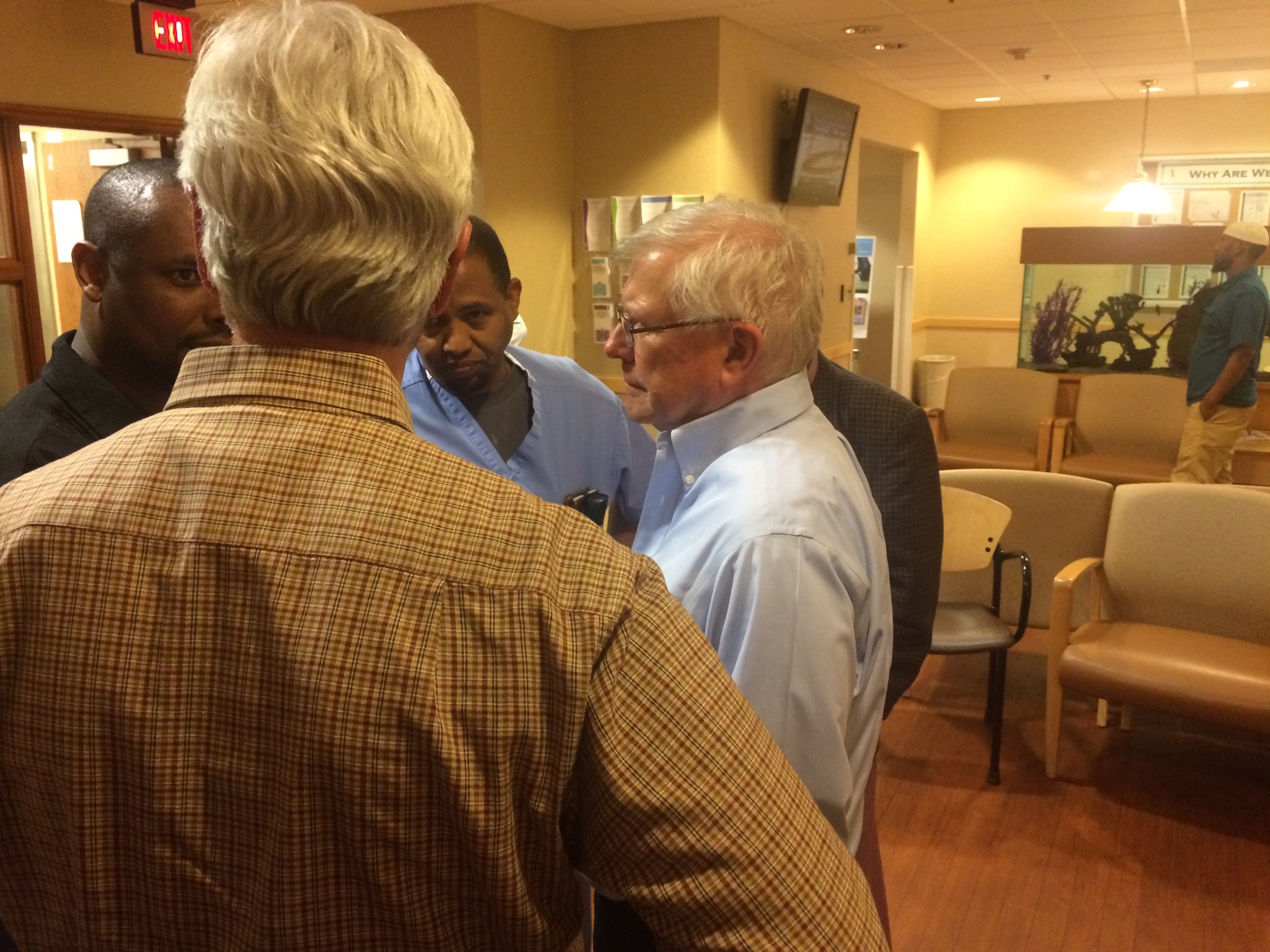
At the hospital I handed the box to two Oromo brothers holding vigil in the ICU Waiting Room. No words were exchanged. They accepted the gift, smiled, and nodded.

Only on my way to visit Phil in the ICU did it dawn on me. Muslims don’t drink! Even if the biscuits were made in Oromo instead of Oran, Bourbon-flavored anything is unacceptable, even disrespectful, however unintentional.

I returned to the Waiting Room. They smiled broadly. “Good!” said the one who speaks English. The other repeated his word with raised eyebrows. “Good!” We shook hands the way brothers do on the street in the hood. All was well! Salaam, Shalom, Peace was everywhere in the room.

Grace covers a multitude of sins!

The Waiting Room

The surgery went “as well as could be expected” after two months of undiagnosed illness, but Sepsis is taking over his body, threatening his survival. The next two hours are critical.

His loved ones and friends are gathered in the ICU Waiting Room at Abbott-Northwestern Hospital in Minneapolis.

Several hours earlier, I had observed six Muslim men praying the evening prayer at sundown at the far side of the Waiting Room. Oromo (Ethiopia) men had prayed the evening prayers at sundown, off to the far side of the large Waiting Room.

The men from Orono (Ethiopia), whom I had assumed to be Somali, are now gathered in chairs in the center of the Waiting Room, talking among themselves in Oromo.

When I approach them, intruding into their space, they recognize my presence. They stop talking. “Salaam,” I say. “Salaam,” they respond as if with a single voice and smile. “My friend is very sick. The next two hours are critical. I ask your prayers. His name is Phil.”

They respond as one would expect compassionate people to respond. “We will pray for him.”

I return to the small family area where my fellow Christians are gathered. I tell them the Muslims are praying for Phil. They’re pleased. We chat. Phil and Faith’s pastor eventually leads us in a Christian prayer.

Muslim prayer visitors

Muslim prayer visitors

An hour or so later three of the Oromo men come to our little room. They have come to tell us they have finished their prayers for Phil.

The voices and eyes of the men, led by their Imam, are kind, pastoral, as we say in the church. Full of compassion and concern for us. They have prayed in Arabic a Muslim prayer for healing on behalf of a stranger about whom they know nothing but his need:

“Remove the harm, O Lord of humankind and heal [Phil], for You are the Healer and there is no healing except Your healing, with a healing which does not leave any disease behind.” [narrated into English by al-Bukhaar]

Sometimes we have no choice but to wait. The Muslims from Oromo are waiting with us actively. Would that we all would wait so kindly, so patiently, so actively, and so wisely.

For a split second, I imagine the world as a Waiting Room.

– Gordon C. Stewart, Abbott-Northwester Hospital, Minneapolis, MN, June 12, 2015

Quote of the day; Stories . . .

Scroll down to read Day Parker’s quote about stories. Anthony de Mello was an Indian Jesuit priest who died of a heart attack at the age of 55. His writings were of some controversy, such that Joseph Ratzinger (who later became Pope Benedict XVI) investigated de Mello’s views 11 years after his death, concluding that some of his writings were “inconsistent with the teachings” of the Faith. The Indian magazine Outlook claimed it was an attempt by Rome to undermine the clergy in Asia and indicative of widening fissures between Rome and the Eastern Church. Like Elie Wiesel, Father de Mello knew that stories, not investigations and pronouncements, are the (appropriate) currency of human contact.

Jesus in the Hospital

Jesus is in the hospital.

I had one of those nocturnal throw-back dreams retired people sometimes have.

It’s a Sunday morning. I’m the Senior Minister just returned from being out-of-town. The other ministerial staff and I are robing for worship. Though I’m the preacher for the morning, I am totally unprepared.  In addition, I remember that we are scheduled to receive new members from the new members class during worship. I ask Byron (a wonderful former colleague who shows up in the dream) for an update. He is clueless. He fears the members of the class haven’t been notified. Perhaps no one will be joining, though the reception of new members is clearly listed as part of the morning Order of Worship. We wonder how to handle an embarrassing situation.

Then Byron says, “Oh…and I just learned Jesus is in the hospital.”

“Which hospital?”

“I think it’s Star,” he says.

“What’s Star? I’ve never heard of it.”

“Oh,” says Byron, “it’s a private wing of Christ Hospital for public figures concerned about their privacy.”

“When was he admitted, and why? What’s the diagnosis?

“I don’t know; I just learned of it a moment ago from John (the custodian).”

“Well… what should we do?  The congregation’ll be shocked, but we should announce it. We should remember Jesus in the Prayers of Church, don’t you think?”

The idea of Jesus being in the hospital didn’t strike me as that strange in the dream, but it did pose its own kind of curious scenario. I’d never imagined Jesus sick. I wonder if Jesus was ever in the hospital? There was something strangely comforting about the thought of Jesus in the hospital, one of the flock for whom  we could pray.

Dreams, they say, are ways the subconscious works on things the conscious mind dares not address. What if Jesus had died in the hospital?

– Gordon C. Stewart, Chaska, MN, April 20, 2015.

“Minnesota Nice” and Better – John Skogmo

Minnesotans are known for Minnesota Nice, a phrase that describes Minnesota’s Scandinavian culture of civility. Sometimes Minnesota Mean lies just below the surface. Other times civility and gentleness pervade a person’s character. John Skogmo was Minnesota Nice at its best. There was no meanness in him.

Minnesotans also don’t like fanfare. That Minneapolis is called “the little apple” refers not only to the city’s size compared to “the Big Apple” but also to Minnesotan’s disdain for big splashes, big stages, and floodlights. ‘Ego’ and ‘Minnesotan’ belong together in the Thesaurus as antonyms.

Working back stage behind-the-scenes is what Minnesotans are about at their best.  John Skogmo’s obituary, laced with subtle humor, is a great tribute. John was a man without guile; his faith was the foundation of the quiet stature universally recognized by his family, friends, church, and work colleagues.

Obituary, published April 12, 2015 [highlights added by VFTE]

John Gunderson Skogmo died April 4, 2015 of cancer. Born in Fergus Falls, MN, July 15, 1947, to James Bertram and Joyce Shirley Skogmo.

John found his calling at age nine, reading his father’s issues of Kiplinger’s financial magazine. He became fascinated with compounding interest and saw the benefits of delayed gratification. As a teenager he ran a concession that sold popcorn, cotton candy, and caramel apples at local events. At the end of the day he laundered money-at the kitchen sink, to get the sugar and grease off his cash intake. He used his earnings to buy shares in the Security State Bank of Fergus Falls and was frequently excused from school to attend shareholders’ meetings.

After graduation he left for the Cities to attend Macalester College, where he received a treasured liberal arts education. He earned a J. D. from the University of Minnesota Law School in 1972 and went to work immediately in the three-person legal department at Northwestern National Bank. Except for a summer at the Cornell University School of Business as a 1978 Bush Foundation Fellow and the bank’s temporary displacement by the 1982 fire, John spent his entire career at the corner of 7th and Marquette, as NWNB became Norwest and then Wells Fargo. He was fortunate to work in several departments before finding his true home in 1989 in Wealth Management, where he applied his stellar relationship skills to helping individuals and families. He was set to retire in June 2015 after 43 years with the bank.

John Skogmo’s volunteer work, much of it behind-the-scenes, helped assure the solvency and stability of some important organizations. As a trustee of Macalester College, he reinvigorated the Alumni Fund at a critical juncture. He worked with Artspace to maintain affordable housing and workspace in gentrifying neighborhoods and was instrumental in establishing the Cowles Center. He served as president of the Friends of the Minneapolis Public Library and was appointed by the city council to the Minneapolis Community Development Agency.

His proudest achievement was his long-term service to Westminster Presbyterian Church as a deacon, trustee, elder, and treasurer. John’s was the voice of prudence in many crucial financial decisions, and his steadfast leadership earned respect for Westminster’s endowment as one of the most wisely managed church funds in the country.

He was predeceased by his parents and a grandniece, Lily Irene Martyn, and is survived by Tom Morin, his partner of 32 years and husband of 1 year; his sister, Shirley Nelson; niece Sharri Martyn and her daughter Claire; nephew Trevor Steeves (Jana) and his children, Elizabeth (Kyle) and Joshua; half-brothers Phillip Skogmo (Yukiko) and David Skogmo (Linda); two aunts and many cousins. Memorial service on Friday, May 1, 2015, at 3:00 PM, at Westminster Presbyterian Church, 1200 Marquette, Minneapolis. Reception following at the Minneapolis Club. Memorials preferred to Westminster or donor’s choice. No Flowers Please. www.Washburn-McReavy.com Edina Chapel 952-920-3996.

– Gordon C. Stewart, Chaska, MN, April 13, 2015

The Day the School Burned Down

“Where were you on April 9, 1956?” The answers are pouring in from the Class of 1960.

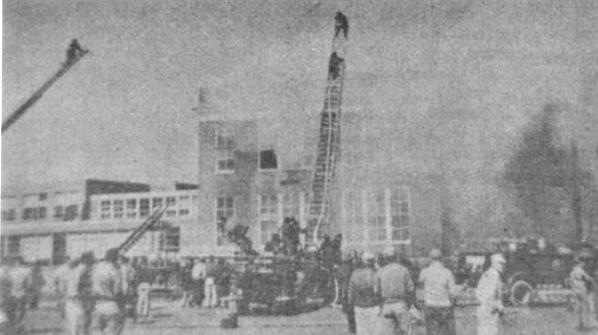
Marple-Newtown Junior High-Senior High School Fire, April 9, 1956

Marple-Newtown Junior High-Senior High School Fire, April 9, 1956

We were in the 8th grade of Marple-Newtown Junior-Senior High School. On that day we were eating lunch, getting ready for our next class when the fire alarm sounded. Must be a fire drill. We knew the drill. So did the teachers. The teachers led us outside, hand-in-hand in the continuous line processional we’d learned in those ridiculous fire drills. The school was going up in flames.

One of my classmates, Dave, remembers it this way:

The Boys’ Room was crowded with guys smoking cigarettes before class, the air was filled with a cloud of tobacco smoke and smells, so we didn’t have any indication that a fire was building below the first floor. Hearing the fire alarm, we stepped out into the hallway to see a trickle of smoke rising from each plank of the hardwood flooring. Seeing that smoke, we knew that the school and the students were facing a serious fire emergency. An orderly evacuation began and although it was a cold day, no one was permitted to go back to their homerooms for their coats.

To a chorus of cheers, we all stood outside shivering for what seemed to be a long time and watched the fire fully consume the building. To a chorus of boos, the fire trucks finally arrived and the volunteer firemen had trouble hooking up the hoses and getting water on the destructive blaze.

The school building was obviously a total loss and since I was cold, I decided to hitchhike home. It was about lunchtime, when I arrived home. My mother immediately descended on me, “…why are you home, are you playing hooky and where is your leather jacket?” “No,” I said. “It wasn’t my fault,” I blurted out, before feeling the back of her hand across my face. “Tell me the truth,” she demanded. I said,”the school burned down,” just before getting a fresh one on the other cheek.

One of the memories we share is the picture of Mr. Harvey, still inside the building, handing the typewriters out the upstairs window from his typing class to Seniors who were ascending and descending a firetruck ladder to save the typewriters until he had to come down himself to loud gasps and cheers.

Fred, remembers being “in typing class a year later using one of those ‘saved’ machines with melted keys.”

Ellie, who wasn’t in the building when the first started, adds something else:

I was approaching the school entrance after lunch at the pizza shop and was met by students rushing out to safety. Still remember that once we were all assembled by homerooms Mr. Rathey went tearfully from group to group checking whether we were all accounted for.

What a surreal day!

Mr. Rathey pointing

Mr. Rathey pointing

The miracle is that we all made it out safely. Before Mr. Rathey, shown here pointing to the school, could see his charges walk across the stage at graduation, he was diagnosed with cancer. The Class of 1960 presented him with a gold watch at his early retirement. Ellie reminded us today of Mr. Rathey’s tearful care on the day the school burned down and in the years that followed.

– Gordon C. Stewart, Chaska, MN, April 9, 2015.

A memory of Ken

The first Good Friday following retirement from active ministry is filled with the memory of a friend named Ken.

On Good Fridays from 2006 through 2013 Ken Beaufoy was the one member of the congregation I could count on to be with me in the Chapel from noon to 3:00 p.m. There were years when there were three or four. But most Good Fridays, it was just the two of us.

The pattern for the three-hours was very simple. Each half-hour began with a reading from the passion narratives of Gospels. A five minute silence followed, ending with a movement from Gabriel Faure’s Requiem. A brief prayer was spoken aloud. Another contemplative silence ended the half-hour segment.

There were times when I looked at Ken and felt as though I knew him the way his beloved wife, Ilse, had known him. Isle had been the third person in the pews before her death in 2007. Ken and Ilse were like no other couple I’d ever known and not only because theirs was the most unlikely of loves. Ken, a British soldier during the occupation of German following the end of World War II, and Ilse, a German soldier decorated with the German Silver Cross for bravery, fell in love during the occupation and made a life together against all odds. Their marriage was a sign of the power of reconciling forgiveness and love.

Two people never adored each other more than Ken and Ilse. During Ilse’s demise, when hope was scarce and hard decisions were made, I saw Ken’s faith up close and personal in his Good Friday moment of saying goodbye to his Ilse. As often happens between a pastor and a congregant, we became blood brothers until Ken died quietly in his sleep.

Today I’m remembering Ken and those six half-hour segments in the Chapel. I read the readings, listen to the movements of Faure’s Requiem – Introit et Kyrie, Offertory, Sanctus, Pie Jesu, Agnus Dei et Lux aeterna, Libera me, and In Paradisum – pray the prayers, and give thanks for a communion deeper than words. It still endures.