A sermon preached at Shepherd of the Hill Presbyterian Church in Chaska, MN the Sunday following the death of Dana Niskanen, a member whose father had been a professional shepherd.
The Three “Persons” of the Trinity
Reply

A sermon preached at Shepherd of the Hill Presbyterian Church in Chaska, MN the Sunday following the death of Dana Niskanen, a member whose father had been a professional shepherd.
The Gospel of Mark tells the story of the blind beggar who regained his sight. His name in Mark is “‘Bartimaeus’, the Son of Timaeus”. The name is strange because although the word ‘Son’ is in Hebrew (‘Bar’), the name ‘Timaeus’ is Greek, raising the question of what Mark wants his readers to “see” when the blind Son of Timaeus cries out “Son of David, have mercy on me!”
The New York Stock Exchange was closed down. For two full days the trading bell on Wall Street did not ring. But on Main Street the bells that mis-identify American freedom with Wall Street were ringing in our living rooms, flooding the airwaves with campaign ads about freedom and the loss of it.
In front of Westminster Presbyterian Church on the Nicollet Mall at the heart of downtown Minneapolis stands an eye-catching sculpture called “The Birth of Freedom.”. The figures are naked, emerging from primal slime, evolving, reaching toward the heavens.
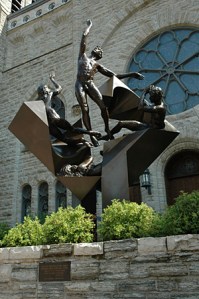
The Birth of Freedom, Paul Granlund
The late Paul Granlund was the sculptor. Westminster commissioned him to give visual expression to the words of the Apostle Paul:
“For freedom Christ has set you free; stand fast therefore, and do not submit again to a yoke of slavery.” (Galatians 5:1)
There is a freedom from and there is a freedom for.
“For your were called to freedom; only do not use your freedom as an opportunity for the flesh, but through love be servants of one another. For the whole law is fulfilled in one word, ‘You shall love your neighbor as yourself.’ But if you bite and devour one another take heed that you are not consumed by one another.” (Letter to the Galatians 5:13-15)
I listen to the campaign speeches. I hear the freedom talk. I see crowds cheering. I hear loud applause. And I wonder…what kind of freedom is being cheered? What kind of slavery is feared?
The advertisers who write the ads for the candidates and the PACs know the answers to these questions. They know that the psyche of American generations that grew up in the Cold War defines freedom as freedom from “Communism” or “Socialism.” They also know that the Christian Right fears submission to the “godless” whom they believe threatens their religious freedom.
But no one can take away my freedom or yours, and it is misleading to paint one’s political opponent as intending to take it way. For me, as a Christian, the freedom for which we are released (set free) is not freedom from but freedom for communion with my neighbors. It applies not only to personal relationships. It applies equally to the political and economic systems.
This morning the bell rang again at the stock exchange. The biting, devouring, and consuming of each other becomes a way of life again, the adored substitute for freedom. To condone it is to submit again to a yoke of slavery, the most widespread violence where, to quote Jacques Ellul,
“in this competition ‘the best man wins’ – and the weaker, more moral, more sensitive people necessarily lose.
“The violence done by the superior may be physical (the most common kind, and it provokes hostile moral reaction), or it may be psychological or spiritual, as when a superior makes use of morality and even of Christianity to inculcate submission and a servile attitude; and this is the most heinous of all forms of violence.”
– Jacques Ellul, Violence: Reflections from a Christian Perspective, Seabury Press, 1969.
Meanwhile Paul Granlund’s “The Birth of Freedom” still stands silently in downtown Minneapolis, calling for the birth of something as yet beyond our imagination. “Stand fast therefore [in the freedom for which Christ has set you free], and do not submit again to a yoke of slavery.” The Apostle Paul often wrote his letters from jail cells, charged with disturbing the Pax Romana.
“The competition that goes with the much-touted system of free enterprise is, in a word, an economic ‘war to the knife,’ an exercise of sheer violence that, so far, the law has not been able to regulate. In this competition ‘the best man wins’ – and the weaker, more moral, more sensitive necessarily lose. The system of free competition is a form of violence that must be absolutely condemned.
“The violence done by the superior may be physical (the most common kind, and it provokes hostile moral reaction), or it may be psychological or spiritual, as when the superior makes use of morality and even of Christianity to inculcate submission and a servile attitude; and this is the most heinous of all forms of violence.”
– Jacques Ellul, Violence: Reflections from a Christian Perspective, Seabury Press, NY, 1969)

Jacques Ellul
Jacques Ellul was active in the French Resistance Movement during World War II, a social critic, lay theologian, sociologist, Professor of Law and Government at the University of Bordeaux, and prolific author. His legacy includes The Technological Society, Propaganda, The Political Illusion, and The Presence of the Kingdom.
Click HERE for information on Jacques Ellul from the International Jacques Ellul Society.
October 14, 2012 at Shepherd of the Hill Presbyterian Church in Chaska
Text: Amos 5: 6-7, 10-15, 18-24
This morning I ask you which of the gods we will bow down and serve: the god of the profits, the organizing principle for those who were at ease in prophet Amos’ time, or the God of the Prophets who thundered against excessive profits in the marketplace?
Some will say that’s too simple.
Amos didn’t think so. Isaiah didn’t think so. Micah didn’t think so. Jeremiah didn’t think so. Jesus didn’t think so. Mohandas Gandhi didn’t think so. We’ve heard from Amos and from Jesus. Here’s what Gandhi called the Seven Deadly Sins of Society. The first sin on Gandhi’s list is
Less than one month before we go to the polls to cast our votes for candidates for public office, I put before you from this pulpit the question of which God you will serve.
Will you commit yourself, or re-commit yourself, to the God of the biblical prophets, or will you line up your life and your values behind the god who thinks there’s no problem with wealth without work, worship without sacrifice?
I have never been more troubled in my life than I am today. It’s not because belong to a political party. It’s not that I want my team to win and the other team to lose. It’s because I believe in the God of the Prophets. I wake up every morning to scripture. And what do the scriptures say?
There were two sets of scripture that informed Jesus’ life. The Torah (also referred to as “The Law”) and the Hebrew prophets. “All the Law and the prophets are summed up in this: You shall love the Lord your God…and your neighbor as yourself.”
Jesus put the Voice of the prophets in the center of Jewish faith and life. Often he sounds like Amos.
We celebrate the Beatitudes of Jesus’ Sermon on the Mount or the Sermon on the Plain. We read in Luke’s Gospel:
“He lifted up his eyes on his disciples and said,
And our hearts rejoice. Because some of us, like Jesus’ first disciples, live in poverty; some of us know what it is to be hungry. Some of us are weeping now, wondering when we will laugh again.
Jesus consoles us. And these words of consolation are lifted up in the churches, as they should be.
But you can’t stop reading there if you want to follow Jesus. For in the very next lines of Jesus’ Sermon to his disciples, he echoes the thundering voice of the prophet Amos and his Woes:
Jesus is calling it like it is. He is describing the revolution of economics, political power, and redistribution of wealth that is the Kingdom of God. The Kingdom of God is an economy – God’s economy. The economy preached by the biblical prophets and Jesus. The world of our best dreams where no stomach is empty, no one goes hungry; no one goes without health care. No one lives on the street under the viaduct, or in a car. No longer will those who have laugh at or pass by those who don’t.
The message of Jesus does console. It comforts the afflicted. But it also afflicts the comfortable. It causes trouble. It makes waves. It speaks the truth. It cuts through the lies that keep the privileged privileged. It calls us to take responsibility in the here and now – to implement in the most practical ways the summary of the Law and Prophets. The over-riding question for the Christian is HOW to love my neighbor as myself? How to live now in the economy of God as the protest of hope and love within the economy of greed, disparity. How to live NOW as those whose worship DOES mean sacrifice.
A businessman notorious for his ruthless pursuit of profits once announced to Mark Twain that before he died, he meant to make a pilgrimage to the Holy Land. “I will climb Mount Sinai,” said the ruthless profiteer, “and I will read the Ten Commandments out loud from the top of Mount Sinai.”
“I have a better idea,” said Twain, with a twinkle in his eye. “You don’t have to go to the Holy Land. You could stay home in Boston and keep the commandments.”
Earlier in his life, Samuel Clemens (who became known as Mark Twin) had been a young reporter in Virginia City. He was walking along the street one day with a cigar box under his arm when a wealthy lady acquaintance said to him scornfully, “You promised me that you would give up smoking.”
“Madam,” he said, “this box does not contain cigars. I’m just moving.
Today we are asked to make a decision of stewardship. In three weeks we will make other decisions in the voting booth. As we consider these decisions, remember Amos yourself which God of the Prophets/Profits your decisions will honor. Will your action bear witness to the economy of greed and extravagance, the world of Gandhi’s Seven Deadly Sins?
Or will your decisions proclaim with Jesus the different Kingdom for which every heart longs to celebrate?
In conclusion, a writer named Ted Kooser invites you to think of yourself as a Daddy Longlegs. You know the Daddy Longlegs, those strange creatures with those tiny little brown bodies like a small brown pill, walking across the floor on those eight long legs.
“Here, on fine long legs springy as steel,
A life rides, sealed in a small brown pill
That skims along over the basement floor
Wrapped up in a single obsession.
Eight legs reach out like the master ribs
Of a web in which some thought is caught
Dead center in its own small world,
A thought so far from the touch of things
That we can only guess at it.
If mine, it would be the secret dream
Of walking alone across the floor of my life
With an easy grace, and love enough
To live on at the center of myself.
You don’t have to go to the Holy Land to read the commandments from Mt. Sinai. Walking on your eight long legs across the floor of your life, you can walk with an easy grace, and with love enough to live on at the center of yourself…You can make love real today right here in Minnesota.
The “Nones” are the fastest growing group in the United States religious landscape. Time publicized the story in its March 12, 2012 issue.
Last week Rose French, religion editor of the Star Tribune here in Minneapolis, personalized the Pew Forum research in “Fastest growing group in religious circles? The ‘Nones’” (10.15.12).
The story begins with Marz Haney, a young woman who grew up attending an evangelical Christian church every Sunday. But she had questions. And, it appears, the church she attended wasn’t big enough for her big questions.
Questions and doubts are not enemies of faith. They are the friends of faith. They refine, correct, expand, and reform faith. They challenge what Jean-Paul Sartre called “bad faith.”
Sartre, of course, thought that all religious faith was bad. Some of the “Nones” agree with Sartre. Others still profess faith or “spirituality” but live it outside the boundaries of the traditional institutions that no longer hold meaning for them.
“I had some doubts all along. I was sort of in continual doubt about my personal salvation,” says Marz Haney.
That Marz and others have concluded that spirituality/faith/religion is all about personal salvation brings me great sadness. That she would think so is a reflection of the right turn that began to dominate the American religious landscape beginning in the 1950s.
To many of the “Nones”, fear and hate have become the face of Christianity. Sometime in the late ’50s, the televangelists began to change the face of Christianity to the world. Those who tuned in watched and heard the voices of snake oil salesmen selling purple handkerchiefs that would heal, if only you purchased one and put the hanky on your television screen while the evangelist prayed for you. Intelligent faith was turned into an oxymoron. One either is intelligent and without faith, or full of faith and without intelligence.
At the coffee shop recently, the proprietor who greets me “Good Morning, Your Reverence” with a smile, invited me to join a conversation he was having with two other coffee drinkers. “You can help us here,” Mike said. His grin told me this was a set up. “If God created the world, who created God?”
“Hmmm. Interesting question. Really good question. Really, really, really good question. It assumes, of course, that everything is created. That’s the way we think. If something’s here, it has to have been created. But that begs the question endlessly. So….maybe some things are not created. Whatever that is ultimate reality. In theology, the word we use for the ultimately real is ‘God’.”
 Several weeks later a young couple sat at the table at The School of the Wise, a coffee shop and wine bar humorously named after the euphemism for speakeasies during the era of Prohibition. The couple had sent a message through the church’s website inviting a conversation about their needs and whether Shepherd of the Hill Church might be a good fit.
They were “Nones”. I love this couple! They made my evening. So honest. So genuine. So open. Wondering and hoping that perhaps Shepherd of the Hill might be a place unlike that mega-church up the road whose very small print declares belief in “the intention, eternal punishment of the wicked”. They were cautious but feeling the need for a community that welcomes rather than scorns, unites rather than divides, thinks as well as feels, and moves them beyond self-absorption in the comfortable but confining precincts of economic privilege.Sitting in a coffee shop with The New York Times on Sunday Morning over a cup of coffee was no longer enough.
Which, of course, is what the gospel is about, as I understand it.
Jesus had one message: “the Kingdom of God/Heaven is at hand.” A “Kingdom” is a society, a commonwealth. A society is people in relationship. “At hand” means “Now!” The kingdom of Heaven was something like the heaven the young couple and I were experiencing right there at the back table in The School for the Wise – real people in real relationships, exploring ultimate reality over delicious mocha-mint-lattes, looking beyond our privilege and celebrating the magnificence of a moment that is at the very heart of creation as we know it.
“Views from the Edge” is not partisan. We couldn’t care less who owns the ideas. It’s the ideas themselves we care about. Our intent is to unpack the deeper philosophical and religious convictions embedded, like Pavlov’s bell, in our speech and public policy.

Whenever we salivate at the mere hint of the conviction of national superiority or privilege, Socrates is whispering from off-stage. “The unexamined life is not worth living.”
“Truthout” granted permission to re-publish “The Measure of a Nation” Challenges Illusions of American Superiority (Sunday, 07 October 2012).“Book Review: Author Howard Steven Friedman compared the US with 13 competing countries on health, education, infant mortality, life expectancy and other critical social and economic indicators. He found only one in which America excels: producing billionaires.
“In his book, ‘No Apology: The Case for American Greatness,’ Mitt Romney laid his cards on the table: ‘I’m one of those who believe America is destined to remain as it has been since the birth of the Republic – the brightest hope of the world.’
“Obama’s reluctance to acknowledge America’s manifest moral and economic superiority is for Romney a telltale of his essential foreignness. ‘American prosperity is fully dependent upon having an opportunity society – I don’t think President Obama understands that,’ he told the Republican Jewish Coalition last Pearl Harbor Day. ‘I don’t think he understands why our economy is the most successful in the world. I don’t think he understands America.’
Click HERE for the entire piece.
The idea of “the Chosen,” otherwise described on “Views from the Edge” as “Exceptionalism,” is perhaps the deepest, least examined conviction of the long history of the United States of America. The misapplication of the biblical call to Abraham is pernicious.It leads to mischief and war. Every citizen of whatever country is responsible to love that country and to engage it in a lover’s quarrel. The notion of national superiority is not love. It’s an illusion.

Paul Johannes Tillich
This morning’s crossword quote is from theologian Paul Tillich:
“The first duty of love is to listen.”
To learn more about Paul Tillich click THIS LINK.
Most weeks I return to the works of Tillich. Paul Tillich has rescued many a faith, including my own, when doubt had been mis-perceived to be faith’s enemy.
“Doubt is not the enemy of faith; it is one element of faith.”
– Paul Tillich, The Dynamics of Faith
Tillich’s statement about faith and doubt go hand-in-glove with listening as the first duty of love. If you missed “Staying Together” on Views from the Edge’s, scroll down. Steve’s poem puts these two Tillich quotes into practice of listening. Here’s a sip:
“Listen, learn, respect, rephrase, repeat
before you even start to speak.”
 Views from the Edge