
Reflections along the way of a terminal illness

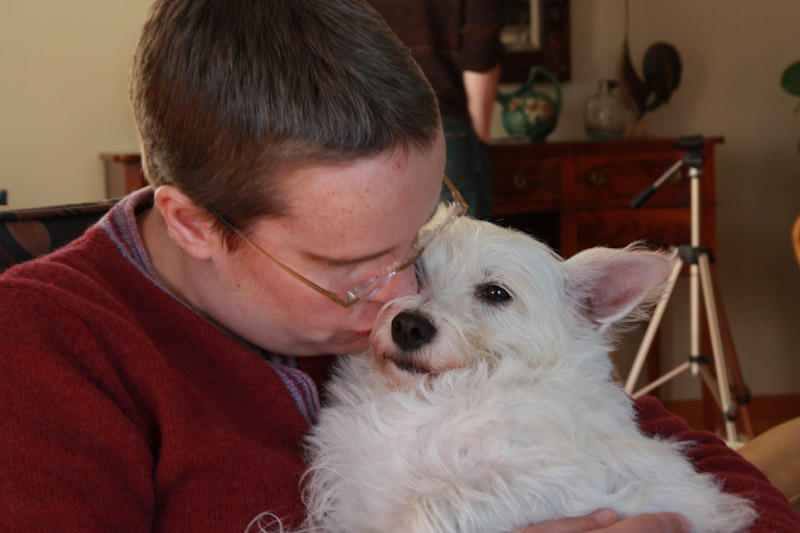
Katie and Maggie sharing a moment of sadness. Maggie knew!

Katie and Maggie sharing a moment of sadness. Maggie knew!

Today, three years to the day after Katherine’s (“Katie’s”) death (May 9, 2010), we inter her cremains.

IT’S RAINING, IT’S POURING” was written the day we learned that Katie’s incurable Leiomyosarcoma had taken a turn for the worse. In memory of Katherine (“Katie”) Elizabeth Slaikeu Nolan.

Gordon C. Stewart Feb. 11, 2009

It’s raining, it’s pouring
The old man is snoring
He went to bed and he bumped his head
And couldn’t get up in the morning

It’s a day like that. I bumped my head on the illness of a 33 year-old loved one. It’s raining sadness. I’m having trouble getting out of bed in the morning.

Terminal illness has a way of doing that unless you believe in miracles of divine intervention or you have extraordinary powers of denial.

My spirituality has become increasingly like that of Rebbe Barukh of Medzobaz, an old Hasidic master in Elie Wiesel’s tale of Four Hasidic Masters and Their Struggle Against Melancholy. When he prayed the customary Jewish prayer, “Thank you, Master of the Universe, for your generous gifts – those we have received and those we are yet to receive” – he would startle others with his weeping. ‘Why are you weeping?” one of them asked. “I weep,” he said, “in thanksgiving for the gifts already received, and I weep now for the gifts I have yet to receive in case I should not be able to give thanks for them when they come.”

For my family at this critical time, the real miracle has already occurred – the shared gift of love – and it will come again in ways I cannot now anticipate when the last page of the final chapter of our loved one’s life is over.

The miracles are more natural, nearer to hand. Although I don’t believe in selective divine intervention, I am on occasion a sucker for denial – except on days like this when it’s raining and gray and I’ve bumped my head on the hard fact that cancer is ransacking my loved one’s body. A certain amount of denial, too, is a blessing in disguise, one of God’s generous gifts to keep us sane when the rain pours down and clouds are dark.

Faith comes hard sometimes. In college mine was challenged and refined by Ernest Becker‘s insistence that the denial of death lies at the root of so many of our problems. My faith has been refined along the way by the courage of Albert Camus and Jean-Paul Sartre to face the meaninglessness of the plague, the faith and courage of Dietrich Bonhoeffer and Paul Tillich who stuck their fingers in the gears of Nazism, and the humble witness of Mother Teresa working in the slums of Calcutta with more questions than answers and some anger at God.

The job of faith, as I see it, is to live as free as possible from illusion with a trust in the final goodness of Reality itself, despite all appearances to the contrary. Faith is the courage and trust to look nothingness in the eye without blinking or breaking our belief in the goodness of mortal life.

When I look into my loved one’s eyes I see that courageous kind of faith that defies the cancer to define her, and a resilient spirit that makes me weep tears of joy over the gifts we’ve already received and the ones we have yet to come.

It’s still raining and it’s still pouring, but I refuse to snore my way through this. I’ve bumped my head on the news of a loved one’s terminal illness, but I’m getting up in the morning.

POSTSCRIPT March 21, 2012

Conversation yesterday about “The List” posted on Bluebird Boulevard:

Karen:

My mother died of cancer eight years ago. Her loss is still visceral. She is in every bird I see.

Me:

The morning of Katherine’s memorial service Kay, Katherine’s mother, was standing by the large picture window gazing out at the pond in our back yard. Out of nowhere, it seemed, two Great Blue Herons flew directly toward the window and swooped upward just before they got to the house. “She’s here. That’s Katie,” said Kay without a second’s hesitation. On her last day of hospice care, Kay and I each remarked that her face looked like a baby bird. I’m a skeptic about such things. I’ve always been, and always will be, a doubting Thomas. My assumptions and conclusions come the hard way. But on the day the herons flew directly at Kay from across the pond, I saw it with my own eyes…and HAD to wonder.

Within a minute a third Great Blue Heron perched on the log by the edge of the pond and stood alone for a LONG time. It reminded me of a gathering on the steps of the State Capitol in Saint Paul following the tragic deaths of school children at Red Lake, MN. The crowd stopped listening to the speaker. They were looking up. “What’s going on?” I asked Richard, the Red Lake American Indian advocate and my co-worker at the Legal Rights Center.org. “Eagles,” he said. “Where?” “WAY up. They’re circling.”

I learned later that the eagles were also circling at that same moment over the grieving families gathered at Red Lake. I asked American Indian colleague what he took it to mean. “We don’t ask. That’s the white man’s question,” he said. “We just accept it. We live in the mystery.”

Katherine Slaikeu Nolan

Katie and Chris at Arenal Volcano, Costa Rica

Katie and Chris at Arenal Volcano, Costa Rica

Today we inter Katherine’s (“Katie’s”) ashes – three years to the day after she left her cancer behind at the age of 33.

It takes awhile sometimes. The stages of grief don’t come in standard sequence like the innings of a baseball game.

In “The Final Time” in Max Coots’ collection of poetic prose, Seasons of the Self (Abington Press, 1971), he wrote:

It takes a little while to know how much of life is death and not to dread it so.
To sense the equilibrium of the earth,
To be at home in time, and take the limits of both life and love.

A person’s death is a private thing, like grief, like prayer, like birth.
I know nothing of that final time, except what I know of life,
But I know I live and in my life I have so many opportunities to die,
For death is many things and times,
Before the days are gone,
But I have, yet, a while, and things to be, and much to do.

Max Coots is a poet and Minister Emeritus of the Canton Unitarian-Universalist Church in Canton, NY. His words still echo today as the family gathers to lay Katie’s ashes to rest. Special prayers today for Katherine’s husband Chris, her mother Kay, her father Steve, and her siblings Kristin and Andrew.

It’s the little deaths before the final time I fear.
The blasé shrug that quietly replaces excited curiosity,
The cynic-sneer that takes the place of innocence,
The soft sweet odor of success that overcomes the sense of sympathy,
The self-betrayals that rob us of our will to trust,
The ridicule of vision, the barren blindness to what was once our sense of beauty –
These are deaths that come on so quietly we do not know when it was we died.

Precious Lord, deliver us from these, and grant us peace within the limits of life and love.

The Donkey: a Kid’s Verse

“The Donkey” has been waiting for the right occasion. Dennis Aubrey’s photographs and commentary “The Ineffable” on Via Lucis Photography linking suffering and beauty led me fetch “The Donkey” from the “draft” file today for reasons hard to explain.

What I love about Dennis’s commentaries is that he refuses to engage in simplicities that reduce ambiguity to something manageable.

It led me this morning to The Passion (“suffering”) of Jesus, which begins Palm Sunday with a mistaken public perception: the Redeemer is a King who will vanquish the Roman “King” and who, perhaps, by his “Triumphal” Entry, will triumph over suffering.

The wish to escape suffering is, in some way, the kiss of death. There are Christian theologians today who argue that we should remove the cross as the central Christian faith symbol because it glorifies suffering, shifts the focus away from Jesus’ life, and contributes to the perpetuation of violence. But to do so would be to run and hide from the peculiar mystery of the human condition described by Dennis Aubrey’s piece – the ineffable and the beautiful in the face of suffering. The truth is in the paradox and the contradiction.

Steve’s poem brings all of that to mind. Jesus sets his face toward Jerusalem to free it from its military-economic occupiers and from its own violent self. The Passion continues to arrest our deepest soul in the mystery of life in the face of suffering and the abyss of nothingness. As Dom Sebastian Moore observed, “the crucified Jesus is no stranger” – we put him there…and we are he.

A Poem for Palm Sunday: “The Donkey: a Kid’s Verse…”

The coats the folks are throwing down

sure make it hard for me to walk

especially carrying this clown

whose feet are almost to the ground.

“Hosannah King!” is all the talk,

but this guy seems to be as poor

as I am–no one could mistake

him for a Royal–he’s just a fake!

They wave palm branches, and they roar,

but my long ears can hear the real

parade across the city square:

the General, the Priests, the score

of war horses–the whole grand deal.

This pitiful parade will fail

to save a soul, and soon the yell

will change from “Hail!” to…”Kill!”

– Verse by Steve Shoemaker, Urbana, IL, March 28, 2012

Verse – Dreams of Failure

Why now, in my retirement, age 70,
have I a vivid dream of being at mid-semester
in a college American History class
and not even knowing when the class meets?
I dream I like the teacher, even the subject,
but I had been sick some, otherwise occupied often,
and absent always… I know I cannot catch up.
Where has the class been meeting?
Who will loan me their notes, and why should they?
Do I even own the textbook or have the syllabus?
The mid-term exam is over; the term paper
for the semester is due soon; the extra credit
readings form a mountain of unread pages;
I don’t know where the library is…

(Am I afraid of a Last Judgment
by God? Have I been truant from life?
Have I spent whole days with trivia, with trash,
with momentary pleasures?)

Then I dream of dying in a head-on car crash.

– Steve Shoemaker, Urbana, IL, May 2, 2013 having a bad night at 70 😦

Two kinds of prayer :-)

Verse — Sanky Reed

Standing in the center aisle
of the small church, she told her friend
about a thief the night before
(while she was sleeping) broke into
her shed and stole her new chainsaw.

Agnes said, “Well, we should pray
for him–we are in church.” Sanky
said, “Let’s pray he cuts off his leg!”

– Steve Shoemaker, Urbana, IL

The Blessing of the Animals

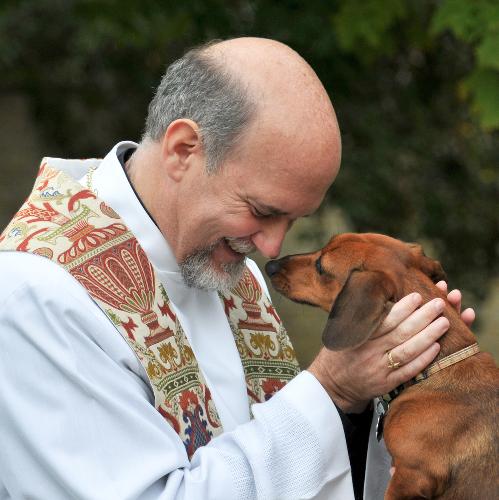
Bald priest, Fr. Paul Jarvis, blesses furry friend

Bald priest, Fr. Paul Jarvis, blesses furry friend

Friend and colleague Father Paul Jarvis could have written these words of Franciscan Friar Kevin E. Mackin, O.F.M about The Blessing of the Amimals:

The bond between person and pet is like no other relationship, because the communication between fellow creatures is at its most basic. Eye-to-eye, a man and his dog, or a woman and her cat, are two creatures of love.

No wonder people enjoy the opportunity to take their animal companions to church for a special blessing. Church is the place where the bond of creation is celebrated.

At Franciscan churches, a friar with brown robe and white cord often welcomes each animal with a special prayer. The Blessing of Pets usually goes like this:

“Blessed are you, Lord God, maker of all living creatures. You called forth fish in the sea, birds in the air and animals on the land. You inspired St. Francis to call all of them his brothers and sisters. We ask you to bless this pet. By the power of your love, enable it to live according to your plan. May we always praise you for all your beauty in creation. Blessed are you, Lord our God, in all your creatures! Amen.”

Father Paul, one of God’s balding creatures, is Pastor of St. Joseph in Rosemount, Minnesota, and former Pastor of Guardian Angels Catholic Community in Chaska. He is recovering from emergency open heart surgery. Blessings to Paul, his family, friends, parishioners, and furry friends.

The Deeper Silence of Boston

Video

This sermon was preached at Shepherd of the Hill Presbyterian Church in Chaska, MN the Sunday following the bombings at the finish line of the Boston Marathon. It draws on Red Sox player David Ortiz’s nationally televised statement “This is our (expletive) city!”; Richard Rohr’s “Finding God in the Depths of Silence” (Sojourners, March, 2013), and the Epistle of James’ insight that the “tongue” (i.e., speech) is “a restless evil” ready to curse others even while it blesses “the God and Father of us all.” “Brothers and sisters,” writes James, “this should not be so!”

The sermon calls for engagement in the inner silence that moves down into the undivided reality that words so easily and quickly divide and destroy. It ends with the Pie Jesu from Gabriel Faure’s Requiem and the invitation “Be still, and know that I am God.”

A prescription for spiritual health

Video

A sermon on forgiveness as releasing or letting go preached at Shepherd of the Hill Presbyterian Church in Chaska, MN April 7, 2013. The sermon is indebted to Professor Robert Kegan, neo-Piagetian psychologist at Harvard University and Professor Mona Gustafson Affinito, Southern Connecticut State University Professor Emerita and author of Forgiving One Page at a Time and other books on the theology and psychology of forgiveness.

Views from the Edge re-published today

Thanks to Sojourners for publishing “After Boston – Above and Beyond“, published earlier on Views from the Edge.

End the Violence

Today’s Sojourners’ blog posted End the Violence .

After reading this article, I submitted this comment about the “comments”:

I am continually amazed and dismayed by the character and content of comments on articles like this. I have the sense that Glenn Beck and Rush Limbaugh have told their listeners, “Go on Jim Wallis’ blog and take him down!” Lines like “liberal Christian drivel,” “a law that restricts a persons (sic) ability to fulfill their divine obligation to protect their home and family” (the legislation does NOT restrict it, and there is no such “divine mandate” except in the NRA Bible), and “what are these faith leaders doing about abortion?” (when the issue here is violence with guns and the allegation is that religious leaders must choose between the two) – these comments do not engage the issue.

There is an anti-legislation, anti-democratic, anti-government streak in so many of these comments. The comments are political in the worst sense, demeaning the integrity of the writers and stereotyping their views into predetermined conclusions.

This seems to be the nature of the blogosphere, but it is especially distressing to see it here on Sojourners where readers mostly profess Christ and have attempted to take to heart The Epistle of James, “So the tongue is a little member and boats of great things. How great a forest is set ablaze by a small fire!” The tongue is “a restless evil, full of deadly poison. WITH IT WE BLESS THE LORD AND FATHER, AND WITH IT WE CURSE OTHERS, WHO ARE MAD IN THE LIKENESS OF GOD. FROM THE SAME SOURCE COME BLESSING AND CURSING. Brothers, this ought not to be so. (James 3:5-10).

As a writer and a blogger, I am grateful that the comments on Views from the Edge are respectful and thoughtful. Those of you who choose to comment engage the substance of what this blog posts. Such is not the case with the Sojourners blog with Jim Wallis. Jim Wallis is a progressive evangelical Christian, author of “God’s Politics: How the Left Doesn’t Get It, and the Right Gets It Wrong” and subsequent books on American values, economics, religion, and politics. Glenn Beck has publicly targeted him as a Social Gospel liberal (i.e.) a socialist disguising himself as a Christian.