Click HERE for the YouTube broadcast of last Sunday’s sermon at Shepherd of the Hill Presbyterian Church in Chaska, MN. The sermon text is published on this blog as “The Biouquet” and on the Sojourners blog, blogging with Jim Wallis.
Category Archives: Spirituality
The Bouquet
Re-posted by Sojourners’ blog, “God’s Politics with Jim Wallis” March 27, 2012.
Most every Sunday Ruth or Lily Janousek hands me a drawing on the way out the door. I have quite a collection. Lily and Ruth are budding theologians. They may not know that about themselves, but that’s what they are: budding theologians – they do theology, they do their best to speak of God.
They draw pictures of God and us. Like the one from last Sunday. The drawing of a bouquet with the words:
“God doesn’t loves us as a flower but as a bouquet”
Right then and there, standing at the door last Sunday, I knew I had the sermon for the next week in my hand.
Ruth’s drawing took me back some years ago when I had the great privilege of serving as the summer minister for Saint Timothy’s Memorail Chapel in Silver Cross, Montana, a ghost town with four residents where they would bring the world’s greatest preachers! One of the four residents of Silver Cross was the 92 year old Eliza who lived up the hill, perhaps the length of a football field, from Saint Timothy’s . Every Sunday morning Eliza would cut the wildflowers in her yard, arrange them into a beautiful bouquet and place them on the altar for worship. Now I get a drawing from eight year old Ruth, younger version of the 92 wilting theologian, Eliza.
“God doesn’t love us not as a flower but as a bouquet.”
I wonder who the flowers are in this bouquet, the Kingdom of Heaven, as Jesus speaks of it in the Beatitudes of the Sermon on the Mount (Matthew 5:1-14) or, the Body of Christ, as Paul speaks of it in First Corinthians.
As in Ruth’s drawing and Eliza’s Sunday morning arrangements, a bouquet is made up of a variety of flowers. Individual flowers come in a single size and shape, eac with its own color. In a bouquet, these different colors, shapes and sizes complement and contrast with one another to make something altogether beautiful in the hand of a skilled florist.
Ruth may be a rose and Lily a sunflower, Bob might be a purple Iris, and I might be…a Milkweed or a thistle or a twig of red oshier – but put us all together and we become something more than who we are.
God loves us as a bouquet. We are God’s bouquet. We are the flowers; God is the florist; we belong in God’s bouquet.
Could this be what Jesus is talking about in the Sermon on the Mount? Could the collection in Jesus’ Beatitudes be the bouquet, the Kingdom of Heaven?
Listen to the florist’s strange list of flowers in this bouquet:
Blessed are the poor in spirit;
Blessed are those who mourn;
Blessed are the meek,
Those who hung and thirst after righteousness,
The merciful, the pure in heart,
The peacemakers,
Those who are persecuted,
Those who are slandered against for doing what’s right.
“You are the city set on a hill that cannot be hid. the bouquet that cannot be ignored.”
Until this morning, I had always thought of these individual beatitudes as a description of the individual life of the disciple of Jesus. But to think of them that way is depressing because it’s unachievable.
In a former pastorate I used to visit four young men in psychiatric institutions whose demented states of mind I was sure were rooted in some way to their failure to measure up to this impossible spiritual standard. Each of them was a professor’s son. Each of them had been raised on a missionary style of Christianity. Each of them had been raised to feel sorry for the persecuted, the meek, the poor, the oppressed. And each of them, as we walked the grounds of the psychiatric hospital in Mansfield, would talk as though he should be able to save the world from its pain. Each of them seemed to believe that purity of heart meant being like Jesus – which meant to them incessant suffering, guilt, and sorrow.
Each of these brothers bore the marks of the Beatitudes. Each was poor in spirit. Each hungered and thirsted for justice. Each was merciful. Each was pure in heart. Each felt persecuted for pursuing what was right in a world that didn’t care or didn’t know. Each of them felt slandered for doing what their parents – and Jesus – had taught them to do.
But there was one quality that was missing: the quality of meekness…
So long as they lived in the illusion that they, as individuals. were responsible for the world as It was, or that each of them alone was responsible for ridding the world of its suffering, each of them was lost in the lonely world of a flower without a bouquet. So long as they embraced the twisted missionary moralism of their distorted Christian upbringings, they would suffer the horrors of shame and loneliness.
Now, I know, of course, that each of the four brothers I visited back then were mentally ill. They didn’t choose to be in the state psychiatric institution. But I also knew their parents. And I knew the church in which they had been raised. It came as no surprise to me that there seemed to be a profound connection between what I was hearing from the homes and the church of their upbringing and what I was hearing form their sons in the psychiatric hospital.
I have to admit to sharing in the twisted spirituality that saw the Beatitudes as a list of requirements for the Christian life. It’s made me sick along the way.
But this morning, in light of Ruth’s yellow card from last Sunday, I’m seeing them differently.
“God loves us not as a flower but as a bouquet.”
Not every flower in God’s bouquet is poor in spirit. Not every one of us is in mourning. Some of us got up this morning with smiles on our faces and a song in our heart. Not every one of is meek. Not everyone came here this morning hungering and thirsting for righteousness – some of us came out of habit; some of us came for comfort, some of us came to sing some hymns. Some of don’t know why we came. Not everyone is known by acts of mercy – we come with grudges and desires for retribution. Not everyone is pure in heart or a peacemaker. And almost of none of us is being persecuted as advocates for social justice.
But TOGETHER all of those blessed people are here in God’s Bouquet.
Makes me wonder whether Jesus had read the Bhagavad Gita, the Hindu scriptures of India written two to five centuries before he preached the Sermon on the Mount in Palestine. Listen to its familiar ring, and let the Florist place you in the vase of God’s remarkable Bouquet.
“I am the Self…seated in the heart of every creature. I am the origin, the middle, and the end that all must come to.
“All your thoughts, all your actions, all your fears and disappointments, offer them to me, clear-hearted; know them all as passing visions.
“Thus you free yourself from bondage, from both good and evil karma; through your non-attachment, you embody me, in utter freedom.
“I am justice; clear, impartial, favoring no one, hating no one. But in those who have cured themselves of selfishness, I shine with brilliance.
“Even murderers and rapists, tyrants, the cruelest fanatics, ultimately know redemption through my love, if they surrender
“To my harsh but healing graces. Passing through excruciating transformations, they find freedom and their hearts find peace within them.
“I am always with all beings; I abandon no one. And however great your inner darkness, you are never separate from me.
“Let your thoughts flow past you, calmly; Keep me near, at every moment; trust me with your life, because I am you, more than you yourself are.”
Seeing the crowds, Jesus went up on the mountain, and when he sat down, his disciples came to him. And he opened his mouth and taught them, saying:
“You – together – are the salt that preserves the earth from its own self-destruction.
“You – together – are the city set upon a hill that gives light to the world.”
We – together – each and all – are God’s bouquet. God loves us as a bouquet!

Sermon: “Blogging on the Cross”
Sermon, Shepherd of the Hill Presbyterian Church, Chaska, MN March 18, 2012.
Click HERE for the YouTube re-broadcast.
A Sermon on Suffering
The post of my friend Steve Shoemaker’s poem “Murillo’s Christ after the Flagellation” and the comments that you posted prompted the sermon I delivered this morning at Shepherd of the Hill Presbterian Churchin Chaska, MN. The sermon never would have happened without your thoughtful, penetrating comments on the earlier post. THANK YOU. Here’s the sermon.
THE FLAGELLATION
“Now the men who were holding Jesus mocked him and beat him; they also blindfolded him and asked him ‘Prophesy! Who was it that struck you?’ And they spoke many other words against him and reviled him.” – Gospel of Luke 22:63
Two months ago I created a blog. One of my seminary classmates, Steve Shoemaker, wrote the other day to say that he was impressed by how prolific I was. I thought maybe he meant “wordy” until he said that my productivity embarrassed his laziness as a poet. So, he said, “Here’s the deal I’ve made with myself. For every piece you put up on your blog, I’ll write a poem.” Steve is 6’8 and a basketball player in college. Clearly, he hasn‘t lost his competitive spirit.
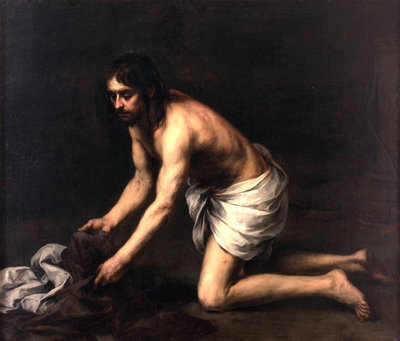
A poem arrived last Friday. It’s a reflection on a painting by sixteenth century Spanish artist Bartolomé Esteban Murillo. In the painting, Jesus is bent over on all fours after he being mocked and beaten.

Christ after the Flagellation
Steve’s poem, “Murillo’s Christ after the Flagellation” changed the direction of the sermon this morning. Here’s the poem.
The human had been tied to the whipping
post, a pillar that had been used many
times before by the Romans (and ages
earlier by the Greeks–but for a much
different purpose). Now, his pale skin looks
translucent (should it not have been darker,
with more blood?) His mother recalled his bris.
They had both cried then, too.
A strong young man, broad back, thick arms, now on
hands and knees, but head raised with eyes open:
seeing a cross that’s even worse ahead…
Still, unflinching, resigned–no, determined
to go on, face more pain, indignities,
shame, even death (there is no sign of God.)
Shortly there arrived a brief comment from a blogger who blogs about the daily struggle with mental illness.
“This poem brought tears to my eyes.”
Score one for my friend Steve.
Later in the day another comment arrived on the blog in response to Steve’s poetry. Like the first comment, this one also comes from someone with a history of some kind of long-term suffering. It reads as follows.
I have a response to the stories of Christ’s beating that often leaves others aghast. So brace yourselves:
He was beaten for several hours, or a day or two? Big deal. Those of us who have suffered years of abuse and terror know what real suffering is.
I don’t find focusing on Jesus’ suffering, or any of that 12 stages of the cross crap, to be helpful at all. I find it to be insulting. As if there is something noble and glorious about suffering. Nope, not a damn thing to recommend it. I know that Jesus voluntarily placed himself in the position for that to happen. So? Doesn’t help.
Please, fellow readers, don’t think that I am an isolated one, or few. There are lots and lots of us feeling this way.
The world is full – FULL – of people who have suffered much worse for decades or lifetimes. Think of people who live in North Korea. Or poor girls growing up in India. Or young girls in Fundamentalist Church of the Latter Day Saints settlements who get married off to much older men and are then raped daily for the rest of their lives. Jesus’ few days of humiliation are nothing in comparison.
The Lenten/Easter season is my favorite church season because I am reminded of how deeply I am loved and how quickly I am forgiven. Jesus’ brief beating plays no role in that….
The writer is hardly alone in his thinking about this. What do we say about those whose tenures of torture and suffering far exceed the relatively short period of Jesus’ suffering? Is focusing on Jesus’s suffering and the stations of the cross insulting to those who have suffered, and continue to suffer, for decades or for a lifetime?
How would you reply to the writer?
Here’s how I responded:
Your thoughtful response calls for an equally thoughtful reply. So I’ll try.
The cross, in my theology, in no way minimizes or disrespects the suffering of others. Nor does it say, as it is too often understood by sacrificial atonement theology, that suffering itself is noble or glorious. The cross was an instrument of Roman torture and execution. The Jesus who was tortured and executed, as were thousands of his Jewish contemporaries, is not somehow God masquerading in human flesh. That being said, moving the cross to the sidelines of Christian faith and reflection is, in my view, a mistake. Well meaning because it reacts against the twisted theology that understood it to be separate from, and above, all other human suffering, but mistaken nonetheless.
When I look at the cross, I see all these people. And I see myself there as both the crucified and the crucifier. What I see in the crucifix is total abandonment. “My God, my God, why have you forsaken me!” And in some way I hear not only the cry of Jesus but the cry of the God Dietrich Bonhoeffer described as the Divine Center we push to the edge of the world. I see in the Christ-event the tragedy and the hope of the divine-human encounter.
Sebastian Moore (The Crucified Jesus Is No Stranger and The Inner Loneliness) and Joseph Campbell awakened me to this richer Christology. Moore: “We have to think of God as closer to our evil than we ever dare to be. We have to think of God not as standing at the end of the way we take when we run away from our evil in the search for good, but as taking hold of us IN our evil, as the sore point which the whole idealistic thrust of man is concerned to avoid.
“Redemption through the blood of Christ is (wrongly!) interpreted as the bending of Reality itself to man’s great dream of himself. And it is exactly the reverse. It is the ending of the dream. It is the beautiful collapse of the whole enterprise. It is the invasion of man by himself, with God at the center as love.” (Bolding added for emphasis.)
Closer to home, another great theologian, my wife, Kay, reflected on the cross the other night at a Lenten series on “The Place of the Cross”:
“The Apostle Paul used to talk about all of his theology in terms of transformation at the foot of the cross. If a theological insight couldn’t go to the foot of the cross and be transformed there, then it wasn’t of God. This darkness is not for lightweight faith statements or testimonies. The annihilation of all goodness and all love which takes place in the action of one human being in violence to another human being—it cannot be redeemed by any other force but God’s pure love. That is a faith statement that lives inside a vacuum until manifested. There is no meeting of love and abandonment, they are mutually exclusive realities. We are lost. Period. And if God is to find us, then it is all about God’s initiative.”
From today’s perspective, Moore’s language is too gender- specific, not inclusive. But the substance of his Christology is totally inclusive. We’re all there. Anything short of that either drifts off into a new utopian project or into some new rendition of the power of positive thinking. The power of Christian theology is its gravitas: it doesn’t turn away.
I told the blogger, “Love to hear more…. Hope we can keep the conversation alive.”
Hours later, an email arrived from the second blogger who had watched “The Leper” on the blog saying s/he was moved and grateful for the sermon.
If I could sit down in a coffee shop or in a living room by the fire to continue the conversation, this is what I would say.
The cross of Jesus does not minimize other suffering. It casts a light backward and forward into all darkness for all time. From inside the light we see the darkness of all human violence and abuse, and at the foot of the cross, we look up to realize that the protest against the suffering we impose on others and our own self-imposed suffering – our own reviling of others and our reviling or ourselves — is not just our protest. It is God’s. It is the suffering of God at the hands of a godless world. And the word for “they reviled him” is the same as the word “blasphemed” him. Whenever we treat others cruelly, or treat ourselves cruelly, we blaspheme God. We are reviling and whipping the back of God.
From Jesus’s cry to God – “My God, my God, why have you abandoned me?” – there comes an echo from the heavens: “My children, my children, why have you abandoned me? My children, how could you forsake Me?”
The cross calls for an end to the reviling of others and our own sorry self-flagellation, as though those we revile, or we ourselves, would be or should be beyond love’s reach.
Who is the “the human tied to the whipping post”? Who puts her there?
Will you join the suffering of the God who wants it all to stop? Will you rejoice in the inevitable, eternal reach of God’s love and redeeming grace?
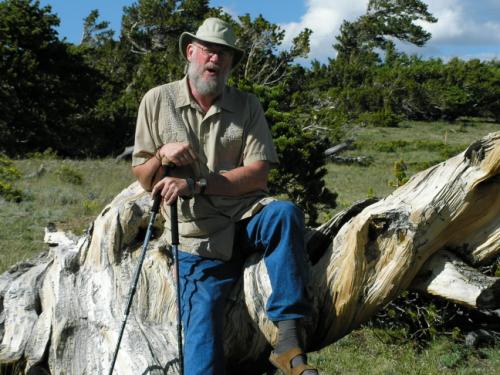
Footnote: Here is Steve, the poet, among the Bristle Cone Pines at 11,000 feet in Colorado:

..
A fellow student at McCormick Theological Seminary in Chicago, we’ve continued the friendship for 47 years. A published poet, Steve was the Senior Minister of the McKinley Presbyterian Church and Director of the McKinley Foundation (campus ministry) at the University of Illinois for many years. He hosts “Keepin’ the Faith” on WILL, Illinois Public Radio,. He and his wife, Nadja, a research biologist, live in a geo-thermally-heated house on the prairie outside Urbana, IL where his neighbors often spot Steve’s kites riding the winds of the prairie skies.
On and off my rocker

My Amish Rocker
“WHY, in a world filled with yelling and screaming, would you ‘PREACH’? Are you off your rocker?”
I can’t help it. I’m a preacher. I have to preach. But it’s the time in the rocking chair that matters most, times when I sit in Jacob Miller’s Amish rocker preparing for Sunday that I love the most. Jacob made the rocker just for me in his Amish shop in Millersburg, Ohio on a farm that spoke volumes about peace and love.
I approach the pulpit in fear and trembling, knowing that it is sacred space where people expect to hear a different kind of word, its sacredness only as real as the humanity that walks into it. The requirements of preaching result in a daily discipline: a fresh cup of strong coffee with the Scriptures in one hand the newspaper in the other.
We live in a crazy world where religion is a source of great sorrow as well as a source of joy. Religion divides and religion unites. It opens us up to the Other, or it walls us off. It broadens us or narrows us. It increases our circulation or it constricts our arteries.
Not long ago American Christians seemed to take for granted that Christianity and our country were simply flip sides of the same coin (a curious blending of the Judeo-Christian idea of an “elect” people and the national misappropriation of Jesus’ “city set upon a hill” as a light to the other nations). That bogus idea is dead, but the news is still reaching our ears, like the news of the town crier in Frederich Nietzsche’s The Gay Science:
Have you heard of that madman who lit a lantern in the bright morning hours, ran to the market place, and cried incessantly, “I seek God! I seek God!” As many of those who do not believe in God were standing around just then, he provoked much laughter…Whither is God,” he cried. “I shall tell you. We have killed him – you and I. All of us are murderers…. God is dead. God remains dead. And we have killed him….
– Friedrich Nietzsche, The Gay Science (1882), Section 126.
That god is already dead, but the message is still reaching our ears. The death of this god “clears the decks for the God of the Bible,” wrote Dietrich Bonhoeffer in a letter from a prison cell July 18, 1944 before his execution by the Third Reich:
Christians range themselves with God in his suffering; that is what distinguishes them…. As Jesus asked in Gethsemane, “Could ye not watch with me one hour?” That is the exact opposite of what the religious man expects from God. Man is challenged to participate in the sufferings of God at the hands of a godless world. He must therefore plunge himself into the life of a godless world, without attempting to gloss over its ungodliness with a veneer of religion or try to transfigure it. He must live a ‘Worldly” life and so participate in the suffering of God. He may live a worldly life as one emancipated from all false religions and obligations. To be a Christian does not mean to be religious in a particular way, to cultivate some particular form of asceticism (as a sinner, a penitent or a saint), but to he a man. It is not some religious act which makes a Christian what he is, but participation in the suffering of God in the life of the world.
– Dietrich Bonhoeffer, Letters and Papers from Prison
I’m no Dietrich Bonhoeffer. But his words and life frame the way I look at the world. To whatever extent the sermons and commentaries that appear here reflect Bonhoeffer’s spirit, I am grateful to him and to others who have shaped my ministry: Ted Campbell, Paul Louis Lehmann, Lewis Briner, William Sloan Coffin, Jack Stotts, William Stringfellow, James Cone, Sebastian Moore, and a host of others. When my attempts fail to keep faith with their examples, they reflect my shortcomings and foibles. If and when any of them manages to speak a Word through my human frailty, it is because I have stood on their shoulders on the watchtower, grasped again by the Spirit of the Living God.
“I will take my stand to watch, and station myself on the tower, and look forth to see what G-d will say to me, and what G-d will answer concerning my complaint. And the LORD answered me, ‘Write the vision; make it plain…so those who run may read it. For still the vision awaits its time….'” (Habakkuk 2:1-3a)
Jacob Miller’s Amish rocker is my watchtower. A cup of coffee, Habakkuk, and the morning newspaper. Thank you, Jacob, for the place to be on your rocker when I’m about to go off mine!
Whitney Houston, the Leper, and Us
Two news stories caught my eye this week: The death of Whitney Houston and Minnesota Governor Mark Dayton’s visit to the Hospital for the Criminally Insane in St. Peter, Minnesota. The New Testament Gospel text for this morning was the story of Jesus and the leper (Mark 1:40-45). The title of the Sermon was simply “THE LEPER” preached at Shepherd of the Hill Presbyterian Church, Chaska Minnesota, February 12, 2012. Here’s the text of the sermon:
Just another leper,
the better left unseen.
“Surely it is their own fault
for not keeping clean.”
Just another AIDS case
now hidden well away,
“They must have brought it on themselves
promiscuous or gay.”
Just another boat person
sponging on me and you,
“They’ve only got themselves to blame
by trying to jump the queue.”
Just another drug addict
shooting up behind the shed,
“Don’t waste your pity on such trash
they’re better off dead.”
Just one determined Jesus
coming through our lands,
welcoming all the unclean mob
with warm, saving hands.
– Copyright B D Prewer 2002, “Lepers, Jesus and Us”
Who is the leper? Could he be me? Could he be you?
I’ve spent a lot of time with the leper. I live inside his body. The sense of nausea with my own sorry self, and I’ve met him a thousand times in the same sense of leprosy I’ve experienced in the lives of others.
This disease is part of the human condition itself. The sense that there’s something wrong with us, something that doesn’t belong, isn’t worthy, needs to stay hidden, closed off from the rest of the world, a leper kept at arms length from full participation in the fullness of life.
Sometimes the disease is so clear it slaps you in the face. We see it clearly in others.
Whitney Houston, that beautiful soul – the god-daughter of Aretha Franklin and cousin of Dione Warwick – is found dead somewhere in Beverly Hills. “Cause of death unknown.” But what we do know is that she struggled for years with the horrors of addiction, this sense of isolation and self-accusation that was the lot of the leper who came to Jesus that day.
Some of the lepers are people of fame and apparent success, like Whitney.
Others are people of infamy. Like the psychotic mother who took the life of her nine-year-old son when the voices told her to kill him. As we did at The Legal Rights Center, we took her case not because she was innocent, but because she was a human being – the most obvious of lepers, a decrepit sinner who had stabbed her son more than a hundred times. She had gone off her medication, and the “voices of the Devil” had taken over. After rhe State had committed her to the Minnesota Department of Corrections’ Hospital for the Criminally Insane, a sorry place, if ever there was one, I visited her. I listened to her sobs. I watched the tears streaming down her face, looking through the glass of the prison visitation room tha t stood between us. The walls of her inner prison were thicker and higher than the walls of the hospital that housed her. Back on the medication that put her back in her right mind, she was inconsolable, a leper who could never undo what the voices had told her to do.
But it’s not just the likes of Whitney,whose sense of leprosy was hidden by success, or the likes of Mary, the pitiful victim of criminally insanity, who is the leper.
We all are.
Listen to Dietrich Bonhoeffer, one of the great heroes of the Christian faith, in words of Voices in the Night, preserved from his prison cell where he was imprisoned for his participation in a failed conspiracy to assassinate Adolf Hitler. He is alone in the middle of the night, restless, ill at ease, in dis-ease, you might say, with the dis-ease of spiritual leprosy, lying there, listening in the night for the sounds inside and beyond the prison.
Night and silence.
Only footsteps and shouts of the guards.
Do you not hear it in this silenced house,
Shaking, breaking and collapsing,
As hundreds kindle the glowing ember of their hearts?
Their songs they hide,
My ears are open wide.
“We who are old, and we who are young,
We children of every tongue,
We who are strong, and we who find it hard,
We who sleep, and we who guard,
We who are poor, and we who have all,
Together into failure fall, (italics mine)
We who are good and we who are unclean,
Whatever we have been,
We…with scars we cannot hide,
We witnesses of those who died,
We who are defiant and we who are bemused,
By long isolation, sorely abused.
Brother, we seek and call for thee!
Brother, do you hear me?”
Who was the man who broke the rules to force his way through the clean crowd, shouting “Unclean! Unclean!” while he coveed his face until he got to Jesus?
Could he be me? Could he be you?
“If you will it,” he says to Jesus, “you can make me clean!”
And stretching out his hand with great compassion, he touches the untouchable, and says, “I will! Be clean!”
“Just one determined Jesus coming through our lands, welcoming all the unclean mob with warm, saving hands.” And the cleansed man ran and told everyone what Jesus had done for him.
How about you?