Daily Riches: Pimping Religion, Confronting Empire – Part I (Dan Clendenin)

Bill Britton's avatarRicher By Far

“Amos wrote 2,800 years ago, but his prophecy reads like today’s newspaper. He lived under king Jeroboam [whose] kingdom was characterized by territorial expansion, aggressive militarism, and unprecedented economic prosperity. Times were good. Or so people thought. The people of the day interpreted their good fortune as God’s favor. Amos says that the people were intensely and sincerely religious. But theirs was a privatized religion of personal benefit. They ignored the poor, the widow, the alien, and the orphan. …Making things worse, Israel’s religious leaders sanctioned the political and economic status quo. They pimped their religion for Jeroboam’s empire. Enter Amos. Amos preached from the pessimistic and unpatriotic fringe. He was blue collar … neither a prophet nor even the son of a prophet in the professional sense of the term. Amos was a shepherd, a farmer, and a tender of fig trees. He was a small town boy who…

View original post 314 more words

Verse – Wasp Leg

WASP LEG
(How to remember
the 7 Deadly Sins)

Wrath is unrighteous indignation
Avarice is wanting more than enough
Sloth kept me from doing what I should
Pride has I in the middle
Lust will do it no matter what
Envy hates that you have more than I do
Gluttony is as American as apple pie

– Steve Shoemaker, Urbana, IL, July 13, 2015

Would you like to see Walter?

“Would you like to see Walter?” asked the funeral director to the 19 year-old college student who’d just arrived at the funeral home.

“Walter who?”

“Walter Fraser,” said Mr. Gibson, who only an hour before had recruited the 19 year-old to ask whether he owned a dark suit, and could he serve in a pinch as the greeter for the visitation the night before funeral. The staff person who normally welcomed people at the front door had called in sick at the last moment. Because the Gibsons, Stewarts, and Frasers were friends and members of the same church, Mr. Gibson turned in desperation to the inexperienced 19 year-old as the greeter’s substitute.

So far as I had known before arriving at the funeral home, Walter wasn’t dead. Mr. Fraser was a highly respected member of the community, and the father of my friend ‘Fuzzy’ Fraser, the star offensive guard on the Marple-Newtown High School football team. Last I knew, Mr. Fraser was as healthy as my father and Mr. Gibson. Mr. Fraser wasn’t supposed to die.

Suddenly “Mr. Fraser” – a man of great dignity and stature – was “Walter”.

“Would you like to see Walter?”

Stunned by Mr. Fraser’s death, I said, “No thanks,” before realizing my refusal was a kind of insult to Mr. Gibson’s work and skill. After the Masons had finished their private ritual of white gloves and strange prayers pretending that Walter was not really dead, Mr. Gibson led me into the viewing room where the guests would see Walter in his open casket.

My family wasn’t into open caskets. When you die you’re dead; you’re gone. A painted corpse, though it may console some of the survivors — “Doesn’t he look good!” they say, or “He looks so peaceful” or “Didn’t they do a nice job” — serves, as Jessica Mitford and other critics of American funeral practices have said, as a denial of death.

Seeing the previously presumed-to-be-alive Mr. Fraser laid out in a casket as ‘Walter’ came as a shock to the senses that underlined the responsibility to offer a friendly greeting at the door, all dressed up, like Walter, in a dark blue suit.

“Would you like to see Walter?”

“Walter who?” remained the question after I left the Gibson Funeral Home. Who was Walter? Was he Mr. Fraser? Or just Walter, all dressed up, like the rest of us, with no place to go, as naked as the day he was born? I’d like to see him again to ask what he can tell me that I don’t yet know.

— Gordon C. Stewart, GeorgetownLake, MT, July 8, 2015

Verse – Death Never Suits Us

Death comes
in many shapes
and sizes but
never suits us

though morticious
cosmeticians
paint the gray of
mannequin faces

to smile, and fold
life-like hands
on chests that
do not breathe

The body is
to Life what
ashes are to fire
and spirit to dust

a painted figure
dressed in suit
and tie for work
that is no more

Blessed are they
who die in the Lord,
for their works
do follow them.

– Gordon C. Stewart, Georgetown Lake, MT, July 7, 2015

When the Breath flies away

It takes only a moment to see oneself in the experience of Andy Catlett in Wendell Berry’s story, “Fly Away, Breath!” Our experience is of time flown away and flying away.

Most of us, most of the time, think mostly of the past. Even when we say, “We are living now,” we can only mean that we were living a moment ago.

Nevertheless, in this sometimes horrifying, sometimes satisfying, never-sufficiently-noticed present, between a past mostly forgotten and a future that we deserve to fear but cannot predict, some few things can be recalled.

Wendell Berry, “Fly Away, Breath (1907),” A Place in Time: Twenty Stories of the Port Williams Membership,” Counterpoint Press, 2012.

We are creatures of a specific time and place — and relationships with loved ones, friends, and enemies, a plot of land, a town or city we call home, a state, a nation, a world in time sandwiched between past and future that we call the present.

A ghost town is a reminder of time. Southern Cross stands on the mountain high above Georgetown Lake, Montana, where the vistas are breathtaking, and the past is barely remembered except for the abandoned miners’ quarters and mine shafts below the surface of the place that remind the visitor of the fickleness of time.

“All flesh is grass” and yet, despite our intuitive awareness of it, we unconsciously pretend most days it is not true that “the grass withers, the flower fades….” [Isaiah 40:8].

“Nevertheless,” says Wendell Berry, “… between a past mostly forgotten and a future that we deserve to fear but cannot predict, some few things can be recalled” — things like my friendship with Phil, now ended unexpectedly by a rare nearly undiagnosable lymphoma in his spleen. Hours before his death, the interventionist ICU doctor described Phil’s case and his 10 days in the ICU as “a real shit storm” because of the many ongoing complications that mystified the medical staff. In all of medical history only 10-15 cases have been reported where lymphoma originated in the spleen. By the time it was discovered in Phil, other organs had begun to shut down. The first organ to go was the gallbladder, which was already abscessed when they operated to remove the spleen.

Medical professionals are no different from the rest of us, except for their skill and training in how to treat illness and preserve life. Despite every effort to keep the present from slipping into the past, against every attempt to retain some kind of future, the breath always flies away.

Phil’s death, as I had come to see it days before he passed, came as an act of mercy, a release from the torturous interventions of advanced medical technology that asks the question ‘How?’ without first asking ‘Why?”

I’m increasingly convinced that the denial of death (mortality) and the search for immorality are the opposites of the Christian faith in God – on Hebrew YHWH (“I am Who I Am/ I will Be Who I will be”) who alone is Eternal. All else is species hubris, the refusal to live thankfully, graciously and peacefully within the limits of finite, mortal goodness.

We are all standing in line, not knowing at what time or place our time will come. We’re all headed for the ghost town, thinking of the past or dreading the future we deserve, but also, in moments of grace, remembering with thanksgiving the tender mercies along the way that cannot be denied.

I do not know what of Phil or any of us may lie beyond the grave, an odd thing to say for a minister of the gospel whose faith lives out of the life, death, and resurrection of Jesus. Knowing my unknowing, my best friend reminded me of “Jesus’s question to Nicodemus at night about the not entirely unrelated matter of being born of the Spirit: ‘You are the teacher of God’s people, and don’t know these things?’”

I confess to knowing very little, especially when what Chaim Potok calls the four-o’clock-in-the-morning-questions wake me in the middle of the night between a present now gone and a future that remains inscrutable. However that may be, what I do know is that bodily life — mortal life in space and time in the midst of Eternity — is what we have and it is to be cherished. Bound to the limits of time and place, it is God’s good creation.  Yet only God is the Eternal One.

Whatever lies on the other side of my years is beyond my mortal knowing. But I can and do affirm the Eternity of God and the scriptural point of view that whether we live or whether we die, we belong to the Lord. “All flesh is grass. The grass withers, the flower fades, but the Word of our God [YHWH, the Eternal] shall last forever.” Right now, in good conscience, that’s enough bread to live on today as I recall the blessing of Phil to our lives and pray for all who loved him.

– Gordon C. Stewart, written at Georgetown Lake, Montana, July 26, 2015.

In Memory of Phil

Sunday, June 21, the text from Faith in Minneapolis reached us in Montana.

“6:15 p.m. – A great soul has passed.”

Phil Brown and I go back 55 years when we met as freshmen at Maryville College in Maryville, Tennessee. Within two weeks we were doing something entirely juvenile. We were running for President of the best class the college had ever admitted or would ever see again. J 😇

From the day I met Phil, I knew him as a person of dignity and stature. He carried himself with an outward confidence that belied an inner self-doubt. His posture was erect, shoulders back with a disgustingly athletic physique and stride, a classically chiseled face, and the brains to go with it. He was a Big Man on Campus from the day he set foot on campus to the day he left it for Law School at Indiana University in 1964. When he left law school to prepare for a vocation in ministry, we again became classmates at McCormick Theological Seminary in Chicago.

In ways we only later came to understand and celebrate, in spite of the early competition, we were tied by similar family histories and destinies, although anyone who knows us well could easily call us the Odd Couple, one of us like Felix Unger, the always well-groomed, meticulously tidy maintainer of order and propriety played in the film by Jack Lemon; the other more like the unpredictable, care-free, disorganized, careless slob named Oscar Madison, played by Walter Matthau. Can there be any doubt who was whom?

At Phil’s retirement party as Synod Executive of the Synod of Lakes and Prairies, his beloved sons, Ian and Jess, delivered a comical roast of their Dad who, they said, had taught them many things, not the least memorable of which had to do with tools from Phil’s workshop. “If you took it, put it back where you got it!” was his consistent teaching. I always wondered, though, why Phil didn’t put the special microbrewery beers that Ian mailed him back in the refrigerator where we’d gotten them.

Phil and Faith are Kay and my best friends in the Twin Cities. Our tears have fallen for more than two months, as we have watched with Faith the inexplicable, undiagnosed loss of energy that came on like an sudden thunderstorm that drenched him in night sweats the evening he returned from a North Oaks Association Board Meeting.

Always the most gracious of hosts, he and Faith hosted newcomers to North Oaks in their home a few weeks later with the understanding that if Phil grew weary, he should retire early. He did. It was not like Phil to call attention to himself or to bow out on a promise, a duty, or a commitment. He had to be restrained from overdoing, but restraining a race horse committed to doing the right thing takes a trainer with strength not even the strongest life partner or lifelong friend could muster.

At Maryville Phil chose Economics for his major. His academic advisor and mentor, Bob Lynn, was a professor known equally for his brilliance and his demands for academic excellence. At McCormick Theological Seminary, Phil again chose to study with the very best, Jack Stotts, Professor of Christian Ethics. Phil was always drawn to the highest standards of excellence.

As Presbytery Executive with Blackhawk and Milwaukee presbyteries and as Synod Executive of the Synod of Lakes and Prairies, he embodied that combination of ardor and order, grace and discipline that is the signature of the Presbyterian theological and ecclesiastical tradition where all things are to be done “decently and in order”. In that respect Phil and I each followed in our father’s footsteps. Phil succeeded at it much better than I.

But, if our friendship began as student competitors and friends wandering in the night through the foothills of the Smokey Mountains around Maryville, my last memories will be of Phil as the patient at Abbott Northwestern Hospital in Minneapolis. Though so weak that he could barely speak aloud, he unexpectedly joined me in saying the 23rd Psalm. His faith was on his lips, bubbling up from a deep, trusting heart, the secret place of the son of Victor and Francis Brown. I’m sure he noticed, as did his son Jess, my omission of the line “He leadeth me in the paths of righteousness for his Name’s sake” — an omission made, whether consciously or unconsciously, I suppose in retrospect, because I wanted him to give up the struggle for righteousness in order to rest peacefully beside the still waters there beside the valley of the shadow of death.

There are no still waters here in Montana where I am committed to serve as summer minister at St. Timothy’s Memorial Chapel in the ghost town of Silver Cross where we prayed for Phil, Faith, and the Brown family this morning. After receiving Faith’s message this evening, Kay walked to the backyard of the Manse and returned with a bouquet of wild purple irises and other wild flowers in honor of Phil. We read the Psalms and prayers from The Book of Common Prayer and found some solace there in the company of the saints in light.

Good friendships last a lifetime. Over time, the tears of loss and mourning will be turned, by God’s grace, into the tears of great thanksgiving.

– Gordon C. Stewart, Georgetown Lake, MT, June 23, 2015


When Religion Becomes Sinful

Mark H Miller's avatarMark H. Miller's Blog

My clergy colleague, Mike Murray, recommended a new book that builds bridges between right and left-wingers, between those who are conservative/fundamentalist and liberal/progressives. Have started it, The Righteous Mind by Jonathan Haidt.

But was interrupted this morning when reading a Huffington Post article about someone with whom I have next to nothing in common theologically, Evangelist Pat Robertson. I’m pretty sure a bridge between the two of can never be built—especially on his version of the purpose for God to kill children. Even the more general indictment that God “kills children.”

I’m pretty sure clergy, no matter their tilt theologically, would find it reprehensible that “God takes the life of a child.” Yes, I’ve had grieving parents and relatives tell me about a young girl’s death, “God needs her for God’s Children’s Choir in heaven.” Or, “All death is God’s Will.” Or, “This is the fault of the parents for…

View original post 455 more words

The Waiting Room

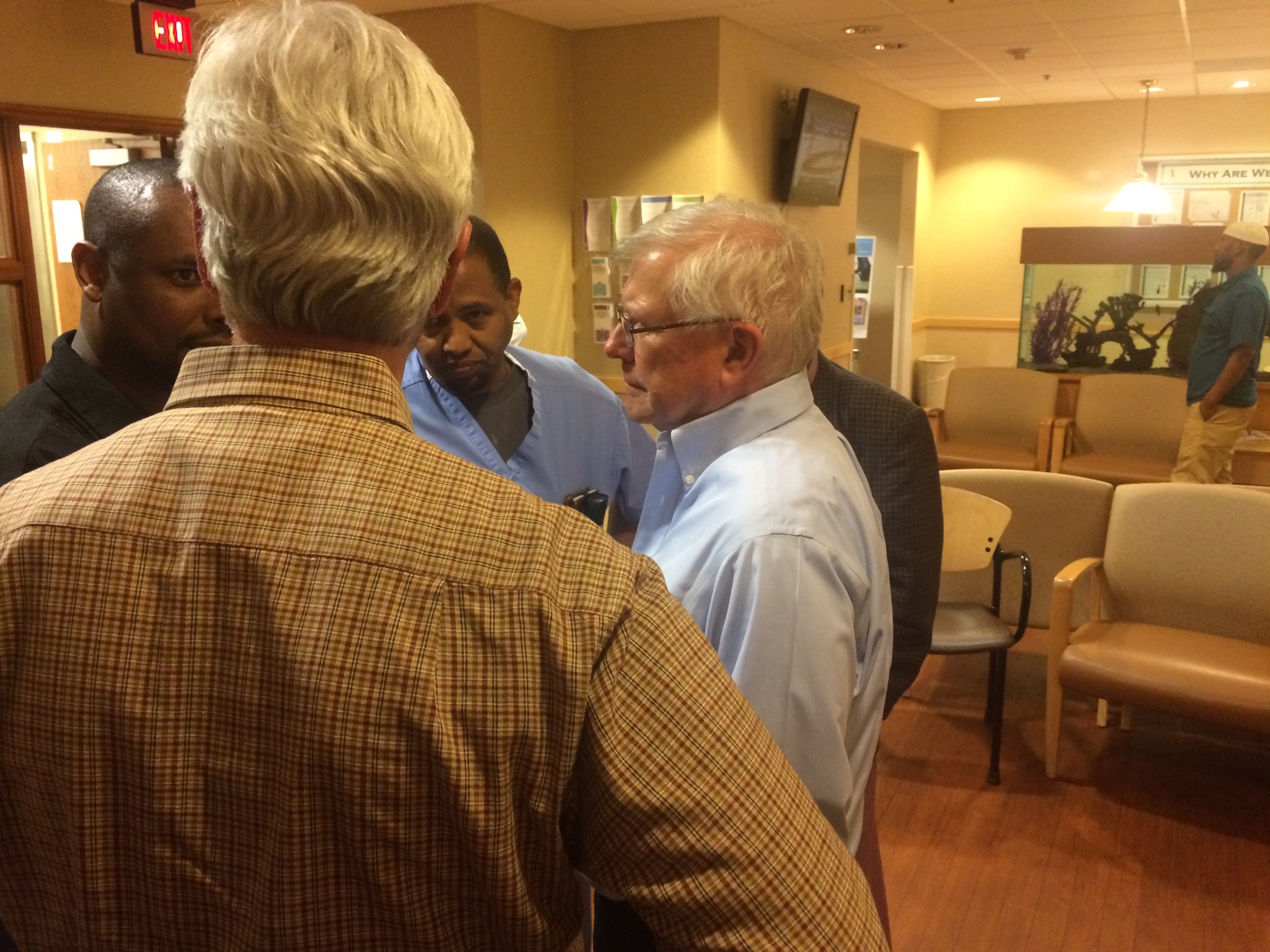
The surgery went “as well as could be expected” after two months of undiagnosed illness, but Sepsis is taking over his body, threatening his survival. The next two hours are critical.

His loved ones and friends are gathered in the ICU Waiting Room at Abbott-Northwestern Hospital in Minneapolis.

Several hours earlier, I had observed six Muslim men praying the evening prayer at sundown at the far side of the Waiting Room. Oromo (Ethiopia) men had prayed the evening prayers at sundown, off to the far side of the large Waiting Room.

The men from Orono (Ethiopia), whom I had assumed to be Somali, are now gathered in chairs in the center of the Waiting Room, talking among themselves in Oromo.

When I approach them, intruding into their space, they recognize my presence. They stop talking. “Salaam,” I say. “Salaam,” they respond as if with a single voice and smile. “My friend is very sick. The next two hours are critical. I ask your prayers. His name is Phil.”

They respond as one would expect compassionate people to respond. “We will pray for him.”

I return to the small family area where my fellow Christians are gathered. I tell them the Muslims are praying for Phil. They’re pleased. We chat. Phil and Faith’s pastor eventually leads us in a Christian prayer.

Muslim prayer visitors

Muslim prayer visitors

An hour or so later three of the Oromo men come to our little room. They have come to tell us they have finished their prayers for Phil.

The voices and eyes of the men, led by their Imam, are kind, pastoral, as we say in the church. Full of compassion and concern for us. They have prayed in Arabic a Muslim prayer for healing on behalf of a stranger about whom they know nothing but his need:

“Remove the harm, O Lord of humankind and heal [Phil], for You are the Healer and there is no healing except Your healing, with a healing which does not leave any disease behind.” [narrated into English by al-Bukhaar]

Sometimes we have no choice but to wait. The Muslims from Oromo are waiting with us actively. Would that we all would wait so kindly, so patiently, so actively, and so wisely.

For a split second, I imagine the world as a Waiting Room.

– Gordon C. Stewart, Abbott-Northwester Hospital, Minneapolis, MN, June 12, 2015

The Paradox of Pentecost — Presence and Absence

A stranger than strange text for today’s Feast of Pentecost, the day the Church celebrates the coming of the Spirit, the Advocate, reads:

“I tell you the truth: it is to your advantage that I go away, for if I do not go away, the Advocate will not come to you…” [Gospel according to John 16:7].

It is Jesus in John’s Gospel who speaks these words to his disciples. They scratch their heads, like confused children being dropped off at camp against their will. They already sense the homesickness that will come. The thought of being abandoned brings anguish, the foreboding of oncoming forlornness.

The experience of absence, endemic to the human condition, is essential to faith. The feeling of anguished forlornness builds courage, and faith, of one sort or another, with or without an advocate.

Enter Jean-Paul Sartre’s reflections on anguish and forlornness. Fully conscious without religious crutches, I experience the anguish of my responsibility for myself and others, and the forlornness that realizes that I am alone in my decision-making. The decisions are mine along. No one but I am responsible.

Like the disciples, we want it to be otherwise. Some of us pray as though the feelings were a hoax, the Devil’s trickery or God’s pre-ordaining, as though our course were charted by another decision-maker disbelieved by Sartre. But regardless of our faith or faith denials, the truth is that to be human is to know this sense of anguish and forlornness.

Dietrich Bonhoeffer, the brilliant theologian imprisoned and executed by the Third Reich, caught the sense of it in a letter he wrote from a prison cell.

“The only way to be honest is to recognize that we have to live in the world etsi deus non daretur. And this is just what we do see — before God! So our coming of age forces us to a true recognition of our situation visa a vis God. God is teaching us that we must live as [people] who can get along very well without him. The God who is with us is the God who forsakes us (Mark 15:34). God who makes us live in the world without using him as a working hypothesis is the God before whom we are ever standing. Before God and with him we live without God. God allows himself to be edged out of the world and onto the cross. God is weak and powerless in the world, which is exactly the way, the only way, in which he can be with us and help us. Mark 8:17 makes it crystal clear that it is not by his omnipotence that Christ helps us, but by his weakness and his suffering.” [Dietrich Bonhoeffer, Letters and Papers from Prison, pp 219-220, McMillan Company, 1953, translated from German by Reginald H. Fuller.]

Bonhoeffer’s writing acknowledges the anguish and forlornness that precede the disappearance of the divine usurper of human freedom and responsibility. In place of the bad-faith God who keeps her children in diapers, there comes the advantage of Christ’s going away — the arrival of the Advocate who brings the unexpected joy of coming of age.

“I tell you the truth: it is to your advantage that I go away, for if I do not go away, the Advocate will not come to you; but if I go, I will send him to you” [Gospel according to John 16:7].

– Gordon C. Stewart, Chaska, MN, May 24, 2015 – Feast of Pentecost.

The Movement Made the Man (MLK)

Martin Luther King, Jr. did not make the civil rights movement. As Elizabeth Myer Boulton reminds us, it was the movement that made the man. Without the movement there would have been no “I Have a Dream Speech”.

Elizabeth (Liz) Myer Boulton’s spouse, Matthew Myer Boulton, President of Christian Theological Seminary, hosted five McCormick Theological Seminary classmates this past week, including Steve Shoemaker and me.

I returned from Indianapolis and found Liz’s powerful sermon. It reminded me of Kay and my month in Saint Augustine.  It was the unsung local heroes who built the movement, paid the price, and drove the buses to the Poor People’s March on Washington. Martin represented them all.

– Gordon C. Stewart, Chaska, MN, May 23, 2015.