
In Defense of Darkness

INTRODUCTION: Every few years a sermon knocks my socks off. This unusual sermon by The Rev. Devon Anderson was heard last Sunday at Trinity Episcopal Church in Excelsior, Minnesota. The text is Luke 3:1-6. Disclaimer: the sources for the sermon are listed at the end; the text itself does not include footnotes and does not always include quotation marks.

___________________

A few weeks ago I was in Baltimore at a church meeting held at the Maritime Institute of Technology’s conference center. The institute teaches how to pilot everything from a tugboat to the biggest of seafaring barge. During our meeting my friend Ernesto discovered that the Maritime Institute boasts two “full mission, ship handling” simulators. With a bit of sweet talk, he finagled a tour.

The simulators are housed inside huge 80X30 feet curved projection screens (kind of like an iMax theater). Inside is constructed an actual bridge – the literal steering wheel, radar, and control panels that any barge of that magnitude would have. We stepped onto the bridge in darkness. But after our guide punched some buttons and threw a few switches, the lights came on and we were – in an instant – ship captains, navigating an industrial barge through Baltimore harbor. Ernesto and I took turns serving as captain and first mate.

At some point our tour guide started to mess with us. “Hmmm…,” he said, “it looks like it’s about to rain.” A few buttons, a few switches, and the sky began to darken, as virtual raindrops misted the windows. “Hmmmm…,” he said again, “I think we’re heading for a bit of a hurricane,” and all of a sudden we were in the open sea gazing back at the Maryland coastline, as the waves swelled, and the barge dipped and rocked deeper and deeper. “Oh no,” said our host, clearly enjoying himself in the face of our growing panic, “it looks like the hurricane knocked out power in Baltimore.” As he said it, the control panel, too, flashed and went cold as the sound of the engines cut out. In an instant everything went black. I mean, really black. Out of the darkness came the voice of our guide, “Hmmm…what are you going to do now?” We drove the barge around in the dark for a while – which was terrifying — as the hurricane subsided. Eventually the click click click of buttons and switches cleared the night sky, and from the darkness emerged a million sparkling stars. “When everything goes dark,” our guide told us, “a good pilot slows down and watches for what can help him.”

Hmmm….I’ve been thinking about that virtual darkness out on the virtual sea these past weeks. Advent always happens in the darkest of days, as our little place on the planet moves further and further away from the sun. This time of year, we know a lot about darkness. Our Advent scriptures reflect that. So much of what we read in Advent is about darkness and our thirst for light. “The Lord is my light and my salvation…(Ps 27:1)” writes the psalmist, “the fountain of life in whose light we see light (Ps 36.9). “The people who walked in darkness have seen a great light; those who lived in a land of deep darkness – on them light has shined.” (Is 9:2). And even today John the Baptist calls the people out into the cold, dark, desert night so they are ready for the light that will save them all. In so many of our Advent stories, the message is the same: the light of the world has come to put an end to darkness, to be a lamp in the hands of those who believe. Like myself, I know so many people whose lives depend on that promise – when we can’t see where we are going; when the bottom drops out; when our prayers go unanswered and we’re marooned in the kind of darkness that makes us afraid to move – we cling to the promise that if we can just keep our minds focused on the light of the world then sooner or later God will send us some bright angels to lead us out.

And yet – deep in our holy scriptures there lives an equal and opposite truth that almost never comes up in church: that God dwells in deep darkness. God comes to the people in dark clouds, dark nights, dark dreams and dark strangers in ways that sometimes scare them half to death but almost always for their good, or at least, for their transformation. God does some of God’s best work in the dark.

We have been conditioned to view darkness as a negative, symbolizing what’s sinister, or dismal, or tragic or wrong. It was a really dark film. We’re in a really dark place right now. He’s gone to the dark side. No one ever asks God for more darkness, please. Please God, come to me in a dark cloud. Give me a dark vision. Please eclipse the sun and throw life as I know it into complete shadow. Put out my lights so I can see what I need to see. Then, send me a dark angel on the worst night of my life, please.

And no one asks for darkness in the Bible, either, but it happens. Once you start noticing how many things happen at night in the Bible, the list grows fast. God comes to Abraham in the dark, instructing a series of desired sacrifices then sealing the covenant with the people Israel forever. God comes to Jacob in the dark not once, but twice – the first in a dream at the foot of a heavenly ladder, and the second on a riverbank where an angel wrestles him all night long. The exodus from Egypt happens at night; God parts the Red Sea at night; manna falls from the sky in the wilderness at night – and that’s just the beginning.

The cloud and the glory always seem to go together – not just in the Hebrew Scriptures, but in our Gospels, too. Ask Jesus’ disciples Peter, James, and John who entered another cloud on another mountain where they too were overshadowed by the glorious, terrifying darkness of God. Ask Saul the ferocious who was blinded on the road so he could be led by the hand to a hard bed in a rented room, where he finally became soft enough to welcome a dark angel named Ananias. Ask Mary how her life – and the life of the whole world – changed when the savior of the world was born in that scary, darkest hour just before dawn. Ask Mary Magdalene who, in her insurmountable grief, discovers the risen Christ. “Early on the first day of the week, while it was still dark…” the discovery of resurrection begins.

It’s not a popular truth, but there it is: God dwells in deep darkness. When we cannot see – when we are not sure where we are going and all our old landmarks have vanished inside the storm – then plenty of us can believe we are lost and forgotten. But what I am asking you to consider is an additional theology – that when we find ourselves in darkness, we may be the exact opposite of lost and forgotten. Based on the witness of those who have gone before, we know that darkness is where God most often restores us when our lives have broken apart. It is the cloud of unknowing where nothing we thought we knew about God can prepare us to meet the God who is. It is in darkness where new life, no matter how shattered, is born.

There are real benefits to this kind of faith, though they may not appeal to those for whom God can only be light (and in whom there is no darkness at all). The first benefit is that we have to slow way, way down when we find ourselves in the dark. When the kids were little we took them to visit Crystal Cave in western Wisconsin, right off I-94. It’s campy as all get-out, but it’s been around as a tourist attraction for a long time, first discovered in 1881. Just like any cave or mine tour, visitors must walk down flight after flight of industrial stairs, down, down, down – 70 feet in this case — into the damp, drippy earth. At some point the guide flips off the lights so everyone can get a feel for how dark the dark can be – like, can’t see your hand in front of your face dark. Anyone that’s been on one of these tours knows – the minute those lights go out, everyone freezes. There’s just no running around in dark like that. All the things we pride ourselves on in the light outside – our speed, our agility, our ability to talk fast and get things done – they don’t help us one single bit in that kind of darkness. Darkness forces us to slow down and use senses we don’t use when our eyes are working in the light of day. Darkness like that sharpens our senses, hones our awareness, makes us hyper-sensitive to God’s light touch.

Another benefit of faith in darkness is teaches that none of our outside navigational tools can, in the end, really help us. Just like when the power went out in the virtual Baltimore harbor – when we hit real darkness, external things we depend upon in the light of our normal lives to keep us safe and secure, no longer work. If it’s not already inside us, then it’s of limited use to us in the dark places. Once we enter darkness we find out what our primary resources are: love, hope, vulnerability, openness, and what insistent, sacred whisper we can learn to trust when we’re navigating by faith and not by sight. We learn in that place to trust more supremely what only God can do for us, over what we think we can do for ourselves.

And finally, inside darkness with everything slooooowed waaaay doooowwn, depending on what’s inside ourselves to feel our way forward, the good news is that God has room and time and enough of our attention to bring forth new life – an entirely new thing that didn’t exist before dark descended. One of my favorite paintings of all time is from Van Gogh’s olive tree series, housed in the permanent collection of the Minnesota Institute of Arts. A light, lavender punctuates the painting in rows between trees and in the background mountain scape. Apparently Van Gogh considered the lavender a color of “consolation” (his word) in that he felt the color was not its own entity, but created by the stormy confrontation of darkness weakened by light. The new creation only possible because of darkness.

I know my defense of darkness will never, ultimately, sell. Endarkenment is never going to appeal to anyone the way enlightenment does. But for those who are already sitting in the dark, and for those of us who know that at some point we’ll be there, too, to consider the possibility that God dwells there with us is Gospel Good News indeed. And, in the end, I do know this: the thing about the cloud of unknowing, which even the saints take on trust is that it’s not there to get through like a test or a fever. It is God’s home. It is the place where God dwells. To be invited in is a great honor, and to stay awhile? Better yet. When sitting in darkness, we never feel that it’s a great honor – it’s the last place any of us want to be. But I do know this: that for those who make it out the other side, while they may not have a lot of words to describe where they have been, and they’ll tell us they never would have chosen it in a million years – they do have a great story to tell and more than not it’s a story that includes redemption and healing, regeneration and a new wisdom. They might just tell us that now that it has happened they would never give it back. AMEN.

Sources:

The brilliant idea and direct quotes about God doing God’s best work in the dark are excerpted from Barbara Brown Taylor’s Learning to Walk in the Dark (2014), an excellent read that I highly recommend.

The Maritime Institute of Technology’s website (click HERE) has interesting information about its simulator-based training programs.

Van Gogh’s approach to the cover lavender is commented upon by Goethe in the book Goethe’s Way of Science by David Seamon: “…this reciprocity between darkness and light points to the ur-phenomenon of color: Color is the resolution of the tension between darkness and light. Thus darkness weakened by light leads to the darker colors of blue, indigo, and violet, while light dimmed by darkness creates the lighter colors of yellow, organize, and red. Unlike Newton, who theorized that colors are entities that have merely arisen out of light (as, for example, through refraction in a prism), Goethe came to believe that colors are new formations that develop through the dialectical action between darkness and light. Darkness is not a total, passive absence of light as Newton had suggested, but, rather, an active presence, opposing itself to light and interacting with it. Theory of Color presents a way to demonstrate firsthand this dialectical relationship and color as its result.”
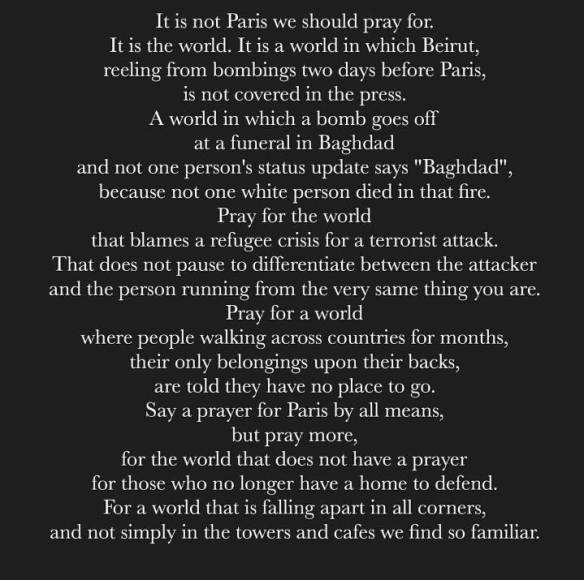
Donald: Pray for THESE things

Donald Trump proposes a travel ban on all Muslims. We invite Mr. Trump and those who applaud him to read the U.S. Constitution prohibiting the establishment of religion, and to pray for these things posted several weeks ago on FB from an anonymous source.

Prayer for the World

Two Universities: Liberty and Paris

When the president of “the largest Christian university in the world” in Lynchburg, Virginia urges every student to buy a gun and get a permit to carry a concealed weapon, for whatever reasons, it seems a little oxymoronic and moronic. It’s neither Christian nor smart. It’s not what people do in college. They buy books, not guns. It’s not consistent with the traditions and standards of higher learning. Real universities don’t talk like that.

At one of the world’s first universities, the University of Paris (the Sorbonne), way back in the 13th century, a young Thomas Aquinas was a student of philosophy and Christian theology. His professors introduced him to great critical thinkers like Aristotle, Plato, and Maimonides in their original Greek and Latin languages.

Lynchville, Virginia in the 21st Century is long way from Paris in the 13th Century, and that’s too bad for all of us in America where what Aquinas later called “willful ignorance” has become the order of the day.

 It is clear that not every kind of ignorance is the cause of a sin, but that alone which removes the knowledge which would prevent the sinful act. …This may happen on the part of the ignorance itself, because, to wit, this ignorance is voluntary. …  For such like negligence renders the ignorance itself voluntary and sinful, provided it be about matters one is *bound and able to know.” [Thomas Aquinas, Summa Theologica, I-II, q. 76, a. 1, a. 3.]

Today’s Catholic World, an online encyclopedia, adds these footnotes to Aquinas’s text:

*Catholics are bound (required) to learn and know their Faith. A sin against faith (often caused by willful ignorance) is the gravest of all sins according to St. Thomas Aquinas.

St. Augustine, cited by St. Thomas, characterizes sin against faith in these words: Hoc est peccatum quo tenentur cuncta peccata. “This is the sin which comprehends all other sins.”

Liberty University is not a Catholic university. It’s not big on Catholics. It’s fundamentalist protestant.  It prides itself on its knowledge of the Bible.

But don’t we have to suppose that somewhere in that auditorium in Lynchburg, there was a professor who cringed? Someone there who resonated with the old student at the University of Paris? Someone who thought that telling young professing Christians to arm themselves was a deliberate act of willful ignorance, a sin against faith, the sin that comprehends all others?

“Put away your sword. Those who live by the sword will perish by the sword” – Jesus of Nazareth to Peter after Peter had cult off the High Priest’s servant’s ear at Jesus’s arrest, 1st Century, according to The Gospel of Matthew 26:52.

Gordon C. Stewart, public theologian, author of Be Still! Departure from Collective Madness (2017 Wipf and Stock) host of Views from the Edge. Brooklyn Park, MN. Originally published 2015.  Re-posted here June 13, 2022.

Dueling Presidents: Obama and Falwell

President Obama speaks from the Oval Office during prime time, seeking to calm a jittery nation following terrorist attacks abroad and in California. I questioned the wisdom of devoting so much of a speech on national security to domestic relations with our own Muslim neighbors …until this morning I watched Jerry Falwell, Jr., President of Liberty University, urging his students to apply for conceal-and-carry permits so that they could “end those Muslims.”

http://www.stuff.co.nz/world/americas/74836735/us-college-president-tells-students-to-carry-guns-to-end-those-muslims

The media describe Liberty University as “a leading evangelical Christian college” in Virginia. It’s not. It’s a poor excuse for a university or college, a right-wing fundamentalist school led by the son of Jerry Falwell, founder of the Moral Majority, an arch-conservative fundamentalist religious-political movement to take back the country from liberals… you know…people like Jimmy Carter.

Three days after telling his students to buy guns and on the eve of President Obama’s Sunday evening address to the nation, Falwell tweeted that his reference to “those Muslims” was meant only for those Muslims who commit acts of terror. But Jerry, Jr. is not stupid. The deafening applause from the Liberty auditorium was still ringing in his ears.

President Obama and President Falwell both know we are shivering. Only the non-preacher President represented the spirit and ancient counsel of Baruch: “Take off the garment of your sorrow and affliction, O Jerusalem, and put on forever the beauty of the glory from God” [Baruch 5:1-9; 2nd Century BCE].

We can freeze ourselves to death wearing living in the garment of sorrow, affliction, and fear. Or we can take it off to put on the warm garment of beauty – the glory of God shining in mutual consolation, hope, and steadfast determination to live in peace with our neighbors.

If you can imagine Jesus telling his students (disciples) to apply for conceal-and-carry permits, pack some heat, and put an end to anyone, you’re making that Jesus up. You don’t get to make Jesus up in your own image.

“You have heard that it was said, ‘Love your neighbor and hate your enemies.’  But I say to you, love your enemies. Pray for those who hurt you. If you do this, you will be true children of your Father in heaven. He causes the sun to rise on good people and on evil people, and he sends rain to those who do right and to those who do wrong. If you love only the people who love you, you will get no reward. Even the tax collectors do that. And if you are nice only to your friends, you are no better than other people. Even those who don’t know God are nice to their friends. So you must be perfect, just as your Father in heaven is perfect.” – Jesus, Sermon on the Mount, Gospel According to Matthew 5:43-48, NCB.

  • Gordon C. Stewart, Presbyterian minister, would-be disciple of Jesus, Chaska, MN, Dec. 7, 2015


You are not entirely alone. Ever.

With votive candles lit in remembrance of loved ones, we entered the softly lit church at dusk. We sat in silence until the piano and violin soothed the gatherers with Fantasia on Greensleeves, arranged by Ralph Vaughan Williams. Imagine yourself there with a candle.

After readings from Frederick Buechner, Mary Oliver, Romans 8 and a brief homily, Arvo Pärt’s Spiegel im Spiegel provided the music for worshipers to come forward to place our candles on the altar.

As the teenage daughter and her 9 year-old brother returned to their pew in front of us, it was apparent they’d experienced a devastating loss. Perhaps a grandparent? A cousin? A pet? The brother, half her size, threw his arms around his sister with great tenderness, sharing a vulnerable moment of deep grief. The father’s hand stretched across the pew to hold them both.

I learned later the reason for their grief – the death of a close friend two months before in a murder suicide that killed her friend, classmate, and teammate, two other children, and their parents. They’d had a normal dinner together the night before the tragedy no one had anticipated or imagined.

votive-candlesTonight the friend was there to deal with her grief. There was something profoundly sacred about the church tonight – a community of the grieving like no other community. Real. Unvarnished. Reverent. Open. Prayerful. Tender. A healthy vulnerable community of mutual need and faith lighting candles, bearing witness to an inexplicable grace greater than the darkness that had fallen upon us.

Members of the Trinity Mental Health Initiative (MHI) Board of Trinity Episcopal Church, founded two years ago, hosted the service. The note in the bulletin read:

“MHI was birthed in the sorrow of personal loss, and with the intent that no one should have to be alone in the terrible helplessness and sadness that comes with some deaths. … We invite you to open yourselves today to both sadness and possibility, and to know that you are not entirely alone. Ever.”

I wish the sorrowing world could have been there.

  • Gordon C. Stewart, Chaska, MN, Dec. 6, 2015.


?

Me: God, Why?
God: No, I ask the questions…
Me: Ok, what are your questions?
God: Don’t ask.

  • Steve Shoemaker, from Mayo Clinic, Rochester, MN, Dec. 5, 2015

A personal reflection in a mad time

I stood in front of the governor’s mansion in Saint Paul last night, its face lit up by thousands of glowing lights. My apartment isn’t all that far from the guv’s place, and I needed a walk after a long day inside, and suddenly, there I was.

The lights are gorgeous, both the governor’s and a number of nearby homes. No question about that. But last night, those lights did not light up my countenance, at least not in the way they are probably intended to do. Not in times like this. Not after yet two more mass shootings this week; not amidst the recent violence of Chicago and Colorado Springs, Syria and Nairobi, Beirut and Paris. and what continues in north Minneapolis. Not after a day-long barrage of social media opinions IN ALL CAPS — and the predictable defensive responses to those solutions, not to mention the downright nasty ones.

As I walked away from the governor’s house back into the dark of night, I found myself thinking about the advice a guy named Howard Beale had for people in times that seemed remarkably similar to today.

“I want you to get MAD! I don’t want you to protest. I don’t want you to riot — I don’t want you to write to your congressman, because I wouldn’t know what to tell you to write. I don’t know what to do about the depression and the inflation and the Russians and the crime in the street. All I know is that first you’ve got to get mad. You’ve got to say: ‘I’m a human being, god-dammit! My life has value!’ So, I want you to get up now. I want all of you to get up out of your chairs. I want you to get up right now and go to the window. Open it, and stick your head out, and yell: I’m mad as hell, and I’m not going to take it anymore.”

Howard Beale was, of course, the fictional deranged former-television anchor played by Peter Finch in the 1976 movie “Network,” that wildly cynical film from and for a battered time period in our history. His rant is legendary; the last line is considered one of the 20 most memorable movie quotes of all time.

But last night, I found myself wondering if Howard Beale’s colorful and so- oft-quoted last line has affected, and infected, us today in ways that have obscured another message from the movie, one more powerful but far less memorable: I’m a human being; my life has value!

Yes, we ought to get mad about what’s going on in the world today. Yes, the biblical call to justice requires us to raise our own voices to stand with the oppressed and challenge the powers of our world. But yesterday, as my social media feeds piled up, one-after-another, what struck me as self-righteous, power- coveting, fear-inducing I’m-not-going-to-take-this-anymore rants, all talk and no listen, I couldn’t help but wonder about the other part, too: the part about all being human. God’s own. And acting as if we believe it.

Advent begins in the shadows, where people are longing to see a great light. The prophets speak into a world much like our own, “where justice has gone missing and there is no safety in the city. The people are oppressed … the weak are trampled … the covenant with God is broken … there’s no peace in the land … nation rises up against nation … the future looks bleak. In other words, a world not all that different in many respects from our own, (that) seems to have come unhinged, to have lost its moral bearings. The prophet looks out on that world, caught up in war and violence and fear, desperately following ways that do not make for peace, and says, with confidence, The days are surely coming … ” (Thanks, Tim Hart-Andersen, for words that both describe and inspire.)

And so I’ve decided my Advent discipline can be this: to walk to the governor’s house every night I can for the duration of the season, not so the glittering lights might lift me out of the darkness of the season, but so they might remind me to listen more intently for the voice of light in the darkness; to ask intentionally how I might also act with the conviction of the prophet. It’s not enough, I know; not nearly enough. But it’s a start, and it starts here:

I’m a human being; my life has value.

  • Jeff Japinga

    Jeff Japinga

    Jeff Japinga, Transitional Executive Presbyter, Presbytery of the Twin Cities Area, published today, December 3, 2015, in the Presbytery’s online newsletter. Links have been added to the original text by Views from the Edge.

I am the enemy who must be loved

Bill Britton's avatarRicher By Far

“It took me a long time to learn that God is not the enemy of my enemies. He is not even the enemy of His enemies.” Martin Niemöller

“The acceptance of oneself is the essence of the whole moral problem and the epitome of a whole outlook on life. That I feed the hungry, that I forgive an insult, that I love my enemy in the name of Christ – all these are undoubtedly great virtues. What I do unto the least of my brethren, that I do unto Christ. But what if I should discover that the least among them all, the poorest of all the beggars, the most impudent of all the offenders, the very enemy himself – that these are within me, and that I myself stand in need of the alms of my own kindness – that I myself am the enemy who must be loved…

View original post 322 more words

Christmas is for Losers

As a loser who has failed more often than not in preaching the Christmas story, I find this blogger’s rendering refreshing. I identify with the shepherds and the bacon. – Gordon

Source: Christmas is for Losers

A Presbyterian Call to Welcome Refugees

“Our Call to Support Refugees from Syria and the World”

NOTE: Views from the Edge has added colored highlights to the text.

Presbyterian Church (U.S.A.) congregations have supported refugee resettlement since the refugee crisis created by World War II. The 160th General Assembly (1948) of the Presbyterian Church in the United States of America stated, “The United States should pass legislation to bring in at least four hundred thousand displaced persons during the next four years. … As they arrive, our church people should stand ready to open their homes and provide work for these unfortunate victims of war” (Minutes, PCUSA, 1948, Part I, p. 204). The people from the pews who approved that policy did so because they knew that scripture calls us to shelter the homeless (Isaiah 58:6–12) and welcome the stranger (Matthew 25:31–46).

The call is no less necessary today. Nearly 60 million people are displaced by war and persecution; 30 million of those displaced are children (UNHCR).  The crisis in Syria alone has displaced 11 million (UNHCR). Families are risking their lives and fleeing their homes to seek safety. They are spending months journeying, sleeping outside, paying smugglers for safe passage, and praying for a future for their families in a place that is safe from conflict.

They fear and flee many of the organizations that we also fear: ISIS, Boko Haram, Mara 18, Los Zetas. Right now governors are attempting to block the resettlement of Syrian refugees into their states because members of ISIS are sometimes Syrian. Ask yourself, should a victim’s shared nationality with perpetrators of violence exclude them from protection in this country?

Entering the U.S. as a refugee is not a quick or easy process. Refugees are the single-most scrutinized migrant group to enter the U.S. They undergo rigorous screening by multiple security agencies at multiple times during their pre-arrival processing (U.S. Committee for Refugees and Immigrants). This process can take more than two years. Once they arrive in the United States, they continue to be screened every time they leave and reenter the country and when they apply for employment cards, green cards, or naturalization.

The risk is low and the humanitarian need is great. While, technically, governors cannot dictate where the federal government resettles refugees, the State Department only resettles refugees in areas where they know communities will thrive (USA Today). Governors are saying for their states, “No room at this inn.” Now is the time for the faith community to speak up on behalf of refugees, from all countries. Do not let the noise of a fearful few drown out compassion, facts, and logic. Answer the call to act prayerfully and recommit as an individual, congregation, or mid council through co-sponsorship, volunteer hours, and donations through your local resettlement agencies. Then send or personally deliver a letter, like the one at pcusa.org/immigration, to your governor about the kind of society we should be. If you personally deliver your letter, please take photos and post on Facebook and Twitter using the hashtags #ChooseWelcome and #RefugeesWelcome. …. Thank you!


  • Gordon C. Stewart, Chaska, MN, Nov. 29, 2015.