“Lent” – a Verse by Steve Shoemaker

Steve Shoemaker (1942-2016) shared equal time on Views from the Edge until his untimely death. Steve’s genre was poetry. Often his poems and verses led readers by the nose through his lines to the surprising last line that shed a humorous light on all that had come before. Steve was a 6’8″ gentle giant who lay on his side at night, quietly typing a new inspiration into his iPhone in the dark so as not to disturb his wife Nadja at 3:00 A.M. Poems like this one were waiting in my in-box in the morning.

Steve lived to write and craved desserts (especially his nightly bowl of ice cream) and sex, matters about which, so far as I could tell, he hadn’t lied. Nor did he brag or exaggerate. Of the seven friends who knew each other well over four decades, Steve was the least self-centered with the wryest sense of humor. He never denied himself a bowl of ice cream!

LENT

I will give up writing poems for Lent

I will give up eating desserts for Lent.

I will give up sex for Lent.

I will give up thinking about sex for Lent.

I will give up lying for Lent.

I will give up bragging for Lent.

I will give up exaggerating for Lent.

I will give up self-centeredness for Lent.


I will give up self-denial for Lent.

– Steve Shoemaker, Urbana, IL

March 5, 2014 (Ash Wednesday)

In this era of ill-humor and self-indulgence, Steve’s tongue-in-cheek verse again rings the bell on the betrayals of our best intentions, and our common need for repentance and forgiveness.

The Level Playing Field: Ash Wednesday

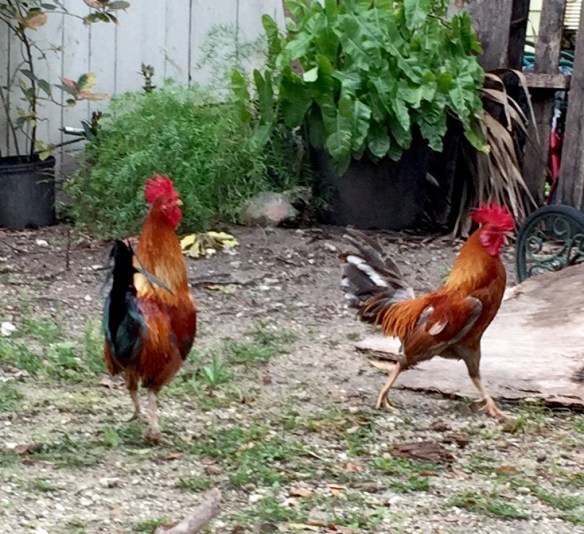
Today levels the playing field. Our differences make no difference today.  What you have become is beside the point today. All the quarrels and distinctions are beside the point. Ash Wednesday is the leveler. The eraser. The antidote. The reminder that we are mortal. That I am living my death as you are living yours and dying my life while you are dying yours. Today, the roosters comb their heads with ashes and stop crowing.

Roosters strutting and crowing in the barnyard

If it often seems that the roosters are in charge of the barnyard, today reminds them and us that, in the end, they are not. Neither are we. Ash Wednesday levels us all to the baseline of zero. “Remember that you are dust and to dust you shall return.” No matter whether you’ve crowed or cowered, no matter the story you tell yourself about yourself in comparison to others, you are no exception. Every reason for pride or self-loathing, and division, is erased by a pencil bigger than our mortal selves.

Whether our stories are re-written by a better Author will continue to be one more matter of dispute and division, but there can be no reasonable doubt about our mortality. “You are dust, and to dust you shall return.” In the meantime, before the roosters stop strutting and crowing and all the cock combs fall to the leveling plain, those who see the face of God in the compassion of Jesus remember the ethic appropriate to those still living in the barnyard:

“As they were arguing over who was the greatest, Jesus said to his disciples, ‘The roosters strut and crow, and you think you are dependent on them. Don’t be like them. Instead, the greatest among you should be like the youngest, and the one who leads like the one who serves.”– (Luke 22: 24-26, GCS translation)

Today, I offer my forehead for the imposition of ashes and pray that in the citadels of power someone else will do the same, for the sake of life itself.

— Gordon C. Stewart, Chaska, MN, Feb. 14, 2018.

Amid the Flood

Days before reading and re-publishing Linn Ullman’s lines about memory and the loss of it (“You just can’t think too deeply about it”), one of the four remaining classmates of what we’ve called The Chicago Seven, The Gathering, and now The Old Dogs, sent the rest of us an article on Alzheimer’s our latest deceased brother, Wayne, had published years ago.

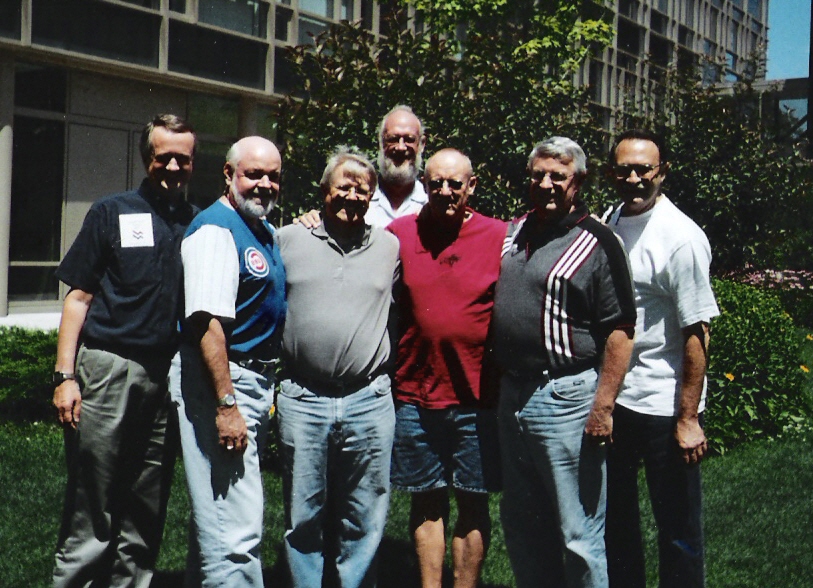
Chicago Seven Gathering L to R: Wayne Boulton, Harry Strong, Gordon, Steve Shoemaker, Dale Hartwig, Don Dempsey, Bob Young@ McCormick Theological Seminary, Chicago, IL, 2004.

As Wayne had imagined his ship going over the far horizon, his worst thought was not death. It was that he would live on, like his father had, without remembering how to tie his shoelaces and without recognizing Vicki, the love of his life, his sons Matt and Chris, daughters-in-law Liz and Libby, and the grandchildren who brought him such joy.

That nightmare didn’t happen. He went out with his mind in tact, as much as a hospice patient’s mind is ever fully there. Aside from his last few days, Wayne’s mind was clear and his heart was full. The article Harry sent the three other surviving Dogs is a reflection on Psalm 90:10, 12 (RSV):

The days of our life are seventy years,
    or perhaps eighty, if we are strong;
even then their span is only toil and trouble;
    they are soon gone, and we fly away. teach us to count our days
that we may gain a wise heart.

When he died in 1989, the sum of Dad’s years came closer to fourscore than to threescore and ten. With the psalmist, I attribute this number to his strength, but I would not wish the manner of his death on anyone. He died of complications due to Alzheimer’s disease.

It was my first experience with the death of an immediate family member, so I was no veteran. I found myself up against a more complicated reality than I had anticipated. I remember thinking at the time that some portion of this is just plain death: nasty, sad, the way death always is. But it is not natural death. It is something else. In the words of Martin Luther’s signature hymn, the disease threw every member of Dad’s little nuclear family—his wife, daughter-in-law, and myself—into a “flood of mortal ills prevailing.”

Amid the Flood,” Wayne G. Boulton, Reformed Review, Western Theological Seminary, December 1, 2000.

Wayne died the way he lived and lived the way he died. Faithful son, husband, grandfather, and friend. Wise. Compassionate. Pastoral. Realistic. Hopeful. Consoler. Prayerful. Private. Counselor. Social critic. Political wonk. Brilliant Christian theologian-ethicist. Follower of truth wherever it led him. All of that and so much more. But, if I had the pen to engrave his epitaph on the simple grave stone in the cemetery of the Mount Vernon Presbyterian Church, if might read,

A sheep of Your own fold, a lamb of Your own flock, a sinner of Your own redeeming, humble servant his Lord and Savior Jesus Christ amid the flood of mortal ills.

  • Gordon C. Stewart, Chaska, MN, March 5, 2019.

I chose to show him empathy

When the killer of 11 Shabbat worshipers at Tree of Life synagogue in Pittsburgh was admitted to the hospital emergency room, he had no idea the E.R. nurse who showed him compassion was Jewish. In this piece, Ari  Mahler, R.N. writes of his experience. It was originally published on Blogspot.com.

“The Jewish Nurse”

I am The Jewish Nurse.

Yes, that Jewish Nurse. The same one that people are talking about in the Pittsburgh shooting that left 11 dead. The trauma nurse in the ER that cared for Robert Bowers who yelled, “Death to all Jews,” as he was wheeled into the hospital. The Jewish nurse who ran into a room to save his life.

To be honest, I’m nervous about sharing this. I just know I feel alone right now, and the irony of the world talking about me doesn’t seem fair without the chance to speak for myself.

When I was a kid, being labeled “The Jewish (anything)”, undoubtedly had derogatory connotations attached to it. That’s why it feels so awkward to me that people suddenly look at it as an endearing term. As an adult, deflecting my religion by saying “I’m not that religious,” makes it easier for people to accept I’m Jewish – especially when I tell them my father is a rabbi. “I’m not that religious,” is like saying, “Don’t worry, I’m not that Jewish, therefore, I’m not so different than you,” and like clockwork, people don’t look at me as awkwardly as they did a few seconds beforehand.

I experienced anti-Semitism a lot as a kid. It’s hard for me to say if it was always a product of genuine hatred, or if kids with their own problems found a reason to single me out from others. Sure, there were a few Jewish kids at my school, but no one else had a father who was a Rabbi. I found drawings on desks of my family being marched into gas chambers, swastikas drawn on my locker, and notes shoved inside of it saying, “Die Jew. Love, Hitler.” It was a different time back then, where bullying was not monitored like it is now. I was weak, too. Rather than tell anyone, I hid behind fear. Telling on the people who did this would only lead to consequences far worse.

Regardless, the fact that this shooting took place doesn’t shock me. To be honest, it’s only a matter of time before the next one happens. History refutes hope that things will change. My heart yearns for change, but today’s climate doesn’t foster nurturing, tolerance, or civility. Even before this shooting took place, there’s no real evidence supporting otherwise. The FBI and the Southern Poverty Law Center note that Jews only account for two percent of the U.S. population, yet 60% of all religious hate crimes are committed against them. I don’t know why people hate us so much, but the underbelly of anti-Semitism seems to be thriving.

So now, here I am, The Jewish Nurse that cared for Robert Bowers. I’ve watched them talk about me on CNN, Fox News, Anderson Cooper, PBS, and the local news stations. I’ve read articles mentioning me in the NY Times and the Washington Post. The fact that I did my job, a job which requires compassion and empathy over everything, is newsworthy to people because I’m Jewish. Even more so because my dad’s a Rabbi.

To be honest, I didn’t see evil when I looked into Robert Bower’s eyes. I saw something else. I can’t go into details of our interactions because of HIPAA. I can tell you that as his nurse, or anyone’s nurse, my care is given through kindness, my actions are measured with empathy, and regardless of the person you may be when you’re not in my care, each breath you take is more beautiful than the last when you’re lying on my stretcher. This was the same Robert Bowers that just committed mass homicide. The Robert Bowers who instilled panic in my heart worrying my parents were two of his 11 victims less than an hour before his arrival.

I’m sure he had no idea I was Jewish. Why thank a Jewish nurse, when 15 minutes beforehand, you’d shoot me in the head with no remorse? I didn’t say a word to him about my religion. I chose not to say anything to him the entire time. I wanted him to feel compassion. I chose to show him empathy. I felt that the best way to honor his victims was for a Jew to prove him wrong. Besides, if he finds out I’m Jewish, does it really matter? The better question is, what does it mean to you?

Love. That’s why I did it. Love as an action is more powerful than words, and love in the face of evil gives others hope. It demonstrates humanity. It reaffirms why we’re all here. The meaning of life is to give meaning to life, and love is the ultimate force that connects all living beings. I could care less what Robert Bowers thinks, but you, the person reading this, love is the only message I wish instill in you. If my actions mean anything, love means everything.

Respectfully,

Ari Mahler, RN.
4th December 2018

A follow-up post will appear on Views from the Edge.

–Gordon C. Stewart, Chaska MN, March 1, 2019.

Monday Morning Wake-Up Call

David Kanigan’s Monday Morning Wake-Up Call popped up this morning while pondering a reference to Jacques Ellul’s “meditation on inutility” cited in a footnote of Walter Brueggemann’s The Psalms and the Life of Faith. The sentence which leads the reader to the Ellul footnote on inutility reads, “In the end — not before, but in the end — praise is a useless act.” (p.122, footnote 21)

Thank you, David for drawing attention to this current meditation in praise of inutility by Kevin Roose in the New York Times.  Jacques Ellul and Walter Brueggemann would call it an act of praise.

Live & Learn's avatarLive & Learn

For the rest of the week, I became acutely aware of the bizarre phone habits I’d developed. I noticed that I reach for my phone every time I brush my teeth or step outside the front door of my apartment building, and that, for some pathological reason, I always check my email during the three-second window between when I insert my credit card into a chip reader at a store and when the card is accepted.

Mostly, I became aware of how profoundly uncomfortable I am with stillness. For years, I’ve used my phone every time I’ve had a spare moment in an elevator or a boring meeting. I listen to podcasts and write emails on the subway. I watch YouTube videos while folding laundry. I even use an app to pretend to meditate.

If I was going to repair my brain, I needed to practice doing nothing…

It’s an…

View original post 37 more words

A Razor Tongue and Razor Wires

A Razor Tongue and Razor Wires is the fruit of an unexpected conversation this morning between the news from Nogales, Arizona, and Psalm 52 on faith and politics. The Psalm texts are from The Book of Common Prayer.

You tyrant, why do you boast of wickedness
against the godly all day long? -Psalm 51:1

Why do you rip innocent children from their parents’ arms? Why do the babies and toddlers yell for their parents at the southern border? Why do you paint yourself as godly when the godly weep and cry out to you from the holding camp?

You plot ruin;
your tongue is like a sharpened razor,
O worker of deception.

Huffington Post, 02/07/2019 11:31 pm ET:

The City Council of Nogales, Arizona, has voted unanimously on a resolution ordering Trump administration officials to rip out new ‘lethal’ razor wire coiled on a border fence along the downtown shopping district.

“Such wire is ‘only found in a war, prison or battle setting’ and is highly inappropriate for an urban area, states the resolution the council passed Wednesday. The bristling concertina wire is now attached to the fence from top to bottom.

“‘Placing coiled concertina wire that is designed to inflict serious bodily injury or death in the immediate proximity of our residents, children, pets, law enforcement and first responders is not only irresponsible but inhuman, the resolution states.”

You love evil more than good
and lying more than speaking the truth.

State of the Union Address:

President Trump 2019 State of the Union Address to Congress

You paint political opponents as enemies of the Country (with a capital ‘C’) and speak hate in the name of making America Great Again. You hold rallies where your base yells “Lock her up” and applaud your hoax that the Mueller investigation is a “witchhunt” like the Massachusetts Bay Colony burning the alleged witches of Salem.

You love all words that hurt,
O you deceitful tongue.

You prey on our emotions. You carefully select the people in the balcony whose stories tug at our heart strings and demonstrate your humaneness. You position yourself as our only sure defense against all enemies foreign and domestic, pointing to the white family left to cope with their loved one’s murder by an illegal immigrant you call an“alien”. Your tactics are clever and effective. You say nothing about the killing of 17 students and one staff member and wounding of another 17 at the Parkland school shooting, or the alleged Russian contributions to the NRA. You divert the nation’s attention from the real world by pointing to heroes and victims who fit your purposes. Your words hurt and deceive by what you have spoken and what you have left unaddressed. You say nothing about climate change and a sustainable energy policy, claiming victory that we are now the world’s largest net exporter of fossil fuel energy. You ignore having turned you back on America’s closest friends and allies, and our withdrawal from international treaties that leave us more vulnerable. You say nothing about anything of substance.

O that God would demolish you utterly,
topple you, and snatch you from your dwelling,
and root you out of the land of the living.

O that Congress would act to stop you! O that your cabinet would invoke the 25th Amendment. O that Melania would abandon you and divorce you for your infidelities and bullying schemes. O that the Supreme Court would rule that you may be indicted while occupying the White House. O that God would snatch you from your opulent dwellings in Trump Tower and at Mar-a-Largo where only the one percent can golf. 

The righteous shall see and tremble,
and they shall laugh at him, saying,

“This is the one who did not take God for a refuge,
but trusted in great wealth
and relied upon wickedness.

O that we shall see and tremble at the greatness of his fall, saying,“This is the maker of the Tower of Babel who seeks to make his name great and confuses our speech. This is the one who claims of great wealth, surrounds himself with fixers and cabinet members sent to prison, arranges agreements with his mistresses to keep them silent and The National Enquirer to keep the stories in a vault, while concealing from public scrutiny the tax returns he promised to provide two and a half years ago.”

But I am like a green olive tree in the house of God;
I trust in the mercy of God for ever and ever.

I will give You thanks for what You have done
and declare the goodness of Your Name 
in the presence of the godly.

I am old and gnarly. Prune back my cynicism. Make me green again, drinking from Your mercy, trusting what I cannot see, and pay You the homage due Your Name alone.

— Gordon C. Stewart, Chaska, MN, reflecting on Psalm 52 and the state of the nation, January 8, 2019.

Living within nature’s rhythms

“I can soon begin to tell the time by how the light is slanting off our walls at sunrise and when the darkness falls — and I suppose back to a more essential human life.

~ Pico Iyer, The Urgency of Slowing Down. An Interview with Krista Tippett (Onbeing, November, 2018), quoted by Live & Learn.

Living within nature’s rhythms comes less naturally to us than it did for our ancestors. I say, “Let there be light,” flip a switch, and there is light. “The light was called ‘day’ and the darkness called ‘night’.” Not anymore. The darkness is as light to us. But not to dogs!

Barclay, the Cavalier King Charles Spaniel shadow chaser.

Barclay, the canine companion who joins me for my daily afternoon nap, is what they call a shadow chaser. He lives by the movements of the sun, the hourly changes of light and shadow. Barclay aims to please. He’s very respectful of the napper. He lies very still . . . until it’s time . . . and he moves from the foot of the bed up to the pillow and licks my face to say “it’s time!”

The angle of the light from the bedroom window is his alarm clock. He knows the exact moment of the shift in the light’s angle that says it’s time to get up and head quickly to master suite bathroom where the light will be like the aurora borealis. Time to rise and shine. Time for me to open and shut the shower door. Over an over, to make the light move around the floor and walls so he can jump at it, pounce on it, eat it, or catch it with a paw. It’s playtime! Until the angle of the light shining through the small hexagonal window changes and the stream of light disappears until tomorrow about 3:10 PM . . . unless the clouds hide keep the light away, and it’s time to stay quiet at the foot of the bed for another day.

Morning sun on cabin wall.

The closest I get to nature’s rhythms here in Chaska is the end of nap time. At the cabin by the wetland, it’s altogether different. The light streams in everywhere, always from a different angle, luscious golden sunlight dancing on the rough-cut pine walls, or the blue light of the full moon that streams through once a month. And all without flipping a switch.

And God said, “Let there be light”; and there was light. And God saw that the light was good; and God separated the light from the darkness. God called the light Day, and the darkness God called Night. And there was evening and there was morning, one day. (Gen. 1:3-5)

— Gordon C. Stewart, Chaska, Minnesota, January 31, 2019.

Why did Jesus have to go to hell?

I’d forgotten the moment during the children’s sermon until David’s mother Jan refreshed the memory of everyone around the dinner table the night before David’s ordination. “Do you remember the time David asked you why Jesus had to go to hell?'” David is forty now. He was five or six when he asked the question on the chancel steps.

Who knows what goes on in a child’s mind? Who expects a Presbyterian church to become a comedy theater? When I turned to look back a my colleague for help, Jack smiled, shrugged, and said, “Your sermon!”

Jack was working toward his PhD. in semiitic langauges at Hebrew Union College at the time. Why Jesus had to go to hell wasn’t question of a Jewish education! Knox Church wasn’t big on hell either. The idea of Jesus in hell was strange enough, but David’s question was why Jesus had to go to hell.

David was a pure soul. A concrete thinker like others his age. He was also thoughtful. Curious. Questioning. Listening carefully to the words we adults spoke, like the Apostles’ Creed: “He was crucified, dead, and buried. He descended into hell.”

“Why did Jesus have to go to hell?”

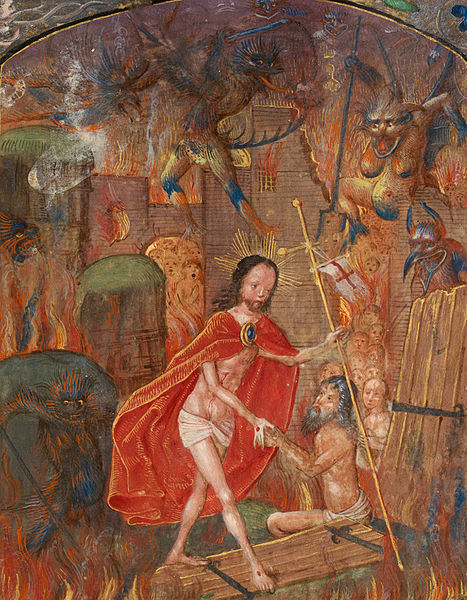
The Eastern Orthodox tradition of the Christian faith celebrates “the Harrowing of Hell” — the descent of the crucified Jesus to open the gates of hell. The Harrowing of Hell expresses symbolically that no one is so far from God that they cannot be reached; there is more mercy in God than there is sin in us.

This preserved parchment scroll from the sixteenth century depicts Christ having “gone to hell,” taking the hand of Adam, a symbol of the unyielding persistence and sovereignty of reconciling Love.

467px-harrowing_of_hell_christ_leads_adam_by_the_hand._on_scroll_in_border,_the_motto_'entre_tenir_dieu_le_viuelle'_(f._125)_cropped

The Harrowing of Hell — Christ leads Adam out of Hell (1503-4)

David’s ordination took place on the same chancel where he had stumped the pastor. Now it’s his turn to field the questions. I’m retired!

— Gordon C. Stewart, Chaska, MN, January 27, 2019.

The Beloved Community

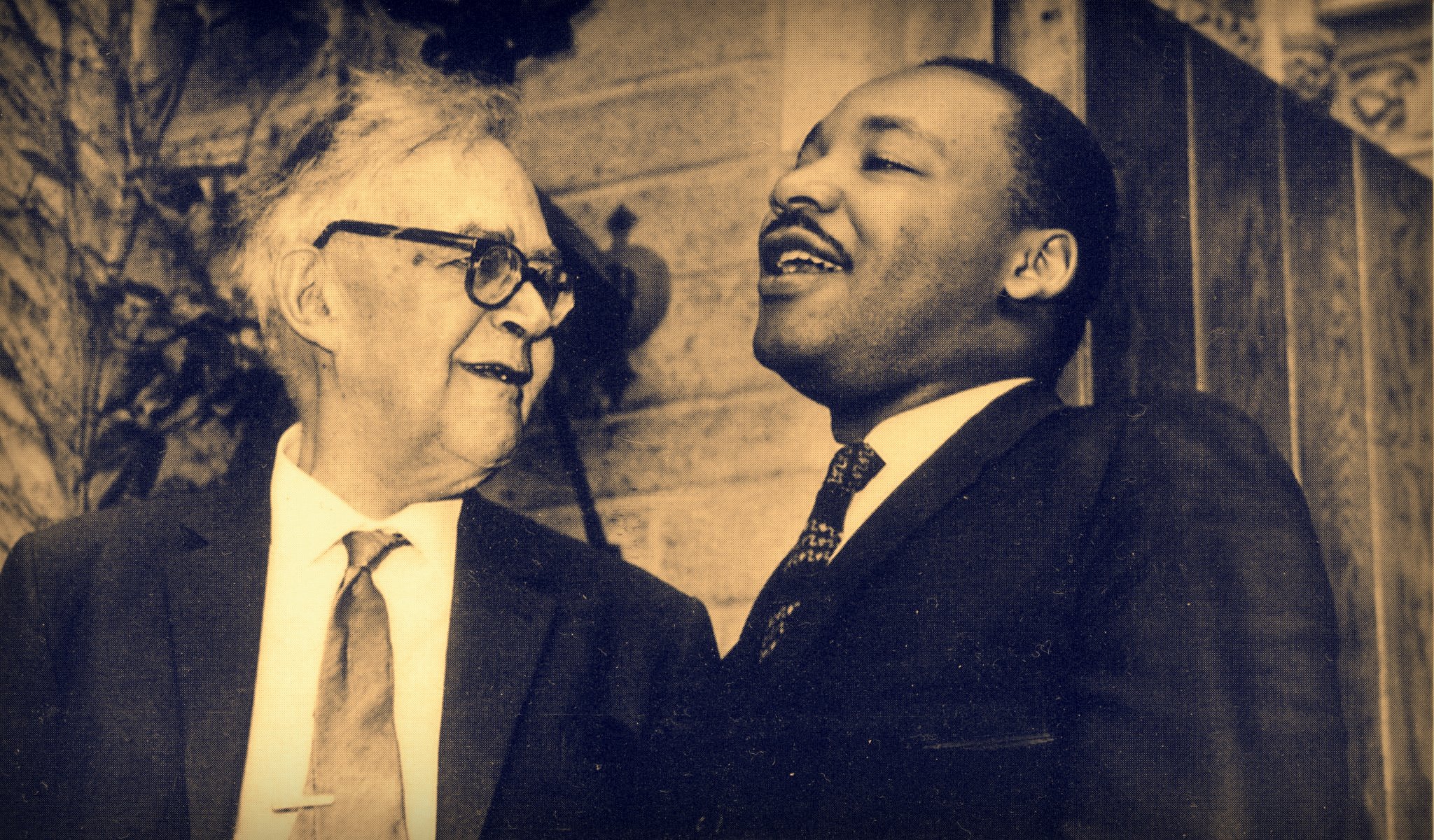
Swiss theologian Karl Barth and Martin Luther King, Jr. enjoying a moment of laughter.

This year’s Martin Luther King, Jr. commemoration comes in the fifth week of the American federal government partial shut-down over a wall. In the name of the Beloved Community — the just and peaceable society — Dr. King and Dr. Barth had things to say about building walls.

Karl Barth and Martin Luther King, Jr. are formative influences on my life. I hadn’t realized until this morning how fully their theology and ethic were in the warp and woof of last Sunday’s sermon at Knox Church in Cincinnati. With apologies to these two great figures, we post an excerpt from a sermon of one of the many lesser lights who live in their long shadows.

Something there is in the Beloved that doesn’t love a wall. Something there is in Jesus that tears down the walls between neighbors and turns enemies into friends, brick by brick, stone by stone — between the Judeans and the Samaritans, and between the male apostles and the Canaanite woman; between the “righteous” who choose purity over compassion and the “good” Samaritan who binds up the wounds of the one in the ditch; between the publicly scorned blind beggar and the charitable nickel-and-dimers who passed by on their way to secure homes and lavish parties; the crowds on the street and the sinful Zacchaeus in the sycamore fig tree; between the Beloved Son and the hosts of sinners who flocked to him for acceptance, forgiveness, healing, hope, and compassion.

For Jesus, love was not a private thing. Love must be made public. As Cornel West puts it, “Justice is love made public.”

Sermon by GCS, Knox Presbyterian Church, Cincinnati, OH, Jan. 13, 2019

— Gordon C. Stewart, Chaska, MN, Jan. 20, 2019.

Invisible or Visible?

“Invisibly, almost without notice, we are losing ourselves” (see yesterday’s post) brought to mind the following piece written in 2007.

Do you ever feel invisible? Ever wonder whether you’re really there? I do. People walk by on the street or in the mall…it’s like I’m not there.  People walk by like ghosts talking to ghosts. They don’t see me. They’re somewhere else, not really there.  They walk like people; they talk like people; they look like people.  But their eyes and ears are somewhere else . . . in some far off place. Their heads down, reading or writing a text or staring into space, babbling to someone who’s not there.  I’ve become invisible.

I have the same experience driving to and from work.  Drivers cut in front of me or run up behind me. They laugh and smile and wildly gesture, but there’s no one else in the car! When their driving puts me in jeopardy, I honk. They just keep talking.  They don’t look and they don’t hear anything but the voice on the other end of the cell phone. Even my Toyota’s invisible; it’s become a non-material world.

Sign along Bellaire Boulevard in Southside Place, Texas

It’s nothing new really.  Western spirituality has always been dualistic. It says that we have a body and we have a soul – the physical and the spiritual.  We have these bodies for a while, and then we die, but we don’t really die; we just escape these bodies, like birds set free from our cages.  This dualistic understanding of life made its way from classical Greek philosophy into the writings of St. Paul as the war between “the flesh” and the spirit. “I’ll fly away,” often sung at funerals, expresses the underlying philosophy. “When the shadows of this life have gone, I’ll fly away Like a bird from these prison walls I’ll fly. I’ll fly away.” The rudeness on the highways, in the malls, coffee shops and restaurants — and even in our homes — is the latest expression of this deprecation of bodily existence.

We don’t see each other anymore. The voice on the other end of the phone is more important than the person in front of me, and the ones I cannot see or hear or receive a text from are unreal…in Iraq, Afghanistan, and anywhere else I decide to hang up and nuke their worlds into the permanent invisibility of nonexistence or the fires of hell.

I sit quietly at the airport gate, waiting for my flight. Used to be people would at least acknowledge one another’s existence – the bare fact that you were really there and not somewhere else or nowhere – but now they’re on their phones, babbling away as though the room were empty except for them. Because, I suppose, we’re ancient Greeks with head sets, cell phones, and iPads, seduced by the old idea that we are meant for non-embodied existence. It’s just me and my invisible world, and you with yours, a rude collection of loud mouths with headsets, alone in the crowd, bereft of the silent pauses between the noises that make us anxious.

Barclay and Kristin pausing on the walking path.

Touch is a basic need. My dog knows it.  I know it.  Hearing and speaking are important. But the most important communication comes by touch. An animal that goes untouched becomes mad as a March hare.  So do we.

In this world of disembodied spirits, we crave the gift of touch. But to touch and be touched is a vulnerable thing. It reminds us of our embodied selves, our mortal selves, our dependent and interdependent selves. The non-material world is safer. Unlike the body, the worlds in our head are invulnerable.

Building of the Tower of Babel – Master of the Duke of Bedford

In my faith tradition, the Feast of Pentecost celebrates the day the babbling stopped, the day the Spirit shifted the crowd’s eyes and ears out of the lonely silos of self-absorption and self-deception — away from their iPhones, iPads, and headsets.

The sound of a mighty wind was so profound, so inescapable and unmistakable, that the company of lonely strangers stopped babbling around the phone tower and noticed the other people around them.


— Gordon C. Stewart, Chaska, Minnesota, Jan. 9, 2019