American ICE and a BURNING COAL from the Altar

“Here am I,” says Isaiah, ”Send me,” in reply to the question of the Holy One,” “Whom shall I send? Who will go for us?”––Young’s Literal Translation

Christian Nationalism is a Parasite

Propaganda is a parasite. It can’t live without a host. ‘Christian Nationalism’ sucks the blood out of sacred texts. Few biblical texts are as beloved as the calling of Isaiah. In the original Hebrew text, Isaiah speaks in the present tense: “In the year that king Uzziah died, I see the Lord, high and lifted up, and his train is filling the temple.” He sees the seraphs flying above the throne, singing “Holy, holy holy, [is] Jehovah of hosts, the fullness of all the earth [is] his glory.”

A Homeland Security promotional recently featured an ICE recruit attributing his sense of call to become an ICE agent to Isaiah in the temple, “Hear am I, Send me.” The Homeland Security promotional [since taken down from X] turns Isaiah’s call into a parasite that sucks the blood of compassion from its host. “We will cut you down,” the voice-over of a helicopter sighting two migrants moving through the night toward the U.S. southern border, displaces the “Holly, holy, holy.” The whole earth that is full of God’s glory is shrunk to the parcel of earth.

An Autobiographical Reflection

It was in college that the calling of Isaiah took hold of me. I don’t remember who put Frederick Buechner’s The Hungering Dark in my hands, but I’ve never forgotten the impact of Buechner’s reflection on the call of Isaiah (Isaiah 6:1-8). I was not in the Temple in Jerusalem; my dormitory room was not filling with smoke; I knew nothing of seraphim, let alone seen them flying overhead or heard them calling to each other their song of praise for God’s holiness. No seraph had touched my lips with a hot coal from the altar. Even so, I knew this story the way a child ‘knows’ a story before the codes of reason ridicule its sense of wonder. Like Isaiah in the year that King Uzziah died, the foundations of what I once thought to be solid were trembling. The world was a mess. So was I. I was a man of ‘unclean lips’ living among ‘a people’ of unclean lips.

The summer before reading The Hungering Dark, my foundations had been shaken by the daily trips on the Red Arrow bus and Philadelphia subway that took me back and forth between where I lived and the squalor of Opal Street in north Philadelphia. Two landmark institutions gave stability to north Philadelphia: the Pennsylvania State Penitentiary and Corinthian Avenue Chapel. The eight homeless men with whom I had spent the afternoons that summer had been guests of the penitentiary before they were released to the streets. Corinthian Avenue Chapel, the empty shell of a once thriving Presbyterian church, vacated by white flight, was three blocks north of the prison.

It was a game of dodgeball with the kids who lived in the tenements on Uber Street that introduced me to the men of Opal Street and set the course for the rest of the summer. There was no traffic on Opal Street. My focus shifted from working with kids to an altogether unexpected summer with “the Brothers of Opal Street.”

An errant throw sent the dodgeball through the circle of ‘winos’ (their designation, not mine) who gathered every afternoon, seated on wooden orange crates, in the middle of Opal Street . After apologizing for interfering, I continued walking to the far end of the block. Like the condemned tenements that lined the east side of Opal Street, the far end of the street was blocked by a boarded-up fence. The chalk outline of a body was still fresh on the pavement

When I returned with the ball, the men asked what I was doing there. When I spoke of games for the kids, one of them drew laughter when he asked, “Do you have any games for us?” “I do,” I said. “Any of you ever play quoits?“ “Quoits?” Again there was an uproar of laughter. “Well, how about horseshoes?” Corky had played horseshoes in the Army. The next day I set up the Quoit stakes on the street. Every afternoon, we played Quoits until the men could no longer stand.

On my last day with them, the men wanted to have “a little talk.” I had expected the sharing of good-byes. What happened was something else. In retrospect it was life-changing, A one-of-its-kind Isaiah in-the-Temple moment. No seraphim flew above us, singing “Holy, holy, holy.” But there was smoke, a red-hot coal striking my lips, and a realization that I was a man of unclean lips among ‘a people of unclean lips’.

“Why did you come here?” they asked. “Don’t come back here. ‘Your people’ own this place. Look around. You don’t see any white faces. Your people never show up around here, but they own this place. It’s too late to help us. But the kids? If you want to make a difference here, go back to ‘your people’ and change things there.”

I had come to Opal Street as a disciple of Jesus, wanting to be of service among the “less fortunate,” like the good Samaritan who crossed the road to show compassion to the man who’d been left half-dead in the ditch. It had seemed that simple at first. I had assumed the western Main-line suburbs and Opal Street were worlds apart. One was wealthy, the other was poor. One was white, the other was black.

Now, after a long, hot summer, the ‘winos’ and ‘junkies’ of Opal Street had shattered the myth of separate worlds. Power and powerlessness, parasites and hosts live in the same world. I returned to college, confused, at sea, questioning everything I had been taught, and threw myself into contemporary philosophy and political science in search of answers to questions that have lasted a lifetime.

Years later, Kai Erikson’s Wayward Puritans provided a sociological framework that deepened my understanding of why and how we human beings ‘other’ each other. Cultures need deviants, outsiders, stereotypes who threaten the majority’s view of itself. Witches became the scapegoats that served to define what the majority was not. The Massachusetts Bay Colony was Christian and moral; witches were neither. The witches of Salem, the banishment of Mr.s Anne Hutchinson and the execution of Mary Dyer, served to save the Bay Colony’s religious–racial consensus from fraying further.


A BURNING COAL melts ICE

The Department of Homeland Security likening the call of Isaiah to a call to join ICE is chilling. It’s bad theology, bad faith, and bad patriotism. But heat always melts ice. Isaiah’s calling is remarkable for its sense of holiness and wonder. The Homeland Security rendering of “Here am I, Send me” is a call to cruelty and unmatched power over the ‘other’. It confuses divine calling with a call to dominate. In the ICE propaganda, there is no sense of the young man feeling lost, no sense of woe, no awareness of unclean lips or of one’s own people as a people with unclean lips, no hot coal from the altar burns away the sin. ICE’s adaptation of Isaiah is a parasite. It replaces the burning coal with an ice cube. Where the seraphim sang of the whole earth filled with God’s glory, border patrol helicopters buzz overhead migrants seeking a better life with the message, “We will cut you down!”

Every person of honest faith and good will is being called in this moment of American history to answer “Here am I, Send me!” Isaiah’s call is not past tense. It is now.

Gordon C. Stewart, Presbyterian Church (USA) pastor and public theologian, author of Be Still! Departure from Collective Madness (2017 Wipf and Stock), writing from Brooklyn Park, Minnesota, August 6, 2025.

American Rhinoceros

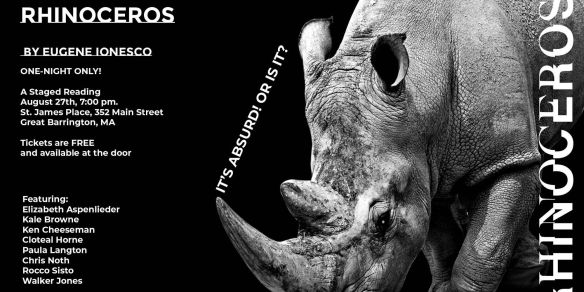
The video of a rhinoceros killing a lion and throwing it into the air like trash called to mind Eugene Ionesco’s Rhinoceros. As I remembered it, Rhinoceros, like other works of The Theater of the Absurd, tore back the curtain of presumption that keeps us from seeing who we really are. If Rhinoceros was about anything else, it was about order and chaos, dominance and subservience, power and the wannabe herd that surrenders its power to the Rhinoceros.

A day in Brooklyn Park

My sense of the absurd grows every day. I see myself as E.E. Cummings’ “Little i” –– Who am I, “little i” among the herd of “little i’s” clamoring for dominance? I know so much less than I once knew. The sense of absurdity has shredded my confidence in the unseen hand of divine providence.

Kay and I live in Brooklyn Park, Minnesota, where a police bulletin advised all residents to stay in our homes until a future advisory. Keep the doors locked while the police searched for a shooter at loose in our neighborhood. The man is armed and dangerous. Do not answer the door under any circumstances. The suspect may be dressed like a police officer. Do not answer the door for anyone until you receive a further advisory.

The next day we learned that a suspect had been arrested. He had shot and killed former Speaker of the Minnesota House of Representatives, Melissa Hortman and her husband, Mark, and had critically wounded MN state Senator John Hoffman and his wife, Yvette.

Speaker of the Minnesota House of Representatives


The Army of God and the ‘unhumans’

The shooter had abandoned his van to flee on foot. The van contained a hit list of 40+ public servants. Everyone on the list was prominent member of the Democratic-Farm-Labor Party (DFL). To some, it came as a shock that the suspect identified himself as a Christian. On most Sundays, he attended worship at an evangelical megachurch. Others were not surprised. They recalled Stephanie McCummen’s article, “The Army of God Comes Out of the Shadows” (The Atlantic, January 9, 2025). The far-right New Apostolic Reformation has quietly sweeps through charismatic-evangelical Churches with its message of Christian nationalism.

Earlier in American public life, residents of Brooklyn Park did not imagine that hate, heartlessness, and cruelty would define their community. Nor would they have thought of a Christian drawing up a hit list, disguising himself as a police officer driving a squad car facsimile loaded with guns, rifles, and military-style weapons used for assassinations and executions of public servants. There was, as there always is among humans anger, frustration, scapegoating, and loathing of others, but the community, for the most part, observed its own cultural commandments of do’s and don’ts.

Living with the Absurd

The ethical norms required for a healthy society have been eroded so slowly that we wonder how we got to the America of 2025 so quickly. Like buildings of brick and mortar, nations, religions, and communities need maintenance. Without it, they crumble.

While a student at a small Christian college, the Theater of the Absurd suddenly came to make more sense than the “Life-of-Brian” view of divine providence in which God’s in his heaven and nothing can go wrong. Things were not right with world. Unless God is a sadist, the world made no sense. I was 19 years-old when Eugene Ionesco, Albert Camus, and Jean-Paul Sartre pulled me, dragging and screaming, into the Theater of the Absurd. I had experienced the angst to which Camus’ The Plague, Sartre’s No Exit, and Ionesco’s Rhinoceros gave expression, but I did not know enough history to understand the Sitz im Leben from which they wrote.

Don’t you see?

Photograph shows South African White Rhinoceros, courtesy of Working with Wildlife, Wikimedia Commons
White Rhinoceros, courtesy of Working with Wildlife, South Africa

All these years later, I get it. Life in 2025 bears ghostly resemblance to these authors’ experience almost a century ago. In an interview published in 1983, Ionesco described the circumstances that led him to the image of a rhinoceros:

I first thought of the rhinoceros image during the war, as I watched Romanian statesmen and politicians and later French intellectuals accommodate themselves to Hitler’s way of thinking. They might say something like, “Well, of course the Nazis are terrible, terrible people, but you know, you must credit them with their good points.” And you wanted to say to them: “But don’t you see, if you start granting them a good point here, a good point there, eventually you will concede everything to them.” Which is exactly what happened. But they looked upon you as an alarmist, then a nuisance, finally an enemy to be run down. They looked like they wanted to lower their heads and charge.

Eugene Ionesco, Le Nouvel Observateur, February 1983

Conceding Everything

The statesmen, politicians, and intellectuals who today accommodate themselves to the thinking and morality of a rhinoceros are not Romanian, German, or French. They are Americans. The way of thinking is the same. The psychology is the same. Though the targets are different, the phenomena are the same. If Jews, gypsies, and homosexuals became the scapegoats that propped up the illusion of Aryan racial superiority in Germany, today in America, the enemy is leftists, socialists, communists, people of color, immigrants, and migrants poisoning the blood of our country. The scapegoat mechanism is the same. The excuses and accommodations are the same. The results are the same.

The strategy and tactics that now threaten democracy in the U.S.A. have a history. Too little has been made of the similarity of the Nazi’s failed coup d’etat –– the Beer Hall Putsch (November 8-9,1923) in Munich –– and the attempted coup d’etat in Washington, D.C. on January 6, 2021. Or of the fact that Adolf Hitler was tried and found guilty of treason and the charges in the second impeachment trial of Donald Trump in the wake of January 6. Or that the book Hitler wrote in prison, Mein Kampf, and the Speeches of Hitler, were, according to members of the Trump family and the co-author of The Art of the Deal, Tony Schwartz, were the only books in his bedroom. Most poignant is the Nazi decision to shift from the strategy of violent revolution to a slower evolutionary road to victory. It would happen more slowly and less spectacularly, but it would succeed. They would destroy democracy from within. And they did.

The late Bill Moyers (RIP) described Donald Trump as a man who has an open sore where a soul should be. Eugene Ionesco saw a Rhinoceros, and a herd of wannabe rhinoceroses, tromping behind the Rhinoceros whenever a snort tells them to lower their heads and charge.

Gordon C. Stewart, Presbyterian Church (USA) pastor, social critic, and public theologian, author of Be Still! Departure from Collective Madness (2017 Wipf and Stock), 49 brief commentaries on faith and public life, Brooklyn Park, MN, July 9, 2025.

Mercy vs. Vengeance: Insights from Psalm 94

Personal Reflections in a time of vengeance

Before Mitchell Dahood’s Anchor Bible Commentary on the Psalms (Psalms II) caught my attention, I had read Psalm 94 as addressing ‘the God of vengeance’. I don’t like vengeance, retaliation, or retribution. I see their results every day in others and in myself. “I am your retribution,” says Donald Trump on the campaign trail. The way of Jesus counters vengeance with mercy, retaliation with forgiveness, retribution with the sweet taste of kindness. 

It was the God of vengeance whose wrath terrified Augustinian monk Martin Luther until Paul’s Epistle to the Romans relieved his distress. “God of vengeance” is mistaken; God was sovereign, yet His heart was for us; not against us. We were no less sinful than Luther had said, but Divine love surpasses our sin. One is ‘justified’ by divine grace through faith.

Father Dahood, Professor of Language and Literature at the Pontifical Institute in Rome, translates the Hebrew word which most translations render as ‘vengeance’ altogether differently. Psalm 94 addresses” the God of vindication.”

I confess that I sometimes hope for vengeance. “’Vengeance is mine; I will repay,’ says the Lord.” So where is it? Is it hiding? If so, why? Is it a projection? Painting God in our image? A Benedictine spiritual guide once replied to my statement, “I don’t believe in Hell” with “Well, we Benedictines say that Hell is real… but there’s probably nobody in it.” The monk was preserving God’s sovereignty as Judge, while maintaining  God’s essence as Love.

Whether it’s God of vengeance or vindication, I feel the psalmist’s cry for God to show up, shine forth, come out of hiding.  Show Yourself. Vindicate Yourself!

Dahood’s translation is also strange for spelling out  the Hebrew Name for God. The Hebrew name was originally four consonants without verbs: YHWH, the inscrutable Name given to Moses out of the burning bush on Mount Horeb. “I Am,” “I Am Who I Am” or “I will be Who I will be.” The Name too holy to speak is above every name – the Breath that breathes in me, in us, in all life. Who , then, am I––little I— to come before You. Who am I to shrink You to a name, you who are the Mystery beyond and within the chaos, neither friend nor foe, “Immortal, Invisible, God only wise, in light inaccessible hid from our eyes.”

I watch the still-to-be sentenced convicted felon entertain his followers, alone on stage at a campaign rally, moving awkwardly, like a teenager who never learned to dance, swaying to the music of YMCA. I see an arena full of adoring fans who have no problem watching the 35-minute visible display of self-absorption.

Learn some sagacity, you dolts,
    fools, when will you understand?
Yahweh knows how vapid are men’s thoughts.

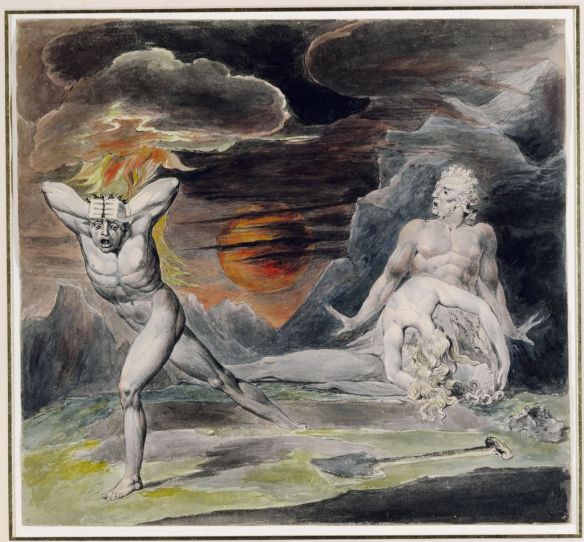
William Blake painting of “Cain fleeing from the wrath of God “as Adam and Eve look on in horror following the fratricide.

“God is hiding, too, Yahiel,” says the Rebbe. “God is crying because we have stopped searching.”

The Gospel of Reconciliation: Finding Peace in Troubling Times

.

The Epiphany of Treason

Epiphany opens our eyes to the Light of truth and goodness, on the one hand, and the darkness of deceit and malice, on the other: the contrasts of light and darkness, hope and despair, fear and love, goodness and evil.


Gordon C. Stewart, public theologian, social commentator, author of Be Still! Departure from Collective Madness (2017, Wipf and Stock), Brooklyn Park, MN. January 6, 2024.

Two Roosters in a Cockfight

Cockfighting in 2024

Illustration of roosters
Two roosters before the cockfight


America in 2024

two roosters beginning a cockfight with audience watching.

How to Win an Election: Fear and Faith

photo of Trump campaign "Fear Not" coffee mug.

The Relationship between Fear and Love

The Christian story of Jesus as the Christ (the Messiah) begins and ends with fear.

And, having come forth quickly, they fled from the sepulchre, and trembling and amazement had seized them, and to no one said they anything, for they were afraid.

Alexis de Tocqueville’s Reflection on America

In the Strife of Truth with Falsehood

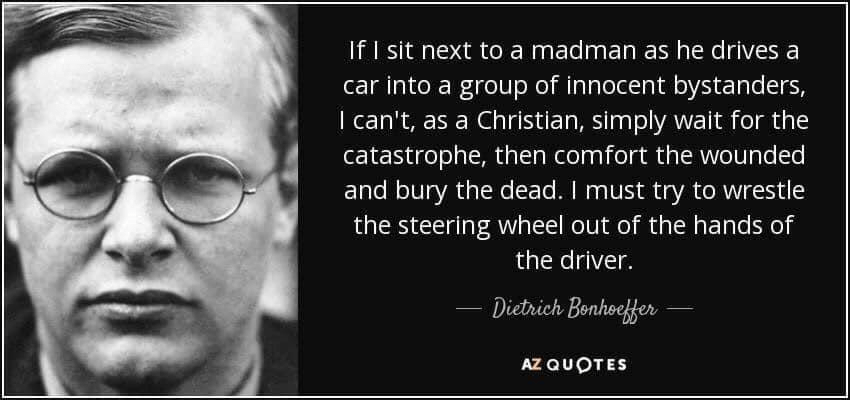
Dietrich Bonhoeffer (4 February 1906 – 9 April 1945

Bonhoeffer and James Russell Lowell

Hymn Lyrics from “The Present Crisis”

Once to every man and nation Comes the moment to decide, In the strife of truth with falsehood, For the good or evil side; Some great cause, some new decision, Offering each the bloom or blight, And that choice goes by forever ‘Twixt that darkness and that light.
Though the cause of evil prosper, Yet ’tis truth alone is strong; Though her portion be the scaffold, And upon the throne be wrong, Yet that scaffold sways the future, And, behind the dim unknown, Standeth God within the shadow, Keeping watch above His own.

JAMES RUSSELL LOWELL, “THE PRESENT CRISIS,” 1845.

The Moment to Decide

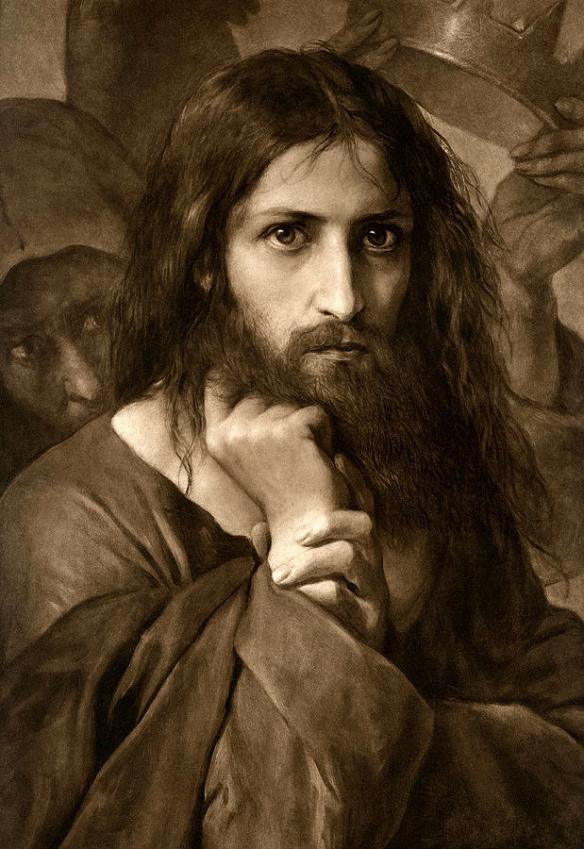
Temptation of Christ

Living among the gods in America: a Meditation on Psalm 82

Then I remember Jesus’ parable of a last judgment in Matthew 25, where the Sovereign of the Universe separates the sheep and the goats, and hear the cry of the lamb of God who takes away the sin of the world, hanging on the cross: “Why have you forsaken me?” “Father, forgive them, for they don’t know what they’re doing.” And I wonder. 

Where is the thunder that will split the veil of religion and empire? Every day I awaken to the knowledge of my helplessness to help. I am a kindergartner in a bully’s world, asking for the gift of daily bread— enough to make it through another day of MAGA madness, another day with hearts turning to stone, another hour watching a sociopath twist law into pretzels. I have seen the crimes. I have gasped at the lies and heard his voice echoing in a swelling chorus of voices cheering on the gods who are not God, silencing the still small voice. 

Where is the God who convenes the council of the gods? Where is the God who judges the gods we confuse with God?

How long will you defend the unjust and show partiality to the wicked?

The “wicked”? Seriously? The wicked? I don’t believe in an impenetrable wall between the wicked and the righteous, the saved and the damned, the sheep and the goats. I have met the wickedness that lurks in me. 

Confession

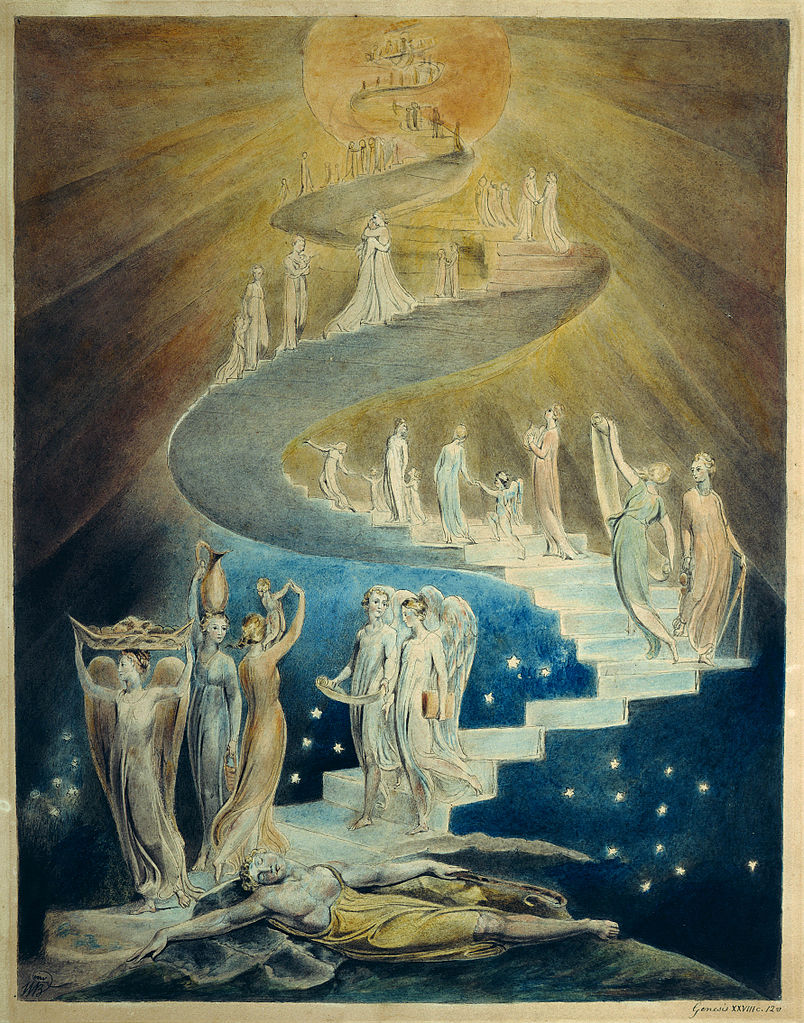
“The prestige of the wicked” and the wickedness of prestige lead me to confess my exaltation of prestige. I have confused the ladder of success with Jacob’s ladder until the wind blew me off the ladder into shame. The climb to the top has been wicked. I have learned how easily the search for excellence inflates the ego and overtakes the gift of authenticity in flesh and blood mortality. Life has a way of knocking the pretense of prestige off the ladder, and, if we’re lucky, we realize that we had it wrong.

Jacob’s ladder is not a ladder for us to climb up; it’s a stairway on which the angels (divine messengers) descend to be with us.


Saint Patrick’s Day at the Irish Pub: A Festive Celebration

It’s the day for green beer, corned beef and cabbage, and the wearing of the green. The television monitors in the pub are broadcasting a rally in Dayton, OH.  “I don’t know if you call them [i.e., migrants crossing the southern border] people,” says the man in the MAGA hat. “In some cases, they’re not people, in my opinion. But I’m not allowed to say that because the radical left says that’s a terrible thing to say.”

“I don’t know if you can call them . . . people. In some cases, they’re not people.”

The poor and oppressed fleeing tyrannical regimes, drug cartels, and gangs in El Salvador, Venezuela, Guatemala, and Honduras are not people? The people now seeking refuge on American soil are not the Jews, gypsies, and “homosexuals” Hitler loaded into cattle cars for a one-way trip t to Auschwitz, Dachau, and Buchenwald for “poisoning the blood of our country,” but they are the same: the less than human ones, the non-Aryans, animals. “Now, if I don’t get elected, . . . there’s going to be a bloodbath for the country.” There will be no rescue for the weak and needy under his watch. Rescuing the weak and the needy is the work of the woke and the weak. We have to be strong.

Jesus’ rebuke: “Woe to you!”

I hear Jesus in the Sermon on the Mount. “Blessed are the poor in spirit, for theirs is the kingdom of heaven.” I am haunted by the curse of the Strong Man that has fallen over the world. I am not digging a mass grave in Ukraine. I am not homeless. I am not searching for food for my starving child in Gaza, Mariupol, or Calcutta. When will the rebuke — “Woe to you” — thunder across the world?  

The gods are neither ignorant nor uncomprehending

President Donald Trump and Vladimir Putin in conversation

Are the gods that troll us ignorant? Are they uncomprehending? No. They are crafty. They are willful. They are calculating. Andrei Navalny did not die of natural causes. He was murdered. The regime that poisoned him knew what it was doing. The gods of power, greed, violence, and war are neither ignorant nor uncomprehending. Aries and Mars are alive and well. They live in our heads. They tell us what to do, leaving Ukrainian and Palestinians to search through the rubble and step over the dead. Here at home a megalomaniac cut from the same cloth as Vladimir Putin threatens a bloodbath if he is not elected. The crowd chants and cheers.

I am at the maximum-security hospital for the criminally insane in Saint Peter, MN. I’ve come to see Mary, who turned to the Legal Rights Center for legal counsel. Her lawyer has asked me to visit as a pastor.

Was Mary ignorant or uncomprehending the day she stabbed her nine-year old son nearly 100 times in broad daylight on Hennepin Avenue in downtown Minneapolis? Did she mean to kill her son? Or were the voices in her head responsible? 

Mary had gone off her meds the day the voices told her that her son was the Devil and that she should kill him. “Not guilty by reason of insanity” sent her to the hospital for the criminally insane. The day I am with her, she is groping in the darkness. The foundations of her world are tottering. Suicide is an option. Which is why I am here.

I had thought, “Are you gods, are all of you sons of the Most High?” No! You will die as human beings do, as one man, princes, you will fall.

The Mortality of the gods

Are you gods children of the Most High?  Or are you as mortal as we? Are you destined to fall, like princes and tyrants? Will you be thrown from the thrones that rule our hearts? Will the shouting and clapping fall silent? Without the language of the heart, only the impostor gods, the carpenter ants, remain to eat away the foundations of compassion and sanity. The impostor god of national supremacy may look different in “Mother Russia” than it does in the USA, but it is the same.

The World and the god of Nationalism

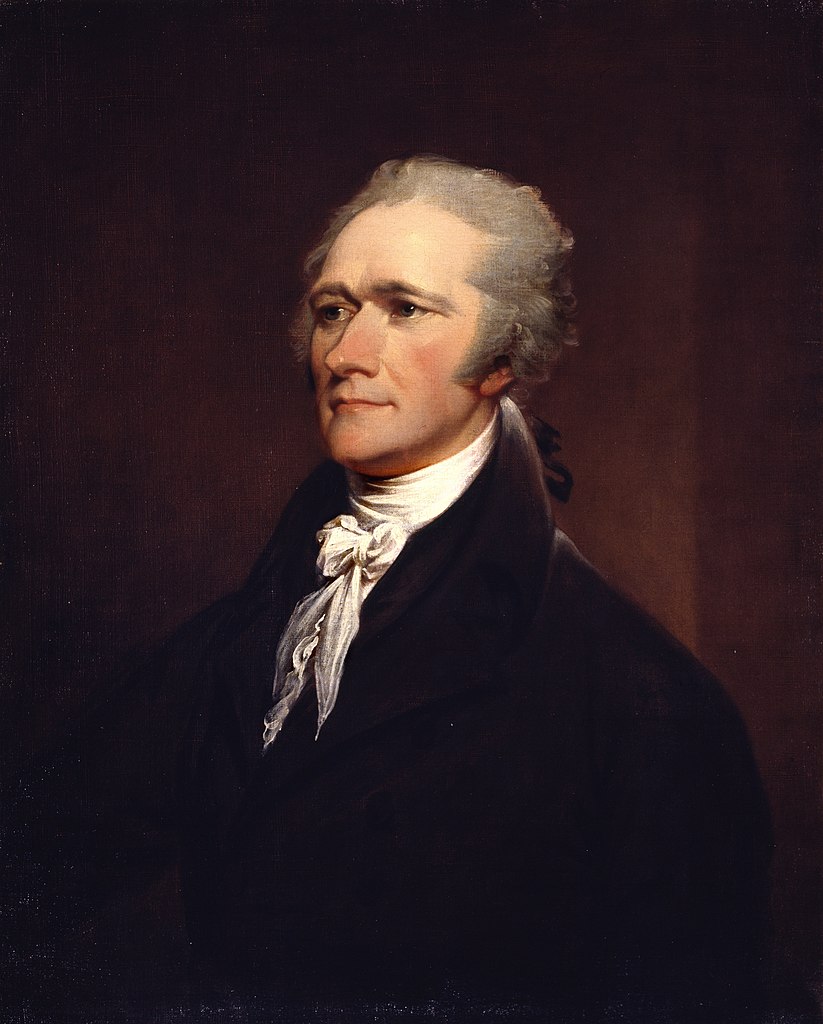
Among the gods gathered for judgment, nationalism has no peer. “If I don’t win this election, we won’t have a country anymore.” He places his right hand over his heart. The crowd does the same. The sound system broadcasts the January 6 chorus of imprisoned “hostages” he promises to pardon singing the national anthem. I hear a still small voice in Alexander Hamilton’s prescient letter to President George Washington in 1792.


Confronting Arrogance and Injustice: Insights from God’s Word to Sennacherib

Featured

Journalist's photograph of Palestinian mother and child walking amid the rubble of destruction.

A personal reflection on God’s word to Sennacherib

Simon the Cyrinian is compelled to carry Christ's cross