“Get off my corner!”

Sen Joe McCarthy purging America of disbelieversGordon C. Stewart (copyright)

I’m sitting calmly in my office when the phone rings. It’s a parishioner who lives near the downtown post office. “I don’t know what’s happening,” she says, “but there’s some kind of ruckus on the corner. There’s some kind of booth on the corner.”

I drive to the Post Office. I park the car half a block away and see a large booth on the street corner. The woman handing out literature is yelling at a man who’s crossing the street, and he’s yelling back. I can’t hear what they’re saying until I draw closer.  A man crossing the street to get away from the booth is shouting over his shoulder. “You’re not only anti-Semitic! You’re anti-American!”

The booth features an eight-foot tall photograph of the President of the United States. But this is no ordinary photograph. There’s a mustache imposed on President Obama’s picture, the mustache of Adolf Hitler and a call for his impeachment, “Du mp Obama!”

I approach the booth.  “Just another Jew,” says the woman.

“What’s happening?” I ask.

She slides a flyer toward me across the counter. “Read it,” she says. I put my finger on the mustache. “You don’t want to hear what we have to say. You’re a spy!” she says as she steps backward, tilts her head in the air, and bellows out “O beautiful for spacious skies, For amber waves of grain, For purple mountain majesty, Above the fruited plain. America!  America! God shed His grace on thee….” But before she sings the last line of the stanza – “and crown thy good with brotherhood… – she stops and orders me off her corner. “Get off my corner!”

She is carrying the message of Lyndon LaRouche, a perpetual candidate for President whose only consistency over a long checkered history of ideological swings on the political spectrum is the red-hot lava of righteous rage.

The behavior of the woman at the Post Office, like that of the Florida pastor whose threat to burn Qur’ans nearly set the world on fire several years ago, is bizarre. But the rage she expresses is not unique to her. Because it is so outrageous, it shines a light into the darkness of the widespread incivility of our time, an incivility that erupts from a core conviction hidden below the surface of our consciousness.

We’re street brawling over what kind of America we will be, and “Can’t we all just get along”- the plea of Rodney King as he witnessed the Los Angeles riots following the “innocent” verdict  exonerating the police officers whose beatings of him had been aired repeatedly on national television– is long forgotten. We’re dividing ourselves into true believers and heretics, patriots and traitors, suspicious of each other all the way to the White House.

This is not new. This volcano of anger erupted in the trial of Anne Hutchinson (1637), banished by the court of the Massachusetts Bay Colony as “a woman not fit for our society” who, when banished, went on to co-found the State of Rhode Island. It erupted in the execution of Mary Dyer, a Quaker hanged for heresy in 1670, and in the Salem Witch Trials. The horrors of powerful religious dogmatism led the Founders of the new American republic to write into the constitution that there would be no established religion. The American republic would a secular republic with freedom of religious expression. It would not be a theocracy.

As the new nation was being conceived, demagoguery often replaced politics, i.e. the art of compromise, as it often does now.  One does not compromise with the enemy. One eliminates him.   Rodney King’s plea is regarded as the way of the ill-informed, cowards, heretics, and Anti-Americans.

The lava of anger originates from a hidden, unexamined conviction that the United States is the chosen people, the messianic people whose job is to eliminate evil within and without in the war of good against evil. It is an idea born of the rape of the Judeo-Christian tradition by nationalism which installs America as the exception to history, the nation divinely ordained to banish Anne Hutchinson in 1637, hang Mary Dyer in 1670, and destroy the reputations of decent people as un-American in Senator Joseph McCarthy’s purge of secret communists in the early 1950s. It’s the belief that America is the exception…and that the real America is only some of us, the righteous believers.

In the unspoken consciousness of our collective memory, “You are the light of the world” becomes the declaration of fact spoken about America, not an itinerant preacher’s call to a small band of first-century disciples to persist in the hard politics of love and peace in a time of hate and violence. The ensuing lines from the primary text, The Sermon on the Mount – “You have heard that it was said, ‘You must love your neighbor as yourself,’ but I say to you, love your enemy and do good to those who persecute you” – are forgotten, ignored, torn out, blacked out or burned on the altar of messianic nationalism.

Even more ironic is that those who attack others, including a sitting president, as un-American – i.e. heretics  who do not bow to the idea of America as the collective messiah  of history– scream against government and taxes as enemies, socialist intrusions on their individual freedom to hoard what is theirs.  The biblical city is no longer a community of sharing of the wealth and care for the least; it becomes a sandbox of greed and competition where the highest value is my freedom to get and keep what is mine.

The irony is that in the minds and hearts of those who have been raped, “America the beautiful…God shed his grace on thee…” is not a statement of aspiration but of fact.  And the prayer “God mend thine every flaw” –  the flaws of selfishness and greed, our meanness to each other, our name calling and stereotyping, our entrenched partisanship, our collective global nationalist arrogance – become a distant memory of a censored sentiment. In times like these when ugliness replaces beauty, America
the Beautiful is, as it always has been, a courageous aspiration and prayer for sanity and the ancient wisdom of the Letter of James that calls us all to engage each other and the world of nations differently: “The fruit of righteousness is sown in peace by those who make peace.”

What do YOU think?

Sit and reflect awhile

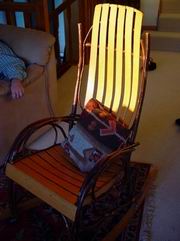
Amish Rocking chair

This post requests YOUR views on a hot topic.

“The GOOD Society: Religion and Politics” drew a crowd last night in Chaska.  The panel was a Quaker, a Christian, and a Baha’i. Those who came were Jewish, Protestant, Catholic, Unitarian-Universalist, Lutheran, Disciples of Christ, agnostic, atheist searching together. Add your voice to the discussion.

QUESTIONS FOR YOUR COMMENT:

What is your vision of the GOOD society, the kind of world you believe in?  Here are several answers from last night to whet your appetite.

The kingdom of God realized (Jesus’ prayer, “Thy kingdom come on earth…as it is in heaven”).

What would that look like? What would be different if it was realized?

What are the qualities of that society? A ‘kingdom’ is a society.

The kin-dom of God, the idea of the kingdom without the ‘g’ – the society of universal kinship. “There is only nation: the human family.”

Agree or disagree and why?

The Unites States is a secular republic, not a religious republic. The founders were clear that America was not to be a theocracy. The “wall of separation” between church and state guarantees the free expression of religion.  It also protects the state (government) against any one religion being on the throne, as in Iran, and as had once been the case in the Massachusetts Bay Colony.

What is the role of religion in the shaping of public life and in politics? By “politics” we do not mean “dirty politics” or “partisan politics’; we mean politics as the work of the polis (the people) in determining the values and laws that hold a religiously free society together. For example:

The Minnesota referendum on Marriage illustrates the problem.

What is “marriage”? Who defines it? Is it a religious concept or a civil concept?

Should a constitution be amended to define marriage?

Should the “wall of separation” leave the definition of and celebration of                  “marriage” (however defined) to the church, synagogue, mosque, etc., and instead provide for “civil unions” (legal contracts between two people irrespective of gender)?

All of us have religious/humanist and political traditions that informs us. One of those for me is the “Principles of Church Order” adopted in 1789 at the founding of the Presbyterian Church in the United States meeting in Philadelphia.  The Rev. John Witherspoon, one of the  signers of the Declaration of Independence and President of Princeton University, was also a key player in the Principles of Church Order intended to guide the church’s internal life and its relation to “the civil power”. Three of the eight principles, it seems to me, inform the current discussion.

On Church and State:

“God alone is Lord of the conscience…. Therefore we consider the rights of private judgment, in all matters that respect religion, as universal and unalienable. We do not even wish to see any religious constitution aided by the civil power, further than may be necessary for protection and security, and at the same time, be equal and common to all others.

In short, we live in a secular democratic republic in which “the civil power” does not aid any religion, but protects the free exercise of all religions equally, without privileging one over another.

On the shared search for truth and goodness: That truth is in order to goodness; and the great touchstone of truth, its tendency to promote holiness, according to our Savior’s rule, ‘By their fruits ye shall know them.’ And that no opinion can either be more pernicious or more absurd than that which brings truth and falsehood upon a level, and represents it of no consequence what a person’s opinions are.  On the contrary, we are persuaded that there is an inseparable connection between faith and practice, truth and duty.  Otherwise, it would be of no consequence either to discover truth or to embrace it.

In short: ideas do matter. The search for what I’m calling “the good society” is based on a shared commitment to the search for truth, not just opinion. Some degree of objectivity or what philosopher Gabriel Marcell called “inter-subjectivity”, not just my own subjectivity. My opinion might be that the moon is made of green cheese or that Earth, not the sun, is the center of our solar system. Ideas and opinions have social consequences.  And in all things, the truth exists for the sake of “goodness” – human and environmental wellbeing.

On the exercise of mutual forbearance: That, while under the conviction of the above principle we think it necessary to make effective provision that all who are admitted as teachers be sound in the faith, we also believe that there are truths and forms with respect to which people of good character and principles may differ.  And in all these we think it the duty both of private Christians and societies to exercise mutual forbearance toward each other.

In summary:  In a secular democratic republic, 1) no religion gets to “capture the flag” of the United States of America.  We honor individual conscience as the corrective light that reforms the prevailing ideas of truth and goodness. 2) We seek truth rather than sinking into the swamp of “I’m sorry, that’s the way I feel, and it’s none of your business, and yours is none of mine.” The acceptance of pluralism is not surrender to the swamp of anarchy or the refusal to look at the evidence of science or to engage in the common search for solutions to social problems.  3) Where we differ and disagree, however intensely, we will exercise mutual respect and patience while we work it out together.

Enough for this morning.  Chime in. Let others know what you’re thinking.

Thanks for visiting.

Throwing Up in the School Cafeteria

Gordon C. Stewart          Feb. 28, 2012

“It makes me want to throw up!”

Nothing causes indigestion more than a food fight over religion and politics. Just because there’s a food fight in the school cafeteria doesn’t mean we should join it.

The 2012 election is shaping up as a battle over religion and the state. But the battle is ill-framed, using a shotgun that sprays everywhere.

The failure to differentiate the issues is widespread in the thinking of the candidates, their supporters and detractors, and news media that are increasing driven by sensational sound-bites that increase viewership and profits than by professional journalistic standards that would help clarify the debate.

Take Mr. Santorum’s statement on ABC’s “This Week” when asked how his faith fits in with his ideas about governing. He referred to then-candidate John Fitzgerald Kennedy’s speech affirming the absolute separation of church and state. The speech, he said, makes him “want to throw up.”

“I don’t believe in an America where the separation of church and state is absolute,” he said. “The idea that the church can have no influence or no involvement in the operation of the state is absolutely antithetical to the objectives and vision of our country.”

There are three separate issues here: 1) the role of religion in shaping public policy; 2) the role of a candidate’s personal faith in the exercise of the duties of elected office in a democratic republic; and 3) the wall of separation between church (institutional religion) and the State.

The question was not about church (i.e. institutional religion) and state. It was issue #2: how the candidate’s faith/religious convictions would influence the way he would govern, if elected President of a pluralistic democratic republic.

“To say that people of faith have no role in the public square? You bet that makes you throw up. What kind of country do we live that says only people of non-faith can come into the public square and make their case?” Santorum asked.

In that respect, Mr. Santorum is correct. For the public or a candidate to assume that it would make no difference would assume that faith and religion are strictly private, personal matters, while politics is a public matter. But as theologians, ethicists and critics of religion like Bill Maher agree, that’s not how it works. What we believe privately informs and drives what we do publicly, whether our personal convictions are religious or some version of secular humanism.

The cross-over between these core convictions and public policy is too important to ignore. The “culture wars” are real. The definition of marriage, the rights of women v. the rights of the unborn, institutional principle/conscience (e.g. contraception) and health care, the value of public education, end-of-life decisions, war and peace, workers’ rights, America’s role in the world, the distribution and re-distribution of wealth, wealth and poverty, and capital punishment are public issues hotly debated by an electorate whose varying religious and secular convictions place them front and center on the national agenda.

The genius of the U.S. Constitution lay in its framers’ ability to differentiate  between individual faith and institutional religion when it comes to matters of State.  What was later described as the “wall of separation” between church and state was, in fact, a wall that prevents the establishment of any one religion as the religion of the State. That is to say, the United States of America was not and would never be a theocracy. It would bea secular democratic republic which respected the free exercise of religion, whatever its stripe.

The founders were also clear that the success of the experiment in representative democracy rested on its citizens being what John Adams called “a moral people and religious people”  instructed in civility and committed to the search for goodness and the common good. They drew the line between the State and institutional religion to protect the republic from the horrors they had witnessed when the two had merged in the attempted theocracy of the Massachusetts Bay Colony, and to protect the free exercise of religion from the restrictive powers of the State.

In that sense, all three questions are fair game. Given the current food fight, the question is not whether to keep all such discussions out of the school cafeteria. Only when we, the electorate, inform ourselves of the nuances of the debate, will the cafeteria be more civil and the candidates stop throwing up in public because they swallowed the wrong question.

Elie Wiesel on Mormon Proxy Baptisms

Elie Wiesel, Nobel Prize and Pulitzer Prize winning author and survivor of the Holocaust, has called on Mitt Romney to join him in calling on the Church of Latter Day Saints (“Mormons”) to stop baptizing Jews who have died.  I wrote the following comment on the Huffington Post story:

We’re taught, and rightly so, to be respectful of religions and views different from our own. But that does not erase the responsibility to think critically about one’s beliefs and practices or those of others. I have the greatest respect for Elie Wiesel and am grateful to him for exposing a practice that insults every Jew, every Christian, every Muslim, every Buddhist, everyone who could not in good conscience embrace any religion at all, by imposing Mormon baptism. Nothing could be more arrogant. The proxy baptisms are not the only beliefs and practices that deserve thoughtful examination. More troublesome to me is the underlying Mormon assumptions that make the United States of America the very center of all human history – the alleged geography of a real Garden of Eden (in Missouri) and of the Second Coming of Christ (also in Missouri). As much as the proxy baptisms, those beliefs should send chills down the spines of everyone whose God belongs to no one nation, no one culture, no one religion – the God of the heavens and the Earth “Whose ways are not our ways and Whose thoughts are not our thoughts.”

An earlier commentary on the matter (posted earlier) addresses the matter moer fully. It’s a reflection that includes a visit to the Mormon Visitation Center in NYC. Let me know what you think.

The God of American Exceptionalism

Gordon C. Stewart          February 7, 2012

Jacket of My People Is the Enemy

“The stairway smelled of piss….

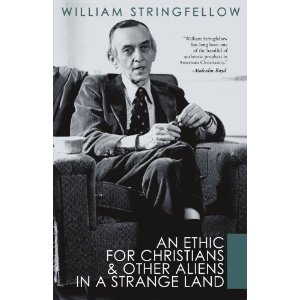
This [a tenement apartment in East Harlem] was to be my home.  I wondered, for a moment, why. Then I remembered that this is the sort of place in which most people live, in most of the world, for most of the time. This or something worse. Then I was home.”  – William Stringfellow, My People Is the Enemy: An Autobiographical Polemic.

I’ve been holding my breath, wrestling with whether to speak aloud what I hear and see.

I’m a disciple of Jesus, a Christian, in the debt to the bold witness of the late William Stringfellow, lay theologian. I’m also a religious pluralist. I believe with Chief White Calf of the Blackfeet that there is not just one way, there are many sides to the mountain and many paths on which the Divine Mystery is experienced.

I have learned over the years to respect the multiplicity of ways different sides of the mountain experience the living God. I work hard to understand my Hindu, Buddhist, Muslim, and Jewish neighbors. I often experience these discussions as encounters with God whose vastness, like the ocean, is so much greater than any of the tea cups in which we hold a few drops of the sea.

I also know that some forms of religion are just plain nuts. The religion of Jim Jones whose followers drank the purple Kool Aid in shared suicide in the jungle of Guyana is only the most ludicrous example of why we need to join comedian Lewis Black’s raging objection to political distortions of the truth: “You can’t just make s—t up!” Religion represents the best and the worst of the human psyche (the Greek word for ‘soul’).

Joseph Campbell, among others, long ago opened the aperture on my theological camera. He helped me to see that what we are all dealing with, on all sides of the mountain, is myth, the human spirit’s uniquely creative meaning-making activity that expresses both the grandeur and the terror of finite experience. Myth is not the opposite of truth; it is the story that points us beyond ourselves to the transcendent and the eternal.

My way of looking at the world is shaped by a vast variety of voices. Among them are Fyodor Dostoevsky, Friedrich Nietzsche, Franz Kafka, Jean-Paul Sartre, Albert Camus and Dietrich Bonhoeffer, whose experiences of the horror of the absence of God caused them to poke their fingers in the eyes of prevailing religious traditions whose tidy moral worlds turn God into a cosmic sadist.

Any religion worth its salt in the 21st century has to pass through the existential protests of these thinkers and of the shrieks and cries that still echo across the world from Auschwitz and Buchenwald that poke holes in every theory of a morally ordered universe. The Garden of Eden was lost a long time ago and, in the wake of the closing of the gates to it, any religion has to take account of the human history that looks much more like the trail of tears paved by Cain’s slaying of Abel than like two innocent people in Paradise before the fall.

Yet there is a deep longing for something more tangible, more trustworthy than myth. Something one can touch, see, feel, smell – a story that is not a story but fact. The longing is strongest when we experience great uncertainty and insecurity.

With this perspective, I have been looking again at the fastest growing religion in America, Mormonism, and the Church of Jesus Christ of the Latter Day Saints (LDS).

My first experience with the Mormons came quite by accident thirty years ago. I was riding a bus in New York City on my way uptown to visit African-American theologian James Cone at Union Theological Seminary in Harlem when I noticed the sign “Mormon Visitation Center.”  Already stressed by an unfamiliar transit system and feeling quite alone, I decided to get off the bus and take the tour.

Unlike the streets outside that were filled with trash and lit by flashing neon signs, the Visitation Center was spick-and-span. Everything was in perfect order, complete with a hologram of a Mormon family in a tranquil woods sitting in a circle, listening to the white upper-middle-class family’s father sitting on a stump higher than the other members of the family, reading from the Book of Mormon to an enthralled wife and two perfect, obedient, happy children. The hologram elicited two responses. One was amazement. I had never seen or even heard of a hologram. The other was a sense of outrage at the perpetration of a promise that was, in short, nothing but a hologram, the illusionary projection of someone’s idea of Eden that would strike a chord with visitors who long for the lost woods of the Garden of Eden. It offered a world of perfection: orderly, tidy, white, rural – nothing like the urban world on the street outside – the antidote to the realities and complexities of life in New York City.

When I left the Mormon Visitation Center it never crossed my mind that the Mormon vision or mythology would become the fastest growing mythology in America in the 21st Century. I was relieved to get back on the bus on my way to Harlem.

I ask myself now why this is so. I look again at Mormon beliefs and practices to try to understand.

In Mormon teaching, the Garden of Eden was a historical place, and it was not in the Mesopotamian Valley by the Euphrates River, as in the original biblical myth of Genesis. It was in North America…in Missouri .

“According to Joseph Smith [Mormonism’s founder] the Garden of Eden was located in Jackson County, Missouri and following his expulsion from the Garden, Adam traveled northward to a place near modern-day Gallatin, Missouri. Mormon Apostle Orson Pratt stated that the name Adam-ondi-Ahman “is in the original language spoken by Adam, as revealed to the Prophet Joseph” (Journal of Discourses 18:343) – Bill McKeever, Mormon Research Ministry.

It is to this very spot of physical geography that Jesus will return at the Second Coming. None of this is in the realm of myth. It’s fact. You can go there to touch it and  walk on it, knowing that Adam was there long before you and that, after you have walked there, it will prove to be the epicenter of the universe, the very spot where Christ will return.

Why is the Mormon myth gaining such traction in America? And why would I break the code of silence, the well-advised reticence to those of us who share White Calf’s belief that the Divine Mystery is known differently on different sides of the mountain?

Some things are too important to leave unaddressed. The Mormon mythology is quintessentially American.

The myth that America is the center of transcendent goodness and power, the world’s epicenter, the original Garden of Eden and the place of Christ’s return, the people of “Manifest Destiny”, the one exception to the rising and falling of empires and nations, is losing its hold on us at home and abroad. We are losing our sense of innocence. Yet there lurks the nostalgia for the secure home provided by the illegitimate marriage of Jesus’ gospel of the Kingdom of God with America, “the City set upon a hill” of Jesus’ Sermon on the Mount and of John Winthrop’s sermon to English settlers on their voyage to the new world.

As Nietzsche knew, such gods don’t die easily, even when they’re already dead. When the town crier takes his lantern into the darkened town square at midnight crying “God is dead! God is dead!” in Nietzsche’s Thus Spake Zarathustra, the rest of the town regarded him as a madman. But it would be only a matter of time before the news would reach their ears.  It was the god of Western civilization that Nietzsche’s madman pronounced dead.

When something dear to us dies, especially when it is the prevailing religious myth of a nation about its own holiness and invulnerability, we become like starving people who continue to look in the same old bare cupboard for bread.

What better place to go than the reassurance that America is still the center – the ancestral home of a real man named Adam, who came complete with his own (now lost language, the special place to which Jesus (who visited the lost tribe of Israel in the Americas between his resurrection and bodily ascension into heaven) will return? When the Christian story the story is concretized to a finite, mortal place, it power as myth – pointing us beyond ourselves to the transcendent and the eternal – is not only lost but turned on its head.

There are many sides of the mountain, and it behooves all of us to approach people of different religious traditions with open ears and open minds. But approaching another’s religious beliefs respectfully does not require that we pretend not to see what we see or that we conclude that all religions are really the same or that one opinion is as good as another in the free market of religious truth claims. “You can’t just make stuff up!”

Let me say without hesitation that what I see in Mormonism is but the most exaggerated illustration of the idolization of the nation that includes so much of the American churches of whatever stripe where the nation is enshrined as God and where patriotism is the unspoken highest virtue with the cross wrapped in a flag.

The American wars of foreign intervention in Vietnam, Iraq, and Afghanistan could not have happened without this widespread faith in American goodness and exceptionalism. It is the cardinal sin that afflicts us across all denominational and religious lines. Whenever the Jesus executed by the Roman Empire becomes the Imperial King of a new empire, those who continue to hear the shrieks and cries of the world that suffers – and who continue to smell the piss on the stairway in the place we call “home”- are obliged to break the silence, violate the code, and get back on the bus to Harlem.

On and off my rocker

My Rocking Chair

My Amish Rocker

“WHY, in a world filled with yelling and screaming, would you ‘PREACH’? Are you off your rocker?”

I can’t help it. I’m a preacher. I have to preach. But it’s the time in the rocking chair that matters most, times when I sit in Jacob Miller’s Amish rocker preparing for Sunday that I love the most. Jacob made the rocker just for me in his Amish shop in Millersburg, Ohio on a farm that spoke volumes about peace and love.

I approach the pulpit in fear and trembling, knowing that it is sacred space where people expect to hear a different kind of word, its sacredness only as real as the humanity that walks into it. The requirements of preaching result in a daily discipline: a fresh cup of strong coffee with the Scriptures in one hand the newspaper in the other.

We live in a crazy world where religion is a source of great sorrow as well as a source of joy. Religion divides and religion unites. It opens us up to the Other, or it walls us off. It broadens us or narrows us.  It increases our circulation or it constricts our arteries.

Not long ago American Christians seemed to take for granted that Christianity and our country were simply flip sides of the same coin (a curious blending of the Judeo-Christian idea of an “elect” people and the national misappropriation of Jesus’ “city set upon a hill”  as a light to the other nations). That bogus idea is dead, but the news is still reaching our ears, like the news of the town crier in Frederich Nietzsche’s The Gay Science:

Have you heard of that madman who lit a lantern in the bright morning hours, ran to the market place, and cried incessantly, “I seek God! I seek God!” As many of those who do not believe in God were standing around just then, he provoked much laughter…Whither is God,” he cried. “I shall tell you. We have killed him – you and I.   All of us are murderers…. God is dead.  God remains dead. And we have killed him….

– Friedrich Nietzsche, The Gay Science (1882), Section 126.

That god is already dead, but the message is still reaching our ears. The death of this god “clears the decks for the God of the Bible,” wrote Dietrich Bonhoeffer in a letter from a prison cell July 18, 1944 before his execution by the Third Reich:

Christians range themselves with God in his suffering; that is what distinguishes them….  As Jesus asked in Gethsemane, “Could ye not watch with me one hour?” That is the exact opposite of what the religious man expects from God. Man is challenged to participate in the sufferings of God at the hands of a godless world. He must therefore plunge himself into the life of a godless world, without attempting to gloss over its ungodliness with a veneer of religion or try to transfigure it. He must live a ‘Worldly” life and so participate in the suffering of God. He may live a worldly life as one emancipated from all false religions and obligations. To be a Christian does not mean to be religious in a particular way, to cultivate some particular form of asceticism (as a sinner, a penitent or a saint), but to he a man. It is not some religious act which makes a Christian what he is, but participation in the suffering of God in the life of the world.

Dietrich Bonhoeffer, Letters and Papers from Prison

I’m no Dietrich Bonhoeffer. But his words and life frame the way I look at the world. To whatever extent the sermons and commentaries that appear here reflect Bonhoeffer’s spirit, I am grateful to him and to others who have shaped my ministry: Ted Campbell, Paul Louis Lehmann, Lewis Briner, William Sloan Coffin, Jack Stotts, William Stringfellow, James Cone, Sebastian Moore, and a host of others. When my attempts fail to keep faith with their examples, they reflect my shortcomings and foibles. If and when any of them manages to speak a Word through my human frailty, it is because I have stood on their shoulders on the watchtower, grasped again by the Spirit of the Living God.

“I will take my stand to watch, and station myself on the tower, and look forth to see what G-d will say to me, and what G-d will answer concerning my complaint. And the LORD answered me, ‘Write the vision; make it plain…so those who run may read it. For still the vision awaits its time….'” (Habakkuk 2:1-3a)

Jacob Miller’s Amish rocker is my watchtower. A cup of coffee, Habakkuk, and the morning newspaper. Thank you, Jacob, for the place to be on your rocker when I’m about to go off mine!

Religion and Politics: Cain and Abel

The Ongoing Saga of Cain and Abel

Gordon C. Stewart | published by MinnPost.com

Religion and politics: oil and water? The problem is that each stakes a claim for the same turf. They both answer the question of how we live together. The fact that religious creeds and political creeds stake claims to leads some of us to separate them, not only as they are separated by the U.S. Constitution, but by carving out different spaces on the same turf: one private/personal sphere (religion), the other public/social sphere (politics). Religion says to politics: Keep your hands off my private beliefs! Politics says to religion: Keep your hands off public policy!

With the exception of adherents of the extreme right or left in religion or politics, most of us have had enough of religious or political fundamentalism. We’re tired of explosive tirades and single-issue politics whose test-tube is organized religion. We’re equally tired of political power plays that dress up a political party (take your choice) as the incarnation of righteousness.

The U.S. Constitution does a good thing when it insists that there be no established religion in this country. Looking back on the failed experiment of the Massachusetts Bay Colony’s blending of religious creed and political authority that resulted in the banishment of dissident Anne Hutchinson (1637), the execution of Quaker Mary Dyer, and the Salem witch trials, the framers of our Constitution had every reason to protect the body politic from the tyranny of any religious majority.

Faith, a vision of the peaceable society

But even as I celebrate the anti-establishment provision of the Constitution, there is no way to separate faith and politics. It’s impossible because faith is about more than the private/personal sphere — it’s a vision of the peaceable society. Faith and politics live in the same territory every time the vexing questions appear regarding the public/social/economic/military ideas and beliefs that create public policy for good or for ill.

The three Abrahamic religions — Judaism, Islam, and Christianity — answer Yes to the question “Am I my brother’s/sister’s keeper?” Our three traditions refuse to confine religion to the vertical and the private. Faith is a living relationship with the Divine that expresses itself, according to Amos, Jesus, and Muhammad, primarily in the daily practice of keeping or caring for the neighbor. Jewish, Christian and Islamic faiths are social as well as personal, public as well as private. While alms-giving and charitable giving are essential, they count for little without also addressing the public policies that set the fires that drive people into the arms of charity. The Cain and Abel story strikes me as a place to anchor the discussion. In the biblical story, Cain (‘kayin’ which means ‘Get’ in Hebrew) is humanity’s first child East of Eden. When Cain kills his young brother Abel (‘puff’ or ‘vapor’ in Hebrew), YHWH asks Cain where his brother is. Cain answers with a crafty question that still echoes down the centuries with war and bloodshed and religious hatred: “I don’t know. Am I my brother’s keeper?”

A call from the NRA

While concentrating on the Cain and Abel story last Monday, my phone rang. The little window on the phone said “NRA.” “Mr. Stewart?” “Yes.” “I’m calling for Ronald Schmeits, president of the National Rifle Association, to invite you participate in a survey with one simple question. It will take just a minute of your time. Mr. Schmeits has an important message. When the message is finished, Mr. Schmeits’ assistant will come on the line for the one-answer survey.”

The message went something like this: “Right now the United Nations is meeting behind closed doors planning to ban all guns everywhere in the world. Even as I speak, they’re planning behind closed doors to take away your freedom in this country. The United States is a sovereign country. We cannot allow a bunch of banana republic dictators to take away the American people’s freedom to bear arms. If we let them succeed, it will be the end of the Second Amendment and the end of freedom in our own country.” Mr. Schmeits’ assistant came on the line to pose the survey’s one “simple” question: “Mr. Stewart, do you think we should allow the United Nations and a bunch of banana republic dictators to take away our freedom? ”

“May I ask how you got my name?”

“Yes, sir, you’re in our data base either as an NRA member, contributor, or as someone who believes in the civil liberties.”

“Well …,” I said, “… I am an advocate for civil liberties.”

“So, Mr. Stewart, would you like to answer the question?”

“Are you serious?! You want me to answer a question that has only one answer, a question premised on demagoguery, fear and lies? Give me a break.”

“You’ve had your break! Have a nice day, Mr. Stewart!”

At that point I wished I’d had a gun. In the name of Abel and all things good, I was becoming Cain.

The work of all religion and politics

YHWH tells an angry Cain in the Genesis story that “sin is crouching at the door, and its urging is for you. But you must master it.” It is the human leaning toward violence that humanity must overcome.

The story of humankind is Cain’s story, the refusal of this mastery. The long sweep of human history is the story of slaying the brother because we have not mastered the beast that crouches inside ourselves. “I am not my brother’s/sister’s keeper.” The sin — i.e. the refusal to take responsibility, the rebellion of separation and of slaying that from which we cannot be separated — goes un-mastered and slays the brother. It comes hurling down the centuries of human development as a rock, a caveman’s club, a sling shot, a rifle, a handgun, a Bazooka, an M-15, an airplane turned into a missile, a drone that kills innocent civilians whose blood, as in the Genesis story, “is crying out to Me (YHWH) from the ground.” Abel’s blood is the ink in which our story is written. Cain’s story sets the stage for the work of all religion and politics worthy of their callings. It is the real story of the Fall from grace held in common by Christians, Jews, and Muslims. It also holds the key to re-writing the story, not by claiming innocence, but by taking responsibility for a violent world.

For faith and for politics alike there is one over-riding question: Am I my brother’s keeper? Or will I insist on the right to slay him? Am I willing to take responsibility for my neighbor, to master the urge to violence that crouches at my door? Do my religion and my politics slay or keep my brother/my sister from deadly harm?

Are we willing to re-claim the Earth as sacred turf — through responsible religion and responsible politics — so that the voice of Abel’s blood no longer cries out from the ground to a horrified God?

“I’m So Sorry”

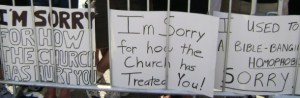
Marin Foundation photo of signs at Chicago Pride parade

I’m a pastor. But there are days when I wonder whether I belong in the Christian Church, whether I’m really a Christian. Ever wonder that about yourself? Or have you left the church as a matter of dissent, embarrassment, or protest?

Take the last two weeks. President Obama shares his faith at a National Prayer Breakfast. He declares that we are “our brother’s keeper”. I feel proud. The comments on CNN run heavily against him. Ayn Rand’s “the virtue of selfishness” – not the story of Cain and Abel or the teaching of Jesus – has won the hearts of the people. Rick Santorum tells an Ohio audience that Obama’s agenda is based on “some phony theology, not a theology based on the Bible.” I feel sad…and angry. I read the story about the church court case of the Rev. Jane Spahr, a lesbian Presbyterian minister rebuked for officiating at same-gender marriages, one of them the wedding of Lisa Bove. Lisa was an ordained student elder at the church I served at The College of Wooster. She went on to seminary and was ordained a Minister of Word and Sacrament. I feel proud of Janie and Lisa, their tenacity, their courage, their strong and gentle spirits, their deep faith. I feel sad that the church still doesn’t get it.

I’m embarrassed by how ridiculous the church debate is and how absurd this church family feud looks to the world. I want to withdraw, pull the covers over my head, go to sleep, take a sedative maybe. But I’m also angry. I want to fight. I want to weigh in on the debate. Yet to do so will only continue the polarization, the disrespect for others, the tendency on all sides of a church argument to proclaim with Little Jack Horner, “What a good boy am I!” If I stick my thumb in the pie, I’ll just continue the ludicrous display of Christian arrogance. What to do? To keep silence feels like abdication of conscience. To speak adds my voice to the appearance of the church’s absurdity. But I’m give fan of the Theater of the Absurd and Albert Camus, as well as Jesus.

I decide to stick my thumb in the story. My comment is the first thumb in a hot pie:

“I know Jane Spahr and Lisa Bove as colleagues and love them both. Lisa was a student leader at the Westminste­r Presbyteri­an Church at The College of Wooster where I served as Pastor. Jane is that rare minister of the gospel who has managed to remain gentle and bold, acting in conscience and ecclesiast­ical disobedien­ce without becoming hard or cynical. Lisa is the same. When you’ve been working for GLBT full inclusion as long as Jane and Lisa, that’s a testimony to their soulfulnes­s. For Jane, Lisa, and so many of us, the Bible calls disciples of Jesus to live in love and to be advocates for justice. The Presbyteri­an Church (USA) last year restored an older principle of church order that removes the restrictio­n against ordaining GLBT members. The issue of marriage remains contentiou­s in the church, as it is in the society as a whole. Some pastors have declared that until church and civil law permit them to officiate at same-sex marriages, they will not marry anyone as a witness to justice. Jane and Lisa are sweet, sweet spirits whose lives bear witness to justice, love and peace, working from that inner light of courage, conscience and consolation that keeps them sane and strong.”

Three replies come quickly:

1) “You are a faithful and honest servant of God.  It has taken a long time, but every year there are more like you” (i.e., “What a good boy am I Good boy!”); and

2) “Pastors should know and preach the truth of God’s word. Please read: 1 Tim: 3:1-7 and Titus 1: 5-9  When folks go against the truth of God’s word, then they are following deceit and you should know who the great deceiver is”  (“Bad boy! Bad boy!”)

3) “Let’s hope this church sees the light and retracts the rebuke.  And perhaps even apologizes­.”

Then this morning a classmate sends me this story about an apology: “Christian Group Shows Up to Chicago Gay Pride Holding Apologetic Signs“.

Marin Foundation photo of signs at Chicago Pride parade

I wish I’d been there to hold one of these signs.

I’ve experienced the forgiving hugs of gay and lesbian church members like the guy in the underwear. And when I write comment or a commentary like this one, I hear a little voice inside myself: “Good boy! Good boy!” Then, as soon as I feel the relief, I know I’ve fallen into the very self-righteousness I despise in others. “Bad boy! Bad boy!” and I’m back where I started: “God help us ALL!”

Read the story. Ponder it. Then stick your finger in the pie with a comment here on the blog.

Plato on Wealth and Poverty

“The form of law which I propose would be as follows: In a state which is desirous of being saved from the greatest of all plagues—not faction, but rather distraction—there should exist among the citizens neither extreme poverty nor, again, excessive wealth, for both are productive of great evil . . . Now the legislator should determine what is to be the limit of poverty or of wealth.”

Sound like Senator Bernie Sanders (I-VT)? Karl Marx maybe? Bill Maher?

It’s not. It was , Greek philosopher (427-347 B.C.) and “father of Western philosophy” who said it.
But it could have been Chuck Collins, grandson of Oscar Meyer, co-founder of Wealth for the Common Good. On their website, watch Chuck speaking on wealth inequality. I met Chuck three years ago at the home of a wealthy couple in Minneapolis.
I chimed in on the discussion in December, 2010 with a guest commentary on MPR, “Fear ‘redistribution of wealth’? Don’t look now”, arguing that the redistribution had already taken place – from the middle to the top of the economic ladder in America.
.
Let me know what you think? Do you agree/disagree with Plato: “Now the legislator should determine what is to be the limit of poverty or of wealth”? Or with Chuck? Should the distribution of wealth (a ceiling and a floor) be on the table or off the table of a democratic republic? If economics is not on the table, what does democracy mean?

Climate Change reflection

Climate Change reflection.

Washington Post Story on Climate Change

A Washington Post story on Climate Change reports this breaking news:

“With global efforts to reduce carbon dioxide emissions stalled, the United States and five other countries are starting a new program to cut other pollutants — including methane, soot and hydrofluorocarbons — that contribute to global warming.

“Secretary of State Hillary Rodham Clinton is set to announce the five-year initiative Thursday morning. Canada, Sweden, Mexico, Ghana and Bangladesh are also participating. The plan will be administered by the United Nations Environment Program, with a $12 million contribution from the United States for the first two years. Canada will add $3 million; contributions from the other countries are not known.”

It goes on to report, “Paul Bledsoe of the Bipartisan Policy Center noted that, in the United States, efforts to reduce methane and soot are far less politicized than efforts to reduce carbon dioxide. Even one of the most vehement congressional opponents of limiting carbon dioxide emissions, Sen. James M. Inhofe (R-Okla.), supports cutting soot emissions. Senator James Inhofe (R, OK), supports cutting soot emissions.”

I have to remind myself to celebrate small steps. This is one of them. My hope and prayer is that Senator Inhofe’s acceptance of scientific evidence supporting action on methane and soot will be one small step toward a saner discussion of global warming. I just asked the question of the Washington Post whether they know why Senator Inhofe is convinced by the scientific evidence re: methane and soot, and, likewise, what scientific evidence convinces him that we do not need to limit carbon dioxide emissions. Anybody know?

.