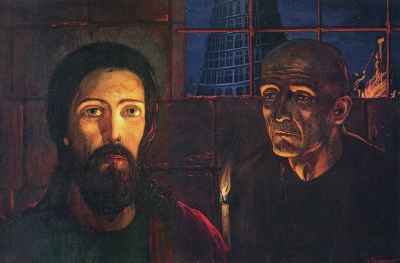
The Jesus Beyond Our Categories

Steve Shoemaker, host of “Keepin the Faith” (WILL/AM, Illinois Public Media) emailed this morning asking for thoughts about a post on “Protestants for the Common Good: ‘People of Faith Advancing Justice in Public Life'”: Can Christians Be Conservative? – an insiders’ academic debate among contemporary Christian theologian-ethicists. It’s worth a read. Tell me what you think.

Here’s what I wrote:

I’m not sure quite how to respond to the piece or the discussion. Off the top, I would say that Jesus himself didn’t neatly fit any of the four polar categories: conservative/liberal; reactionary/revolutionary. Even more, if the question whether the “authentic Christian” can be a conservative is more than a rhetorical question, it should be immediately dismissed – the question itself means that the answer has already been decided in the negative. Sort of like the question “Can anything good come out of Nazareth?!”

Greenfield’s take on Mark 1 is interesting, but, on first reading, it seems to me to miss the point that John the Baptist’s wilderness movement involved all four dimensions. It was conservative, liberal, reactionary, and revolutionary all at the same time. The trek to the Jordean wilderness was a reaction to the collusion between the local religious and political authorities (e.g. Vichy France?) and their Roman (e.g. Third Reich) occupiers. It was also a revolutionary call for a new social order, “the Kingdom of God is at hand; repent and believe the good news.” The grounds for that claim sprang out of the tradition that John and Jesus were conserving, while liberating it from captivity to the spirit of self-serving gains, idolatrous collaboration, self-righteousness and ethnocentrism. In short, the John-Jesus movement doesn’t fit nicely in any one or two categories.

Everywhere I look in the Gospels, I see a Jesus who doesn’t fit our categories. I still don’t know what to do with him.  “Can a Christian be conservative?” assumes from that outset that to be conservative is to be an “inauthentic” Christian. But even if one believes that conservative views and practices are inimical to the way of Jesus, there is the deeper question that puts that question in proper perspective: “Can a sinner be a Christian?” Only a sinner can be a disciple of Jesus. Some of the sinners and sins are primarily conservative, some liberal, some reactionary, and some revolutionary by disposition and by political persuasion. Most of us are some strange mixture of the four. So I would answer Larry’s question “Can Christian be conservative?” with “You betcha!”  How do I know?  Because it’s the wrong question. I don’t get to choose who is “authentically” Christian anymore than Jesus let his detractors decide.  Moreover, I know conservatives who call themselves Christian who put my stewardship and hands-on work with the poorest of the poor to shame. While I’m calling for the revolution, the conservatives I have in mind spend every Saturday preparing and serving meals at the homeless shelter and every Sunday afternoon after putting up with my sermons visiting people they know in town who are down and out – slipping them $100 bills so the utilities don’t get turned off – while I, having preached the revolution, go out for lunch and then go home for a nap.

William Stringfellow stops us all cold in our tracks with his criticism of the church:

Christ’s is a ministry of great extravagance – of a reckless, scandalous expenditure of his life for the sake of the world’s life. Christ gives away his life. The world finds new life in His life and in His gift of His life to the world. His is not a very prudential life, not a very conservative life, not a very cautious life, not – by ordinary standards – a very successful life. He shunned no one, not even adulterers, not even tax collectors, not even neurotics and psychotics…not even poor people, not even beggars, not even lepers, not even those who ridiculed him, not even those who betrayed him, not even his own enemies. He shunned no one. The words that [describe] the ministry of Christ are…sorrow, poverty, rejection, radical, unpopularity. They are the words of agony. It seems ridiculous to apply such words to the ministry of churches nowadays. Yet where these words cannot be truthfully applied to the ministry of churches today they must then be spoken against the churches to show how far the churches are from being the body of Christ engaged in the ministry of Christ in the world.

For Stringfellow the gospel was the vitality of the Word-made-flesh among the principalities and powers of death in this world. None of us has a corner on that Word. One might say that for Stringfellow there is a fifth category that describes the authentic following of Jesus: the life of ‘resistance’ as articulated in An Ethic for Christians and Other Aliens in a Strange Land and The Politics of Spirituality, books uniquely addressed to the church in the American situation.

The question, it seems to me, is beyond ethics, and it is certainly beyond the false choice between the polar opposites: conservative/liberal; reactionary/revolutionary: Can or should a Christian be conservative, liberal, a reactionary, or a revolutionary? The ethics question rises from the theological-faith question: “Where today do we encounter the vitality of th e Word Made Flesh,and, in that encounter, who and how does God call us to be among the principalities and powers as the sinful, timid, confused, forgiven and redeemed disciples of Jesus

In terms of Christian ethics, as I see it, the answer, depending on the situation, involves all four dimensions supplemented by Stringfellow’s fifth descriptor.

I see elements of all five, for example, in Dietrich Bonhoeffer, who boldly conserved the tradition against the false interpretation of the German Third Reich and its ecclesiastical collaborators and paid the price with bodily resistance. Yes?  No? Maybe?

Look forward to hearing your comments.
How I See the World

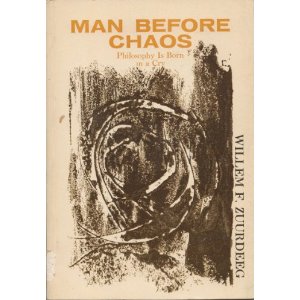
My way of listening and seeing is profoundly shaped by Willem Frederik Zuurdeeg, the late Professor of the Philosophy of Religion and author of An Analytical Philosophy of Religion, and Man Before Chaos: Philosophy Is Born in a Cry, completed following Zuurdeeg’s untimely death by his colleague and friend, Esther Cornelius Swenson, my undergraduate college professor.

They were those rare Christian philosopher-theologians whose work crossed the solid line between the philosophical rigors of empiricism and linguistic analysis, on the one hand, and the depths of existentialists Sartre, Heidegger, Camus, and Marcel and their precursors Dostoevsky and Kierkegaard.

Every day I start out with a fresh-brewed cup of coffee and read the newspaper. What a way to start a day!!! “Don’t give me no bad news, no bad news, no bad news!” But most of the news that’s printed is just that: bad news.

But good news reporting is a thing of joy and a call for celebration. My heroes include muckrakers like A.J. Muste, reporters like Edward R. Murrow, Harrison Salisbury, Daniel Schorr, Bill Moyers, Paul Krugman, and the comedians whose irreverent and sometimes coarse humor exposes the absurd and helps us laugh when we would cry: Jon Stuart, Bill Maher, Lewis Black, Steven Colbert.

I come at the news from a different angle than professional journalism or comedy. My ears are tuned by Willem Zuurdeeg, Esther Swenson, other beloved teachers at Maryville College, McCormick Theological Seminary, and Harvard Divinity School; the people of the congregations and campuses where I have been privileged to minister, and the criminal defense clients of the Legal Rights Center, Inc. where Dostoevsky’s world of Crime and Punishment, Dom Sebastian Moore’s The Crucified Jesus Is No Stranger, and Jesus’ Beatitudes and parables helped me to hear a deeper Voice than the cries that sometimes drove them and their defense lawyers to despair.

I have always had the sense of living at the edge of existence. From the edge I listen for the spoken and unspoken convictions “where ignorant armies clash by night” (Matthew Arnold, “Dover Beach“) to win our minds and hearts, the wars between and among ideologies, ideals, prejudices, states, nations, political parties, religions, economic convictions that shape us for good or for ill.

Lately I have been drawn back to Gabriel Marcel’s The Mystery of Being and Homo Viator to which Dr. Swenson introduced me in college but which were then beyond my experience or interest. Many years later, I find myself more and more at home in the mystery of being itself. I resonate with William Sloane Coffin’s reflection in his last years of life following a stroke.

There is a Zen paradox whereby we may lack everything yet want for nothing. the reason is that peace, that is, deep inner peace, comes not with meeting our desires but in releasing ourselves from their power.  I find such peace is increasingly mine. It’s not that I feel I’m withdrawing from the world, only that I am present in a different way. I’m less intentional than “attentional.” I’m more and more attentive to family and friends and to nature’s beauty. Although still outraged by callous behavior, particularly in high places, I feel more serene, grateful for God’s gift of life. For the compassions that fail not, I find myself saying daily to my loving Maker, “I can no other answer make than thanks, thanks, and ever thanks.”

– William Sloane Coffin, Credo

The American Oligarchy

By the Rev. Gordon C. Stewart | Thursday, April 29, 2010

We do not live in a democracy; we live in an oligarchy, “government by the few, especially despotic power exercised by a small and privileged group for corrupt or selfish purposes” (Encyclopaedia Britannica). I’ve been waiting for people in high places to say it.

Goldman Sachs executives’ testimony Tuesday before the Senate Permanent Subcommittee on Investigations brought the elephant into the living room, but the name of this species of government remains unspoken for understandable reasons.
A democratic republic is a constitutional form of government where the people rule through their elected representatives gathered in deliberative bodies. The faces and voices of Goldman Sachs’ executives demonstrated the intransigent arrogance of the private institutional concentration of wealth and power of deregulated capitalism.

Faith and Politics

For faith and for politics, there is one over-riding question: Am I my brother’s keeper? – Gordon C. Stewart; Published by MinnPost.com | Wednesday, Jan. 6, 2010

Religion and politics. Oil and water. The problem is that each stakes a claim for the same turf. They both answer the question of how we live together. The fact that religious creeds and political creeds stake claims to truth leads some of us to separate them, not only as they are separated by the U.S. Constitution, but by carving out different spaces on the same turf: one private/personal sphere (religion), the other public/social sphere (politics). Religion says to politics: Keep your hands off my private beliefs! Politics says to religion: Keep your hands off public policy!

With the exception of adherents of the extreme right or left in religion or politics, most of us have had enough of religious or political fundamentalism. We’re tired of explosive tirades and single-issue politics whose test-tube is organized religion. We’re equally tired of political power plays that dress up a political party (take your choice) as the incarnation of righteousness.

The U.S. Constitution does a good thing when it insists that there be no established religion in this country. Looking back on the failed experiment of the Massachusetts Bay Colony’s blending of religious creed and political authority that resulted in the banishment of dissident Anne Hutchinson (1637), the execution of Quaker Mary Dyer, and the Salem witch trials, the framers of our Constitution had every reason to protect the body politic from the tyranny of any religious majority.

Faith, a vision of the peaceable society

But even as I celebrate the anti-establishment provision of the Constitution, there is no way to separate faith and politics. It’s impossible because faith is about more than the private/personal sphere — it’s a vision of the peaceable society. Faith and politics live in the same territory every time the vexing questions appear regarding the public/social/economic/military ideas and beliefs that create public policy for good or for ill.

The three Abrahamic religions — Judaism, Islam, and Christianity — answer Yes to the question “Am I my brother’s/sister’s keeper?” Our three traditions refuse to confine religion to the vertical and the private. Faith is a living relationship with the Divine that expresses itself, according to Amos, Jesus, and Muhammad, primarily in the daily practice of keeping or caring for the neighbor. Jewish, Christian and Islamic faiths are social as well as personal, public as well as private. While alms-giving and charitable giving are essential, they count for little without also addressing the public policies that set the fires that drive people into the arms of charity.
The Cain and Abel story strikes me as a place to anchor the discussion. In the biblical story, Cain (kayin which means ‘Get’ in Hebrew) is humanity’s first child East of Eden. When Cain kills his young brother Abel (‘puff’ or ‘vapor’ in Hebrew), YHWH asks Cain where his brother is. Cain answers with a crafty question that still echoes down the centuries with war and bloodshed and religious hatred: “I don’t know. Am I my brother’s keeper?”

A call from the NRA

While concentrating on the Cain and Abel story last Monday, my phone rang. The little window on the phone said “NRA.” “Mr. Stewart?” “Yes.” “I’m calling for Ronald Schmeits, president of the National Rifle Association, to invite you participate in a survey with one simple question. It will take just a minute of your time. Mr. Schmeits has an important message. When the message is finished, Mr. Schmeits’ assistant will come on the line for the one-answer survey.”

The message went something like this: “Right now the United Nations is meeting behind closed doors planning to ban all guns everywhere in the world. Even as I speak, they’re planning behind closed doors to take away your freedom in this country. The United States is a sovereign country. We cannot allow a bunch of banana republic dictators to take away the American people’s freedom to bear arms. If we let them succeed, it will be the end of the Second Amendment and the end of freedom in our own country.”
Mr. Schmeits’ assistant came on the line to pose the survey’s one “simple” question: “Mr. Stewart, do you think we should allow the United Nations and a bunch of banana republic dictators to take away our freedom? ”

“May I ask how you got my name?”

“Yes, sir, you’re in our data base either as an NRA member, contributor, or as someone who believes in the civil liberties.”

“Well …,” I said, “… I am an advocate for civil liberties.”

“So, Mr. Stewart, would you like to answer the question?”

“Are you serious?! You want me to answer a question that has only one answer, a question premised on demagoguery, fear and lies? Give me a break.”

“You’ve had your break! Have a nice day, Mr. Stewart!”

At that point I wished I’d had a gun. In the name of Abel and all things good, I was becoming Cain.
The work of all religion and politics

YHWH tells an angry Cain in the Genesis story that “sin is crouching at the door, and its urging is for you. But you must master it.” It is the human leaning toward violence that humanity must overcome.
The story of humankind is Cain’s story, the refusal of this mastery. The long sweep of human history is the story of slaying the brother because we have not mastered the beast that crouches inside ourselves. “I am not my brother’s/sister’s keeper.” The sin — i.e. the refusal to take responsibility, the rebellion of separation and of slaying that from which we cannot be separated — goes un-mastered and slays the brother. It comes hurling down the centuries of human development as a rock, a caveman’s club, a sling shot, a rifle, a handgun, a Bazooka, an M-15, an airplane turned into a missile, a drone that kills innocent civilians whose blood, as in the Genesis story, “is crying out to Me (YHWH) from the ground.” Abel’s blood is the ink in which our
story is written.

Cain’s story sets the stage for the work of all religion and politics worthy of their callings. It is the real story of the Fall from grace held in common by Christians, Jews, and Muslims. It also holds the key to re-writing the story, not by claiming innocence, but by taking responsibility for a violent world.

For faith and for politics alike there is one over-riding question: Am I my brother’s keeper? Or will I insist on the right to slay him? Am I willing to take responsibility for my neighbor, to master the urge to violence that crouches at my door? Do my religion and my politics slay or keep my brother/my sister from deadly harm?

Are we willing to re-claim the Earth as sacred turf — through responsible religion and responsible politics — so that the voice of Abel’s blood no longer cries out from the ground to a horrified God?

The Language of Demagoguery

THE POWER OF THE WORD

Words are POWERFUL! Sometimes those who preach wonder whether our words matter. But reading this paragraph in Timothy Egan’s NYT, “Deconstructing a Demagogue,” reminded me of just how powerful they are:

Back in 1994, while plotting his takeover of the House, Gingrich circulated a memo on how to use words as a weapon. It was called “Language: A Key Mechanism of Control.” Republicans were advised to use certain words in describing opponents — sick, pathetic, lie, decay, failure, destroy. That was the year, of course, when Gingrich showed there was no floor to his descent into a dignity-free zone, equating Democratic Party values with the drowning of two young children by their mother, Susan Smith, in South Carolina.

Today, if you listen carefully to any Gingrich takedown, you’ll usually hear words from the control memo.

And that’s just the beginning of the story of how language is used and abused for purposes of social manipulation. Gingrich knew that language is “A Key Mechanism of Control.”  Those who are well-schooled in theology and politics know that language is the primary mechanism of mind control: truth becomes falsehood and falsehood becomes truth; beauty becomes ugliness and ugliness becomes beauty; goodness becomes evil and evil becomes goodness, twisted by the language of innuendo and word association.

The cynicism that pervades the American electorate is due, in part, to this demagogic use of language. Words are precious things. Holy things. Sacred things. When they get twisted, they become vulgar and profane, one might even say ‘demonic’ in the sense in which Paul Tillich defined ‘demonic’: the twisting of the good. “The claim of something finite to infinity or to divine greatness is the characteristic of the demonic” (Paul Tillich, “Life and It’s Ambiguities,” Systematic Theology, Vol. 1, p. 102).

Paul Tillich, “The Courage to Be”

Words are sacred. And those who abuse them enter into the darkness of the demonic twistings that led James Russell Lowell to write the hymn lyrics I sang as a child:

Once to every man and nation Comes the moment to decide, In the strife of truth with falsehood…. Though the cause of evil prosper, Yet t’is truth alone is strong; Though her portion be the scaffold, And upon the throne be wrong;, Yet that scaffold sways the future, And, behind the dim unknown, Standeth God within the shadows, Keeping watch above His own. – James Russell Lowell, 1945, “Once to Every Man and Nation”

– Gordon C. Stewart, January 30, 2012

Two pieces on climate change

Following a conversation this morning about why climate change seems to have fallen off the national radar screed as a “hot” topic, John Hopkins, a biologist who recently moved from Alaska to Minnesota, sent me these two important stories:

From the Pew FoundationPew Project on National Security, Energy, and Climate Change connects the dots, and

From the the University of Alaska-Fairbanks’ School of  Fisheries and Ocean Science: Ocean Acidification in Alaska: New findings show increased ocean acidification in Alaska waters

pteropod photo

The pteropod (also known as a sea butterfly or swimming sea snail) may be one of the first marine organisms affected by ocean acidification. Pteropods make up nearly half of the pink salmon diet. This particular pteropod is the Limacina helicina helicina. Photo by Russ Hopcroft, UAF School of Fisheries and Ocean Sciences.

Thank you, John, for sharing. Love to know what others think. Why has the topic cooled when it is getting hotter? 

When political campaigns speak of ‘freedom’, listen with care

When the political campaigns speak of ‘freedom,’ listen with care – text with audio link to MPR All Things Considered commentary aired August 31, 2011.

Mary of Occupy

The Mary of Occupy – All Things Considered commentary on the Song of Mary in the Gospel of Luke. Gordon C. Stewart.

In other cultures and other times, the young woman would be called a peasant. But here and now she is a protester, one of the dwindling numbers of ragged young people on the government plaza. She moves among the Occupier sleeping bags and protest signs in the cold of winter, singing her song of hope and joy.


She makes no demands, which is confusing to some. Hers is a different way: a bold announcement that the old order, symbolized by Wall Street, is already finished. Her purity and her message are impervious to the games of demand-and-response that serve only to tweak and tinker with the old systems of greed and financial violence….

The Shadow of the Grand Inquisitor

Conscience is the “still, small voice” (a whisper) that makes ancient truth appear uncouth. Conscience and dissent change the world.

It is a great sadness to learn of Archbishop Nienstadt’s reported threat of disciplinary measures against priests in the Archdiocese of Saint Paul and Minneapolis who openly dissent from the proposed amendment to the Minnesota State Constitution that would restrict marriage to a man and a woman (“Priests told not to voice dissent,” Star Tribune, 1/18/12).

The protest of the priests and parishes under Archbishop Niensted’s jurisdiction will be mostly silent. They will simply go on about the business of being the church. Their Protestant brothers and sisters either stand by in quiet support or choose to speak out loud what they cannot.

It is customary practice – and a good one – to regard the internal matters of another church as off limits to non-members. Both as a person of significant frailty and as a Presbyterian minister, Jesus’ injunction to take the log out of my own (Presbyterian) eye before reaching for the speck in my (Roman Catholic) neighbor’s eye gives me great pause.

I choose to speak out of great love and respect fore the Roman Catholic Church, my priest colleagues and friends. I tremble that my words will be mistaken as disrespect or that they will turn the clock back to the era before the Second Vatican Council (“Vatican II”) that blew fresh air across the whole Christian world. Before Vatican II, Protestants and Catholics lived in self-imposed religious ghettos on opposites sides of the main street. Today the dividing line has been erased. People are talking, and what many of them are saying is the same…whether out loud or in the chain of whispered protest that happen when the old authoritarian patterns squelch conscientious dissent.

Jesus the Prisoner and the Cardinal, the Grand Inquisitor

We all do well to remember Fyodor Dostoevsky’s The Brothers Karamazov where it is the Church, not Satan, that puts Jesus on trial in the parable of the Grand Inquisitor. The setting is the City of Seville during the 16th Century Spanish Inquisition. The night sky is lit with the fires of heretics being burned at the stake.

Christ has returned to the City of Seville – an unexpected Second Coming without notice or fanfare – to take his place once again among the poor and destitute. As at the first coming, his love for human dignity and freedom of conscience threaten the civil and religious order that has lit the fires of heretical burning martyrs – in his name and for his sake, at the command of the Cardinal of Seville.The Cardinal takes Jesus prisoner – a prisoner of the Church. He tells him that since his departure, the Church has corrected each mistake he had made in the temptations in the wilderness. He tells Jesus that he is a fool for failing to provide the people with what they most want – a hero who will take away their dread of standing alone in freedom before God.

“You thought too highly of them (i.e. ordinary people),” says the Cardinal, “for they are slaves, though rebellious by nature. Look around and judge, Jesus; fifteen centuries have passed. Look at them!   Who have you raised up to yourself?  I swear, man is weaker and baser by nature than you have believed him to be! Can he do what you did? By showing them so much respect, you failed to feel for them; you asked too much from them – you who loved them more than yourself!”

In the end the Cardinal does not execute him. With loss from his “bloodless lips” he sends the Church’s Prisoner off into the night and tells him never to return.

The Archbishop of the Diocese of Saint Paul and Minneapolis is not the Cardinal of Seville. But the Grand Inquisitor’s dark shadow has fallen across the Diocese among those sworn to obedience to the Archbishop’s authority. It has also fallen over their parishes and their Protestant friends. A pall of silence has fallen over the parishioners for whom the Prisoner had “too much respect.” The conversations take place in whispers and in privacy over back fences, or in parish councils where priests and Catholic lay leaders discuss how to be faithful to their own consciences while living under the vow of obedience.

It is one thing for the Church to promulgate an official position on marriage; it is quite another for an Archbishop to tell a priest he must be silent if he dissents on a theological matter, much less on a political and possibly partisan matter.

The Second Vatican Council (Vatican II) strongly re-affirmed the doctrine of the priesthood of all believers.  It made clear that the entire baptismal community constitutes the Church, and that the Church’s teaching office and hierarchy exist to serve the people, not the people the hierarchy. Vatican II lifted up doctrines that date back to the Early Church Fathers: the sensus fidelium (the sense of the faithful) and the sensus fidei (the sense of the individual’s faith).

Among the documents produced by Vatican II was Dignitatis Humanae that celebrated the dignity and freedom of religious conscience. The document opened the Church’s arms to other religions, and there was a great swelling of joy within the Roman Catholic Church and in other Christian churches touched by the Spirit of respect for other views and practices.

No longer were conscience and dissent regarded ipso facto as enemies of the Gospel or of the Church. Those of us in churches separated during the 16th Century Protestant Reformation were embraced by our Roman Catholic brothers and sisters as partners in ministry.  The Second Vatican Council’s spirit of ongoing reform (“aggiornamento”) re-awakened in Protestant communions the call to continual renewal and reform by the Holy Spirit, a 20th Century reformation that refreshed us all.

The proposed Marriage Amendment is a moral question, and the Church’s leadership has a right and responsibility to address it, in light of Traditio (sacred tradition, or the movement of the Holy Spirit among earlier disciples) and the movement of the Holy Spirit among disciples today.

Priests, ministers, and lay people – Roman Catholic and Protestant – on both sides of the pre-Vatican II divide – do not share a single view on the question of the proposed Marriage Amendment that Minnesota voters will decide next November. What we do share is a deep belief in the freedom of the pulpit, the freedom of conscience, and the freedom of the Holy Spirit to work through an informed laity and the church’s ordained leadership in together interpreting Scripture and tradition. We share a deep belief in the sensus fidelium embraced by the Second Vatican Council.

Jesus leaving the city never to return

“By the light of burning martyrs, Jesus’ bleeding feet I track, Toiling up new Calvaries ever With the cross that turns not back; new occasions teach new duties, time makes ancient truth uncouth; They must upward still and onward, Who would keep abreast of truth” (James Russell Lowell, 1845).