“Views from the Edge” exists to promote public discussion of critical public issues. It’s not often that we post something from the NRA, but this one needs to be read by everyone who cares about the future of the United States of America. The “Stand and Fight” campaign announced in this piece is a call to arms. It assumes impending chaos. Readers of Views from the Edge rarely hear it from the horse’s mouth.
I invite readers to listen very carefully to what is said and what is not said – what is written between or below the lines – and the tone of how it’s said.
If you haven’t already read today’s earlier post – “The Common Ground Beneath the Gun Debate” – you might want to swing by it before or after you read this column by Wayne LaPierre, Executive Vice President of the National Rifle Association (NRA).
Click “Stand and Fight” to read how the NRA sees responsible life in our times.
Then post on “Views from the Edge” what you think you saw and heard. Thanks for coming by.
“Six gun companies have announced plans to stop selling any of their products to any government agency in states that severely limit the rights of private gun ownership. Click HERE to read the story.
What is the “Militia” of the Second Amendment and how did “the right to bear arms” get there? Thom Hartmann summarizes a different account of what we now know as the Second Amendment. Please chime in after you’ve read through the piece.
Walter Rauschenbusch (1861 – 1918), “father of the Social Gospel Movement”
“All human goodness is social goodness. Man is fundamentally gregarious and his morality consists in being a good member of his community.”
“The chief purpose of the Christian Church in the past has been the salvation of individuals. But the most pressing task of the present is not individualistic. Our business is to make over an antiquated and immoral economic system….”
The Rev. Walter Rauschenbusch had a profound impact on Christian theology and activism that led to the end of child labor and to legislation that protected worker rights in the early 20th Century. The man whose theology was shaped by his ministry with the poorest of the poor in the “Hell’s Kitchen” of New York City is the man from whose “Social Gospel” Glenn Beck now urges church members to flee for their lives.
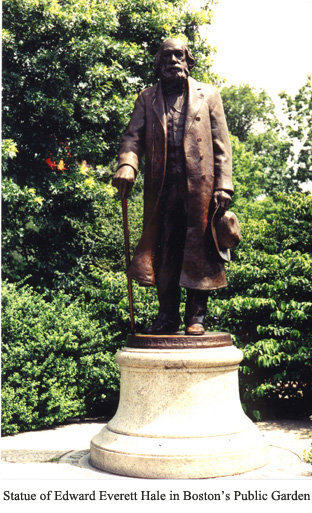
Edward Everett Hale was asked if he prayed for the Senators. He replied:
“No. I look at the Senators and pray for the country.”
The Reverend Mr. Edward Everett Hale (1822 – 1909) served as Chaplain to the U.S. Senate. He was appointed to the position because of his outstanding public ministry as Minister of South Congregational (Unitarian) Church in Boston. He proposed a public retirement pension system for both women and men long before there was Social Security.
First Church Boston’s website provides this account of his ministry.
Thanks to Caroll Bryant for capturing our attention with her blog’s publication of the witticisms famous historical figures.
Thanks to Robert Perschmann for bringing attention to this link, sent out as a New Year’s gift by The People’s World, the newspaper of the Communist Party USA.
Robert sent the link as a part of a comment on Views from the Edge’s post from “Every Valley” from Handel’s “Messiah”. I responded with the following reflection, slightly edited here.:
“Robert, the valleys and mountains, and the rough places a plain, or level place, are so clearly (biblical) metaphors for the coming of economic just. “He has put down the mighty from their thrones, and exalted those of low degree. He has filled the hungry with good things, and the rich he has sent empty away.” The hearer is transported into a vision and hope that can only be voiced and heard in poetry. It is the day of the lion and the lamb, the end of violence and sorrow, the end of the disparities of the sated and the sorrowful.
Josef Hromadka
“Josef Hromadka, Czech theologian and “father of Christian-Marxist Dialogue” during the Cold War, always said the church’s unfaithfulness to its calling was responsible for the atheism of communism. In Czarist Russia there were, on the one hand, the Czar and the Church, and, on the other, the peasants, the poor, the suffering who were oppressed by the throne and consigned to perpetual poverty by the church that taught them to be patient in their hope for another world. Hromadka called for the church to confess the sin of abandoning it charter and its hope. He saw in communism the re-awakening of the original grand hope for the coming of the Kingdom of God.
“Hromadka was a much-beloved professor of theology at Princeton Theological Seminary during the 30s and 40s. My father studied with him and remembered him fondly as a great teacher. When Hromadka left his secure teaching position in Princeton in 1947, many of his Western friends and colleagues were deeply disappointed and highly critical. They viewed him as naïve, a communist, or communist-sympathizer. Hromadka returned to create in Czechoslovakia and the wider Eastern bloc a dialogue that would contribute to the hope for a more humane and human society in both the church and the society..
“Thanks for the link. So interesting and rather mind-blowing that the newspaper of the Communist Party USA would choose Beethoven’s 9th as a New Year gift. I’ll listen with new ears.”
Princeton Theological Seminary Professor Charles West’s “Hromadka: Theologian of the Resurrection” offers an in-depth look at Hromadka’s life and witness as seen by a faculty colleague in the West. Here are some excerpts from the article:
Hromadka rejected both liberalism, with its shallow view (of the human crisis, and conservatism, with its allegiance to old structures which had lost their moral power. “We are living on the ruins of the old world, both morally and politically,” he concluded. “No one single element and norm of our civilization can possibly be taken for granted.”
With this faith which he continually translated into political judgments, Hromadka made the choice to return to Czechoslovakia in 1947, to accept the Communist coup d’etat in 1948, and to work as a Christian within the framework of a Marxist-dominated socialist society.
“I am in no sense a Communist,” he wrote, “but I take part in this revolution from the point of view of my Christian faith which sees the work of the forgiving grace of God in the midst of changes that are coming about.”
Thanks for coming by Views from the Edge. Leave a comment to promote discussion.



 Views from the Edge