
“Beware the Ides of March,” says the seer, warning Caesar that his reign would end that day. ”Well, the Ides of March are come,” declares Caesar, mocking the seer with a sneer. “Aye, they are come,” says the seer, “but they are not gone.” — Joseph Heller’s Catch-22.
A very long day
When words escape me, I look to a psalm, a poem, or work of fiction. Today I find words for what I feel in Joseph Heller’s Catch-22, and in the exchange between Caesar and the seer in the Ides of March. In 2025, it happens, if it happens, on more than one day. The day for us is longer––weeks, months and years – when we are suspended between Caesar’s sneer and the seer’s prophecy.
Donald Trump and Elon Musk continue to turn the Oval Office into a whipping post, the headquarters of a demolition crew, and a showroom for a car dealership. None of us has lived through a period like this. Which is why good fiction like Joseph Heller’s Catch-22 offers a different lens to see what is happening in real time.
Joseph Heller’s character without character: Milo Minderbinder
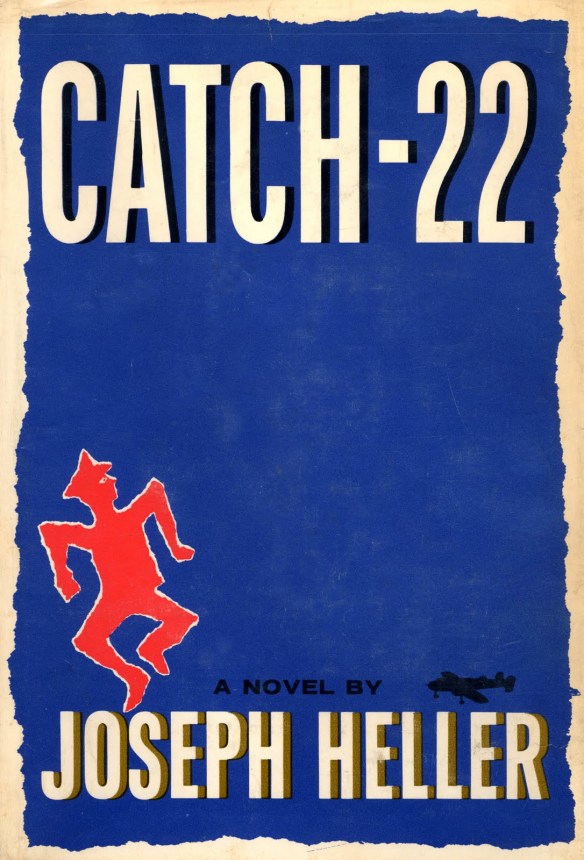
The setting of Catch-22 is a U.S. Army Air Corp base during World War II. First Lieutenant Milo Minderbinder, the squadron’s entrepreneurial mess officer, finds a way to turn the weapons of war to his financial advantage without a hint of principle or scruples.
The result, M&M (Milo & Minderbinder Enterprises) is all about Milo. Led by Lieutenant Minderbinder, M&M Enterprises amasses weapons of war through the black market and by a covert deal with the enemy. By the end, Milo takes pleasure watching the explosions that kill and maim his own troops.
Good fiction lifts the veil on reality,
How does an author describe someone like that? Heller calls him ‘a miracle’. “It was miraculous” is an apt description of what is happening to America now, in real time. Four years ago, it was unthinkable that the American electorate would return Donald Trump to the White House. It would take a miracle, or so it seemed. Until Mr. Trump, like Jesus, walked on water. Heller’s description of Milo Minderbinder jumps from the pages of Catch-22. “It was a miracle,” Heller says,
” It was almost no trick at all, he [Milo] saw, to turn vice into virtue and slander into truth, impotence into abstinence, arrogance into humility, plunder into philanthropy, thievery into honor, blasphemy into wisdom, brutality into patriotism, and sadism into justice. Anybody could do it; it required no brains at all. It merely required no character.” — Joseph Heller, Catch-22.

It takes a character like that to lead others to see you as a miracle, as happened in the Weimar Republic of Germany on Feb. 27, 1933, when the Reichstag (Parliament building) went up in flames. It happened a month after Hitler became Chancellor. Hitler and his devotees blamed the Communists.
Some events outlive their dates on the calendar. Like COVID, Polio, and Measles, they disappear, but never go away. They lie dormant until the circumstances are ripe for their return. Social, cultural, political, economic, and spiritual alienation is the challenge now as it was in Germany. A charismatic sociopath turned Germany into a cuckoo’s nest where morning becomes night, goodness becomes evil, the fear of death turns hearts into stone, mortality into delusions of grandeur, faith into demagoguery, courage into cowardice, patriotism into cruelty and carnage. It’s happening now in America.
Criminal Insanity requires no character
Serving churches and a public defense law office has brought me face-to-face with the likes of Milo Minderbinder. They were patients in the State Hospital for the Criminally Insane. Their delusions and illusions had created their own worlds. None of them had access to nuclear codes. They were burdened, but no one bore the burden of national security. They lived in secure quarters within the real world.
Aside from the nuclear codes, former daily national security briefings, drawing the global spotlight, extreme wealth and power, multiple women, wives, and lawyers, and well-practiced skills to avoid legal consequences, Donald Trump seems undistinguished from similar souls suffering from the worlds in their heads. He, Donald, is its center. His wants, wishes, and desires — and his alone — define reality. He is, in fact, the weak man, the needy man, the sick man who puffs himself up to be a man’s man, the strong man with authority to separate truth and falsehood, good and evil. He is the star who can do no wrong— in a lingerie section of an upscale department store, on an airplane, or in a Moscow hotel suite. His charm beguiles millions of Americans to believe January 6 was an act of patriotism, deserving of pardons, rather than a poorly executed insurrection, an act of treason.
Fiction and reality
Author George Saunders’ work of fiction, “The Moron Factory” (The Atlantic, March 2025) captures what many are feeling in the world’s very long day:
Sometimes feel life stinks, everything bad/getting worse, everyone doomed. Then day like today occurs, reminding one that yes, although life stinks, does not always stink to same extent, i.e., variations can occur in extent to which life, from day to day, may stink.
Today strange.
Maryanne Trump Barry speaks candidly of her younger brother Donald in terms akin to Heller’s description of Milo Minderbindinder:
“He [Donald] has no principles. None. None. And his base, I mean my God, if you were a religious person, you want to help people. Not do this. . . It’s the phoniness of it all. It’s the phoniness and this cruelty. Donald is cruel.”

Today is March 27. The Ides of March have passed, yet nothing has changed. Milo and M&M Enterprises are still undermining the country I thought I knew.
Get up and walk around
You can’t make this stuff up. But novelists and poets can and do. They remove the veil of ignorance. Creative imagination allows us to see reality as it is. Ken Kesey, author of One Flew Over the Cuckoo’s Nest, George Shakespeare, belong in the same guild as Heller and Shakespeare. Kesey saw in Shakespeare’s work a moral imperative.
“When Shakespeare was writing,” said Kesey, “he wasn’t writing for stuff to lie on the page; it was supposed to get up and move around.”
Poetry and fiction may yet save us from Caesar and Milo Minderbinder and our worst selves. That will only happen if we get up and move around.” This long day has not yet passed. Get up and move around!
Gordon C. Stewart, author of "Be Still! Departure from Collective Madness"(2017 Wipf and Stock), 49 brief commentaries on faith and public life, Brooklyn Park, MN; June 4, 2023.








 Views from the Edge