
Bemused by Time

Gordon C. Stewart, August 8, 2013 copyright.

I have always been bemused by time . . . and place. I am on a train listening in the night to the eerie sound of the train whistle and the constant click-clacking of the wheels. Where were we? Where are we going – and why, just my mother and I?

We were between times and places. My father had shipped out for war in the South Pacific. Hewas somewhere on a ship and might not return. My mother and I were on our way from LA to Boston. Two different places: one hours behind, one many hours ahead. But for the time being, there was only the now of the train, the whistle, and the steady clickety-clack from the track carrying us from there to here to there, from then to now to then. Perplexity with time and place is my earliest memory.

We are all in transit. But from where to where and from when to when have become less and less my questions.

I do not share the popular view that time is an illusion or that the material world is the prison from which we will be released at death. Time and place are gifts of creaturely existence, boundaries within which we live our lives appreciatively or scornfully in the midst of the Eternal. To scorn them is to deprecate existence itself in the Promethean hope that we can steal fire from the gods to become what we are not: timeless and placeless.

Time and place are set within the larger Mystery that Rudolph Otto called the Mysterium tremendum et fascinans – the Mystery that makes us mortals tremble and fascinates us at the same time, the Mystery of the Eternal without which we are nothing that draws us to itself like iron to a magnet. Time and place – birth, finite life, death – exist within the Mystery of that which does not die: Eternity.

I am not amused by the denial of death that is so rampant in our culture. Surveys show that roughly 90% of Americans, regardless of religious affiliation, believe in life after death, by which they do not mean that life will go on without them, but that they themselves will never die.

I have come to believe that the denial of death and the fear of death lie close to the core of American culture at its worst. Ernest Becker’s The Denial of Death informs how I see the world and myself; Becker sits beside me as I turn to the Scriptures in the morning.

Psalm 90:1-5, paraphrased by Isaac Watts (1719) and sung as the hymn “O God, Our Help in Ages Past” is as much in my early memory bank as the train whistle on the ride to Boston. It has always represented a mature faith that takes seriously Otto’s Mysterium:

Before the hills in order stood,
Or earth received its frame,
From everlasting Thou art God,
To endless years the same.

A thousand ages in Thy sight
Are like an evening gone;
Short as the watch that ends the night
Before the rising sun.

Time, like an every rolling stream
Bears all its sons away;
They fly forgotten, as a dream
dies at the opening day.

O God, our help in ages past,
Our hope for years to come,
Be Thou our guard while life shall last
And our eternal home.

Standing at the gravesites over the years, I have prayed the same prayer so many times that it has become an essential part of me. I confess that I don’t know what it means exactly but it expresses the sentiment of good faith as I have come to understand it for myself.

O Lord, support us all the day long,
until the shadows lengthen,
and the evening comes,
and busy world is hushed,
and the fever of life is over,
and our work is done.
Then, in Your mercy,
grant us a safe lodging,
a holy rest,
and peace at the last.

The shadows have grown longer since the trip to Boston and the first time I sang the hymn. Evening is closer now. The sense of the Mysterium tremendum et fascinans is different but no less real now than it was on the train to Boston. The hush of the busy world will come soon enough. Between now and the day my work is done, I want to listen more attentively for the Hush in the midst of time, and give thanks that the Silence is not empty. It is full of Eternity. I am bemused by time.

Click O God, Our Help in Ages Past for a video that captures the spirit of the hymn and the prayer.

Verse – Suspicions

Is she? Is he? Are they?
Have they? Will they?

They look, they speak,
they touch, she smiles,
he stares, but do they…

He also stares at men–
Could he be…

She has a woman friend–
Might she be…

Bi? Poly? Omni?
Asexual? Surely not…

Celibate? Faithful?
Don’t make me laugh.

– Steve Shoemaker, Urbana, IL, August 7, 2013

An acrostic verse: Missa Solemnis

“Missa Solemnis”

LORD HAVE MERCY begins the Mass
Under the baton of Maestro
Dean Craig Jessop. The last word: PEACE.
Wisdom and beauty from solo
Instrument, the mass choir, voice
Go to the top of Cathedral.

Vast walls of sound show pain also,
Arising from those who are cruel.
Nothing human escapes alto,

Bass and tenor and soprano.
Even a skeptic like Ludvig
Enlisted to create music,
Tries to make out of the tragic:
Hope, faith, love, kindness, and courage.
Overwhelmed by suffering, he
Values still signs of human will.
Even though stone deaf, he can be
Nurturing peace and harmony.

– Steve Shoemaker, Urbana, IL August 7, 2013

EDITOR’S NOTE: Craig Jessop is Dean of the College of the Arts at Utah State University, and former Director of the Mormon Tabernacle Choir.

Are Rainbows Real?

Rainbow over the IL prairie.

Rainbow over the IL prairie.

They can be seen by other eyes than mine–
but rainbows are mono-directional:

they disappear if you will face the sun.
If you move toward a rainbow you will fail

to ever reach it: always up ahead,
elusive, magical–the circle seen

only above the earth. Sometimes instead
of one, two bows appear, and in between

a darker band in contrast to the light
below the palette of diversity.

Beyond prediction, measurement or fact,
a rainbow’s truth will live inside the eye.

– Verse and photography by Steve Shoemaker on the
plain behind his prairie home in Urbana, IL.

The Fight in the 7th Grade

Two boys I did not know
were to meet after school
in a park just two blocks
away. We all went to see…

The girl they were fighting for,
or over, was surrounded
by other girls from her class.

The first boyfriend stood
in an open space
looking down the street.

Boy number two
was pushed by friends
into the ring
made by classmates.

There were thuds,
then a headlock,
a bloody nose, and
tears from the boy
left on the ground.

His girl ran past
the victor and fell
to hug and wipe away
the blood, dirt, and tears
of the boy she had
just learned she loved.

– Steve Shoemaker, Urbana, IL, July 20, 2013

Catching giants

The damn giants won’t stand still long enough for me to climb on their shoulders!

When I was 20 & they were 40,
I was never jealous of their success:
I knew I would catch up to them in time.
Now that I am 70 and some of them are 90, I doubt it…

– Steve Shoemaker, Urbana, IL

Someone really died?

Verse – “We All Used to be Equal Under the Shroud”

About half way through my life
(I am now 3-score and 10)
funerals became the new
thing, “Celebrations of Life,”
with friends (no enemies would come)
saying fine or funny things
about the very special one
who sadly couldn’t be there then
because the ashes were still stored
at the crematorium
and might not ever be picked up,
or buried (unless family had
a plot already bought and paid for,
then a private internment
might for seven very short
minutes remind a few folks
that someone was dead.)

– Steve Shoemaker, Urbana, IL, July 8, 2013

Four brothers who sing together

Our parents took us to their church four times
each week: on Sunday, twice, and then for prayer
on Wednesday night–on Thursdays they sang hymns
in choir rehearsal while one, two, three, four
of us played on, around, and under pews.
“You boys be quiet!” they would often say.

We learned to sing in Sunday School: “Jesus
loves me,” and “Hallelu Hallelujah!”
Soon all of us were singing in the choir…
Then we grew up, our parents aged and died.
One atheist, one pantheist, one pair
of liberal Presbyterians–none tied
to our folk’s Baptist faith, yet when we drink
we sing their songs in four-part harmony.

– little stevie shoemaker, urbana, il, july 6, 2013

How to win over the new neighbors

Cowboys may ask forgiveness,
but never ask permission.

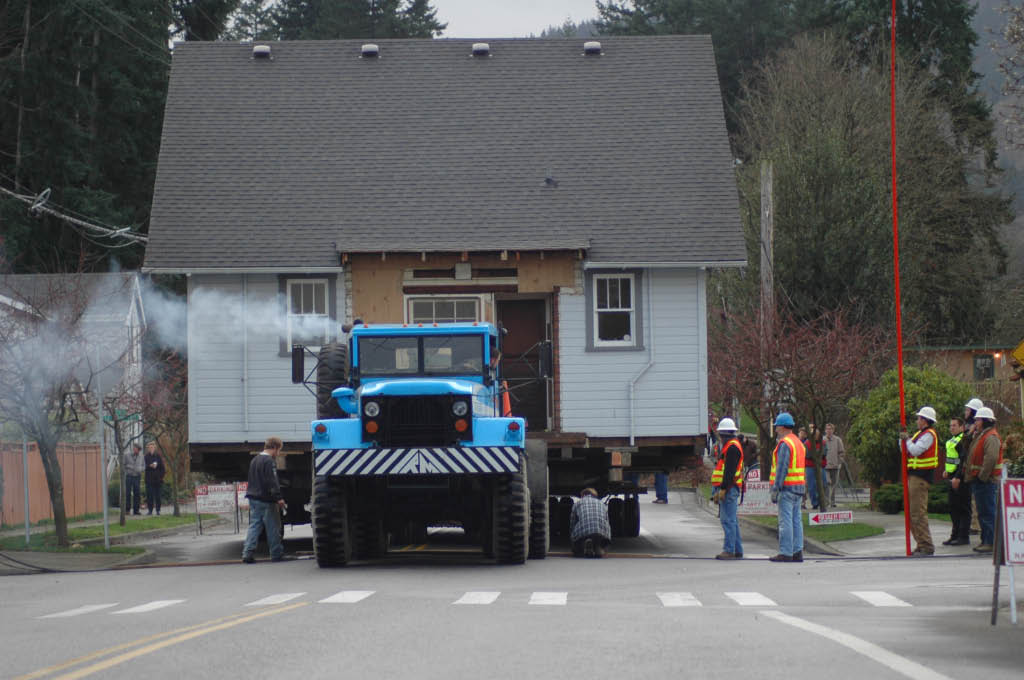
The house-movers had slid huge beams beneath
the floor joist after they used jacks to pry
our home off its foundation. Hauling with
a dirt-filled dump truck, a long chain would try
and pull the house still filled with chairs and beds
and dishes, glasses, breakfast cereal,
to our new farm ten miles down country roads.

Our house arrived intact, but neighbors still
will tell of cowboy-movers cutting trees
and posts of mail boxes with their chainsaw,
then handing out one hundred dollar bills
to angry folks before they called the Law.

The foreman said, “We never ask before
we move a house for someone might say no…”

– Steve Shoemaker, Urbana, IL

house-moving

house-moving

How I didn’t become a Boy Scout

a cub scout recalls

1948
was just six years old
my mom led the pack
(and taught sunday school)
i earned a wolf badge
wore a uniform
of bright blue and gold

1953
would soon be 12 years old
could become a boy scout
first father-son camp-out
dad took navy blanket
folded: my sleeping bag
dad was an eagle scout
but also a baptist
no more scouting for me
when dads drank at campfire

– Steve Shoemaker, traveling in Portugal with Port, June 20, 2013