President Obama Speech at National Holocaust Museum – 4/23/12

President Obama Speech at National Holocaust Museum – 4/23/12. to watch the speech.

UneditedPolitics.com publishes speeches by current and former Presidents, Senators, Congressinal Representatives, Governors in American public life. I have found it a great source of  information without comment. I hope you find it the same.

reflections in a dew drop

Reflections on a Dew Drop

Gordon C. Stewart

Born in water – in a Mother’s womb

the sea of amniotic fluid

– the primordial sea

from which all life begins

“Dust to dust, ashes to ashes”

we say at the end

but it’s the water that goes first

– the one percent

that makes the dust

dance and glisten

into consciousness.

i stand on the porch in the morning

camera trained on a dew drop

hanging from a leaf.

In the drop i see a human reflection

– me with my camera –

And i wonder.

 Am i looking at the dew drop?

Or is the dew drop looking at me?

  Or perhaps there is no ‘it’ or ‘i’,

But a Sea of water everywhere,

an All that contains us all.

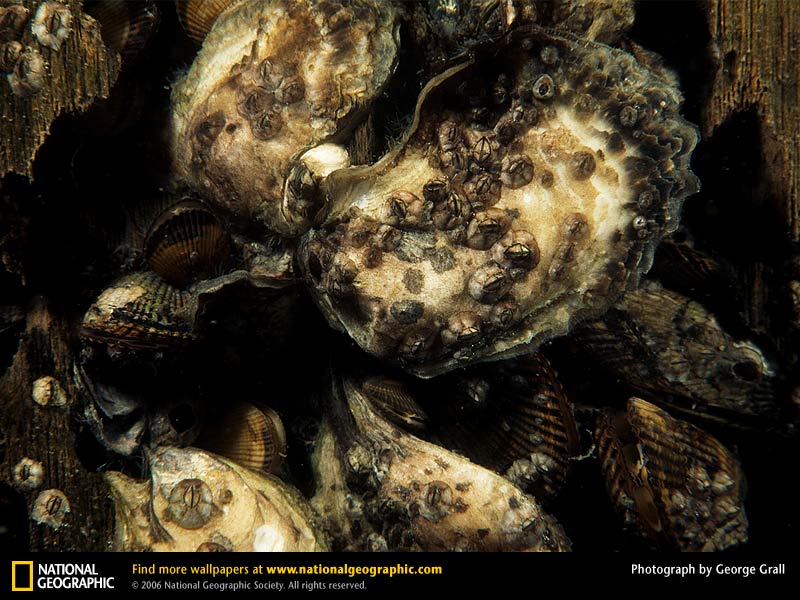
The World in an Oyster – an Earth Day reflection

Oysters

A COMMENTARY FOR EARTH DAY – Rev. Gordon C. Stewart | Friday, June 4, 2010 – published by MinnPost.comThe “spill” in the Gulf of Mexico raises the most basic questions about how we humans think of ourselves.

We’re at a turning point. The crisis we can’t seem to kill in the Gulf of Mexico puts before us the results of a more foundational crisis than the black goo that is choking the life out of the Gulf. The uncontrolled “blow-out” raises basic questions about how we think of ourselves and the order of nature.

Fifteen years ago I was with a group of pastors who spent four days with the Chesapeake Bay Foundation, whose mission is to protect and clean up the Chesapeake Bay. Our time there began with a day on the bay on a Skipjack, one of the last remaining motorless sailing vessels that used to harvest oysters by the tens and hundreds of bushels from oyster beds. The director of the Chesapeake Bay Foundation and an old waterman named Earl, who had worked the bay for 54 years, took us to school.

Back then the oyster population had shrunk to a fraction of 1 percent of what it used to be. Fifteen years before our visit the oyster population would filter all the water in the bay in three days’ time. A single oyster pumps five gallons of water through its filtration system every day.

The oysters were close to extinction; the bay’s natural filtering system was in danger. “It’s humans who’ve done this,” said the old waterman. “They’ll come back; I have to believe they’ll come back.”

Others were less hopeful. The Maryland Department of Natural Resources discussed the damage to the wetlands and the estuaries, the seedbeds of life. It had sounded the alarm for public action to protect the birthplaces of all the seafood we eat, the places on which the whole chain of life depends.

Deepwater Horizon fire

This week we heard from the Gulf of Mexico that the attempted “top kill” has failed and that the “spill” is spreading in every direction — not only on the surface, but below the surface — a glob the size of the state of Texas. I think of Earl and his Skipjack as I see the poisoned oysters in the hands of Louisiana oystermen whose livelihood depends on clean Gulf waters. “It’s humans who have done this.”

But it’s not every human who has done this violence to the Gulf. It was not the indigenous people of North America, nor was it the Moken people (“the sea gypsies”) who, because they see themselves as part of nature, anticipated the 2004 Asian tsunami while the rest of the world was caught by surprise. It was a specific form of humanity known as Western culture that sees humankind as the conqueror of nature.

Our language is not the language of cooperation with nature. “And God said, ‘… fill the earth and subdue; and have dominion over the fish of the sea and the birds of the air and over every creeping thing that creeps upon the earth’ ” — (Genesis 1:28), a conquering view based in the idea of species superiority expressed in the phrase “top kill” for the attempt to plug the hole that is killing the oysters and fish of the sea.

Insofar as interpreters of the Book of Genesis have shaped this Western hubris, my Judeo-Christian tradition bears responsibility for this crisis. The idea of human exceptionalism springs from the Bible itself.

But no sooner do I sink into confession and despair than I remember a prayer that Earl called to my attention on the Skipjack 15 years ago, the prayer of St. Basil from the third century that offers a more hopeful understanding of ourselves, a view like Moken people’s that knows that the whole world’s in an oyster:

“The Earth is the Lord’s and the fullness thereof. O God, enlarge within us the sense of kinship with all living things, our brothers and sisters the animals to whom You have given the Earth as their home in common with us. We remember with shame that in the past we have exercised the high dominion of man with ruthless cruelty, so that the voice of the Earth, which should have gone up to You in song, has been a groan of travail. May we realize that they live not for us alone, but for themselves and for You, and that they have the sweetness of life.”


Muskrat Heaven

A story in preparation for Earth Day, April 22, 2012

Muskrat

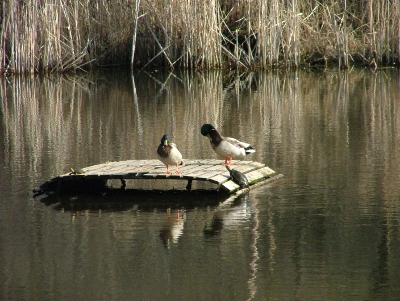
I stand looking through the picture window at the pond behind the house.  The small nature raft in the middle of the small pond is peopled with Canadian geese preening in the mid-morning sun.   To their left, three or four ducks paddle across the pond – but something is different.

They’re moving much faster than usual. They don’t seem frightened; they’re just moving faster.

Then I see why.  A muskrat is chasing them – ten yards or so behind.  I’ve seen this before – mallards and muskrats playing a game of catch us if you can.  Speed up, slow down, speed up.  Nobody ever catches anybody and nobody ever gets caught.  They just chase and get chased.  It’s play.

As the mallards paddle past the raft with the muskrat in hot pursuit, the muskrat makes a sudden 90 degree turn, races at full speed and leaps up for the raft, the geese flapping their wings, scattering in flight just as the muskrat lands and springs into the air. A flying-muskrat in hot pursuit, an air-Jordan muskrat suspended in mid-air, a flying goose wanna-be, leaping and laughing for joy. Muskrat heaven!  Sheer unadulterated play.

I envy the muscrat, the ducks and the geese today. I know I’m making the story up, but the story I tell speaks aloud a yearning for more playfulness.  An enjoyment of each other with natural games that keep away the boredom and challenge our pretensions.

Nature raft with mallards

Nature raft with Mallards

I watch the pond a lot these days to learn about myself and us.  Oh, I know!  There’s also terror and danger in that pond – the snapping turtle lurks beneath the surface, the fox roams the edges, and my neighbor sometimes stands on his deck with his shotgun aimed at the little muskrat who dares to burrow his home under his manicured lawn.  But today all of that is beside the point – upstaged by ducks and geese and a muskrat in self-forgetful play. I stand looking through the window and give thanks for quacking mallards, honking geese and a funny little creature whose muskrat heaven restores my natural sense of play and joy.

Earth Day Poem

Sunday, April 22, is Earth Day. My friend Steve sent this poem this morning.

Hope it lifts your spirits and causes you to do something crazy for the Earth.

“Earth Day” Steve Shoemaker, April 20, 2012

Kites - Morro Bay Kite Festival

Earth Day is best observed with string and kite.

A little bit of wind is nice, but not

Required:  just hold the spool and run–take flight!

To make a kite, buy line and glue, get

Help by recycling– all the rest is free:

Day-old newspapers can be cut just right,

And sticks from fallen branches, two or three.

Your spirits will fly up just like the kite!

News: 24/7

Author C.S. Lewis as a child before his mother's death.

Author C.S. Lewis as a child before his mother's death

“NEWS: 24/7” 

a poem by

Steve

Shoemaker

April 20, 2012

The writer, C.S. Lewis, said he never read the newspapers or owned a TV.  “If any-

thing important happens, someone will always say,”

he claimed. His house was filled with books. The life he led

began each day with prayer, with pen and a notebook,

food, teaching, more writing, then meeting friends for beer

and talk and laughter. 50 books of his appear

in 65 years on this earth. “Just take a look,”

he said, “I’m the last dinosaur you’ll ever see!”

His day of death was not reported on TV:

November 22, 1963.

JFK (R) with big brother Joe Kennedy

JFK with big brother Joe Kennedy

C.S. Lewis’s books have been translated into more than 30 languages and have sold millions of copies. The Chronicles of Narnia are the most popular. having been popularized on stage, TV, radio and film. His book A Grief Observed, an exceptionally honest reflection following the death of the love of his life, Joy Davidman, meant a great deal to me in dealing with my own raw grief. The film Shadowlands was based on A Grief Observed. Lewis was no stranger to the grief that shocked the world in Dallas November 22, 1963, the day he died without the notice he deserved.

 “…God’s demand for perfection need not discourage you in the least in your present attempts to be good, or even in your present failures. Each time you fall He will pick you up again. And He knows perfectly well that your own efforts are never going to bring you anywhere near perfection.”

– C.S. Lewis, Mere Christianity

Purple Martin Mansions

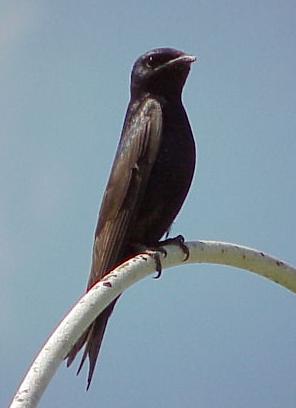
Purple Martin

Purple Martin

The early morning is cool and sunny. The walking trail has been shaded by huge oaks, elms, and ash trees, the path shimmering with light and shadow. I come out of the shadows and suddenly it is there: Purple Martin Place, 76 Purple Martin houses on poles reaching for the sky, each one labeled with a number. “ In my father’s house are many mansions” and a host of chirping Purple Martins flying out across the large open field.I remember the Benedictine morning mass at St. John’s Abbey where I had retreated on the hard walk to the end of my 33-year-old step-daughter Katherine’s terminal cancer. RIP.

From their Purple Martin Mansions

The Purple Martins swoon and swoop

O’er the green grass field shimmering

In early morning light cooled by the breeze


A Purple Martin chorus chants its antiphons

En masse above the green grass field,

A purple Benedictine chorus sings praise

To the morning on their way to breakfast.

–          June 1, 2011

Two Views from the Edge commenters found themselves singing the hymn “Morning Has Broken” after reading the poem. Click  to hear and watch a magnificent instrumental and photographic rendering of the hymn. Here’s the first stanza:

Morning hasd broken

Like the first morning,

Blackbird has spoken

Like the first bird.

Praise for the singing!

Praise for the morning!

Praise for them singing,

Fresh from the Word

– Gaelic melody; lyrics by Eleanor Farjeon, 1931

A Visit with Mary

Mary with Maggie

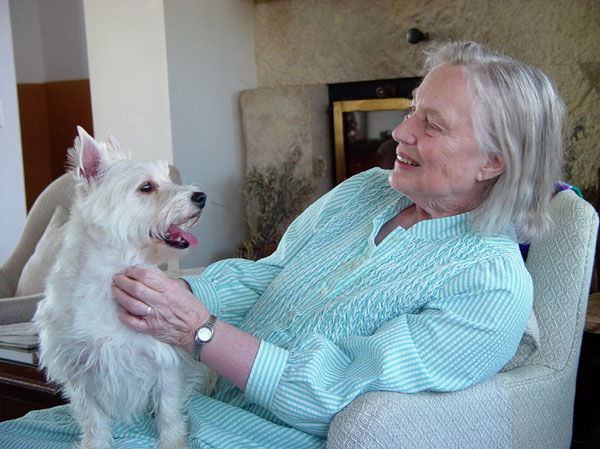
Mary with my dog Maggie

Visiting with a 91-year-old friend with terminal cancer, the discussion turns to her final wishes.  Mary is a child psychologist by profession, a retired professor whose pioneering work with children at the University of Minnesota and Minneapolis’ Children’s Hospital is a legacy that will remain long after she is gone.

Raised in a strict Calvinist Christian tradition in Michigan, her soul long ago had come to drink from gentler wells – the quiet gatherings of the “Quakers,” the naturalist spirituality of St. Francis of Assisi and of American indigenous spiritualities that saw the sacred in the cirrus clouds, the fluttering of a leaf, a chickadee at the bird-feeder on the deck, or the circling of an eagle overhead.

When her husband died three years before, the family gathered privately to inter Doug’s ashes in a small opening in the woods on their farm near Wabasha. Doug, like Mary, is legendary in Minnesota…in a different sort of way…the street lawyer with the pony tail who started and led the Legal Rights Center with leaders of the American Indian Movement (AIM), the chosen intermediary between the federal troops and the AIM members at the Wounded Knee occupation in 1973 – Dennis and Russell Means, Clyde Bellecourt, Leonard Peltier, et. al..

The family marked the spot with four stones pointing North, East, South and West – the “four directions of the four corners of the earth.”  Early the next morning, the day of the public celebration of Doug’s life, one of Doug and Mary’s daughters had walked out to that tiny clearing in the woods. A bald eagle was sitting very still in the center of the four stones above Doug’s ashes.

I asked Mary at the time what she made of that.  With great respect, she paused…and said she didn’t know, and something to the effect that native peoples seem to be in touch with mysteries that elude the rest of us.  er statement struck me at the time because in our talks about death and dying, she had always indicated that she believed that life is lived between the boundaries of birth and death.  The eagle sitting on Doug’s ashes in that tiny opening in the woods didn’t seem to convince her of something beyond the grave, but she held a kind of sacred openness to the possibility, a respectful not-knowing about human destiny, the universe, and our place in it.

Now, three years after Doug’s death, we sit together, as we often have, over a lunch of shrimp, salad and fresh bread at the table that looks out at the bird feeders in the old converted mill on the farm up the hill from Wabasha.  Three of her five children are there.

Missy asks Mary whether she has told me her plans for her service when the end comes. There is a long silence as she goes away to some far off inner place – some wooded glen where no one else can go.  Her eyes are distant, dream-like, looking off to some far off place, sorting through her long spiritual journey to fetch the right words out of the forest of 91 years of memory.

Finally she speaks… softly.  Quietly.  Deliberately. “I want you to do the prayer and I want the benediction.”  “What kind of prayer?” I ask.  She looks at me quizzically, as if I should know.  “Something classical with the gravitas of tradition?”  “Yes,” she says.  “And what kind of benediction?” I ask.  “Blessed are the peacemakers,” she says.  “And music. What about music?”  “Oh, yes” she says, “Bach, Mozart, Beethoven…and ‘Let there be peace on Earth’”… and she wanders off again into that most personal space where no one else can go.

Ninety-one years summed up in four-words “Blessed are the peacemakers” from Jesus’ Sermon on the Mount.

She is growing weary now. It’s time for her afternoon nap.  We say good-bye. I leave this sacred place of Mary’s world, get behind the wheel to drive home, turn on the radio, listen to news that is so far removed from Mary’s world and Jesus’ with all the saber-rattling and the name-calling, and I wish we all could have lunch with Mary or take a walk to the wooded glen where the eagle sat still above Doug’s grave at the center of the four corners of the earth.

———————————————-

For eight years Doug and Mary Hall’s farm was a second home. Mary’s pensive spirit and Doug’s activism made them natural parents of the state-wide movement for restorative justice in Minnesota and the Minnesota Restorative Justice Campaign.

Blessed are the peacemakers. RIP.

Escaping the Inner Prison

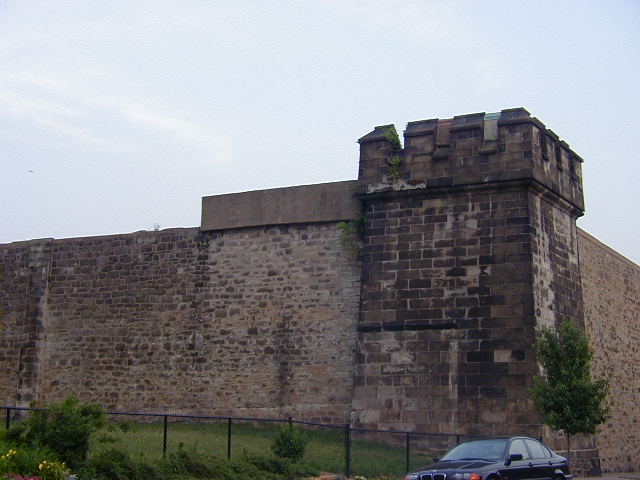
Corinthian Avenue Penitentiary, Philadelphia, PA

I once worked outside this prison as a street worker in North Philadelphia. Young gang members and I played “stickball” on the lawn outside the prison wall. I thought then that the prisoners were inside, and that the gang members were headed for the inside. The rest of us were free…on the outside. Now I see it differently.

We’re all in prison. Yet we’re free. We’re in the prison of deregulated corporate capitalism.We’re back in the Roman Empire, where Paul and Silas were thrown in prison because they dared to interfere with the free market. They freed a young slave-girl who had been put on the street corner as a fortune-teller. She lived on Main Street; all the money from her fortune-telling went to her slave owners on Wall Street.

By rescuing the slave-girl, Paul and Silas were challenging the morality of the prevailing economic system. So the folks from Wall Street seized them, dragged them “into the market place” before those in power and the judges — who were in the hip pocket of those who owned the marketplace and the market — beat them and threw them in prison for advocating “customs and practices” that were unlawful, according to law of the Roman empire. It’s all there in the New Testament Book of Acts. It was unlawful to be moral, unlawful to mess with the economy of a free market.

After beating them to a pulp, the judicial system ordered the jailer to lock them up in the most secure part of the prison — “the inner prison.” It’s always “the inner prison” — the one in our own hearts and heads — whose walls are the thickest. The people who challenge prison security are put in the “inner prison” — solitary confinement.
As Paul and Silas sang and prayed “at midnight” from their inner prisons and all the others were listening, there was a kind of earthquake that shook the foundations of the prison. All the prison doors swung open and everybody’s chains fell off! Everybody’s! And when the jailer woke up to what was happening and drew his sword to commit suicide, Paul and Silas declared that he, too, had been set free from the prison he had guarded.
In September-October 2008 an earthquake rocked the foundations of deregulated corporate capitalism. The earthquake, of their own making, shook the prison walls owned by the big investment brokerage houses and the big banks and AIG, and the inner cell doors had begun to swing open in the hearts and minds of the American people.
But instead of leaving the prison, we stayed in the “inner prison.” We rebuilt the prison, gave the keys back to Wall Street, and chose three square meals a day, a roof over our heads, some chump change for candy and cigarettes, numbed ourselves TV entertainment, and gave the slave-girl back to her owners so we could all dream about a different future. We rebuilt the Wall Street Prison.
What to do? For me, this is a matter of faith. I’m still an inmate of the Wall Street Prison, but my “inner prison” is free. I’m going to keep singing out loud at midnight about human freedom from the prison economy of a deregulated corporate free market that is anything but free. I’m going to walk out of that inner prison by taking my chump change out of the big banks that give $1,000,000 bonuses to the very people who foreclosed on the family of that slave-girl, and I’m transferring all it to the local credit union which belongs to the people. Then I’m going to invite everyone else to do the same.
I’m going to join Paul and Silas and song-writer Timothy Frantzich until everybody’s chains fall off and all the prison doors swing open.
Questions for comment and discussion:
  1. What is “the inner prison”?
  2. How does “the inner prison” work?
  3. Do you agree, in part or in whole, with the commentary?
  4. Where do you agree and disagree?

I’d love to hear from you. Others would, too. Thanks for coming by.

The First Supper

Steve Shoemaker, 4/18/12

Front gate, Ganghwa Anglican Church

With traitors, cowards, doubters he sat down,

he took the bread, gave thanks, passed it around…

With Adam, Eve, and Sarah, Abraham,

with David and Bathsheba:  sinners all.

With you and me, with the whole human family,

he shared the holy cup of salvation.

The water, flour and heat (bread):

his body broken.  Then his blood was shared:

the fruit of the vine, pressed down, runs over

the land–ocean, flood, eternal river…


Give thanks for grace, for love, for mystery.

(Jesus):  This do in remembrance of me.